Almost Everything You Know About Dinosaurs Is 40 Years Out of Date
Most people walk into a dinosaur quiz confident, and most people are confidently wrong — not about the hard details, but about the basics. The animal in your head probably drags its tail, roars with an open mouth, and shares a swamp with a pterodactyl. All three of those things were corrected decades ago. The trouble is that the corrections landed in journals while the mistakes landed in films, and films are much better attended.
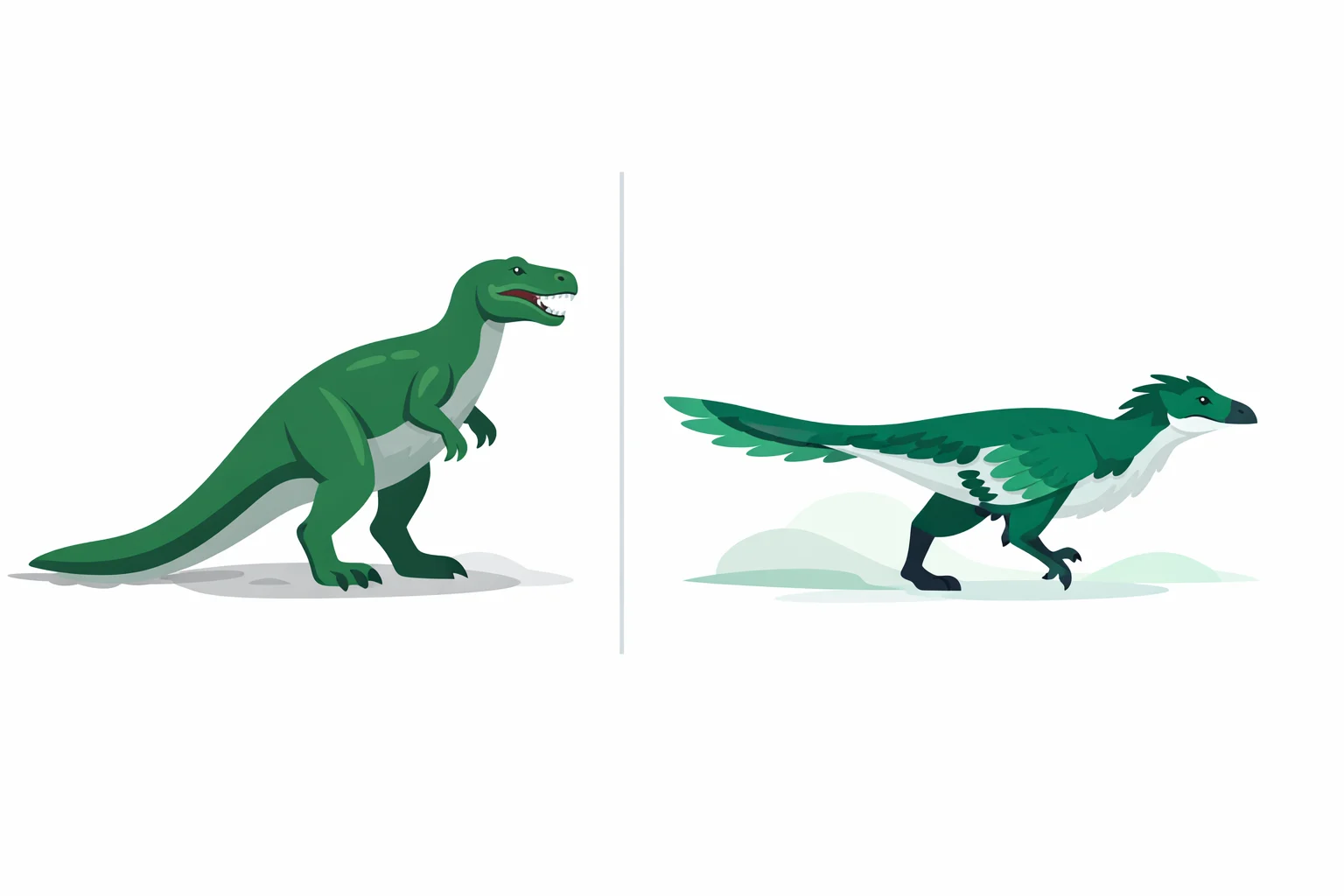
Five Dinosaur Myths That Refuse to Die
Each of these was standard textbook material once. Each survives in popular culture years after the fossils stopped supporting it.
1. Velociraptor was human-sized. It was knee-high — about two metres nose-to-tail, most of that tail, and 15 to 20 kilograms. Feathered, too: a 2007 description of quill knobs on a Velociraptor forearm ended that argument. The screen animal was based on Deinonychus and then enlarged for drama.
2. Stegosaurus plates were armour. They were thin, honeycombed with blood-vessel channels, arranged in two staggered rows, and never fused to the spine. Anything that bit down would have snapped them. They worked as display and heat exchange. The animal's actual weapon was the tail, and we have the receipt: an Allosaurus vertebra with a puncture wound matching a stegosaur spike.
3. Dinosaurs roared. No non-avian dinosaur voice box has ever been found. Their closest living relatives — birds and crocodilians — mostly produce closed-mouth booms, hisses and rumbles, and that behaviour appears to have evolved repeatedly across the group. The iconic movie roar was mixed from a baby elephant, an alligator and a tiger. The raptor screech was mating tortoises.
4. Brontosaurus never existed. That was the settled story for a century after Elmer Riggs folded the name into Apatosaurus in 1903. Then a 2015 specimen-level study of diplodocid sauropods re-examined hundreds of anatomical characters and concluded Brontosaurus is distinct enough to stand on its own again. It is not unanimous, but the ghost is back.
5. Spinosaurus was a land predator with a sail. A 2020 description of a nearly complete tail showed a tall, flexible, fin-like structure — a swimming organ. At 14 to 15 metres it is the longest predatory dinosaur known, longer than T. rex, and it was doing something no other giant theropod attempted. Whether it chased fish or waded and ambushed them is still being fought over in print.
The Time Gap Nobody Believes Until They Check
Here is the single fact that rearranges people's mental picture fastest. Stegosaurus and Tyrannosaurus rex are not contemporaries. They are not even close.
| Animal | When | Gap to T. rex |
|---|---|---|
| First dinosaurs | ~230 million years ago | ~162 million years |
| Brachiosaurus, Stegosaurus, Archaeopteryx | ~155–145 million years ago | ~80 million years |
| Spinosaurus | ~99–93 million years ago | ~28 million years |
| T. rex, Triceratops, Ankylosaurus | ~68–66 million years ago | — |
| You, reading this | today | 66 million years |
Read the last two rows again. You are closer in time to T. rex than T. rex was to Stegosaurus. Dinosaurs held the planet for roughly 165 million years, and the toy box we lump them into spans more time than separates us from the asteroid. If deep time on that scale is your kind of vertigo, the planet quiz does the same thing to your sense of distance.
Why Did Hollywood Get Raptors So Wrong?
Not out of laziness, oddly. In 1988 the paleontologist and illustrator Gregory Paul published a book that treated Deinonychus as a species of Velociraptor — a lumping that never caught on with specialists but was in print exactly when a certain novel was being researched. So the "Velociraptor" that reached the screen inherited the body of a 3.4-metre Deinonychus, then got scaled up again because a knee-high villain does not fill a frame.
Then the feathers question arrived and never left. Quill knobs, fossil plumage in close relatives, and animals like the nine-metre feathered tyrannosauroid Yutyrannus have made bare-skinned raptors indefensible. Even T. rex is complicated rather than settled: skin impressions published in 2017 show scales across the neck, hip and tail, so the adult was probably mostly scaly, with feathers more likely on juveniles or restricted patches. Reconstruction is an argument that keeps moving, which is precisely why the field test above is worth taking twice — once now, once in ten years.
How Five Trait Dials Sort You Into Ten Species
The behaviour half of this quiz does not ask which dinosaur you like. It builds a profile on five dials and then finds the species whose reconstructed profile sits closest to yours in that five-dimensional space. The dials are force, pace, armour, wits and herd, and every answer nudges all five at once, which is why there is no way to game it toward a favourite.
The cloud types quiz runs the same two-part structure over a subject you can check from your own doorstep, and it gets one advantage this page cannot have: its four dials are not reconstructed from fossils but taken directly from the WMO classification, so the profile it builds sits in the same space meteorologists already use to tell the ten cloud genera apart.
| Species | Peak dial | Anatomy behind it |
|---|---|---|
| T. rex | Force 100 | Bite modelled up to 57,000 N, the hardest known on land |
| Archaeopteryx | Pace 92 | Crow-sized, asymmetric flight feathers, under 1 kg |
| Ankylosaurus | Armour 100 | Bone plates set in the skin, tail club modelled to break bone |
| Troodon | Wits 100 | Highest brain-to-body ratio of any non-avian dinosaur |
| Parasaurolophus | Herd 100 | A hollow crest tube up to 1.8 m, tuned for low carrying notes |
| Spinosaurus | Force 85 | Longest predatory dinosaur, fin-tail, snout pressure sensors |
| Triceratops | Armour 85 | Skull to 2.5 m; healed horn wounds from fights with its own kind |
| Stegosaurus | Armour 88 | Seventeen display plates, four tail spikes that did the real work |
| Velociraptor | Pace 88 | Knee-high, feathered, sickle claw held clear of the ground |
| Brachiosaurus | Herd 72 | Forelimbs longer than hindlimbs, browsing about 9 m up |
There is one piece of engineering worth admitting to, because it is the reason these quizzes usually fail. Pure distance matching has a bias: species sitting near the middle of the trait space win almost every time, and the extreme ones — Archaeopteryx, Ankylosaurus — almost never come up. Before publishing, we enumerated all 390,625 possible answer combinations and measured how often each species won. The first run was embarrassing: Brachiosaurus took 36% of paths, T. rex and Triceratops took none at all. Each species now carries a calibration constant tuned against that full enumeration, and the current spread is 9.6% to 10.4%. Ten species, ten roughly equal shares, no crowd-pleaser bonus.
Here's What Your Field Accuracy Score Measures
Not intelligence, and not how many dinosaur names you know. Those eight questions were picked because each one requires unlearning rather than remembering — every wrong answer is something you were actively taught, usually by a screen. That is a different and more interesting test.
Two of them catch confident people most reliably. The pterosaur question gets missed because "pterodactyl" is filed in the dinosaur drawer from childhood, when pterosaurs, plesiosaurs and mosasaurs all sit outside Dinosauria. The deep-time question gets missed because our intuition compresses everything old into one undifferentiated "long ago". Answer both correctly and your mental Mesozoic is in better shape than most museum gift shops.
Score bands run from Gift Shop Guest at nought to two, through Field Assistant and Site Supervisor, up to Curator at seven or eight. Nobody fails, because the feedback panel hands you the evidence for each answer as you go — a wrong guess costs you a point and buys you a citation.
The Dinosaurs Never Actually Left
The asteroid was 10 to 15 kilometres wide and left the Chicxulub crater, roughly 180 kilometres across, 66 million years ago. The blast killed locally; the impact winter killed globally. Around three quarters of all species disappeared, and every non-avian dinosaur went with them.
But one branch got through, and the selection was brutally specific. Toothed birds died. Beaked, small-bodied, seed-eating birds survived — seeds keep for years in a dead forest, which is exactly the resource left standing when photosynthesis collapses. That is the whole ancestry of the roughly 11,000 bird species alive today: dinosaurs that were small enough and unfussy enough to wait out the dark. So if you drew Archaeopteryx, you did not draw the weakest result. You drew the lineage that is still filing through your garden.
The family resemblance runs deeper than feathers, too. Your own humerus, radius and ulna sit in the same order as a theropod's forelimb, because that arrangement was fixed long before either lineage existed — which is the sort of thing the anatomy quiz makes uncomfortably obvious once you start naming your own bones.
All 10 Dinosaur Quiz Results, Explained
🦖 Tyrannosaurus rex — the closer. You wait, choose the moment, and commit everything. T. rex paired the hardest bite known on land with the largest olfactory bulbs and the best binocular vision of any dinosaur, so it was a sensor package as much as a weapon. Its weak point is yours: a plan that big has no smaller version to fall back on.
🐾 Velociraptor — fast, feathered, chronically underestimated, and quietly using that. The real animal was knee-high and 15 kilograms, and the famous Fighting Dinosaurs fossil caught one locked onto a Protoceratops that was crushing its arm. Nerve and speed are not armour, which is the recurring problem for this type.
🛡️ Triceratops — meets pressure head-on in a way others can line up behind. It carried one of the largest skulls of any land animal, and healed lesions on the frill show those horns really were locked against rivals of its own kind. The cost is fights that a sidestep would have ended for nothing.
🪨 Ankylosaurus — becomes a bad idea to attack rather than running or charging. Armoured from eyelid to tail, with a club of fused vertebrae that modelling suggests could break bone. Pure defence with real consequence attached, at the price of never reaching anything new quickly.
🦕 Brachiosaurus — competes by operating where nobody else can follow, feeding some nine metres up on forelimbs longer than its hindlimbs. It looks like serenity and is actually enormous sustained effort. Everything about this profile scales slowly, including turning to face trouble.
🌊 Spinosaurus — sidestepped the competition entirely and got comfortable somewhere nobody else would go. Conical teeth, retracted nostrils, snout pressure sensors, a fin-like tail. Specialising that hard is brilliant until the one environment you mastered changes.
🔥 Stegosaurus — signals first and only then settles it. Seventeen thin, blood-vessel-riddled plates make a superb billboard and radiator and a terrible shield; the four tail spikes handled whatever display could not. Being read as decorative means getting tested more often than is fair.
🎺 Parasaurolophus — holds the group together with signal instead of force. Its backward crest was a hollow resonating tube up to 1.8 metres long, producing deep tones that carry across open ground. The cost is that everything you feel is broadcast, and volume keeps getting mistaken for aggression.
🧠 Troodon — solves it before the fight starts, with the best brain-to-body ratio in the Mesozoic and hands that could grasp. Fittingly for a thinker, its own name is contested: it rests on a single 1856 tooth, and specialists have reassigned much of the material to Stenonychosaurus and Latenivenatrix. Thinking, however, is not armour.
🪶 Archaeopteryx — small, light, and the reason any of this lineage is still here. Crow-sized, teeth in its jaws, a long bony tail, asymmetric flight feathers, pulled from Solnhofen limestone in 1861, two years after Darwin published. It survives the collapse but cannot absorb a single hard hit.
If You Wanted T. Rex and Got Parasaurolophus
Take it seriously for a second, because the disappointment is the informative part. Every one of the ten wins about a tenth of all possible answer paths, so you did not get a consolation prize — you got the corner of the trait space your answers actually built. The people who wanted the apex predator and drew the communicator almost always answered that noise settles their arguments and that they would rather have a whole herd's trackway preserved than their own skull. That is a coherent animal. It is simply a louder, more social one than the poster in your bedroom.
If the result felt off, retake it and watch the two answers listed under "the answers that decided it". Those are the ones carrying your profile, and changing either usually moves you to your second skeleton rather than somewhere random — which is the clearest evidence the scoring is doing something real. And if the extinct version has worn out its welcome, the mythical creature quiz runs the same maths on ten animals that never existed at all — dragons included, most of which were reconstructed from misread fossils anyway.
The same specialisation trade-off that stranded Spinosaurus shows up in plants, incidentally, and rather more sharply. The what flower am I quiz scores you on pollination signal, and its two poles are a daisy anything with wings can land on and an orchid that mimics one specific female bee, pheromone included. Darwin bet on that strategy in 1862 and was proved right in 1903, twenty-one years after he died.