Why Most Mythical Creature Quizzes Hand You a Dragon
Almost every mythical creature quiz you have ever taken was rigged toward the dragon. Not deliberately, and not by anyone dishonest — by arithmetic. We know because ours was too, and we can show you the exact size of it: score the eighteen questions above the ordinary way, by adding up points and taking the highest total, and the dragon wins 19.4% of all possible answer paths while the werewolf wins 4.3%. Nobody wrote a rule saying "prefer dragons." There were simply more dragon points on the board, and that is enough.
This article is mostly about what we did to fix that, because it turns out the fix is also the most useful thing you can know when reading your own result.
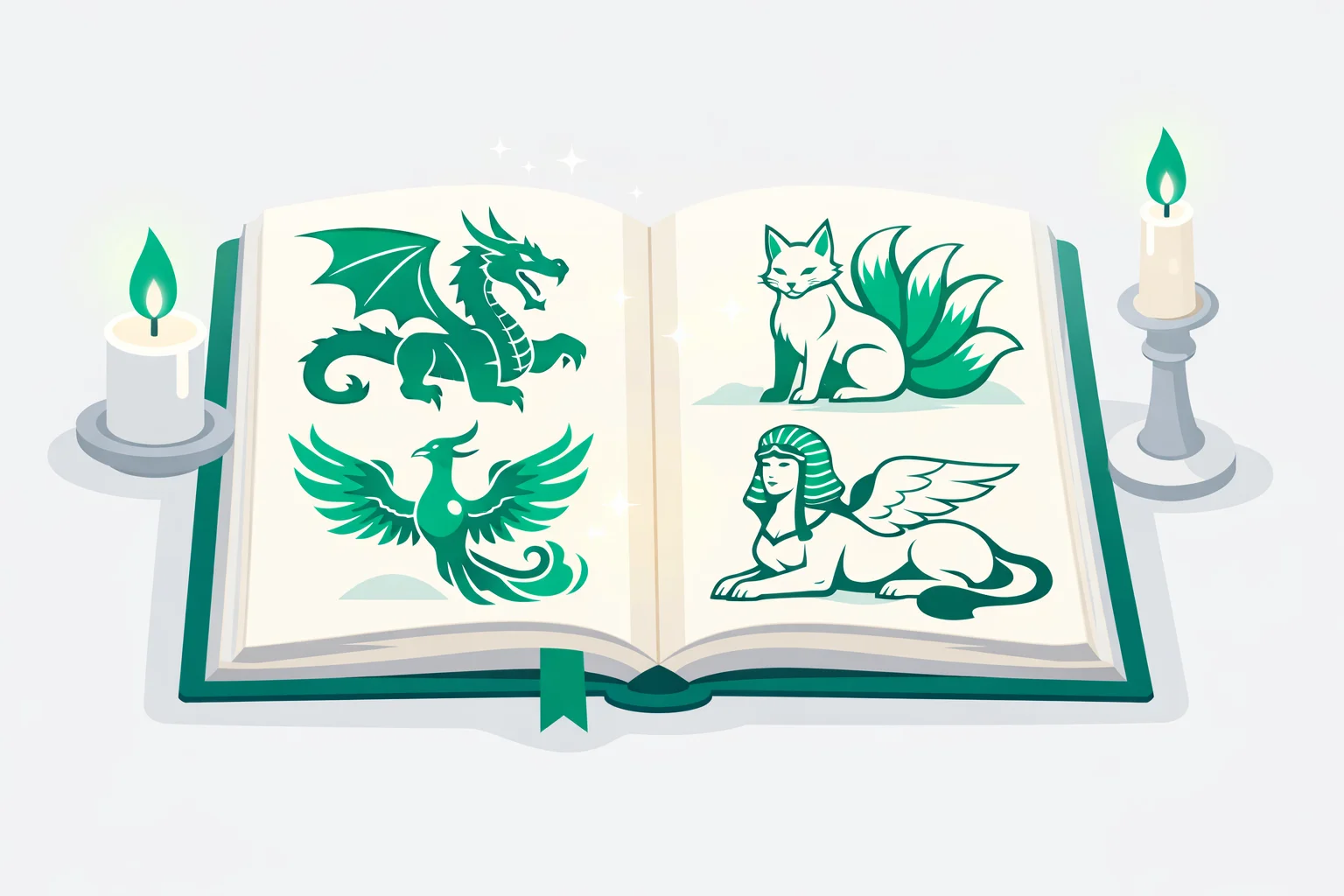
Every Quiz Has a Favourite. Ours Was the Dragon.
Here is the mechanism, because once you see it you will spot it in every personality quiz on the internet. A quiz has ten possible results and eighteen questions with four answers each. Each answer awards points to two or three results. Add the points up, highest total wins. Simple, and quietly broken.
The problem is that the ten creatures do not get equal shelf space in those seventy-two answer options. Writing questions is a creative act, and dragons are easy to write for — power, territory, hoarding, pride, legacy. Phoenixes are hard, because there are only so many ways to ask "have you ever blown up your own life." Count the finished table and there are 34 dragon points available across 13 questions, against 24 phoenix points across 11. Under random answering, that gap produced this:
| Scoring method | Most common result | Rarest result | Spread |
|---|---|---|---|
| Raw point totals | Dragon — 19.4% | Werewolf — 4.3% | 4.5x |
| Corrected for points available | Dragon — 13.1% | Werewolf — 7.4% | 1.8x |
| Corrected for points and spread (what we ship) | Dragon — 10.6% | Werewolf — 9.2% | 1.15x |
A 4.5x spread means that if you answered at random, the naive version would be four and a half times more likely to call you a dragon than a werewolf. That is not a personality result. That is the question-writing showing through.
How We Made All Ten Results Equally Likely
The first correction is obvious once stated: instead of comparing raw totals, compare each creature to how many points it would be expected to collect anyway. If dragon averages 8.5 points from random answering and you scored 11, that is barely anything. If phoenix averages 6 and you scored 11, that is enormous. Subtract the expected value and the spread drops from 4.5x to 1.8x.
Which still is not fair, and the reason is more interesting. Creatures differ not just in their average but in how much they vary. Dragon collects points in big three-point lumps, so dragon scores swing wildly and frequently land far above average. Kitsune collects ones and twos scattered across seventeen of the eighteen questions, so kitsune scores cluster tightly and rarely spike. Whoever swings hardest wins most often, regardless of what you actually answered.
So the shipped version scores every creature as a z-score: your points minus that creature's expected points, divided by that creature's own standard deviation. Both figures are computed in closed form from the weight table when the page loads — there are no hand-tuned fudge factors anywhere in the file, which matters, because fudge factors are how a designer's preference for dragons sneaks back in. We then ran a million random answer paths through it. Every creature now wins between 9.2% and 10.6% of the time, a 1.15x spread.
One more check was needed, because a perfectly flat quiz could simply be a random number generator. We simulated people answering coherently — consistently leaning toward one creature — and the quiz returned that creature as the top result between 92.2% and 99.6% of the time, and in the top three at least 99.7% of the time. Fair and sensitive, which is the combination that is actually hard.
Here's How to Read Your Bestiary Shelf
The bar chart under your result is not decoration and it is not a set of probabilities. Each number is that creature's z-score rescaled onto a 1-100 line, so it answers one question: how hard did this creature pull on your particular eighteen answers, relative to how hard it pulls on everyone's?
The figure worth looking at is the gap between first and second, which the quiz prints for you in standard deviations. Under 0.35 and the two creatures are effectively tied — you are a genuine hybrid and your shadow form is doing as much work as your primary. Over 1.1 and the separation is unusually clean, which in our testing correlates with people who answered fast. A wide gap does not mean the result is more true. It means you were more consistent.
Your Shadow Form Is the More Interesting Half
Because all ten primaries land near 10%, no single result here is rare — which is honest but useless as a thing to screenshot. The rarity lives in the pairing. There are ninety possible primary-and-shadow combinations, and they are emphatically not evenly distributed: the most common, phoenix shadowed by werewolf, appears in 2.75% of answer paths, and the rarest, werewolf shadowed by fae, in 0.57%.
That lopsidedness is the most interesting thing the simulation turned up, because it was not designed in. Phoenix and werewolf shadow each other more than any other pair in either direction — 2.75% and 2.52% — and once you look at them the reason is obvious: both are built around a self that arrives and departs, one by burning the old life down and one by keeping it leashed. Griffin and unicorn are the second-strongest pair at 2.33% and 2.27%, which is the difference between protecting people and protecting principles. Kitsune sits close to both siren and sphinx, the other two creatures that work by performance and indirection rather than by force.
Practically, read your shadow as your failure mode rather than your second-favourite creature. It describes what you do when the primary strategy stops working — when the dragon cannot defend the hoard, when the griffin cannot protect anyone, when the kitsune's joke does not land.
Four Creatures Whose Real Folklore Contradicts the Vibe
Every creature in this quiz had to be attested in a source we could name, which ruled out some popular options and produced some surprises. Four of them contradict the modern version badly enough to be worth saying out loud.
Sirens were birds. In Book XII of the Odyssey, what they offer Odysseus is not beauty but knowledge — they sing that they know everything that happens on earth. The fish tail is a later medieval merger with the mermaid, arriving well over a thousand years after Homer. That is why the siren result here is about emotional pull and dangerous honesty rather than about the sea.
The unicorn was filed as zoology. Ctesias, a Greek physician at the Persian court around 400 BCE, described it in Indica as a real Indian wild ass with a horn whose material neutralised poison. For roughly two thousand years the unicorn was not a fantasy animal at all — it was an exotic species people had simply not got round to catching yet.
The werewolf's oldest name is about clothing. The earliest full werewolf story in Western literature is in Petronius's Satyricon, around 60 CE, and the word used is versipellis — literally "turnskin." The horror is in the changing, not the wolf, which is precisely why the werewolf result here is about containment rather than aggression. The most famous modern wolves are not werewolves at all by their own books' rules: Twilight calls the Quileute pack shape-shifters and keeps the word werewolf for a different creature, and that distinction is one of the things our Twilight character quiz is built around.
The kraken started as a whale-sized bore. The Konungs skuggsjá, a Norwegian text from about 1250, describes the hafgufa as a creature so large sailors mistake it for an island and so inactive that it eats only twice a year. The tentacled ship-destroyer is an eighteenth-century upgrade. The original is a study in stillness, which is the version this quiz scores. That same Norse-Icelandic material is where the jötnar come from, and they are worth correcting on: they were the gods' in-laws and trading partners far more often than their enemies — Skaði negotiated her way into Ásgarðr and stayed. Our Norse god quiz sorts you across twelve of the deities who lived alongside them.
The dragon here is the European one, and that is a choice. The treasure-hoarding, cave-dwelling, knight-eating dragon is a specifically Western build. The Chinese long is a water deity — rain, rivers, floods — and it is the only mythical animal in the twelve-branch zodiac cycle, sitting between the Rabbit and the Snake. Reading the two as one creature is the single most common folklore error in English, which is why our Chinese zodiac quiz scores its dragon on ambition and scale rather than on hoarding anything.
Why We Scored Narrative Role Instead of Personality Traits
Most creature quizzes are personality quizzes wearing a costume: they measure something like extraversion or agreeableness and then attach a dragon to the output. The trouble is that mythical creatures were never personality types. They were plot functions. A sphinx exists to gate a road with a question. A griffin exists to guard gold that is not its own. A phoenix exists so that something can end and continue at the same time.
So the eighteen questions ask about role rather than trait — what you do when a group fractures, what you are still doing a year after a betrayal, what you would be in someone else's account of their own life. That last question is deliberately the eighteenth, because it is the one that resolves close calls, and answering it honestly requires having already answered seventeen others about cost. If you want the trait-based version of this exercise instead, the what animal am I quiz maps behaviour onto real species, and the fursona quiz builds a character out of it rather than sorting you into an existing one. For the folklore these creatures came out of — selkies, hedge-crossings, the sea as something you bargain with — the what kind of witch am I quiz sorts the practices rather than the beings. And if the costume is literal — you are choosing one for October — the Halloween costume quiz sorts on lead time, budget and venue before it gets to taste, which is the order the decision actually happens in.
All 10 Mythical Creature Results, Explained
Listed by how often each comes out on top across a million simulated answer paths — a range narrow enough that none of these is a consolation prize.
🐉 Dragon (10.6%) — The one who guards the hoard. Dragons here are not greedy; they treat accumulation as memory, since everything in the pile was earned and could be lost again. Territorial about work rather than people, slow to let anyone near what they have built, total once committed. The failure mode is confusing the thing you made with your right to exist.
🦅 Griffin (10.3%) — The guardian of what is not its own. Herodotus put griffins over Scythian gold they had no interest in spending, and that is the whole psychology: loyalty as a load-bearing wall rather than as warmth. You stand between people and the thing coming for them. You will also guard something for years after everyone stopped needing it guarded.
🦁 Sphinx (10.3%) — The gatekeeper who asks first. The Greek sphinx fights nobody; it sets a question and honours the answer. You test people without announcing a test is running and release yourself in proportion to how they handle it. Sharp, reframing, allergic to being explained to. The cost is that people who failed never learn they were being marked.
🦑 Kraken (10.2%) — The one asleep at depth. The Norse hafgufa spends most of its story doing nothing, which is the point. You process slowly and completely, sit comfortably in silences that make others talk, and startle people with the scale of your eventual move because they had calibrated to the surface. Depth is not a substitute for being reachable.
🧚 Fae (10.1%) — The keeper of exact terms. The fair folk of the older accounts are not evil, they are literal: the bargain is honoured precisely as worded. You run a private code stricter than most ethics and narrower than anyone expects, and you enjoy the gap between what was said and what was meant. Technically-true is still a way of lying, and the people closest to you can tell.
🦊 Kitsune (10.0%) — The teacher with a terrible bedside manner. In the older Japanese tales the fox is not a villain but an instructor working through mischief. You read rooms fast, switch register without noticing, and your jokes carry load. Everyone feels close to you; few could say what you actually want. The masks eventually stop being optional.
🧜 Siren (10.0%) — The voice that pulls people off course. What Homer's sirens actually offered was knowledge, sung. You get people to say true things sooner than they intended and you are unembarrassed about feeling in rooms where everyone is managing theirs. You also know exactly where the soft spot is on everyone you love.
🦄 Unicorn (9.8%) — The one that cannot be taken by force. Underneath the glitter is a wild animal that heals what it touches and refuses capture. Uncompromising standards, a fast nose for dishonesty, willing to lose the thing rather than win it by a route needing explanation. Purity is expensive, and other people end up paying part of that bill.
🔥 Phoenix (9.6%) — The one who ends and returns. Where others treat collapse as the disaster, you treat it as the transition, and the person who walks out afterwards is recognisably new. Formidable in a crisis, restless in a calm year. The failure mode is leaving before things get boring and calling it growth.
🐺 Werewolf (9.2%) — The one keeping a second self leashed. Versipellis means turnskin, and the emphasis is on the turning. You run hotter than anyone sees, would do unreasonable things for a very small number of people, and most of your visible personality is a well-built container. Suppression is not regulation; the intensity picks its own moment.
If You Got a Result You Hate, Read This First
The most common complaint about any mythical creature quiz is some version of "this is not me." Before retaking it, check the three answers listed under your result as the ones that decided it — that panel exists precisely for this argument. In most disputed results one of those three is a question you answered aspirationally rather than accurately, and it is almost always in Act II, where the honest answer is unflattering.
The other possibility is more interesting: a narrow first-to-second gap means the quiz genuinely could not separate two creatures in you, and the one it named is not more correct than the other, just fractionally ahead. If your gap was under 0.35, read both entries and take the one you flinched at. That reaction is better data than the score is.
One last thought, if the folklore version left you wanting something you can actually hold in a museum drawer. Half the creatures above were built from misread bones — the griffin from Protoceratops skulls hauled out of the Gobi, the cyclops from dwarf elephant crania, dragons from whatever large fossil surfaced in a riverbank. The dinosaur quiz runs the same ten-way scoring on the real animals those legends were reverse-engineered from, and scores your paleontology against published evidence on the way through.
The kraken is the clearest case of that. The hafgufa asleep at depth was almost certainly a giant squid seen badly, and the real deep sea turns out to be stranger than the folklore that borrowed from it — anglerfish that fuse two bodies into one, a shark that has been alive since before Newton. The sea creature quiz sorts you across twelve of them on real survival trade-offs, and it keeps the depth axis this quiz gave the kraken.