Twelve Branches, Five Phases, and the Argument About Which One Is You
Every Chinese zodiac quiz you have ever taken asked for your birth year, did one division, and handed you an animal. That is a lookup, not a reading — and the odd thing is that traditional practitioners would broadly agree with that complaint. In the Four Pillars system, which is the older professional form of Chinese astrology, your birth-year animal is the least informative of the four signs attached to you. It describes the face you show the street. The quiz above ignores your birthday entirely and reads twenty answers instead.
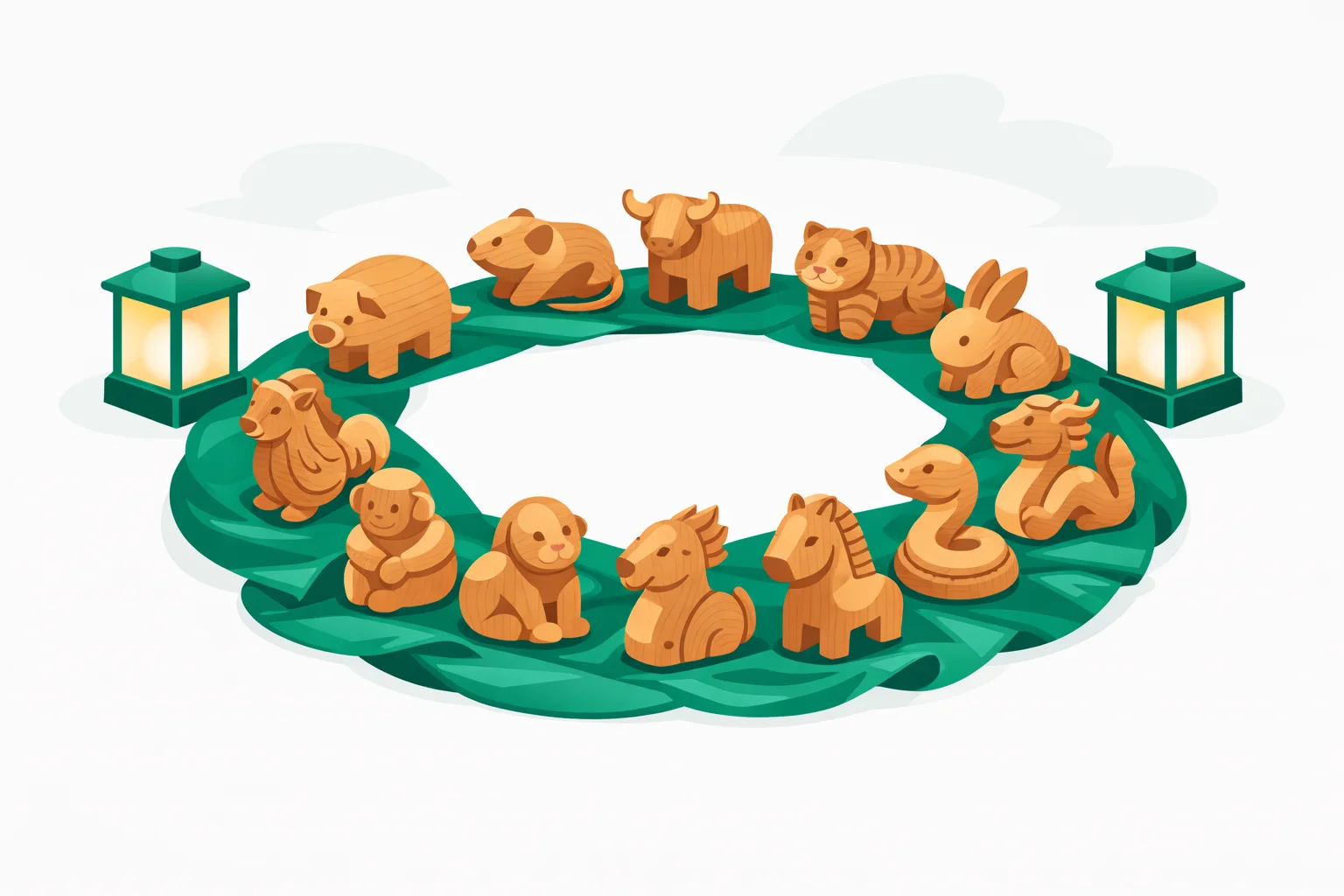
Japan Lost Half a Million Births to a Horse
In 1965 Japan registered about 1.82 million births. In 1966 it registered roughly 1.36 million. In 1967 the figure jumped back to about 1.94 million. Nothing happened to Japanese fertility in between — no famine, no epidemic, no policy. 1966 was hinoeuma, a Fire Horse year, and a folk belief holds that women born in one are so fierce they destroy their husbands. The superstition traces to Yaoya Oshichi, a greengrocer's daughter born in the Fire Horse year of 1666 who set a fire in 1683 hoping it would let her see a lover again, and was executed for it. The 1966 birth collapse is one of the cleanest demographic footprints a piece of astrology has ever left.
Here is why that matters right now: 2026 is a Fire Horse year. The first since 1966, and the last until 2086. Whatever you think of the belief, an entire calendar system that can move national birth statistics is not a trivial thing to sort people with — which is precisely why it's worth being careful about what the sorting actually measures.
Ask Two Astrologers Which Animal You Are, Get Two Answers
There are genuinely two camps here, and English-language writing almost never mentions the second one. The popular camp says your animal is your birth-year animal, full stop — it is simple, it is what appears on restaurant placemats, and it is what almost every online Chinese zodiac quiz implements. The professional camp works in bazi, the Four Pillars of Destiny, where you carry four branches: year, month, day and hour. In that system the year branch is read as your outward and social self, the month as your inner drives, the hour as what you keep private — and the day pillar is the self. Ask a Four Pillars reader what you are and they will name your Day Master, not your year animal.
Both camps are working from the same twelve branches. They disagree about which of your four is you. That disagreement is the entire reason a behaviour-based quiz is a defensible idea rather than a gimmick: if the tradition itself holds that the year animal is the mask and the interior signs are the person, then asking about how you handle a stalled project is closer to traditional practice than asking for your birth certificate. The quiz above leans that way deliberately — the same reasoning behind our Western zodiac sign quiz, which reads the twelve signs as behaviour instead of birthdays.
The Zodiac Year Doesn't Start on Chinese New Year
This is the error that survives in almost every English zodiac article, and it produces wrong animals for real people every single year. The lunar New Year is a moving date — it falls anywhere between 21 January and 20 February. Four Pillars practice does not use it. It starts the astrological year at Lichun, the solar term marking the beginning of spring, which lands within a day or so of 4 February regardless of where the moon is.
In 2026 the gap is unusually wide. Lichun falls on 4 February; the lunar New Year falls on 17 February. Anyone born in that thirteen-day window is a Horse under Four Pillars and a Snake under the placemat. Both answers are internally consistent, and neither camp is being sloppy — they are running different calendars. If your birthday sits in late January or the first half of February, you have probably been told the wrong animal at some point, and nobody was lying to you.
The Calendar Is 3,000 Years Old. The Animals Are Not.
The twelve signs are not, originally, animals. They are the twelve Earthly Branches — 子丑寅卯辰巳午未申酉戌亥 — a counting system that appears on Shang dynasty oracle bones more than three thousand years ago, where it is used to number days in a repeating cycle of sixty. There are no animals anywhere in that early material. The branches were a calendar before they were a menagerie.
The animal correlations arrive much later, and messily. A set of bamboo slips excavated at Shuihudi in 1975, buried around 217 BCE, includes a divination almanac with an early branch-to-animal list — and it does not match the modern one. Several branches carry different creatures; a deer turns up where you would expect a horse. The earliest surviving list identical to the one we use today is in the Lunheng, Wang Chong's sceptical essay collection from around 80 CE. So the animals took roughly three centuries to settle, and they were bolted onto a calendar that already worked fine without them.
So Where Does the Great Race Actually Fit?
Late, and as a mnemonic rather than an origin. The story is lovely and everybody knows it: the Jade Emperor announces a race, the twelve animals compete, the Rat crosses the river riding on the Ox's back and leaps off at the last moment to finish first. The Ox places second having done all the work. The Cat, depending on the version, is either never woken by the Rat or is pushed into the water — which is offered as the reason cats have hunted rats ever since.
Two things to notice. First, the tradition is entirely comfortable with the Rat winning by cheating; resourcefulness is treated as a virtue, not a disqualification, and the Rat result in this quiz is written accordingly. Second, the cat's absence has a duller explanation than the grudge: domestic cats most likely arrived in China after the branch system was already in use. Vietnam solved the problem by keeping the cat and dropping the rabbit, and the likely mechanism is a pun — the fourth branch is 卯 mǎo, which collided with mèo, cat.
Twelve Signs, Four Triangles, and Two Kinds of Element
The twelve branches are not a flat list. Take every fourth branch and you get four groups of three, the San He trines, and each group is treated as an elemental bureau:
| Frame | Branches | Animals | Shared instinct |
|---|---|---|---|
| Water 申子辰 | Monkey, Rat, Dragon | The opportunists | Move on the hint, before it is announced |
| Metal 巳酉丑 | Snake, Rooster, Ox | The refiners | Work to a standard, not to a deadline |
| Fire 寅午戌 | Tiger, Horse, Dog | The idealists | Run on principle and momentum |
| Wood 亥卯未 | Pig, Rabbit, Goat | The peacemakers | Protect the relationship before the position |
Count the elements in that table and one is missing. There is no Earth frame, and the reason is structural: the four Earth branches — Dragon, Dog, Ox and Goat, 辰戌丑未 — sit at the corners between the seasons. Earth is the transition, so it forms no trine of its own. That is also why a sign's frame and its own fixed element usually disagree. The Snake is a Fire branch sitting in the Metal frame. Only two of the twelve match themselves: Rabbit (Wood in Wood) and Rooster (Metal in Metal).
The second element in your result is a different animal altogether — it is the heavenly stem. Ten stems pair with twelve branches to produce the sixty-year cycle, and here is the piece of arithmetic that makes the whole thing checkable: a stem can only pair with a branch of matching parity, so only 60 of the 120 possible combinations exist. Since each of the five phases owns one yang stem and one yin stem, every one of the 12 × 5 animal-and-element pairs occurs — exactly once every sixty years. Metal Rabbit is 辛卯: 1951, 2011, 2071. Fire Horse is 丙午: 1966, 2026, 2086. Your result names a real year because the Chinese calendar leaves it nowhere else to be.
The quiz scores those two readings separately on purpose. Questions one to twelve ask what you do in situations and produce the branch. Questions thirteen to twenty ask how you decide, what you refine and what you call fair, and produce the stem — using the Han-era mapping of the five phases onto the five Confucian virtues: Wood is benevolence, Fire is propriety, Earth is trust, Metal is righteousness, Water is wisdom. They are allowed to disagree, and when they do, that gap is the interesting part.
Every Animal in the Cycle, Trine by Trine
The Water frame — Monkey, Rat, Dragon. 🐀 The Rat runs a constant background audit of what is scarce and who has it, which is why it is never caught without a second route; the cost is hoarding options past the point where committing would have paid better. 🐒 The Monkey finds the seam in any closed system faster than the person who built it, and spends its best thinking on fascinating problems nobody was paying for. 🐉 The Dragon rescales whatever it is handed into something larger, raises the ceiling for everyone nearby, and is reliably bored by the middle eighty per cent where projects are actually won.
The Metal frame — Snake, Rooster, Ox. 🐍 The Snake does its deliberating where nobody can watch and surfaces with a decision already made, which reads as wisdom to people who trust it and evasion to people who don't. 🐓 The Rooster holds standards it considers non-negotiable and will name the error before it reads the room — right, and right about eleven seconds early. 🐂 The Ox does not need the work to be interesting, which is why it finishes things whose novelty died months ago, and why it absorbs unfair loads without mentioning them.
The Fire frame — Tiger, Horse, Dog. 🐅 The Tiger cannot let the silence stand when everyone knows something is wrong, which makes it useful in exactly the moments most people are useless and expensive in the moments that only needed patience. 🐎 The Horse treats motion as an operating condition rather than a preference, generates momentum from nothing, and leaves things at seventy per cent for something new at ten. 🐕 The Dog defends people before consciously deciding to, carries a running moral ledger it cannot put down, and revises a first impression far more slowly than it formed one.
The Wood frame — Pig, Rabbit, Goat. 🐖 The Pig extends trust before it has been earned and finds people are more honest around it than anywhere else, then keeps giving to those who have clearly shown what they will do with it. 🐇 The Rabbit reads a room two moves ahead and adjusts early rather than confronting late, which prevents enormous amounts of damage and occasionally means retreating from an argument it would have won. 🐐 The Goat converts an unusual sensitivity to atmosphere into things it makes, needs stability to do it, and can take the shape of whoever is nearest until its own edges blur. If free-association animal symbolism appeals more than a fixed cultural cycle, our spirit animal quiz works on entirely different logic — no branches, no calendar, just four energies.
One note on the distribution, since most quizzes invent theirs. Ten of these twelve results land between 7.6% and 8.3% across two million simulated runs, because there is no honest reason to make a Tiger rarer than a Rooster. The two exceptions are deliberate and borrowed from real registration data: the Dragon comes out at 12.5% and the Goat at 6.2%, mirroring the fact that births rise in Dragon years and fall in Goat years across Chinese populations. The Chinese long is a rain-and-river deity rather than the treasure-hoarding lizard of European heraldry, which is a distinction our mythical creature quiz has to take seriously too.
The Year of Your Own Animal Is the Unlucky One
Most Western readers assume their own zodiac year is their good one. It is the opposite. The year your branch returns is your benmingnian, and it is treated as a year of friction, on the reasoning that you have come into direct alignment with Tai Sui, the Grand Duke — and direct alignment with something that large is not a comfortable position. The remedy is red: a belt, socks, underwear, something worn against the skin all year. The detail that usually gets lost in translation is that the red is supposed to be given to you by someone older. Buying it yourself is considered to miss the point entirely.
Which means that if the quiz handed you a Horse, this is your year — and 2026 is not just any Horse year but the Fire Horse, the one Japan flinched from sixty years ago. Worth knowing before somebody buys you socks.