How the Major Arcana Maps a Life Journey
A tarot card quiz sounds like it ought to tell you who you are. Picture the scene it's imitating, though. Someone sits down at a table, a deck gets shuffled, and the first question the reader asks is never "what are you like." It's "what's going on?" That single difference is the whole thing — and nearly every "which tarot card are you" page on the internet has it backwards.
The Deck Was Never Trying to Type You
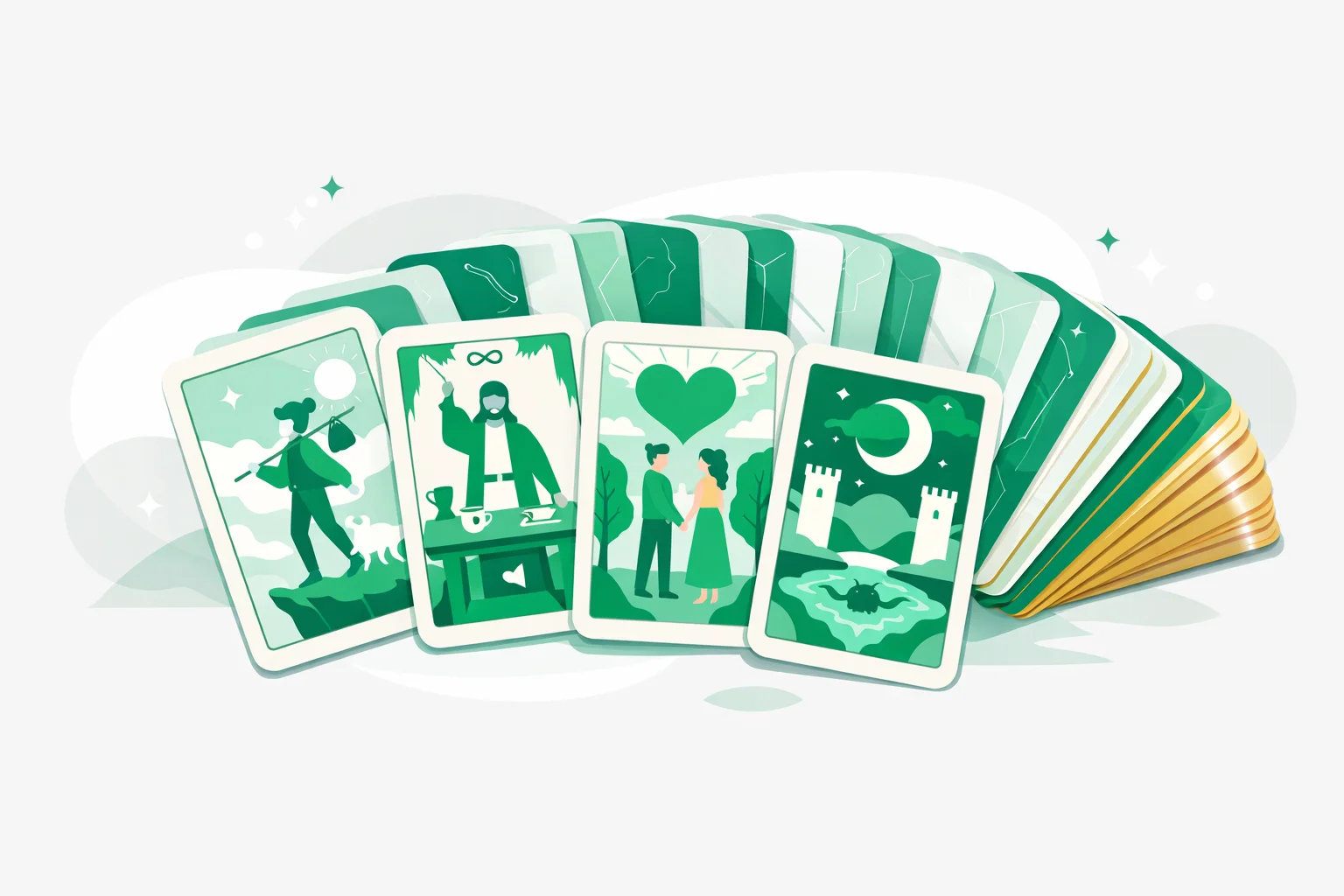
The 22 Major Arcana cards are numbered 0 through 21, and they're numbered for a reason: they're a sequence. Personality frameworks aren't sequences. Nobody is halfway between ENFP and ISTJ, en route. But a person absolutely does move from The Tower to The Star, because that is the order those two cards come in — XVI is the collapse, XVII is what recovery looks like afterwards. Treating them as personality types is a bit like treating Tuesday as a personality.
Psychology has a precise word for the distinction: state versus trait. Charles Spielberger built an entire instrument around it in 1970 — the State-Trait Anxiety Inventory — because measuring how anxious somebody is right now and how anxious they are as a person genuinely require different questions, and mixing the two produces a number that means nothing. Tarot is a state instrument. It always was. That's why this quiz asks about your week, your energy, your 3am thought, and never once asks whether you enjoy parties.
Why Do Ambiguous Pictures Get Honest Answers?
Hermann Rorschach published his inkblots in 1921. Henry Murray and Christiana Morgan followed with the Thematic Apperception Test in 1935 — vague illustrations of people in unexplained situations, with the instruction to say what's happening. Both belong to a family called projective tests, and they all run on the same mechanism: hand somebody an image with no fixed meaning, and whatever they supply comes from them.
The same engine runs under things that look nothing like a card spread. Hypnotic past-life regression is a projective technique wearing a historical costume — ask a suggestible person what they see and they will build you a coherent life, which is exactly why those accounts collapse when investigators go and check them. Our past life quiz takes the honest route through that territory, and the article underneath it walks through what happened the three times somebody actually checked.
Tarot imagery is a projective instrument that happens to be four hundred years older than the theory. The pictures are symbol-dense, hand-drawn and deliberately under-specified — a person hanging upside down, smiling, with no explanation offered. When someone sees that card and immediately thinks about their job, the card didn't know about the job. This is also why a reading feels sharper than a printed horoscope: nobody wrote the content, you did, and you had a specific situation in mind while you were doing it. Nothing supernatural is required for that to work, and understanding the mechanism doesn't break it.
Trait Tests, Tarot Readings, and What This Quiz Measures
Three instruments that look superficially similar, doing three different jobs:
| Big Five / MBTI | A tarot reading | This quiz | |
|---|---|---|---|
| Measures | Stable traits | Your situation, filtered through you | Your situation, scored |
| Time horizon | Years to decades | This week | Roughly this season |
| Should the answer change? | No — drift means bad measurement | Yes, every single reading | Yes. A card that never moves is the warning sign |
| Content comes from | Your self-report | What you project onto the image | Your answers, mapped onto card positions |
| Good for | Choosing environments that suit you | Naming something you already sense | Locating yourself in a cycle |
Read across the third row and you've got the practical difference. If a Big Five score swings wildly between March and September, the test is broken. If your tarot card does, the year worked.
The Fool's Journey Is Younger Than Your Grandmother
Here's the part most tarot pages leave out. The oldest surviving decks — the Visconti-Sforza cards, hand-painted in Milan around the 1440s — weren't made for divination. They were made for a card game. The Italian name was trionfi, meaning triumphs, which is where the English word "trumps" comes from; the Major Arcana is, quite literally, the trump suit of a trick-taking game. People played it for roughly 350 years before anyone told a fortune with it.
Divinatory tarot begins in 1781, when Antoine Court de Gébelin published an essay claiming the deck encoded ancient Egyptian wisdom. He had no evidence, and the Rosetta Stone wasn't deciphered until 1822, at which point his invented Egyptian etymologies fell apart entirely. Etteilla published the first commercial cartomancy manual in 1785 and the industry never looked back. And the Fool's Journey specifically — the narrative reading that this quiz is built on, where the cards form one continuous story — was popularised by Eden Gray in books published in 1960 and 1971. It is newer than the ballpoint pen.
None of that is a debunking. It just means the structure earns its place by being a genuinely good model of how change goes, rather than by being ancient. Plenty of useful frameworks are recent.
Three Arcs of Seven, and One Card Standing Outside
Occultists have been splitting the Major Arcana into three groups of seven since at least Papus's Le Tarot des Bohémiens in 1889, and your result names which one you landed in. Cards I–VII are the outer road: skill, structure, tradition, choice, drive — all the things you do out in the visible world. Cards VIII–XIV turn inward: enduring, retreating, waiting, ending, healing. Cards XV–XXI are the long road home, where the stakes stop being practical and start being about meaning — attachment, collapse, hope, confusion, clarity, reckoning, completion.
The Fool is card 0 and belongs to none of the three. He stands outside the sequence because he's the one entering it.
The arc matters as much as the card, and this is where most quizzes lose the plot. Three people can all describe themselves as "fine" and be in completely different arcs — one building a company, one enduring a diagnosis, one finishing a decade of therapy. Same word, three different roads. If your result surprised you, read the arc label before you argue with the card.
Why Twenty Questions About Your Week Beat Twenty About Your Personality
Every answer you gave distributed points across three to five cards, because no single statement about your life points at exactly one Major Arcana card. "I'm avoiding a conversation where I already know how it ends" feeds Justice, The Lovers, The Tower and Death, in that order of weight.
Raw totals alone would have been unfair, though, and this is the part that quietly ruins most 20-outcome quizzes. Some cards sit underneath far more answer options than others — The Moon and Temperance are reachable through most of the quiz, The Emperor through much less of it. Left uncorrected, the broad cards win on volume and half the deck becomes unreachable. So each card's total is divided by a figure combining its ceiling with the score it would pick up from purely random answering.
Simulated across 200,000 random answer sets, no card is stranded. The rarest result is The Emperor at 3.1% and the most common is Wheel of Fortune at 7.4%, against 4.5% for a perfectly flat 22-way split. That spread is deliberate, not sloppy: some cards describe situations that a great many people are genuinely in.
Every Card Has a Planet, and That's Not a Coincidence
Your result shows an astrological attribution — Aries for The Emperor, Capricorn for The Devil, Mars for The Tower. Those come from the Hermetic Order of the Golden Dawn in the late 1800s, and the arithmetic behind them is almost suspiciously tidy: twelve zodiac signs, seven classical planets, three elements. Twelve plus seven plus three is twenty-two. The deck was retrofitted onto the sky, one card per slot, with nothing left over.
That retrofit is also why Strength is card VIII here. In older Marseille decks Justice holds the eighth position and Strength the eleventh; A. E. Waite swapped them in 1909 so that Strength would line up with Leo and Justice with Libra. This quiz uses the Waite order, which is the one nearly everyone has seen. If you want the sky read directly instead of through the cards, the zodiac sign quiz works the same terrain from the other end — and it will tell you plainly that your star sign and your behaviour often disagree.
All 22 Major Arcana Results, Card by Card
Every outcome this quiz can produce, with the percentage of answer patterns that land on each.
0 · The Fool (4.0%) — You're about to start something you're not qualified for. Card zero sits outside the journey because it's the decision to enter one. Optimistic, unprotected, and correct to go. The failure version stands at the edge for years.
I · The Magician (4.9%) — The resources are already yours and you're treating them as insufficient. This card lands on people with the skills and the half-finished draft who are waiting for a signal. Its weakness is showmanship replacing output.
II · The High Priestess (3.6%) — You know something you haven't said out loud. Quiet, observant, unwilling to be rushed into evidence you don't have yet. Rare, and easily mistaken for indecision by everyone around you.
III · The Empress (6.1%) — You're growing something and it's costing you. Nurture, creation, physical care, patience with slow living things. The most common way this goes wrong is a person who nourishes everything except themselves.
IV · The Emperor (3.1%) — You're the one building the structure and living inside it. Order, boundaries, unglamorous systems that hold other people up. The rarest result on this quiz, and the one most likely to calcify.
V · The Hierophant (6.4%) — You're learning the established way from people who already know it. Tradition, mentorship, belonging to something older than you. Its risk is membership quietly replacing curiosity.
VI · The Lovers (4.8%) — A choice is sitting in the middle of your life and it's a values question, not a romance one. Two genuinely wanted things that can't both be true. Waiting is also an answer here.
VII · The Chariot (3.3%) — Fast movement, opposing forces, one road. The card of somebody winning something who hasn't looked up in months. Slowing down feels more dangerous than it is.
VIII · Strength (4.9%) — Endurance without applause. You're handling something with patience where force was available and you didn't use it. The people leaning on you have stopped checking whether you're fine.
IX · The Hermit (6.0%) — Deliberate withdrawal, and it's working. Solitude as a search rather than a hiding place, though the two are indistinguishable from outside. The lamp is meant to come back down the mountain.
X · Wheel of Fortune (7.4%) — Something outside your control is turning and you're honest about it. The most common result here, because the most common human situation is being partway through a cycle you didn't start.
XI · Justice (4.2%) — An accounting is coming due. Consequence, clarity, the obligation that follows from seeing something plainly. Turns unhelpful the moment fairness only points outward.
XII · The Hanged Man (3.3%) — Suspension. A pause you can't shorten, which is either a chosen reframe or just being stuck with a flattering story attached. The test is whether you can name what the waiting is for.
XIII · Death (3.9%) — Something has ended and you're still carrying it. This card never predicts; it names. The pain in it is the stretch between knowing and admitting, which people hold open for years.
XIV · Temperance (3.2%) — Slow blending of things that don't obviously combine. The unspectacular middle where healing actually happens. Its failure is using balance as an excuse never to commit.
XV · The Devil (3.9%) — Something owns more of you than you'd choose. The chains on the card are loose enough to lift off, which is the entire message. The belief that leaving would cost too much is doing the chaining.
XVI · The Tower (4.2%) — Sudden collapse you didn't choose, because the structure rested on something untrue. The correction, not the catastrophe. The temptation is rebuilding the identical thing immediately.
XVII · The Star (4.1%) — Quiet repair after damage. Always follows the Tower in the sequence. Unguarded, hopeful, and specifically not triumphant — recovery that nobody's watching.
XVIII · The Moon (3.3%) — You can't tell which fears are real. Genuine uncertainty rather than dithering. Almost nothing decided in this state survives contact with daylight, so the instruction is to keep walking.
XIX · The Sun (5.0%) — Things are good and you're permitted to say so. The simplest card in the deck and the one people most often argue with. Its only failure mode is superstition about naming it.
XX · Judgement (5.9%) — You've reassessed an earlier version of yourself and something moved. A verdict delivered on your own past. Goes wrong when the verdict turns into a sentence.
XXI · The World (4.8%) — A chapter closing properly, which is rare. Not arrival but integration — the point where a hard-won thing becomes ordinary. The gap it leaves behind is the uncomfortable part.
Take It Again in Ninety Days — That's the Whole Point
Screenshot your card and note the date somewhere you'll find it. Then take the quiz again in about three months and read the distance rather than either card on its own. Moving forward one or two positions is ordinary progress. Tower to Star means the recovery took. Hanged Man to Death means you finally stopped waiting and ended it. Getting the identical card twice means either genuinely nothing moved, or — more often — you answered as the person you'd prefer to be, which is worth knowing on its own.
And if you land on The World and then draw The Fool next time, that isn't regression. Card XXI is followed by card 0. Finishing something well returns you to being a beginner at something else, which is either the most reassuring thing in the deck or the most annoying, depending on the week you're having. If symbols are how you think, the angel number quiz runs on the same pattern-recognition instinct, and what kind of witch am I asks what you'd actually do with a practice rather than which archetype you resemble.