What the Norse Sources Actually Say About Their Gods
Close to a thousand Thor's-hammer amulets have come out of Viking Age graves and hoards across Scandinavia, and this Norse god quiz treats that number as evidence rather than trivia. Nothing comparable survives for Odin — no mass-produced pendant, no household charm you'd hang around a child's neck. The god who dominates every modern retelling was, on the physical record, a specialist deity for kings, poets and the war-band. The god ordinary people actually wore was the red-bearded one who kills giants and cannot hold his temper.
That gap — between the myths we retell and the religion people lived inside — is what this quiz is built on top of. It is also why the twelve results are weighted the way they are.
The Archaeology Says Something Different From the Films
For decades archaeologists argued about whether the little hammer pendants were really hammers at all, or a pagan answer to the Christian cross. Then in 2014 a metal detectorist on Lolland, in Denmark, turned up one from Købelev with runes cut into it: hmar x is — "this is a hammer." Somebody in the tenth century had labelled it, which closed the argument in the least ambiguous way possible.
Place-names tell the same story from a different direction. Odense in Denmark is Óðins vé, Odin's sanctuary, and Odin-names cluster around the big aristocratic and royal centres. Meanwhile farm and parish names built on Freyr, Njörðr and Ullr are scattered right across ordinary Swedish and Norwegian farmland — the land people actually worked. Odin got the halls of chieftains. Freyr got the fields.
The quiz reflects that, and the numbers are not an accident. The three most common results are Freyr at 11.6%, Njörðr at 11.5% and Freyja at 10.7% — all three of them Vanir, the family of gods associated with land, sea, harvest and wealth. Odin lands on 7.1% of answer paths and Loki on 6.0%. If you were expecting the two most famous gods in the pantheon to be the two most common outcomes, that expectation comes from the films, not the ground.
Why Does Týr Get a Weekday and Almost No Myths?
Four days of the English week are Norse gods: Tuesday is Týr's, Wednesday is Woden's, Thursday is Thor's, Friday is Frigg's. Three of those four are major characters with dozens of surviving stories each. Týr has essentially one.
The explanation is buried in his name. Týr descends from the same Proto-Indo-European root as Zeus, Jupiter and the Latin word deus — a sky-father term meaning something close to "the god." In Old Norse the word had even become a common noun for a god in general, which is why Odin picks up by-names like Hangatýr, the god of the hanged. In other words, the linguistic evidence says Týr was very probably the chief deity once, long before anybody wrote any of this down, and that by the time the poems were recorded he had been almost entirely displaced by Odin. You can follow that etymology in detail if you want the full comparative picture — and if the shared sky-father root interests you, our Greek mythology quiz runs the same personality logic against the pantheon on the other end of that family tree.
What survived his demotion is one scene, and it is the best one in the collection. The gods needed the wolf Fenrir bound, and Fenrir would only accept the fetter if a god laid a hand between his jaws as a pledge of good faith. Everyone present knew the pledge was worthless. Týr put his hand in anyway and lost it at the wrist. That is a god who has already been demoted, already been overtaken, and keeps his word regardless — which is exactly what the Týr result on this quiz reads as.
Everything You Know Came Through One Christian Icelander
Iceland's assembly accepted Christianity around the year 1000. Snorri Sturluson, the man responsible for most of what we can say about the Norse gods in any detail, wrote the Prose Edda in the 1220s — roughly two hundred and twenty years later. He was a Christian chieftain and lawspeaker, and he wasn't writing scripture. He was writing a technical manual for poets who had started losing the old references and could no longer decode their own tradition's imagery. Snorri's own biography is worth knowing, because it explains the shape of what he chose to preserve.
The Poetic Edda — the older verse that Snorri himself was working from — survives mainly in a single manuscript, the Codex Regius, copied around 1270. It then vanished for centuries and turned up again in 1643 in the hands of an Icelandic bishop. One book. If that codex had burned, most of what people now call Norse mythology would simply not exist.
So there is no Norse bible, no priesthood's own account, no orthodoxy. Anyone offering you a definitive Norse god personality system is overselling their sources, and this page would rather say so out loud than pretend otherwise. What the quiz does is read the texts that actually survived and score against the behaviour recorded in them.
Three Jobs, Twelve Gods, and a Model That Doesn't Quite Close
From the late 1930s onward, the French comparativist Georges Dumézil argued that Indo-European societies divided divine labour into three functions: sovereignty (split between the magical and the legal), physical force, and production or fertility. Norse fits the pattern almost too neatly.
| Function | Norse | Roman | Vedic |
|---|---|---|---|
| Sovereignty — magical | Odin | Jupiter | Varuna |
| Sovereignty — legal | Týr | Dius Fidius | Mitra |
| Force | Thor | Mars | Indra |
| Production and plenty | Freyr, Njörðr, Freyja | Quirinus | The Ashvins |
Here's the problem, and it is the interesting part. Loki fits nowhere in that scheme. Neither does Heimdall, born of nine mothers and doing a job no other god does. Neither does Skaði, who is a jötunn who negotiated her way in, or Iðunn, whose entire function is maintenance. Critics have pointed out for decades that the model is suspiciously tidy — that it was built to be found.
So the reading this quiz gives you keeps Dumézil's three functions, splits sovereignty the way he himself did into wisdom-hunger and troth, and then adds the one he could never place: cunning. That is why the result panel shows five readings rather than three. If you like your archetypes with a rulebook attached, the D&D class quiz runs a comparable set of instincts through a very different framework.
Where the Films Quietly Redrew the Family Tree
Screen adaptations changed more than the costumes. Several of the changes are so widely absorbed now that the actual sources read as the surprising version.
| What most people believe | What the Eddas say |
|---|---|
| Loki is Odin's adopted son | Loki is Odin's sworn blood-brother — they mixed blood, and he says so |
| Loki and Thor are brothers | They are travelling companions, which produces most of the good material |
| Thor is blond | Thor is red-bearded throughout |
| Hela is Odin's firstborn | Hel is Loki's daughter by the jötunn Angrboða — Fenrir's sister |
| Frigg and Freyja are one goddess | Two goddesses, two halls, two husbands; Friday is Frigg's day |
| Heimdall is an ordinary Aesir guard | Born of nine mothers; hears wool growing on a sheep |
If you came to the Norse gods through Rick Riordan's Magnus Chase books rather than through Marvel, you already had a head start on most of this — his Norse series is noticeably closer to the sources than the films are. Riordan readers usually want the Percy Jackson cabin quiz as well, which sorts you by divine parent instead of by temperament.
Each Question Sits on the Rune That Tests It
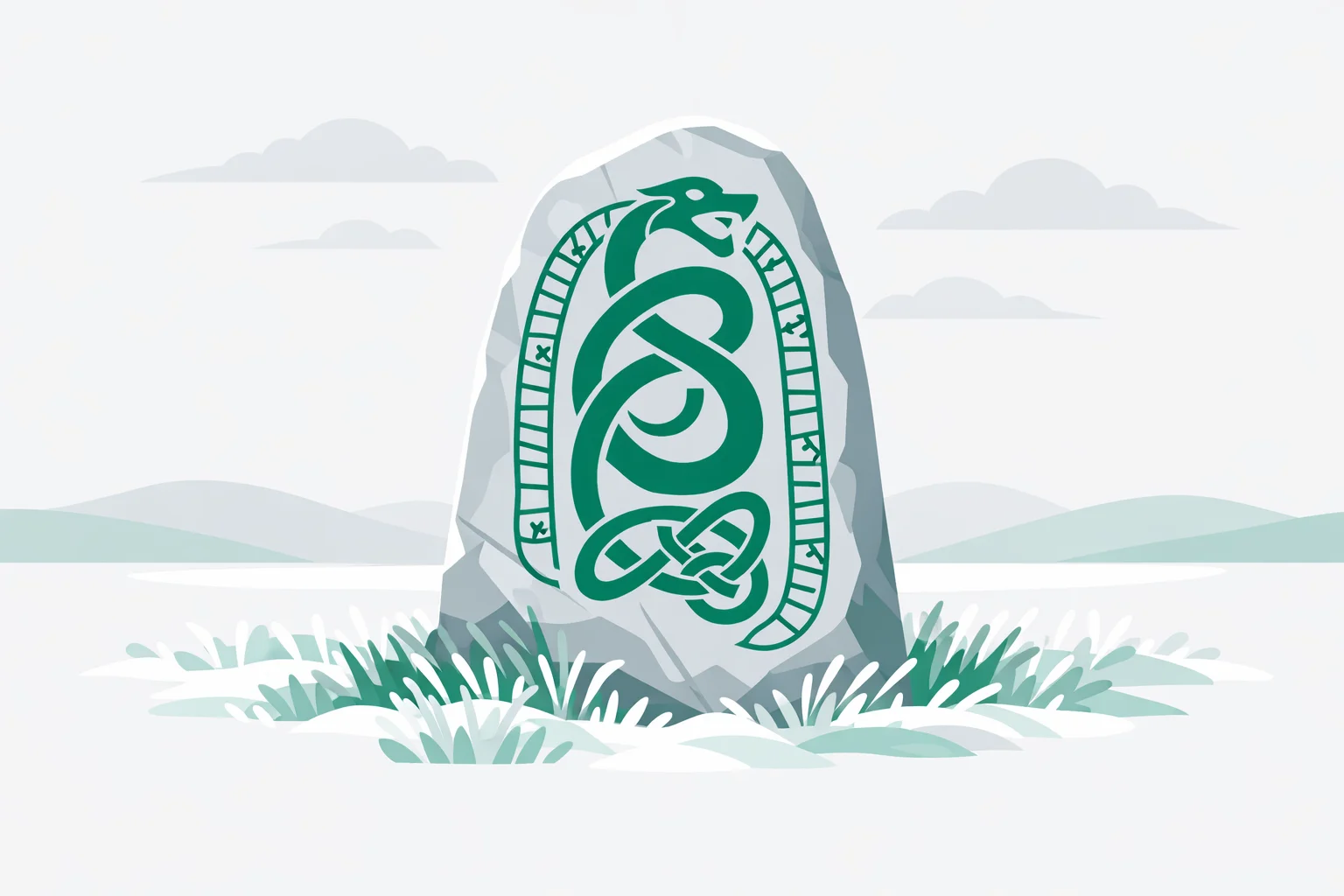
There are twenty questions here and twenty runes, and the pairing isn't decoration. The Elder Futhark is a twenty-four rune alphabet attested from around the second century AD, and we know its traditional order from complete inscriptions like the Kylver stone on Gotland, cut around AD 400. The quiz walks the first twenty in that order, from Fehu to Mannaz.
One honest caveat, because this is where most rune content on the internet goes wrong: the "meanings" of individual runes are reconstructed from rune poems written far later — the Old English one from perhaps the eighth to tenth century, the Old Norwegian and Old Icelandic ones from the thirteenth to fifteenth. Nobody in the second century left us a glossary. The glosses under each question are a disciplined reading, not a reconstruction.
Within that limit, the mapping does real work. Gebo, the gift-rune, carries the question about a friend who needs a week you don't have, because Hávamál is blunt that a gift always looks for a gift in return. Tiwaz, Týr's own rune, carries the promise that turned expensive. Eihwaz, the yew — the tree Odin hung from — carries the question about what you'd pay to know something for certain. And Mannaz, the rune of the human being, carries the last question, which is the one that matters most.
Why Baldr Is the Hardest Result to Get
Baldr lands on roughly 4.4% of possible answer paths. Freyr lands on 11.6%. That spread isn't arbitrary, and it isn't invented for the sake of a social-proof line under your result — it comes from running 200,000 answer paths through the scoring model before this page went live.
Each god is measured against its own ceiling rather than against a shared pool. Odin can collect at most 39 points across the twenty questions; Iðunn can collect at most 28. Both are then expressed as a percentage of what they could have got, which is the only way to stop a god with fewer high-weight options from being mathematically stranded — a real failure mode in quizzes that add raw points and declare a winner. In the simulation, every one of the twelve wins somewhere between 4.4% and 11.6% of the time, and every one of the 132 possible winner-and-runner-up pairings actually occurs.
Baldr is rare because his profile is an awkward combination to produce by accident: very high troth and high growth with almost no cunning at all. Answer even two questions in a self-interested direction and he drops away. Loki is rare for the mirror-image reason. And when your top two finish within a hair of each other, the result tells you so rather than hiding it behind a confident-sounding sentence — about one path in a hundred is a genuine photo finish.
The kenning is the one piece of pure invention, and it's flagged as such. Kennings are a real skaldic device — the sea as the whale-road, blood as the wound-sea — and Snorri catalogued hundreds of them precisely because thirteenth-century poets had begun to lose the references. Yours is assembled from your strongest reading plus your god's own by-name. Built in the pattern, not lifted from a poem.
All 12 Norse God Results, Most Common to Rarest
🌾 Freyr — The Giver (11.6%). Peace, plenty and open-handedness. Freyr traded away the sword that fights on its own to marry a giant's daughter he saw once, and every source agrees the trade killed him and was worth it. The most common result here, which matches the place-name record almost exactly.
⛵ Njörðr — The Negotiator (11.5%). Sea, wind and wealth, and the only god on this list who arrived as a hostage in a peace deal. He is superb at the exchange and equally good at recognising when one has stopped working — his marriage to Skaði ended because neither could sleep in the other's landscape, so they stopped.
📿 Freyja — The Sovereign (10.7%). She gets first pick of the battle-dead, before Odin sees them. She taught the Aesir seiðr, drives a chariot pulled by cats, and weeps red gold. Desire, war and magic are one department in her, and she is far less domesticated than most retellings allow.
⚖️ Týr — The Oathkeeper (9.7%). A demoted sky-father with one great scene left. He gave a hand to a wolf as surety for a promise everybody present knew was a lie. Reads as somebody who keeps their word specifically at the point it becomes costly.
⚡ Thor — The Shield (9.4%). Not the king of the gods; the working household's god, which is exactly why the amulets are everywhere. Enormous, hungry, fast to anger and faster to forgive, and entirely willing to look ridiculous if that gets the job done.
🍎 Iðunn — The Renewer (8.6%). She keeps the apples that keep everyone young, and the only time she was taken, the whole pantheon started visibly ageing within a season. The classic invisible-load result: nothing seems to depend on her until it very obviously does.
🎿 Skaði — The Winter Walker (7.4%). A jötunn who marched into Ásgarðr armed, demanded compensation, and left with a seat at the table. She picked a husband by looking only at feet, got it wrong, and went back to the mountains without much visible regret.
🧵 Frigg — The Silent Knower (7.3%). Snorri says she knows all fates and speaks none of them. She took an oath from every thing in the world not to harm her son and skipped one plant for looking too young to swear. Enormous quiet competence with one specific failure mode.
🐦⬛ Odin — The Seeker (7.1%). An eye at Mímir's well, nine nights on the tree wounded by his own spear, all of it for knowledge. Poetry and frenzy as much as war. Rarer than people expect, because the questions reward keeping a household running rather than abandoning one to go looking.
📯 Heimdall — The Watchman (6.2%). Nine mothers, less sleep than a bird, hearing sharp enough to catch grass growing. He is the god of noticing early — and of the discipline required not to announce it immediately.
🔥 Loki — The Catalyst (6.0%). Not the devil, not Odin's son, and genuinely the reason most of the stories have a plot. He finds the seam in every system and cannot leave it alone, which makes him indispensable right up until it doesn't.
☀️ Baldr — The Beloved (4.4%). The rarest result on the quiz. So loved that the whole world swore not to hurt him, which made the one unasked plant fatal. Reads as somebody universally liked, universally assumed to be fine, with a single unguarded spot nobody thought to check.
Read Hávamál Before You Read Anything Else
If the quiz sent you looking for a source to actually read, skip the creation myths and start with Hávamál — the "Sayings of the High One," around 164 stanzas of advice attributed to Odin. It is by a distance the least mystical thing in the Poetic Edda and the most useful. Don't drink more than you can carry. Don't outstay your welcome. A limping man can ride, a handless man can herd. Never step away from your weapons in open country. Three of its stanzas surface between questions in the quiz above, which is the closest thing this page has to a thesis.
Because the thing the sagas actually measure isn't which god you resemble. It's whether people could rely on what you said — Hávamál 77 flatly states that everything you own dies with you except the reckoning left on your name. So take the result as a description of your instincts rather than a verdict, and pay particular attention to the cost listed underneath it: that section is the part of your profile that other people notice first and mention last. If you want the older layer underneath all of this, Norse belief also held that everybody walks around with a fylgja, a following spirit that takes animal shape — which our spirit animal quiz is the modern descendant of, whether or not it knows it.