Wings of Fire Tribes: What Your Result Says About How You Handle Pressure
A Wings of Fire tribe quiz has ten possible answers — seven tribes in Pyrrhia, three more across the ocean in Pantala — and not a single dragon in any of them ever got a vote. You hatch into your tribe. What you do about that is the entire series, which is why this one doesn't ask you to pick a favourite colour and hand you a dragon.
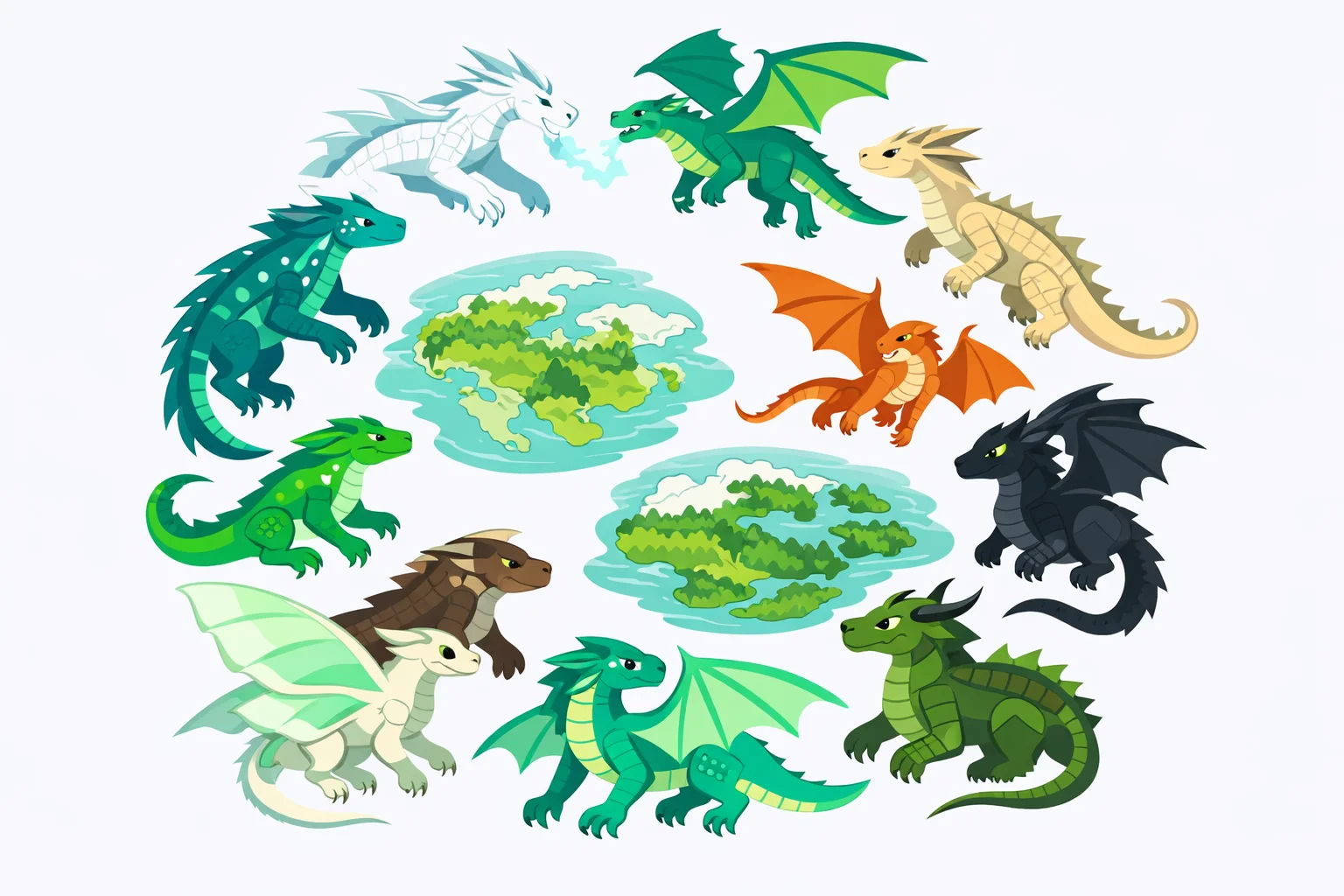
Ten Tribes, Two Continents, and One Rule Nobody Chose
Tui T. Sutherland started this in 2012 with The Dragonet Prophecy, and by the end of the third arc the map had doubled. Pyrrhia holds the seven tribes most readers meet first: MudWings, SandWings, SkyWings, SeaWings, RainWings, IceWings and NightWings. Pantala — a continent Pyrrhia spent two entire arcs not knowing about — holds HiveWings, SilkWings and LeafWings.
Here's the structural detail that makes this fandom's sorting question different from every other one. In Hogwarts sorting the Hat takes your preference into account. At Camp Half-Blood a cabin claims you through a parent. In Divergent you choose at sixteen. Wings of Fire has none of that. Tribe is biology — scales, wings, venom, frostbreath, the lot — decided before you were conscious. Which means a Wings of Fire quiz is really asking a stranger question than it looks: not what you want to be, but what you'd already be behaving like.
The Dragonets Built a School to Break the Sorting
After a war that ran for twenty years on nothing but tribal loyalty, the Dragonets of Destiny did something genuinely odd. They opened a school inside a mountain and filled it with the children of every tribe that had just been killing each other. Then they made one rule that the whole thing rested on: no winglet is allowed to be from one tribe.
Jade Mountain Academy sorts students into five winglets — Jade, Gold, Silver, Copper and Quartz — with one dragonet from each tribe in each. The Jade Winglet is the one the books follow: Moonwatcher the NightWing, Winter the IceWing, Qibli the SandWing, Kinkajou the RainWing, Turtle the SeaWing, Umber the MudWing, and Carnelian the SkyWing. Seven dragons whose tribes had recently been at war with each other, assigned to sleep in the same cave and pass the same classes.
It was a deliberate experiment, and it's the reason this quiz scores two things instead of one.
Why This Quiz Scores Two Things at Once
Eighteen questions run two independent tallies. The first spreads points across all ten tribes — that's your biology, the egg you hatched from. The second tracks five character traits that have nothing to do with tribe: curiosity, honour, charm, grit and craft. That second score is what places you in a winglet.
The split matters because it's how the books actually work. Winter and Qibli are an IceWing and a SandWing, tribes with no love for each other, and they end up in the same winglet because they share a temperament their tribes don't account for. Two readers can both hatch as SeaWings and land in completely different winglets. That's not a scoring bug — it's the point Jade Mountain was built to prove.
Your runner-up tribe doesn't get thrown away either. It comes back as hybrid heritage, because canon is full of hybrids: Sunny, one of the five dragonets in the original prophecy, is a SandWing and NightWing mix, and she spends most of arc one being told that makes her wrong. Roughly a third of results finish with the top two tribes separated by a point or less — if that's yours, the hybrid is genuinely the more accurate answer than either tribe alone.
Your Result Measures Threat Response and Loyalty Radius
Strip the dragons out and the eighteen questions are measuring two things. The first is what you do when something goes wrong — move toward it, wait it out, or shield somebody from it. The second is how wide your loyalty runs: one dragon, one clutch, one tribe, or anyone who happens to be in trouble in front of you.
| Tribe | Continent | Under threat, you… | Loyalty runs to… |
|---|---|---|---|
| SkyWing | Pyrrhia | Fly straight at it | Whoever earned your respect |
| MudWing | Pyrrhia | Absorb it and stay put | Your clutch, absolutely |
| SandWing | Pyrrhia | Outlast it, then act | Yourself, then a chosen few |
| SeaWing | Pyrrhia | Read it before reacting | Family, complications included |
| IceWing | Pyrrhia | Go cold and precise | Rank, then quietly everyone |
| NightWing | Pyrrhia | Watch, and say nothing | One dragon, if that |
| RainWing | Pyrrhia | Stay calm until you don't | Everyone, casually |
| HiveWing | Pantala | Organise around it | The structure itself |
| SilkWing | Pantala | Endure, and quietly refuse | The one who sees you |
| LeafWing | Pantala | Shield whatever's growing | Home ground and its people |
Read down the "under threat" column and you'll spot why the quiz can hand a SilkWing result to someone who was certain they'd get SkyWing. Wanting to be the dragon who charges the problem is not the same as being her.
The Tribes Fans Get Wrong Most Often
Three misreads come up constantly in this fandom, and each one is actually the books setting a trap on purpose.
RainWings are not lazy. Every Pyrrhian tribe says they are, readers absorb it, and then Glory ends up running the rainforest and the same "lazy" tribe turns out to carry venom that dissolves scales on contact. The laziness was always other tribes' convenient story about a tribe that simply refused to be at war.
MudWings are not slow. Blunt is not stupid. Clay reads a room through loyalty rather than analysis, which is a different instrument, not a worse one — and the MudWing bigwings structure is one of the more sophisticated social arrangements on the continent.
NightWings were never mostly psychic. This is the big one. The tribe traded on a reputation for prophecy and mind reading that only appears in dragons hatched under three full moons, like Moonwatcher. For generations it was closer to a public relations operation than a superpower, which makes NightWing an unnervingly good result for readers whose real talent is watching carefully and letting people assume the rest.
What Really Happens When You Sort Children Into Groups
Sutherland didn't invent the winglet experiment out of nothing. Social psychology has been running versions of it since the 1950s, and the results are bleak enough to explain why Jade Mountain was such a gamble.
In 1954, Muzafer Sherif took twenty-two eleven-year-old boys to a summer camp at Robbers Cave in Oklahoma, split them into two groups, and watched them invent hostility from scratch. The Rattlers and the Eagles burned each other's flags and raided each other's cabins within days — over an assignment that had been essentially arbitrary. Tajfel's later minimal group studies went further: people favour their own group even when they know the group was formed by a coin toss.
The interesting half of Sherif's study is the fix. Simply putting the two groups in the same room did nothing; they just had somewhere new to fight. What worked was superordinate goals — problems neither group could solve alone, like a broken water supply. Cooperation under shared crisis, not proximity.
Which is exactly what happens at Jade Mountain. Mixed sleeping caves alone don't fix anything, and the books are honest about that. What changes Winter isn't the seating plan — it's a series of emergencies he can't survive without a NightWing, a SandWing and a RainWing. Sutherland wrote a plausible contact-hypothesis experiment into a middle-grade fantasy series and then, to her credit, let it fail in the realistic places.
All 10 Wings of Fire Tribe Results
Every outcome this quiz can produce, and what each one says about how you handle pressure.
🟤 MudWing — Loyal, physically tough, and the dragon everyone else instinctively looks at when things break. MudWings hatch in clutches and stay in them; the bigwings is whoever the group turns to without discussing it. You can hold your breath for about an hour and only breathe fire once you're warm. The weakness is quiet: you absorb far more than you report, and you'll defend a group long past the point it earned that.
🏜️ SandWing — Strategic, self-sufficient, and always holding one advantage in reserve. A venomous barbed tail and weeks of survival without water make SandWings the tribe most comfortable in conditions that would finish anyone else. The SandWing Succession dragged on for two decades because three sisters could all wait. Your risk is that self-reliance quietly turns into isolation.
🔥 SkyWing — The strongest fliers in Pyrrhia and the least interested in hiding what they think. SkyWings correct things out loud and go toward the storm, which makes them the tribe most likely to be right and least likely to be diplomatic about it. Queen Scarlet's arena worked on exactly this: a dragon who can be provoked can be aimed.
🌊 SeaWing — Perceptive, deep-feeling and fluent in a language written in light on their own scales. SeaWings breathe underwater, see in the dark, and tend to ask a careful question rather than make a statement. The flaw is secrecy by reflex — withholding things from people who had a right to them and calling it protection.
🌈 RainWing — Relaxed, warm, endlessly underestimated, and carrying venom that can dissolve scales in seconds. RainWings change colour with their mood, which means everyone can read them and almost nobody bothers to. Being underestimated is comfortable — and comfortable is how a RainWing stays smaller than they are.
❄️ IceWing — Disciplined, exacting, and raised inside a ranked system of seven circles where your position is public knowledge. Frostbreath and serrated claws make them lethal in the cold. What reads as coldness is usually the reverse: Winter's loyalty runs hot enough to embarrass him. The real danger is that rank teaches contempt before it teaches anything else.
🌑 NightWing — Observant, secretive, and carrying things nobody asked them to carry. Only dragons hatched under three full moons get mind reading or prophecy; the rest built a reputation on silence and let other tribes fill in the blank. Moonwatcher's problem is the NightWing problem — knowing what everyone actually thinks is a weight, not a gift.
🐝 HiveWing — Industrious, organised, and the reason Pantala functions at all. HiveWing weapons vary by dragon: stingers, venom, paralytic breath. They'd rather repair a broken system than give a speech about it, which is admirable right up to the third arc, where Queen Wasp demonstrates that a tribe this good at falling into line can be captured wholesale.
🦋 SilkWing — Patient, gentle and far harder to move than they look. SilkWings hatch wingless and don't metamorphose until six, which produces a temperament built on waiting without complying. Blue's arc is the proof: a tribe treated as decorative while quietly running a resistance. The cost is that endurance becomes the default, and you tolerate for years what you should have left in a week.
🌿 LeafWing — Nurturing, rooted and defined by outlasting an extinction rather than winning a war. Believed wiped out after the Tree Wars, the survivors hid in the Poison Jungle, and leafspeak lets them sense and influence growing things — care that happens to be power. The unresolved tension is the SapWing and PoisonWing split: how long do you stay peaceful with something that keeps hurting you?
Where the Winglet Experiment Failed
Jade Mountain doesn't work cleanly, and the books never pretend it does. Carnelian dies. The dragonets self-segregate by tribe at meals within days. Winter arrives carrying prejudice his entire family installed, and mixing him into a winglet doesn't remove it — it just puts him somewhere the cost of holding it becomes visible.
That's the honest reading of your result too. A tribe result is a starting condition, not a verdict. If you got IceWing, the standards you hold yourself to came from somewhere, and it's worth checking whether you chose them. If you got RainWing, the thing everyone reads as easygoing might be doing more work than they realise. If your top two finished a single point apart, you're a hybrid — and every hybrid in these books spent a while being told that made them less of both before working out it made them more.
If sorting systems built on birth rather than choice are the part you find interesting, the Warrior Cats Clan quiz runs the same question through a different animal fantasy, and the Fourth Wing quiz inverts it entirely — there, the dragon does the choosing. For the full publication history of the series and its three arcs, Wikipedia's Wings of Fire entry is the cleanest summary available.