The Four Elements of Avatar: What Your Bending Style Really Says About You
Almost everyone starts an Avatar element quiz already certain of the result. Twenty years of fandom polls say most of them are wrong — because most fans answer with their favorite element, and Avatar: The Last Airbender never once suggests that's how bending works. The show built each discipline on a real martial art with its own temperament, then spent three seasons showing characters whose elements fit who they are, not what they'd pick from a menu. Zuko doesn't love fire; for two seasons he can barely stand what it means. It fits him anyway. That gap — between the element you'd choose and the element that would choose you — is exactly what these fifteen questions measure.
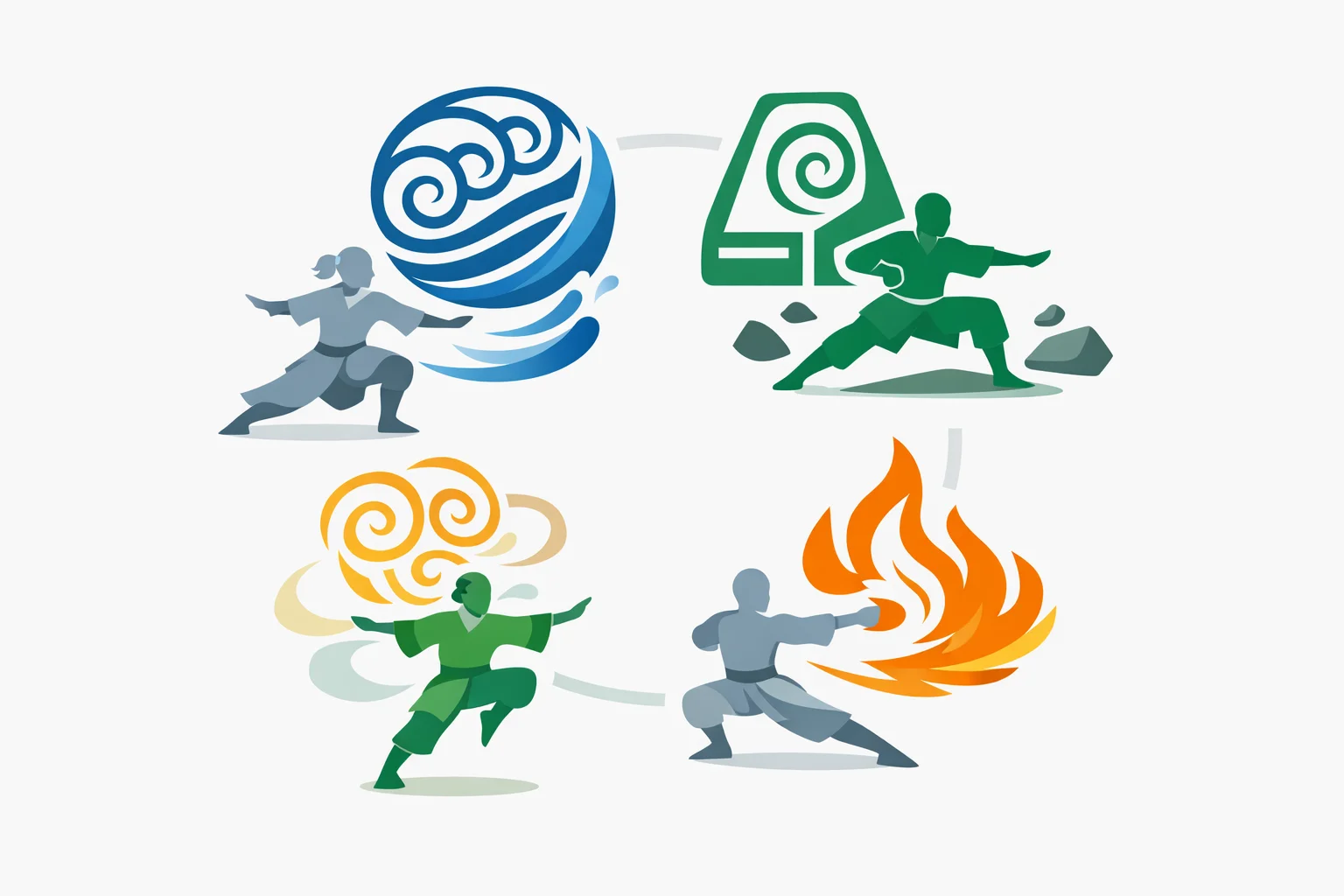
Every Bending Style Is a Real Martial Art
Before a single episode was animated, the creators brought in a martial arts consultant — Sifu Kisu of the Harmonious Fist Chinese Athletic Association — and assigned each element a genuine fighting system. The choreography you see on screen isn't decorative. Waterbenders move like tai chi practitioners because waterbending is tai chi: yield to the incoming force, redirect it, return it. Earthbending is Hung Ga, a Southern Chinese style famous for stances so rooted that practitioners train by holding them for minutes at a time. Firebending is Northern Shaolin — long-range, explosive, always advancing. And airbending is Ba Gua Zhang, the strange, beautiful art of walking circles around an opponent so you're never where the strike lands.
| Element | Real martial art | How it handles force | The temperament underneath |
|---|---|---|---|
| 🌊 Water | Tai chi | Yields, redirects, counters | Adaptive, patient, protective |
| 🪨 Earth | Hung Ga | Roots down, absorbs, outlasts | Stubborn, loyal, direct |
| 🔥 Fire | Northern Shaolin | Commits fully, always advances | Driven, decisive, hungry |
| 🌪️ Air | Ba Gua Zhang | Circles, evades, never engages head-on | Free, creative, elusive |
There's one deliberate exception, and it's the best character detail in the series. Toph doesn't move like Hung Ga at all — her style is Chu Gar Southern Praying Mantis, a compact system built on stillness and listening, chosen because she fights blind. She waits, reads the vibration, then strikes once. The animators changed the martial art to match the person. Keep that in mind when your result arrives: the show's own logic says the person comes first and the element follows.
Four Myths the Fandom Refuses to Drop
Myth #1: Fire is the villain's element. The series goes out of its way to dismantle this one. In “The Firebending Masters,” Zuko loses his bending entirely when rage stops fueling him — and the dragons Ran and Shaw teach him that fire was never anger. It's energy, will, life itself; the Sun Warriors call it “the sun inside you.” If this quiz places you with fire, it read your drive, not your temper. Iroh, the gentlest character in the franchise, is a firebender. So is the guy who invented redirecting lightning rather than throwing it.
Myth #2: Air is the weakest element. Airbending is the only discipline with no named killing technique for nearly the entire franchise — and its practitioners were the one nation the Fire Lord considered dangerous enough to eliminate first. Those two facts aren't in tension. Guru Laghima achieved unassisted flight through total detachment, something no other bender in any era managed with their element. And Aang ends a hundred-year war without taking a single life, which is either weakness or the single most dominant feat in the series, depending on how carefully you were watching.
Myth #3: Your element is whichever one you think is coolest. Preference measures your taste in choreography. Temperament is what you do when someone shoves you, when plans collapse, when anger shows up uninvited. That's why none of the fifteen questions here ask which element or character you like — the quiz watches how you handle force, fear, grief, and freedom, then matches the pattern to a discipline. Plenty of Katara fans move through conflict like firebenders. It surprises exactly none of their friends.
Myth #4: Great benders master their own element and stop there. The show argues the opposite at every turn. Iroh invented lightning redirection by studying waterbenders. Zuko's firebending only matures after he learns from another culture's source. Toph's seismic sense is closer to a waterbender's sensitivity than to anything in Hung Ga. The best benders in the franchise are all cross-trainers — which is why the balance bars under your result matter more than the seal above them.
Why Doesn't Avatar Have a Fifth Element?
Here's the odd part: the show is steeped in East Asian philosophy, but its element system isn't the East Asian one. Chinese cosmology uses Wu Xing, five phases — wood, fire, earth, metal, and water. No air at all, and metal as a first-class element. The four-element set the show actually uses is the classical Greek arrangement Empedocles proposed around 450 BCE, which maps cleanly onto four seasons and four nations. That same four-element set is the backbone of Western astrology, where each element covers three signs — so if you want to see which element you land on outside the show's framing, the zodiac sign quiz scores it against a second axis and hands back one of twelve. The franchise then smuggles Wu Xing back in through the side door: metalbending, lavabending, lightning, and bloodbending are all sub-disciplines — specializations of the four, not elements of their own. The only true outsider is energybending, the lion turtles' art from the era before the Avatar, which bends a person's life force directly. If anything deserves the title of hidden fifth element, it's that.
What 15 Forced Choices See That You Can't
The rubric behind this avatar element quiz comes from the show itself — Iroh's lecture to Zuko in “Bitter Work”: fire is power, earth is substance, water is change, air is freedom. Every question is a forced trade-off between those four values. You can't simultaneously plant yourself between two fighters and joke the tension away; you can't fear both insignificance and captivity most. Each answer feeds weighted points to one or two elements, and your placement is simply the discipline that kept winning the trade-offs — with all four totals shown as your elemental balance, because almost nobody is one element pure.
The questions cluster around four tells. How you meet force: block it, redirect it, evade it, or hit back harder. What you're most afraid of — Iroh's tea question is doing more work than it looks like. What your anger does when it arrives. And what peace means when everything finally settles. A sorting built on trade-offs behaves differently from one built on stated values, which is why this reads less like our Divergent faction quiz — where choosing is the whole point — and more like a placement exam you can't study for. The reason any of this separates cleanly is that the four nations were designed not to overlap, the same constraint that makes the Sailor Moon character quiz work — Takeuchi built her guardians on Super Sentai rules, where a squad member who duplicates another squad member is dead weight. Honest caveat: it's a mirror for self-reflection, not a validated instrument. But fifteen forced choices in a row leak a surprisingly specific silhouette.
Your Lowest Score Is the Interesting One
Everyone reads their top bar. The show would tell you to read the bottom one. In “Bitter Work,” Aang — a prodigy who picked up waterbending in weeks — completely fails at earthbending, because its temperament is his opposite: face the problem, hold your ground, do not dodge. His block wasn't technical. It was personality. The same structure runs through the whole franchise: the element that resists you marks the skill your instincts avoid, and every master character eventually turns toward it rather than away. Being claimed by an element you didn't expect is its own kind of information — the same reason a Percy Jackson cabin result stings or sings depending on which parent you secretly hoped for. So if your air score is nearly zero, that's not a rounding error. That's the quiz telling you what you never let yourself do.
All Four Element Results Explained
🌊 Water — the Element of Change. The most common placement, at about 29% of takers. You adapt, you read people, and your strength scales with how much you love the person you're protecting — the Katara profile. Your fighting style yields and redirects instead of blocking. The shadow side is tidal: moods that move with the room, and a long, precise memory for being wronged.
🪨 Earth — the Element of Substance. Around 27% of takers. You're the anchor: loyal, direct, allergic to drama, and genuinely unmovable once you've decided. Like Toph, you listen and wait before you act, and people underestimate you at their own expense. The cost is flexibility — you can hold a position long after holding it stopped being strength.
🔥 Fire — the Element of Power. Roughly 25% of takers, and the most argued-with result on the trial. You run hot in the show's original sense: desire, will, and energy pointed at a goal, the way the dragons taught it before rage corrupted the form. You commit fully where others hedge. Your failure mode is the comet's: burning through fuel — and people — faster than either replenishes.
🌪️ Air — the Element of Freedom. The rarest placement, at about 19%. You evade what others confront, not from cowardice but from a genuine refusal to be pinned — by force, by expectations, by other people's definitions of serious. You're the room's lightness right up until a principle is crossed, and then you don't move at all. Your risk: taking the exit one scene before the story needed you in it.
Your Training Assignment
Your result comes with homework. Water types should rewatch “The Puppetmaster” — the episode that shows what water's adaptability becomes without a moral anchor. Earth types get “The Blind Bandit” and the earthbending half of “Bitter Work.” Fire, obviously, “The Firebending Masters.” Air types should sit with “The Guru” and ask which chakra they'd fail. Then compare balance bars with a friend — the argument about whose second element is more accurate is, in our experience, the best part. If being chosen by something suits you, see which crystal calls in the lightsaber color quiz — same instincts, different galaxy. And if what you actually like is a sorting system with a documented family tree underneath it, the Demon Slayer breathing style quiz traces all fourteen styles back to one root, then decides how far down the branch you belong. If you want the same inherited-power question asked by a world where almost everyone has one, the MHA quirk quiz classifies you the way My Hero Academia actually does — Emitter, Transformation or Heteromorph first, the specific quirk second, and the drawback you pay for it last. For the version where the element is only half the answer, the Naruto clan quiz runs a chakra paper test alongside a clan sorting — Fire, Wind, Lightning, Earth or Water on one axis, and the family that handed you the pressure on the other. For the same question asked from the opposite direction, the Genshin element quiz sorts seven elements instead of four and awards them for ambition rather than birth — in Teyvat an Archon hands out a Vision only once a mortal wants something badly enough to act on it, so Air types there come back Anemo far less often than you would guess and Fire types split almost evenly between Pyro and Hydro. And remember the one rule Iroh actually insisted on: draw wisdom from many places, because the element you were given describes your defaults, never your ceiling. In the show, bending is inherited. Temperament is trained. That difference is the whole point of asking the question.