Which Naruto Clan Are You? The Argument Fans Have Been Having Since 2002
Every Naruto clan quiz sits on top of an argument the fandom has never settled, and it started in 2002, in a Chunin Exam arena, when Neji Hyuga told a boy with no family that fate is decided at birth. Naruto's rebuttal was a fist coming up through the floor. Twenty-something years later the fight is still going in comment sections, and both sides have better evidence than they usually admit. One camp says the series proves blood is destiny. The other says it proves the opposite. The awkward part is that Masashi Kishimoto wrote a world where both are true, and that contradiction is exactly what this quiz sorts on.
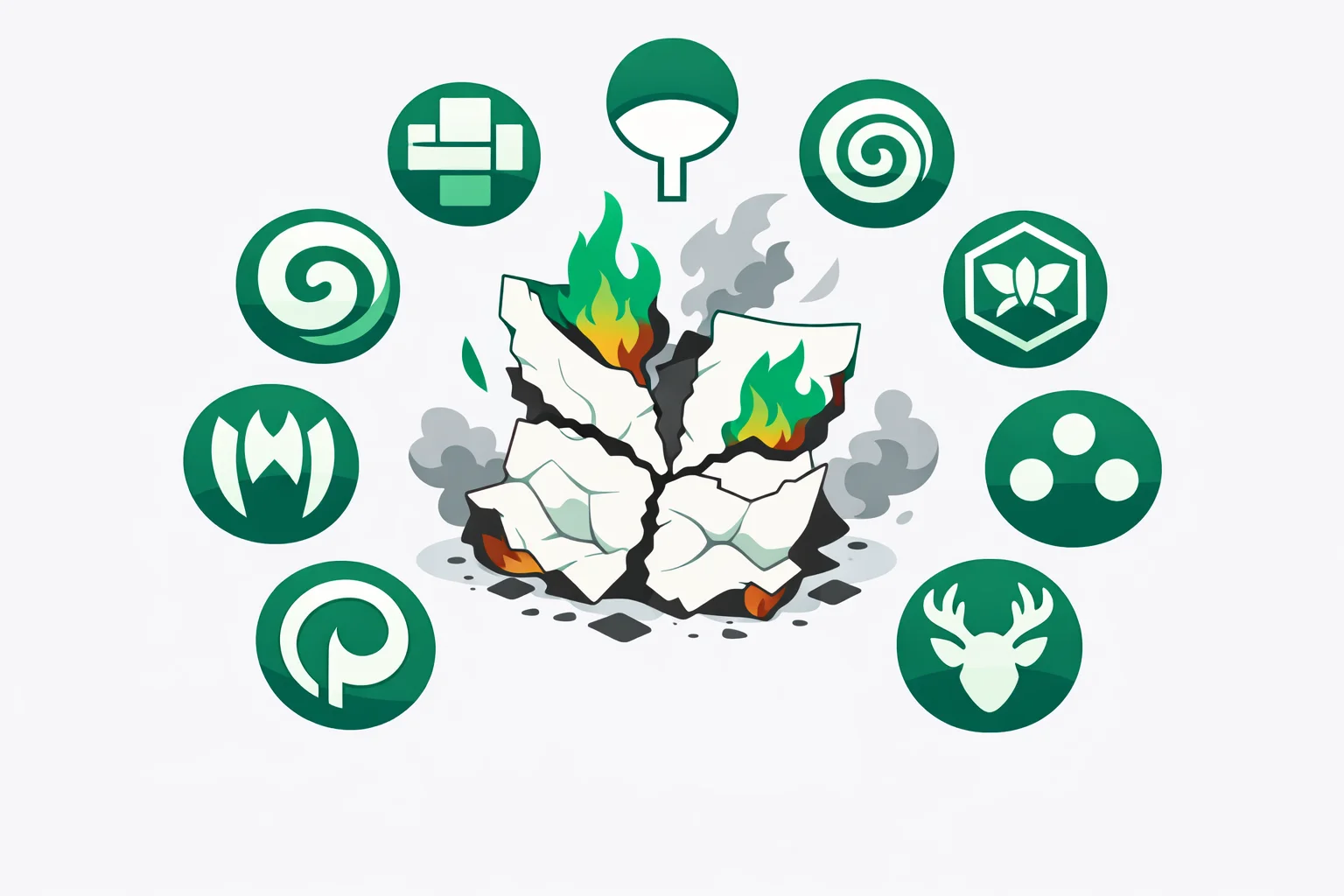
Neji Was Right, and That's the Uncomfortable Part
Start with the camp nobody wants to be in. Neji's argument is mechanically correct inside the rules of the world he lives in. A kekkei genkai is genetic. You cannot train your way into a Sharingan, a Byakugan, Shikotsumyaku or Wood Release — those travel through families and only through families. The Hyuga did not merely inherit an eye, they inherited a caste system built to protect it. Kimimaro's bones were not a reward for effort. And the strongest ninja in the series are, with very few exceptions, people who were handed something at birth.
Now the other camp, which has the louder case. Naruto beats Neji. Rock Lee, who cannot use ninjutsu at all, walks into the Chunin Exams and makes the genius clans look slow. Might Guy — no bloodline, no eye — opens the Eighth Gate and comes closer to killing Madara than anyone with a kekkei genkai managed. The story keeps stacking the argument that what you do with your hours matters more than what your parents handed over.
Here is the detail that keeps the fight alive: Naruto is not clanless. He is Uzumaki on one side and Namikaze on the other, and his mother's bloodline — its freakish life force, its sealing tradition — is a large part of why he survived being a jinchuriki at all. The kid who won the argument against inherited fate won it partly with inherited biology. Kishimoto knew what he was doing there. The series' real position is narrower and more interesting than either camp: your bloodline decides what you are handed. It does not decide what you think you owe for it. That second thing is a personality, and it is the thing being measured here — the same structural question that the Percy Jackson cabin quiz runs on, in a world where your parent hands you your powers before you get a vote.
The Warring States Deal Every Clan Signed
Before there were villages, there were only clans. During the Warring States period, ninja families sold themselves as mercenaries to whichever feudal lord could pay, which meant the Senju and the Uchiha spent generations being hired to kill each other by clients who did not care which side won. Children were fielded at ages that would horrify a modern Konoha instructor. The clan was the whole state — its own laws, its own graveyards, its own succession problems.
Konoha was a merger, not a founding. Hashirama Senju and Madara Uchiha agreed to stop, and every clan that joined signed the same deal: give up autonomy, get a village. What people miss is that the deal never dissolved the clans. It froze the old rivalries into internal politics. The Uchiha were folded in, handed the Military Police Force, and given a compound at the edge of the village — proximity to power, distance from the centre. That arrangement is the entire pressure system behind the massacre, and it's why an Uchiha result on this quiz carries something the other nine do not: the feeling of being inside an institution that has never quite let you in.
Two clans show what refusing the deal costs. Uzushiogakure, the Uzumaki village, was destroyed during the Second Shinobi World War — not for being aggressive but for being too good at sealing, which made the survivors valuable and the village a target. The Kaguya were wiped out attacking Kirigakure for no strategic reason at all, because combat was the only vocabulary the clan had. Two opposite fates, one lesson: in this world, a bloodline that stays outside the system does not get to stay neutral.
Every Bloodline in Naruto Charges the Same Price
Here is something you can check yourself, and it does not show up in any clan ranking list on the internet. Line up all ten clans against what their inherited technique actually costs, and the costs are not random. They are the same shape every time: power now, autonomy later.
| Clan | What the bloodline gives | What it takes back |
|---|---|---|
| Uchiha | Sharingan — copy, predict, adapt | The Mangekyo awakens through loss; overuse blinds you |
| Hyuga | Byakugan — near-total field vision | A branch-house seal, and a blind spot behind the neck |
| Nara | Shadow Possession — removes their options | Runs on your reserves, and the Nara have few to spend |
| Uzumaki | Extreme life force and sealing mastery | That vitality makes you the ideal vessel — the gift is the target |
| Senju | Vitality, healing, Wood Release | The name spent itself down to a single survivor |
| Aburame | A colony that scouts and drains for you | Implanted at birth; they feed on your chakra for life |
| Inuzuka | Senses far beyond human range | No off switch — every room is loud, every lie audible |
| Akimichi | Multiplied size and strength | The red pill buys one hour and charges you the rest |
| Yamanaka | Mind Body Switch, sensory range | Your body lies there with nobody home while you work |
| Kaguya | Shikotsumyaku — the skeleton as a weapon | The body carrying it burns out early |
Read the right-hand column on its own and a pattern falls out. Not one of those costs is paid in pain. Every one is paid in freedom — your sight, your body, your name, your lifespan, your ability to switch it off. The bloodline gives you something nobody can take, then quietly takes the thing you would have used to walk away from it. That is why the Hyuga seal is not a plot device but a thesis statement, and it's also why fans who love the series and fans who find it frustrating are often reacting to the exact same design. If you want to see how a different author handles the same trade, the MHA quirk quiz runs on a world where every power comes with a drawback written into the registration form — same idea, filed as bureaucracy instead of tragedy. One Piece charges for it more literally than either: the Devil Fruit quiz sorts you onto a power whose price is the ocean itself, permanently, no seal required.
So What Is Chakra Paper Actually Testing?
Asuma introduces the chakra paper test early in Part II, and it is the cleanest piece of mechanics in the series: a square of paper grown from a chakra-fed tree, held between two fingers, reacting to whatever runs through it. No instructor, no exam, no interpretation. That is why this quiz opens with it — question one is the paper, and the other fifteen keep scoring the same axis underneath the clan questions.
| The paper | Nature | Strong against | Weak to | How it reads as a person |
|---|---|---|---|---|
| Ignites | Fire (Katon) | Wind | Water | Forces the issue rather than waiting it out |
| Splits in half | Wind (Futon) | Lightning | Fire | Finds the seam, goes through, moves on |
| Crumples | Lightning (Raiton) | Earth | Wind | Decides fast, treats speed as defence |
| Crumbles to dirt | Earth (Doton) | Water | Lightning | Absorbs and holds; the fixed point others plan around |
| Goes damp | Water (Suiton) | Fire | Earth | Redirects instead of colliding |
The cycle matters because it means no nature is best — each one beats exactly one other and loses to exactly one other, which is why Kakashi being a Lightning specialist is a liability against Naruto's Wind and an advantage against an Earth user. Your nature result is scored separately from your clan on purpose. Clan measures what you do with inherited pressure; nature measures tempo. A Nara who reads as Fire is a strategist who runs hot the second the plan breaks. If you want the same elemental question asked by a completely different framework, the Avatar element quiz sorts on philosophy rather than tempo, and people routinely get results that feel like they contradict this one.
Why Konoha Builds Squads of Three, Not Four
The third card in your result is a squad slot, and there is a reason a clan alone is not enough to place you. Konoha does not assign genin randomly. The clearest proof is Ino-Shika-Cho, a formation the village has fielded across at least three generations: a Yamanaka locks the mind, a Nara locks the body, an Akimichi ends it. Inoichi, Shikaku and Choza ran it, then Ino, Shikamaru and Choji ran it again. That is not sentiment. It is a capture cell so effective the village kept rebuilding it from whichever children those three clans happened to produce.
Team 8 is the other tell. Hinata brings the Byakugan, Kiba and Akamaru bring scent, Shino brings a colony that can be scattered across a forest — a pure reconnaissance cell where not one member is built to win a straight fight. Meanwhile Team 7 is stacked with frontline talent and spends most of Part I being rescued by its jonin. Konoha builds for function, not for firepower, and that is why your result names a slot: Vanguard, Tracker, Tactician or Medic-Sealer. Plenty of Uchiha score Tactician. Plenty of Nara score Vanguard. The clan is the inheritance; the slot is what a squad leader would actually do with you.
Here's Where Fans Sort Themselves Wrong
Almost everyone walks into a Naruto clan quiz expecting Uchiha, and fewer than one in eleven answer paths here actually lands there — 8.8%, which puts it seventh out of ten. The mistake is treating "intense" as an Uchiha signal, when three separate clans in this quiz score on intensity aimed in different directions. Uchiha intensity points at not being ordinary. Kaguya intensity points at belonging to something — same fuel, different target, and it is the rarest result here at 6.8% of paths. Inuzuka intensity points outward and immediately, which is why it reads as impulsiveness rather than ambition. Question 13 — the one about what actually frightens you — is doing most of that separating work on its own.
The second common mis-sort is Nara versus Hyuga. Both read as restrained, both notice more than they say, and people who expect one often get the other. The split is what each one withholds: a Nara withholds effort and will happily let you think they are not trying, while a Hyuga withholds speech and is trying constantly. Question 7, about the family rule you think is wrong, is the cleanest separator — breaking it quietly is Nara, following it while keeping score is Hyuga.
One honest note about the percentages on your result card. They are not survey data and they are not made up either — they are measured from the scoring model itself, by running two million randomly generated answer sets through it and recording where each one lands. So "7.4% of answer paths" means precisely that: out of every possible way to answer these sixteen questions, that share resolves to Kaguya. Real people do not answer randomly, so treat it as a map of the model, not a census of the fandom.
Every quiz on this site that quotes a result percentage is built the same way. The Blue Lock quiz runs 200,000 simulated answer sets rather than two million, and its headline finding is the same shape as the Uchiha problem above: the result people expect is not the one the model actually produces most often. There, Rin Itoshi beats the protagonist.
All 10 Naruto Clan Results Explained
🔥 Uchiha — Clan of the Sharingan. High-contrast people who cannot do anything at half volume. You learn fast because you watch harder than anyone realises, and being ordinary reads to you as a kind of threat. The strength is a refusal to settle; the weakness is that you attach to people and grudges with identical permanence, and you rarely know which one you are carrying.
👁️ Hyuga — Clan of the Byakugan. Composed to the point that people occasionally mistake you for cold. You catch posture, tone and the half-second before a lie. Discipline is genuinely your strength — you are the person who follows through when nobody is checking. The cost is that you follow rules you disagree with while silently keeping a ledger, and the ledger never gets read aloud.
🦌 Nara — Clan of Shadows. Ten moves ahead and four minutes late. You conserve effort because wasted effort genuinely bothers you, so people read you as indifferent right up until the plan collapses and you are the only one holding a workable one. The weakness is that you have already simulated the confrontation and decided it was not worth having.
🌀 Uzumaki — Clan of the Whirling Tides. Stubbornness wrapped in warmth, which is why people underestimate it. You attach fast and permanently, and you are still standing several rounds after standing stopped making sense. Endurance is the whole technique. The weakness is treating your own limits as a rumour rather than information.
🌳 Senju — Clan of the Forest. You default to responsible whether or not anyone asked. Crisis instinct: get between the danger and everyone else, count heads at the door, keep going. The strength is that people are genuinely safer around you. The weakness is that you are permanently tired and you have never once described that as a problem.
🪲 Aburame — Clan of the Kikaichu. The most observant person in most rooms, and hardly anyone notices you are doing it. You gather before you act, always. Being underestimated does not bother you — you have found it tactically convenient and stopped correcting people. The weakness is that you sometimes wait past the point where the information stops being useful.
🐺 Inuzuka — Clan of the Ninken. Gut-led and usually right, which has made you overconfident in the cases where you are not. You are blunt in a restful way — nobody has to decode you. Loyalty is immediate and total. The weakness is that betrayal stays personal for years, and you would rather have a fight now than a conversation later.
🍙 Akimichi — Clan of Expansion. You notice who has not eaten and who is standing alone at the edge of a room. Slow to anger in a way people mistake for softness, right until someone you love is in the way. The strength is steadiness. Underneath it is a quiet fear of being the weak link, which is exactly why you keep making yourself useful.
🌸 Yamanaka — Clan of the Mind. Other people's moods land on you like weather. You read tension before anyone speaks and you have spent years managing rooms nobody asked you to manage. You are sharper than your friendliness suggests. The weakness is that the same instinct that makes you kind tells you precisely where someone is soft.
🦴 Kaguya — Clan of the Dead Bone Pulse. The rarest result here. You need something to belong to, and once you find it there is no ceiling on what you will spend on it. Half-measures feel dishonest to you. That makes you extraordinary on a team and genuinely risky alone with an idea, because your loyalty is not transactional and the wrong person could do a great deal with it.
What the Swirl on Every Konoha Vest Is Actually For
Look at the back of a Konoha flak jacket. That red spiral is not a village logo — it is the Uzumaki crest, worn by every Leaf ninja in memory of an allied clan whose village was destroyed and never rebuilt. Kakashi wore it. Asuma wore it. Thousands of shinobi who never met an Uzumaki have gone on missions with a dead clan's name across their shoulders without giving it a second thought. It is the single best piece of set dressing in the series and almost nobody clocks it on a first watch.
Which is a decent way to hold whatever result you got. A clan in this world is not a trophy and it is not a power level — it is a debt someone else has already paid part of. If you want to test that on yourself, retake the Naruto clan quiz answering as the person you were three years ago and see whether the clan moves. It usually moves on the fear question and the sacrifice question, and the direction it moves is more informative than either result on its own. For the wider context on how the manga built this system across 72 volumes and more than 250 million copies in circulation, the Wikipedia entry on Naruto is a solid starting point, and Britannica's overview covers the publication history without spoiling the back half.