The Breathing Style Family Tree: Where All 14 Styles Actually Come From
Here's a question almost no Demon Slayer breathing style quiz bothers to ask: which style came first? Not which one wins — which one is the trunk that everything else grew out of. The answer reorganises the entire roster, and it's the reason this quiz sorts you the way it does.
Fourteen styles get passed around in fan arguments as though they're fourteen equal options on a menu. They aren't. Five of them are partial translations of a single technique that nobody in the Taishō era could actually perform, and seven more are translations of those translations. Once you can see the shape of the tree, "which breathing style am I" stops being a vibe check and turns into a genuinely answerable question about what you're built for.
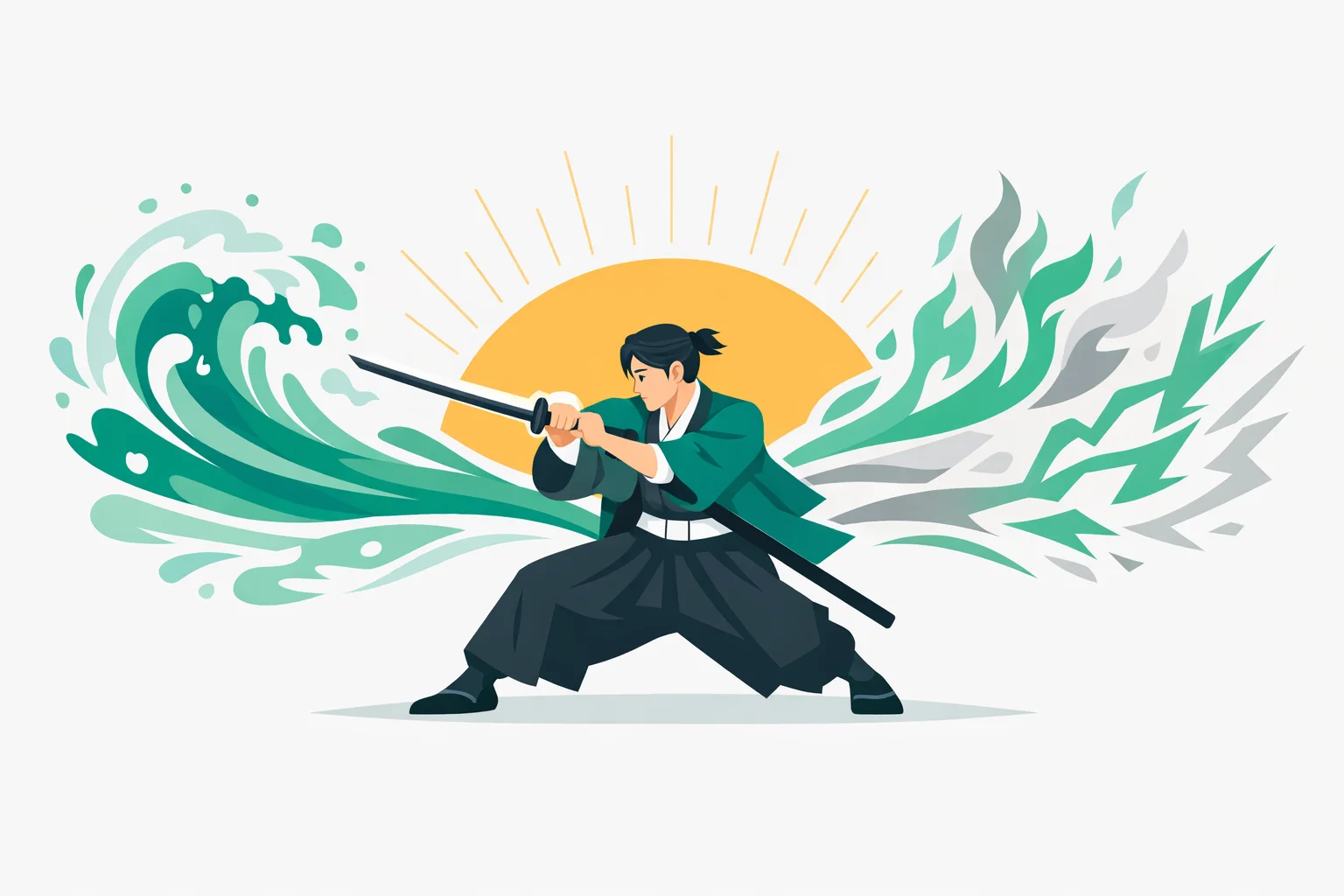
Sun Breathing Came First — Everything Else Is a Translation
Roughly three hundred years before the series opens, a swordsman named Yoriichi Tsugikuni developed the first breathing style. He didn't derive it from anything. He was simply born with a body that could see the flow of blood through an opponent's muscles — the Transparent World — and Sun Breathing is what that perception looks like translated into thirteen linked forms.
Then came the part that matters. Yoriichi tried to teach it, and everyone failed. Not through laziness — their bodies simply could not do what his did. So each swordsman kept the fragment they could manage and built a discipline around it. That single failure is the load-bearing beam of the whole system: every style in the Demon Slayer Corps exists because somebody couldn't copy Yoriichi properly.
Sun Breathing itself nearly vanished. It survived in one place nobody was looking — the Kamado family kept the movements alive as Hinokami Kagura, a New Year's dance performed at a shrine, because Sumiyoshi Kamado couldn't learn it as swordsmanship either and preserved it as choreography instead. That is why Tanjiro performs the most powerful technique in the series for years without knowing what it is. He learned it from his father, in the snow, as a ritual.
Why Did Only Five Styles Branch Off the Sun?
Water, Flame, Wind, Stone, Thunder. These five are called the main breathing styles, and the tidy assumption is that they represent some fundamental elemental scheme — five classical elements, five aspects of combat, something deliberate. They don't. They're five because five is how many swordsmen happened to be in the room.
Each root isolates one axis of the original: Water takes its adaptability, Flame its unyielding forward pressure, Wind its speed and aggression, Stone its mass and endurance, Thunder its explosive burst. None of them takes all of it. The corps' entire technical foundation is an accident of which fragments the first generation could hold onto — which is a much stranger and better story than five neat elements. If you like sorting systems where the category is a temperament rather than a team, the Avatar element quiz runs on a similar idea, just with a tidier cosmology behind it.
| Root style | Fragment of Sun it isolates | Best-known user | Descendants |
|---|---|---|---|
| Water | Adaptability — changing form without losing power | Giyu Tomioka | Flower, Serpent (and Insect, via Flower) |
| Flame | Unyielding forward pressure | Kyojuro Rengoku | Love |
| Wind | Speed and pure aggression | Sanemi Shinazugawa | Mist, Beast |
| Stone | Mass, weight, endurance | Gyomei Himejima | None |
| Thunder | Explosive single-instant burst | Zenitsu Agatsuma | Sound |
The Second Generation Nobody Bothers to Diagram
Most breathing style charts stop at the five roots and list the rest as miscellaneous. That flattening loses the best material in the whole system, because the derivative styles all exist for the same reason the roots do — somebody couldn't do the thing they were taught, and built a workaround that outlived them.
Insect Breathing is the clearest case, and the only third-generation style on the tree. Shinobu Kocho was physically unable to decapitate a demon, full stop. Rather than spend a decade failing at strength, she took Flower Breathing — itself a Water derivative — and rebuilt it around wisteria poison and exact thrust placement. Every one of its four forms is a stab. She changed what winning required, then won.
Beast Breathing is the outlier that proves the pattern. Inosuke Hashibira invented it alone on a mountain with no master, no scroll, and no idea the Demon Slayer Corps existed — and it still classifies as a Wind derivative. He got to the same place by a completely different road, counts his forms as fangs instead of forms, and leads with touch rather than sight. Convergent evolution, in a series about breathing.
And Stone has no descendants at all. Look at what the other four gave up to make room for a child style and the reason is obvious: each of them had a component someone could isolate and specialise. Stone is mass plus endurance plus faith, and there's nothing there to subtract without the style ceasing to be Stone. It's the only indivisible branch on the tree.
Here's the Part That Isn't Fiction
The series is set in the Taishō era, 1912 to 1926 — a fourteen-year window when Japan had electric trains and gas lamps in Tokyo while mountain villages a day's walk away were still lit by lantern. That contrast is doing real work in the story, and it's also why the swordsmanship reads the way it does. Traditional Japanese koryū schools organise technique into named, numbered kata, taught in fixed sequence. First Form, Second Form, Third Form isn't an anime invention. It's how the real thing has been catalogued for centuries.
Total Concentration Breathing is more grounded than it first appears too, at least in principle. Controlled hyperventilation genuinely alters blood chemistry, and a 2014 study published in PNAS found that participants trained in a breathing-and-cold-exposure protocol could voluntarily blunt their own inflammatory response to an injected bacterial toxin — an effect previously assumed to be outside conscious control.
That said: it will not make you stronger, it will not let you cut anything, and deliberately hyperventilating to feel focused mostly makes people lightheaded enough to fall over. Nobody is holding Constant Total Concentration. The honest version is that breath control genuinely affects your nervous system in measurable ways, and the series took a real effect and multiplied it by a thousand.
How the Lineage Scoring Actually Works
Nearly every other quiz on this topic scores all fourteen styles flat against each other, which creates a specific and avoidable problem: Insect and Water end up competing on the same axis, even though one is a great-grandchild of the other. You get whichever style the question writer happened to weight hardest, and the result feels arbitrary because it is.
This one runs in two stages instead, mirroring the tree. Your sixteen answers only ever push points into the five roots — Water, Flame, Wind, Stone and Thunder. Whichever root pulls hardest opens its branch, and nothing else on the tree is reachable. That's stage one, and it's the bar chart you see first in your result.
Stage two takes five separate readings — Precision, Devotion, Ferocity, Flair and Resolve — and asks whether you've actually earned a derivative. Each one is gated on the trait it was genuinely built around: Sound wants Flair at the very top of your profile, Beast wants Ferocity and Flair together, Mist wants Precision high with attachment trailing well behind it. Fail every gate on your branch and you stay on the root, because that is what the root is — the unspecialised version. Shinobu didn't invent Insect Breathing by being well-rounded.
One detail worth stating plainly, because it's the difference between a quiz that works and one that only looks like it does: each reading is scored against its own baseline before anything is compared. Some traits simply come up more often across sixteen questions than others, and a naive scoring model hands the win to whichever trait it happened to offer most. Measuring each one against how often it was even available means a Flair result has to beat your own average, not just out-count a trait that had twice as many chances to score.
Question 14 — the one about where an unavoidable loss lives in you — is doing the heaviest lifting on the whole page. Grief in the open routes you toward Love. Grief behind a composed face, with something being done about it the entire time, routes you toward Insect. Same event, same branch of the tree, two completely different disciplines built out of it.
The Two Results You Can't Train Toward
Sun and Moon sit outside the branch logic entirely, and both are deliberately hard to reach — around 3% of finishers each, for reasons that are exact opposites.
Sun is not awarded for scoring high. It's awarded for scoring evenly, with all five roots landing inside a narrow band. That mirrors the canon precisely: Sun Breathing was never something a slayer earned through training, it was something Yoriichi was born with and nobody else could replicate. If the quiz hands it to you, it's because you refused to specialise anywhere — which is genuinely rare and comes with its own problem, since people notice specialists first.
Moon is the mirror image: one root running away with the whole board, Ferocity near the ceiling, Devotion near the floor. Kokushibo was Yoriichi's twin. He watched his younger brother do effortlessly what he could not do at all, became a demon chasing it, and spent four centuries building a style with sixteen forms — more than any other on the tree. The volume is the tell. It's compensation, not superiority. Read Moon not as the evil result but as the one for talent that has run out of things to protect. If you enjoy the way a fictional system reads temperament back at you, the lightsaber color quiz is built on the same premise — the object chooses the wielder, and what it chooses says something. For a system that branches the same way this one does, the MHA quirk quiz settles your classification before it names your quirk, exactly as a root breath comes before a style — and like the Breathing Styles, every result carries the cost of using it. The sharpest contrast to this whole page is the Jujutsu Kaisen cursed technique quiz, where nothing is inherited at all: your technique is fixed before birth and the only thing you control is what you agree to give up for it.
All 14 Breathing Styles, Root by Root
☀️ Sun Breathing — the original, thirteen forms, and the only style that isn't missing anything. Yoriichi's complete perception turned into swordsmanship. Its weakness is that it can't be taught to anyone whose body doesn't already work that way, which is nearly everyone.
🌊 Water Breathing — the most widely taught root, eleven forms, built on adaptability rather than a specific physique. It has no bad matchup and no obvious flourish, which is exactly why Giyu spent years being told he didn't belong. Fluid people get misread as uncommitted.
🌸 Flower Breathing — Water made gentler and more watchful, six forms, carried by Kanae Kocho and then Kanao Tsuyuri. It suits people who notice the shift in someone's face before anyone else does. Its final form costs the user their eyesight, which is a fairly direct comment on what constant watching takes.
🦋 Insect Breathing — the only third-generation style, four forms, all thrusts, all poison. Shinobu built it around a physical limitation and kept smiling through years of grief she fully intended to act on. Precision plus a ferocity you keep behind something pleasant.
🐍 Serpent Breathing — Water made to coil rather than spread, five forms, a wavy blade and angles that shouldn't be available. Obanai Iguro loved someone completely and expressed it in the most roundabout way available to him. Devotion that never quite says itself out loud.
🔥 Flame Breathing — nine forms, kept inside one family for generations, and Rengoku says plainly that he isn't the most gifted swordsman around. That's the point of it. What gets inherited here is posture, not talent, and people steady themselves on it without being asked.
💗 Love Breathing — six forms and a whip-thin blade nobody else can hold. Mitsuri couldn't make Flame fit her body, so she designed around extraordinary muscle density instead. It isn't the soft option; it's what happens when someone stops apologising for being built differently.
🌪️ Wind Breathing — nine forms, every one of them an attack, with no defensive posture in the set. Sanemi is aimed at people rather than careless with them; the abrasiveness is engineered to keep others at a distance he considers safe. Reads as contempt to anyone who hasn't worked that out.
🌫️ Mist Breathing — Wind with the aggression rerouted into disorientation, seven forms. Muichiro made Hashira in two months while remembering almost nothing about himself, and the series never frames that as a triumph. Detachment is efficient right up until you can't find the way back.
🐗 Beast Breathing — eleven fangs rather than forms, self-invented on a mountain by someone who didn't know the corps existed. It leads with touch instead of sight and works because Inosuke never learned there was a correct way to do any of it. He also relearns every expensive lesson personally.
🪨 Stone Breathing — five forms, the only root with no descendant, and the strongest slayer in the corps carries it while crying in most panels he appears in. Gyomei is blind, devout and immovable. The combination is the thesis, not an irony.
⚡ Thunder Breathing — six forms, the fastest style in the series, and its most famous user only ever learned the first one. His master told him one technique honed past perfection beats six done adequately, and Zenitsu proved it repeatedly, usually while unconscious. Depth without breadth.
💥 Sound Breathing — five forms and an enormous amount of noise, all of which conceals the fact that Tengen's actual technique is arithmetic. He reads an opponent's rhythm as musical notation and calculates the gap. The spectacle is cover for the strategy, not the strategy.
🌙 Moon Breathing — sixteen forms, more than anything else on the tree, built by the only demon to grow a branch on it. Kokushibo kept adding forms for four centuries and never once got the thing he actually wanted, which was to be his brother.
The Style You Got Is a Starting Posture
The most useful thing in your result isn't the style at the top. It's the second bar on the stage-one chart. Your strongest root tells you what you already reach for under pressure; your runner-up tells you what you have access to and don't use. When those two sit within about five points of each other, you're standing on a genuine border, and the honest reading is that you haven't picked yet rather than that the quiz couldn't decide.
Tanjiro is worth copying here. He trains Water for years, hits a ceiling against an opponent it simply cannot handle, and rather than grinding harder at the style he identifies with, he picks up the one he already knew from a dance. By the end he alternates between two — not because Water failed, but because he stopped treating it as a personality. A style is a posture you take up, and postures are supposed to change when the ground does.
If the inherited-lineage part is what pulled you in — the idea that where you come from decides what you can do before you get any say in it — the Percy Jackson cabin quiz sorts on exactly that axis, with the claiming done by parentage rather than training. Different mythology, same argument about how much of you was decided in advance.