Game of Thrones House Quiz: The Great Houses of Westeros Explained
Every Game of Thrones house quiz — including this one — is secretly a quiz about a real war. In 1455, two branches of England's royal family started killing each other over the crown: House Lancaster and House York. Thirty years of betrayals, boy kings, and battlefield executions later, an exile named Henry Tudor sailed home and ended it. George R.R. Martin has never hidden the debt. Say "Lannister" and "Stark" out loud, then say "Lancaster" and "York." You can hear the fifteenth century underneath.
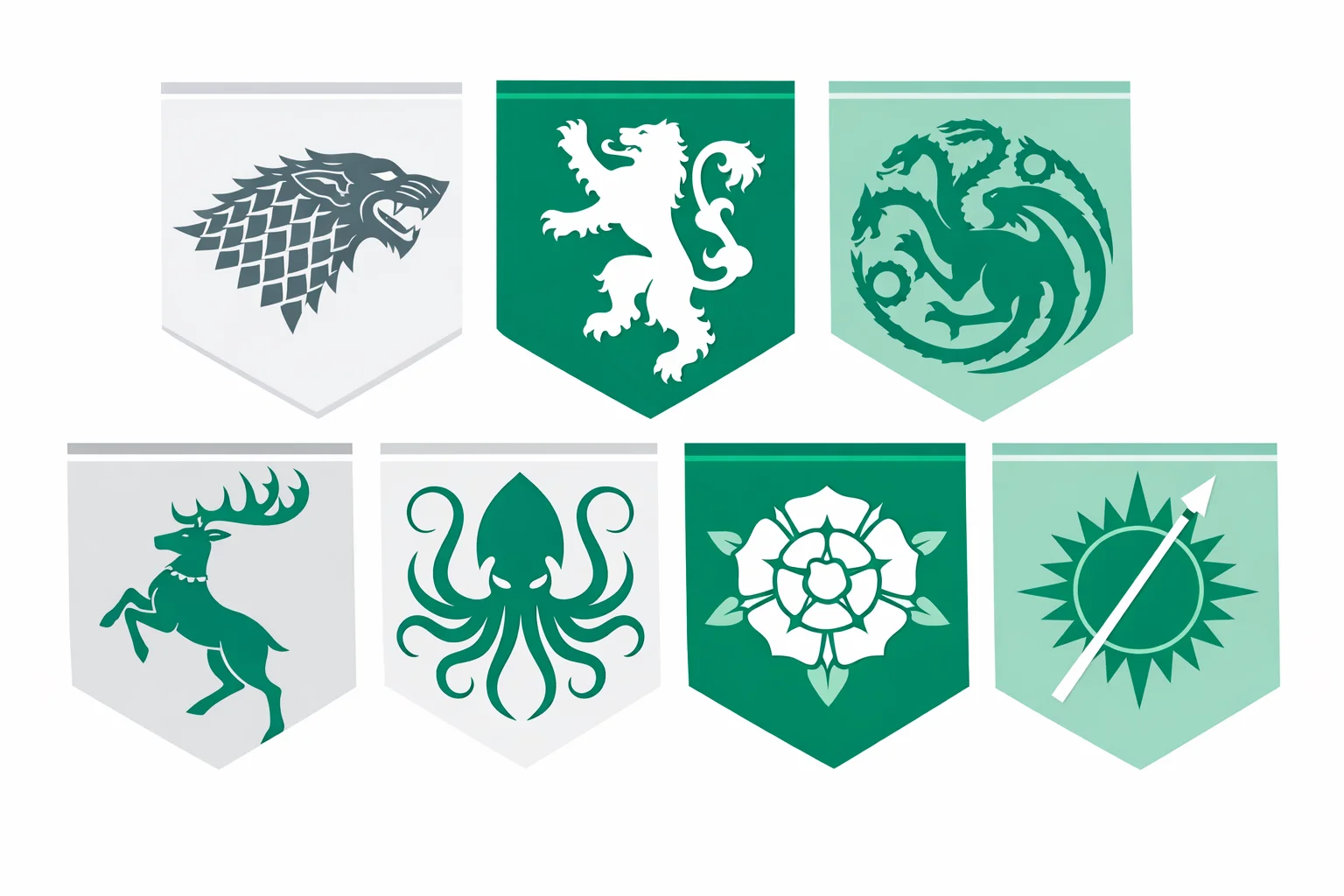
The Real War Behind Every Great House
The Wars of the Roses gave Martin more than two house names. In 1460, Richard, Duke of York — the honorable northern-leaning lord with a strong claim and stronger principles — was killed in battle, and his severed head was displayed on a city gate wearing a paper crown. If that image feels familiar, it's because you watched a version of it happen to Ned Stark at the Sept of Baelor. The Red Wedding borrows from Scottish history instead: the Black Dinner of 1440, where a sixteen-year-old earl was invited to dine with the king and executed after the meal, and the Glencoe Massacre of 1692, where soldiers slaughtered the hosts who had sheltered them for nearly two weeks. Guest right wasn't Martin's invention. Neither was breaking it.
Even Daenerys has a historical skeleton. Henry Tudor spent fourteen years in exile across the water, holding a thin claim, foreign backing, and an unreasonable amount of patience — then landed with an army and took the throne from a dynasty that had run out of heirs. Swap the Channel for the Narrow Sea and the ships for dragons, and the outline is the same. The point for your quiz result: these houses aren't random personality buckets. Each one is built from a real faction's survival strategy, which is exactly why they sort people so well.
From Hadrian's Wall to House of the Dragon: How the Houses Grew
The whole saga started with a wall. In 1981, Martin stood on Hadrian's Wall at sunset and later described imagining what a Roman legionary felt staring north into the unknown — the seed that became the Wall and the Night's Watch. A decade passed. In the summer of 1991, while drafting a completely different novel, he wrote a scene about a family finding direwolf pups in the snow. That family was the Starks, and the scene still opens A Game of Thrones, published in 1996.
Then the houses started evolving in public. The HBO series arrived in 2011 and turned house allegiance into a global identity marker — by the Red Wedding in 2013, declaring "I'm a Stark" was shorthand for a worldview. The 2019 finale scattered that loyalty. House of the Dragon complicated it further in 2022 by splitting a single house against itself: suddenly the question wasn't which house you'd join but which Targaryen you'd follow, Black or Green. And with A Knight of the Seven Kingdoms arriving in early 2026 and House of the Dragon still mid-Dance, house sorting is having its biggest moment since the original run. Fifteen years of screen time have changed which banners people reach for — but not what the banners mean. That's what this quiz measures.
House Words Are Personality Tests in Disguise
Here's a detail most fans miss: House Stark has the only words in Westeros that are a warning to their own family. Every other Great House uses its motto to threaten outsiders or advertise strength. "Winter Is Coming" says prepare, endure, protect — inward-facing duty rather than outward-facing pride. Martin designed each house's words as a compressed value system, which is why the final question of this quiz simply shows you all seven and asks for the truest. Most people hover between two. Which two is the most diagnostic single answer in the entire quiz.
| House | Official words | What choosing them signals |
|---|---|---|
| 🐺 Stark | Winter Is Coming | Duty first — you prepare for storms others deny |
| 🦁 Lannister | Hear Me Roar! | Reputation as armor — being underestimated is unacceptable |
| 🐉 Targaryen | Fire and Blood | Destiny-driven — you'd rather burn than be ordinary |
| 🦌 Baratheon | Ours Is the Fury | Direct force — conflict is faced, never managed |
| 🦑 Greyjoy | We Do Not Sow | Radical self-reliance — you take, you don't wait |
| 🌹 Tyrell | Growing Strong | Soft power — patient, pleasant, and always climbing |
| ☀️ Martell | Unbowed, Unbent, Unbroken | Endurance as identity — you outlast everyone |
And the famous exception proves the rule: "A Lannister always pays his debts" is not House Lannister's motto. The official words are "Hear Me Roar!" The unofficial saying became so feared it replaced the real one in the public imagination — which is the most Lannister outcome possible. Their reputation does more work than their heraldry.
The Two Axes That Decide Your House
Under the hood, every answer in this Game of Thrones house test feeds a weighted score along two hidden axes: honor versus pragmatism, and tradition versus ambition. Stark sits at honor-tradition, Lannister at pragmatism-ambition, Baratheon at honor-ambition (fury in service of winning openly), Tyrell at pragmatism-tradition (soft power through the existing order). Targaryen breaks the grid on conviction, and Greyjoy and Martell pull on a third dimension — independence and patience — that the other five barely touch. No single answer decides anything; fifteen small weights accumulate, and the allegiance grid at the end shows you the full spread rather than hiding everything behind one banner.
The forced choices matter more than they look. Take the oath question: almost everyone who self-identifies as a Stark picks "stopping something monstrous" as a fair reason to break a vow — and that's Jaime Lannister's answer, the exact reasoning behind the most infamous oath-breaking in Westeros. Sorting quizzes that let you see the "right" answer measure your self-image. Ours measures the trade-offs you actually make, the same approach we use in the Hunger Games district quiz, where your district is assigned by temperament rather than chosen.
Two axes is the floor, not the ceiling. Martin's houses are political units, so honor and ambition cover most of them; peoples built on culture rather than politics need more room. The Lord of the Rings race quiz needs five axes for exactly that reason — drop the one measuring memory and grief and its Elves and Dwarves become the same result, because both of them build beautifully and neither of them forgets anything.
Why Does Everyone Think They're a Stark?
Count the narrators. A Game of Thrones has eight point-of-view characters after the prologue — and six of them are Starks, counting Jon. You didn't just watch Westeros; you were trained to think like a Stark for thousands of pages before any other house got a fair hearing. Protagonist bias is why self-sorting runs overwhelmingly toward Winterfell, and it's the same effect that sends most people toward Dauntless in our Divergent faction quiz — the story's camera position becomes the reader's default personality. Warriors readers have exactly the same argument about ThunderClan, and for exactly the same reason: our Warrior Cats Clan quiz places about 29% of takers there, because you spend six arcs watching the other four Clans arrive at a border already angry. The most extreme case in fantasy right now is Prythian, where the Night Court eats nearly every sorter online — so our ACOTAR court quiz is deliberately calibrated flat, landing all seven courts between 13% and 14%, and Rhysand's court gets no head start at all.
The weighted scoring corrects for it. Stark still comes out as the most common banner here, around 24% of takers, because honor-and-duty answers genuinely are popular. But Greyjoy lands at roughly 8%, Martell near 10% — results you almost can't reach by accident, because they require choosing independence or patience over warmth and glory again and again, in scenarios that never mention the Iron Islands or Dorne at all. If you landed one of the rare banners, the quiz didn't glitch. You just answered like someone the ravens weren't watching.
All 7 Great House Results Explained
🐺 House Stark — the duty-keepers. Starks lead by absorbing responsibility: they eat last, apologize first, and honor promises that have stopped being convenient. Steady, loyal, and allergic to theatrics, their weakness is assuming everyone else plays as straight as they do. Winterfell trusts slowly and forever.
🦁 House Lannister — the strategists. Lannisters treat every interaction as a ledger: favors, debts, and slights all get repaid with interest. Sharp, articulate, and relentlessly practical, they win rooms other people don't realize are contests. Their edge dulls when cleverness slides into contempt for slower minds.
🐉 House Targaryen — the visionaries. Targaryens run on conviction and scale: the current system is a rough draft and they're holding the pen. Magnetic and tireless, they attract believers rather than employees. The risk is the famous coin flip — unchecked certainty curdling into obsession.
🦌 House Baratheon — the storm front. Baratheons say the unsayable at full volume and meet every problem head-on. Their honesty is a form of strength — nobody wonders where they stand — but fury without a follow-up plan wins wars and loses peaces, as Robert demonstrated from the throne he hated.
🦑 House Greyjoy — the self-made. The ironborn answer to no one: they pay the iron price, chart their own course, and find crowds more exhausting than storms. The rarest result on this quiz. Their independence becomes a weakness only when it hardens into isolation no ally can crack.
🌹 House Tyrell — the gardeners. Tyrells grow power the way Highgarden grows roses: patiently, pleasantly, and with thorns nobody notices until they're bleeding. Perceptive and universally liked, they run politics without holding a sword. Their danger is wearing the mask so long it replaces the face.
☀️ House Martell — the unbroken. Dorne never bent to the dragons, and Martells never bend to pressure: they feel everything fiercely and still play the longest game in the room. Patient, passionate, and impossible to rush, they stumble only when waiting for the perfect moment becomes never acting at all.
Your House Is a Starting Point, Not a Sentence
Take the result as a mirror, not a verdict. If your banner surprised you, look at your allegiance breakdown before retaking anything — a 45/40 split between two houses says more about you than a clean match ever could, and rereading both descriptions usually locates you precisely in the overlap. Then rewatch one episode through your house's eyes. Lannisters notice who controls each conversation; Starks notice who keeps their word; Martells notice who's waiting. The show changes shape depending on which banner you carry into it. And if you want to test whether your sorting instinct holds across universes, see whether your Westeros house agrees with your Hogwarts house — the frameworks measure different things, and the disagreements are where the interesting self-knowledge hides.