Genshin Element Quiz: What a Vision Actually Measures (and Why It Isn't Personality)
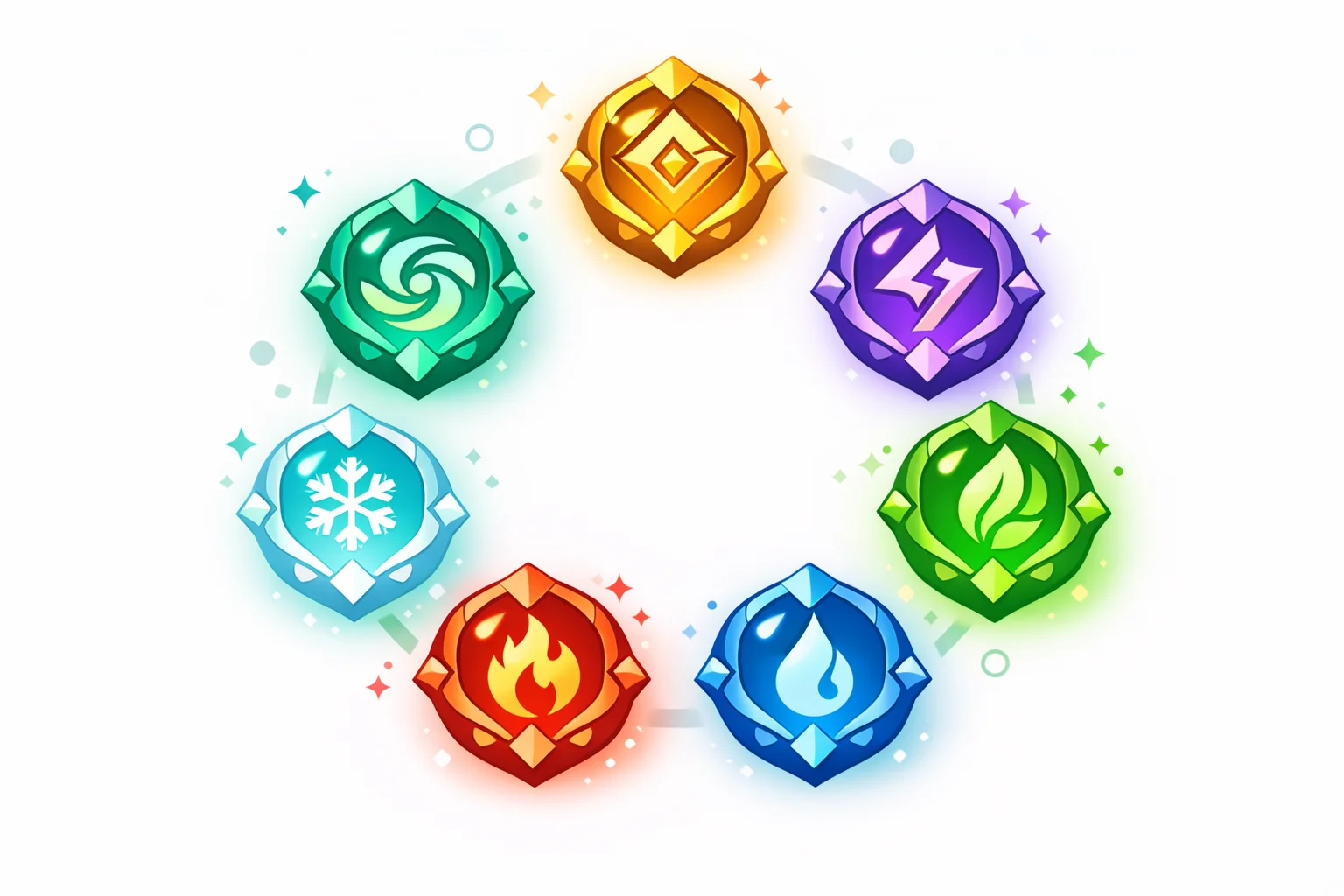
Almost every Genshin element quiz on the internet asks a version of the same question: are you hot-headed, or are you cool under pressure? That is the wrong question. In Teyvat a Vision is not a temperature reading — it is a receipt. An Archon hands one out when they notice a mortal who wants something badly enough to wreck their own life over it, and the element you get back says what you would wreck it for. Not how loud you are. What you would lose everything to reach.
The Fandom Has Been Arguing About This Since 2020
Ask in any Genshin community what a Vision actually means and you will get two answers that cannot both be right.
The first camp says elements are temperament, and it is an easy case to make. Diluc broods, burns and works alone — Pyro. Ganyu is quiet, dutiful and emotionally reserved — Cryo. Zhongli is unhurried and immovable — Geo. HoYoverse leans into this in the character art, the idle animations, even the voice direction. If you have ever guessed a new character's element from a silhouette and got it right, you used camp one's logic and it worked.
The second camp says that reading collapses the moment you list who actually shares an element. Klee is a child who blows up fish for fun. Arlecchino runs an orphanage as a Fatui Harbinger and speaks in a near-whisper. Hu Tao pulls pranks at funerals. Diluc has not visibly relaxed since launch. All four hold Pyro, and there is no temperament connecting them. Venti is a drunk bard who dodges responsibility; Xiao is a grim adeptus who refuses to rest. Both Anemo.
What those groups do share is a want. Every Pyro character is chasing something they would burn for. Every Anemo character is structurally about refusing to be held. That is not personality — that is ambition, and the game says so out loud.
Seven Archons, Seven Ideals, One Table
Teyvat's seven nations are not just biomes with different weather. Each is governed by an Archon who rules by a single ideal, and the element attached to that Archon is the shape the ideal takes when a mortal picks it up.
| Element | Archon | Nation | Ideal | The ambition it rewards | Quiz-takers |
|---|---|---|---|---|---|
| 🌪️ Anemo | Barbatos | Mondstadt | Freedom | To stay unowned | 17% |
| 🪨 Geo | Morax / Rex Lapis | Liyue | Contracts | To be relied upon | 14% |
| ⚡ Electro | Beelzebul / Raiden Shogun | Inazuma | Eternity | To make one thing permanent | 11% |
| 🌿 Dendro | Buer / Nahida | Sumeru | Wisdom | To understand, whatever it costs | 13% |
| 💧 Hydro | Focalors | Fontaine | Justice | To correct an imbalance | 15% |
| 🔥 Pyro | Murata | Natlan | War | To go and take it | 16% |
| ❄️ Cryo | the Tsaritsa | Snezhnaya | Love | To keep someone else safe | 14% |
Read that Ideal column again. Freedom, Contracts, Eternity, Wisdom, Justice, War, Love. Six of those are things you would organise a life around. Only Cryo's is an emotion — and that turns out to be the most complicated one of the seven.
Electro is the least common result on this quiz at 11%, and that fits. Eternity means wanting things to stay exactly as they are, which very few people will volunteer out loud even when they defend it fiercely in practice.
Why Does the Vision Hunt Decree Settle It?
Inazuma's entire arc is the argument's answer, and most people read it as a story about tyranny without noticing it is also a story about what a Vision physically is.
The Raiden Shogun declared the Vision Hunt Decree, had Visions confiscated from every holder in the nation, and fixed them to the hand of a statue. Look at the mechanism rather than the cruelty. Ei wanted Eternity — an Inazuma where nothing changes, ever. To get it she had to remove the one thing that reliably produces change.
She did not confiscate personalities. You cannot. She confiscated Visions, because in Teyvat a Vision is the physical proof that a mortal wants something enough to act on it, and mortals acting on what they want is how nations change.
The detail that settles it: the people who lost their Visions did not become different people. They stayed exactly who they were and simply could not chase what they wanted anymore. Temperament survived the decree. Ambition was the thing that got taken. If elements were personality readings, the whole policy would have accomplished nothing at all.
That is the lore this quiz is built on. If you have taken our Avatar element quiz, the difference is immediate — bending is inherited by birth nation, so that quiz sorts what you are. A Vision is awarded, never inherited, so this one sorts what you are after.
There is a third way to sort a game's cast, and it is the one Teyvat deliberately does not use: sorting on routine rather than on ambition. Pelican Town runs entirely on that principle — every villager in Stardew Valley is defined by a schedule file that says where they stand hour by hour, not by an element or a stated desire. Our Stardew Valley character quiz sorts you the same way, which is why it can land somewhere your Vision result never would.
How This Quiz Scores Ambition Instead of Vibes
Sixteen questions. Fifteen of them score an element, and not one maps a single click to a single result.
Every scored option carries three points to a primary element and one point to a different secondary, so choosing "I have never once felt enough" pushes you toward Pyro while quietly crediting Electro. That is deliberate. Real ambitions are not pure, and a quiz where one answer decides your result is not measuring anything.
Question 11 is the anchor. It drops the fiction entirely, names the seven ideals outright, and asks which one you would actually give something up for. It is worth four points instead of three, and it also breaks ties — because if two elements finish level, the honest tiebreaker is the one you named yourself.
The build is balanced on purpose. Each element leads exactly ten options, appears as the secondary on exactly ten, and sits in each of the five on-screen positions exactly twice, so the layout cannot quietly funnel you toward a crowd-pleasing result. Running 200,000 randomised answer sets through the scoring puts the seven results between 13.9% and 14.8% — no element is unreachable, and none is a dumping ground for indecisive answers.
Question 16 scores no element at all. It asks how much of what you just described you have already acted on, and that sets your Vision Clarity, because canon is specific: a Vision is granted for ambition that burns, not ambition you can describe. Psychology has been circling the same distinction for decades — self-determination theory separates what people aspire to from how autonomously they pursue it, and the second predicts far more about outcomes than the first.
Here's Where It Gets Interesting — Your Second Element
Your result does not stop at one element. The quiz keeps your runner-up and runs the pair through Genshin's actual reaction chart, which is where the reading gets specific instead of generic.
| Pairing | Reaction | What it says about you |
|---|---|---|
| Pyro + Hydro | Vaporize | You do not just want to win, you want to win rightly |
| Pyro + Cryo | Melt | Heat applied to something you deliberately kept frozen |
| Pyro + Electro | Overloaded | You detonate rather than adapt |
| Pyro + Dendro | Burning | Curiosity that will not stop feeding the fire |
| Hydro + Electro | Electro-Charged | Fairness that spreads and does not stop at one person |
| Hydro + Cryo | Frozen | You stop the moment instead of escalating it |
| Hydro + Dendro | Bloom | You build the alternative instead of only dismantling |
| Electro + Cryo | Superconduct | Devotion that lowers other people's defences |
| Electro + Dendro | Quicken | You learn fast and, unusually, you keep it |
| Anemo + anything reactive | Swirl | You do not hold your drive, you spread it |
| Geo + anything reactive | Crystallize | You convert what you feel into something that shields others |
Four pairings produce nothing at all: Anemo with Geo, Anemo with Dendro, Geo with Dendro, and Cryo with Dendro. That is not a gap in the quiz — those are genuinely the only combinations in the game that refuse to react, a quirk players have been asking about since Sumeru launched in 2022. If you land one, your two strongest drives simply coexist without amplifying each other, which is steadier and rarer than it sounds.
The loudest outcome here is Vaporize. In game it is the largest damage multiplier available, and as a reading it means drive and fairness reinforcing each other, with no natural stopping point built in. The least dramatic-looking one is Crystallize, which produces a shield rather than damage — and is, for most people, the more useful thing to be.
The Tsaritsa's Ideal Is Love. Her Element Is Ice.
This is the knot at the centre of the whole system, and it is worth understanding before you read a Cryo result.
Six ideals are strategies. Love is a feeling. And the Archon who rules by it is the Cryo Archon — the coldest element in the game, governing the most militarised nation in Teyvat, currently gathering the power to make war on the other six gods. The fandom has spent years on this, and the best reading is also the simplest: her love did not stop. It froze, because staying warm was not protecting anyone.
Look at who gets Cryo. Ganyu works herself past exhaustion for a city that mostly forgets she is there. Ayaka carries a clan's obligations and apologises for the inconvenience. Kaeya wraps genuine affection in enough irony that nobody can use it against him. Wriothesley runs a prison decently and would much rather you assumed otherwise. Not one of them is cold. Every one of them is warm underneath something functional.
So if you scored Cryo, the result is not "you are distant." It is that your ambition is somebody else's safety, and you have built a temperature around it so it cannot be taken off you or used as leverage. That reads very differently from the other six, and it is the single most misread outcome on this quiz.
All 7 Genshin Element Results, Explained
🌪️ Anemo — Freedom. Your ambition is negative space: you want the absence of a hand on your shoulder more than any particular destination. That makes you almost impossible to bribe and genuinely hard to keep. The weakness is that you will sometimes leave something good because staying started to feel compulsory, and call that instinct when it was closer to fear.
🪨 Geo — Contracts. You want to be relied upon, and a broken promise registers with you the way a physical injury does. You build things meant to outlast your involvement in them and you read the whole agreement. The trap is specific: you honour terms long after the other party stopped, and people learn that about you fast.
⚡ Electro — Eternity. The rarest result and the least comfortable to admit. Your ambition is preservation — one relationship, one version of yourself, one stretch of life you have decided was the correct one. It makes you unusually loyal. It also means you defend arrangements past their expiry and experience ordinary change as theft.
🌿 Dendro — Wisdom. Comprehension outranks comfort for you. You would rather have the true answer that ruins your week than the pleasant one that lets you sleep, which makes you hard to deceive and unusually comfortable holding contradictions. The cost is that understanding a problem can start to feel like having solved it.
💧 Hydro — Justice. You cannot leave an imbalance alone. Unfairness registers as physical discomfort and you will spend disproportionate energy fixing it, often on behalf of people who never asked. That makes you the person others come to when they have been wronged — and it means you sometimes win the argument and lose the relationship it happened inside.
🔥 Pyro — War. Not aggression: momentum. You would rather make the wrong decision quickly than the right one in six weeks, and you genuinely cannot tolerate a thing being left unfinished. You move first, which is why you are often right before anyone else is, and occasionally spectacularly wrong before anyone else is too.
❄️ Cryo — Love. Your ambition is somebody else's safety, and you have built a working coldness around it so nobody can use it as leverage. You absorb cost silently and rarely mention it. The risk is that the temperature you built for protection eventually keeps out the people it was protecting.
The Traveler Never Got a Vision
Here is the thing that should take the pressure off whatever you scored.
The protagonist of Genshin Impact is not an Allogene. Aether and Lumine have never been granted a Vision by anyone, which means no Archon has ever looked at them and recognised an ambition worth stamping. They resonate with Statues of the Seven, swap elements at will, and are the one character who actually changes Teyvat.
Your element names what you would give something up for right now. It is not a ceiling and it is not a diagnosis. Ambitions move — the Vision you would be awarded at nineteen and the one you would be awarded at thirty-four are frequently different elements, which is exactly why retaking this after something significant happens is worth doing.
One practical use for the result. Take the ideal you landed on — Freedom, Contracts, Eternity, Wisdom, Justice, War or Love — and find the most recent decision where you chose against it. That gap tells you more than the result does, and it is the entire reason the Vision Clarity score exists.
A Vision is also permanent, which is worth holding next to a game that made the opposite call. Elden Ring hands you a class at character creation and then sells you an item that undoes almost all of it, so the Elden Ring class quiz is sorting you on instinct rather than on anything the game will hold you to — the cleanest available contrast with an Archon deciding your ambition is worth stamping.
The sharper contrast is HoYoverse's own next game. Honkai: Star Rail pulled the two halves of a Vision apart and made them separate labels: a Path for what a character believes, and a Combat Type for the element they happen to deal. Nothing is welded, and a Path can change. So if the reading you just got felt like it was measuring two things at once, the Honkai: Star Rail Path quiz scores those two things separately and hands you both.
If sorting systems are your thing, the lightsaber color quiz runs on a similar bond-with-the-wielder mechanic, and the Percy Jackson cabin quiz sorts by inheritance rather than ambition — the exact opposite axis to this one.
There is one more worth comparing, because it inverts the Vision entirely. A Vision is granted for an ambition; the Triforce is not granted at all. In the Legend of Zelda character quiz the relic measures whether you hold Courage, Wisdom and Power in balance and breaks apart when you do not, handing each fragment to whoever matched it best. No Archon, no negotiation, no ambition worth stamping — just a reading of what you already are.