Why Stardew Valley's Villagers Feel So Real
Nearly every Stardew Valley quiz on the internet asks which crop you'd plant, and that is the one thing the villagers of Pelican Town are never defined by. The game defines them by something far less romantic: a text file listing where they stand at four in the afternoon on a rainy Tuesday in fall. That file is the reason Sebastian feels like a person and the reason a hundred other farming games have neighbours who feel like vending machines. So this quiz sorts you the way the game sorts them — on routine, distance, disclosure and roots — rather than on whether you like blueberries.
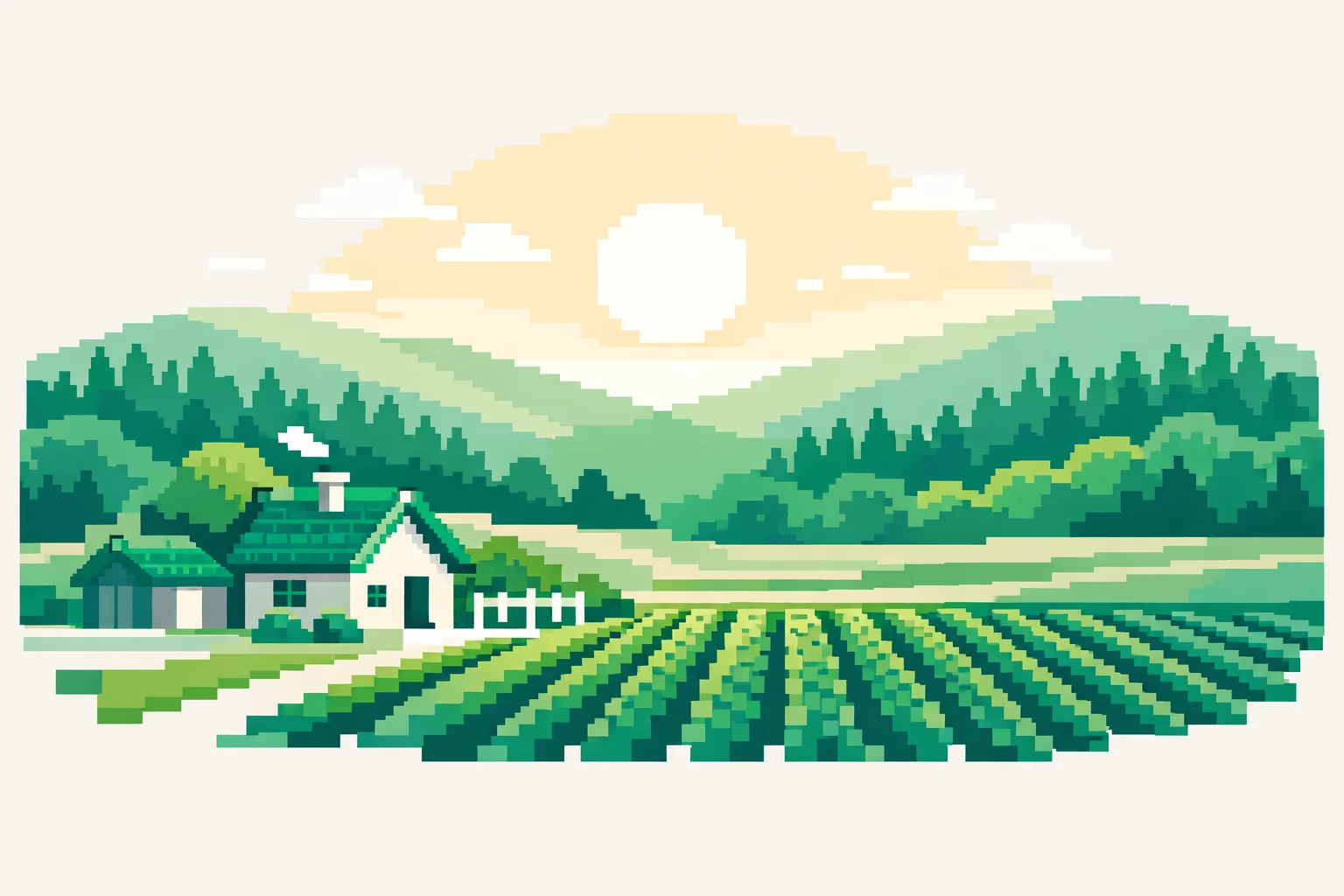
One Man, Four And A Half Years, And Every Line Of Dialogue
Eric Barone started building Stardew Valley in late 2011. He had a computer science degree, no job in the industry, and a plan that was really a portfolio piece: make a game good enough that somebody would hire him as a programmer. He worked as an usher at a Seattle-area cinema to pay rent. He wrote the code, drew the pixel art, composed the soundtrack and wrote every line of dialogue himself, and he redrew the character portraits so many times that the versions people know today bear little resemblance to the 2012 drafts. The game shipped on 26 February 2016, four and a half years later, and has since sold well past 30 million copies — a number that puts it among the best-selling games ever made by a single person. You can check the release history and sales milestones on Wikipedia's Stardew Valley entry. It's the same tiny-team lightning that struck Hollow Knight — three people in Adelaide and a AU$57k Kickstarter — which is why the two games share a fandom and why our Hollow Knight character quiz makes a natural companion piece once you've met your villager.
What matters for this quiz is why he wrote the villagers the way he did. Barone was making a successor to Harvest Moon, the 1996 SNES farming series he loved as a kid and felt had gone downhill. In those games, the marriage candidates were largely decorative — a portrait, a favourite item, three or four lines of rotating dialogue, and a wedding. The single biggest thing Stardew Valley did differently was to give its villagers problems the farmer cannot solve by handing them a gift.
The Villagers Feel Alive Because They Have Somewhere To Be Without You
Here is the mechanism, and it's more mundane than most players assume. Each villager has schedule data that determines their position hour by hour, and the game picks which schedule to run based on a stack of conditions: the season, the day of the week, whether it's raining, whether a festival is on, how many hearts of friendship you have with them, and whether they're married to you. Change any one of those and the villager's entire day changes. Rain empties the beach and fills the Saloon. Winter moves half the town indoors. Reaching a certain friendship level can unlock a route they never walked before.
The consequence is that no player ever sees most of any villager's life. You catch Sebastian on the lake dock at eleven at night only if you happen to be on the mountain at eleven at night. Miss it, and you have simply never seen the thing he does when nobody is looking. That gap — the strong impression that someone's day continued while you were elsewhere — is what a dialogue tree alone cannot manufacture, and it's the single most copied idea in the decade of cozy games that followed. It's also why the quiz above hands you a generated daily schedule instead of a paragraph of adjectives. A person is a set of places at a set of times.
Here's Where It Gets Interesting
Stardew Valley measures friendship in points. Two hundred and fifty of them make one heart, and the scale runs to ten hearts. Talking to someone earns twenty. Gifts earn considerably more, but you can only give a villager two per week, so there's a hard ceiling on how fast a relationship can be bought. And if you go a day without speaking to someone, you lose points. Not many — but the drift is real, and it means every relationship in the valley is a maintenance cost rather than an achievement you unlock and keep.
Now stack that against where the writing lives. The best scenes in the game are heart events, and they fire only when you hit a specific heart threshold and walk into a specific location at a specific time. Shane's six-heart event, the one that made a farming game the subject of a thousand essays about depression, requires you to be in Cindersap Forest at night after reaching six hearts with a man most players write off as the rude drunk at the Saloon. Leah's art show, Penny's quiet ambitions for a home of her own, Haley's photography — all of it sits behind the same double lock.
So the game's finest writing is gated behind a chore. That sounds like a design flaw and it's actually the whole trick: it forces the player to do the thing that real closeness requires, which is turning up repeatedly with nothing in particular to say. If you've ever wondered why Stardew friendships feel earned in a way that most game relationships don't, that's the reason.
The Four Things This Quiz Actually Measures
Once you accept that a villager is a schedule, the useful axes fall out of the data rather than out of a personality framework. Every question you just answered contributed to four scores, and each one corresponds to something the game genuinely models.
| Axis | What it measures | Highest in the valley | Lowest |
|---|---|---|---|
| Routine | How much of the day is decided before it starts | Maru — clinic shifts, workshop, telescope, in order | Sam — the Grange Display gets filled at 2:50 |
| Company | How much of the week happens in front of other people | Sam and Emily — the Saloon is a second home | Sebastian — a basement, on purpose |
| Openness | The distance between the public version and the private one | Emily, who will tell you her dream unprompted | Shane, whose answer is always "fine" |
| Roots | Whether this is where you live or where you currently are | Leah — the only villager who chose the valley | Sebastian — Zuzu City is always one decision away |
Two of those deserve a warning, because they're where most mismatches come from. Company is not the same as Openness: Haley is at a festival every week and tells you almost nothing, while Leah is alone in a forest and will answer any question honestly. And Routine is not the same as Roots. A rigid daily structure inside a place you keep thinking about leaving is Sebastian's exact profile, and it's the combination people most often misread as commitment. If your Routine bar came back high, it's worth comparing against the chronotype quiz — a lot of what reads as discipline is really just a body clock that happens to line up with the world's.
Why There's a Second Score That's Allowed to Disagree
At the start of Year 3, Grandpa's ghost turns up at his shrine and grades you. The evaluation is scored out of 21 points across total earnings, skill levels, friendships, the Community Center and a handful of smaller achievements, and twelve points lights all four candles. It is, notably, a scoring of your record. Grandpa doesn't know who you are. He knows what you shipped, who you befriended and what you rebuilt.
That distinction is worth borrowing, so the quiz scores it separately. Your villager comes from how you'd spend a Tuesday; your candles come only from the answers where you turned outward — brought the best thing to the Luau, filled the Grange Display properly, left something on a doorstep, asked the awkward question. The two readings run on different data and they're meant to be able to contradict each other. A four-candle Sebastian is a real and fairly common outcome: someone quite private who nonetheless shows up for every single thing that matters. A one-candle Emily is rarer and more poignant — enormously warm, and pointed entirely at one or two people rather than at a town.
If the candle score landed lower than you expected, that isn't a verdict on your character. It's a measurement of visible participation, which is a different variable, and one that's much easier to change than temperament.
Do the Villagers Change, or Do You Just Learn to Read Them?
This is the longest-running argument in the fandom, and Haley is always the test case. She opens the game dismissive and vain, and by ten hearts she's funny, self-aware and quietly generous. Half the fandom calls it the best character development in the game. The other half points out, correctly, that nothing about Haley changed — the player simply reached a threshold that unlocked scenes that were always written and always there.
Both camps are describing the same design, and the second reading is the more interesting one. Barone didn't write growth arcs; he wrote people with a public register and a private one, then made the private register expensive to reach. Shane doesn't get better because you befriended him. He was always the man who takes care of Jas. You just weren't someone he'd say that in front of yet. Alex's bravado, Penny's deflection, Sebastian's silence — all of it is a front that the game charges you time to get behind, which is a much more honest model of how people work than a personality that improves because you gave it enough amethysts.
Which is exactly why this quiz measures Openness as a gap rather than as a trait. Nobody scores low on Openness because they have nothing to say.
All 10 Pelican Town Results
Ten villagers, sorted on the same four axes. The percentages come from pushing 200,000 randomised answer sets through the scoring model before publishing, which is how we checked that no single result swallows the quiz — the gap between the most and least common outcome is under two and a half points.
💻 Sebastian (10.5%) — Private, wry, loyal to a very small number of people, and quietly convinced he should be living in the city. Sebastian is the valley's most misread villager: not shy, not cold, just unwilling to perform a friendlier version of himself for an audience. His weakness is that the door to Zuzu City stays open in his head long after he's stopped meaning to walk through it.
⚔️ Abigail (10.2%) — Goes into the dark part first and is genuinely puzzled that this is unusual. Abigail is curiosity that never learned to be frightened: the mines, the blunt question, the refusal to be managed by a well-meaning mother. She'll tell you what she thinks to your face, which people mistake for aggression. The flaw is a low tolerance for anything routine, including the useful kind.
🪵 Leah (10.7%) — The most common result, and the only villager who arrived in the valley by choice. She left a city and a partner who treated her sculpture as a hobby, and rebuilt something smaller on purpose. Rooted, honest, unhurried, and much more decisive than her calm suggests. Her risk is retreating so completely that the work never meets an audience.
📷 Haley (10.3%) — Presents beautifully and reveals selectively. High Company, low Openness: at every festival, telling you nothing. Behind it is a real photographer's eye, a sharp sense of humour and more loyalty than the people who wrote her off after one conversation. The cost of being judged only on the finished version is that nobody ever sees the draft.
🖋️ Elliott (10.5%) — Trades comfort for uninterrupted hours, which is why he lives in a one-room cabin on a beach. Elliott is carrying one large unfinished thing and organises his life around protecting it. He notices detail nobody asked him to notice and wants specific feedback rather than praise. The failure mode is a project that stays perpetually two months from done.
🐔 Shane (9.9%) — The most serious writing in the game. A job he hates, a room in someone else's house, a drinking problem he doesn't discuss, and a quiet, complete devotion to a child who isn't his. Shane endures rather than explains. If this is your result, it's worth noticing that his arc isn't a rescue — it's him deciding that chickens are a reason to get up.
🎸 Sam (9.4%) — The highest Company and Openness scores in the valley, and there's a job hidden underneath the volume. His father is away at war for the entire first year and his little brother needs somebody light in the house. Sam improvises everything and carries the room. Nobody thinks to ask how he is, and he doesn't bring it up.
📖 Penny (10.2%) — Notices what everyone else in the room missed, then doesn't mention it in case it's presumptuous. She teaches two children in an empty library out of a trailer she'd like to leave. High attentiveness with low self-advocacy makes her the most useful person present and the least likely to say so. Her arc is about wanting a life she doesn't feel entitled to ask for.
🔭 Maru (10.1%) — Clinic shifts, a workshop full of half-built machines and an observatory telescope, all running in parallel without drama. If something is annoying twice, Maru builds the thing that removes it. Genuinely curious rather than merely tidy. The one problem she can't engineer around is people, who insist on not behaving like systems.
🧵 Emily (8.3%) — The rarest result, because the combination is genuinely uncommon: wide open, socially generous, deeply rooted, and entirely unbothered about being taken seriously. She sews, keeps crystals and will describe last night's dream without checking whether you're into that. People read contentment as simplicity. Staying that open and that steady is more work than being guarded.
What To Do With a Result You Didn't Want
Roughly a third of people who retake this quiz get a different villager, and the reason is almost always the same: the first run was answered as the person they're trying to become. That's why the questions are about a rainy Wednesday and a conversation in a shop rather than about values. Aspiration shows up in the big questions and it never shows up in what you actually did on Tuesday.
If you got a villager you didn't like, read the runner-up in your valley roster before you retake — when two results sit within a heart of each other, the second one is usually the version other people would have picked for you. And if the disagreement is between your character and your candles, that's the genuinely useful signal. Grandpa is measuring what you did where the town could see it, and that number moves in a season. Temperament takes considerably longer. If the low-Roots score is the part that stung, the where should I live quiz is the more practical follow-up; if you enjoyed being sorted on mechanics the source material actually uses, the Genshin element quiz runs on the same principle.
One last thing worth sitting with. In Stardew Valley, friendship decays if you stop turning up. Not dramatically, and not permanently — but the game is quietly insisting that the people you care about need maintenance, not intention. It's a farming sim, and it snuck that in between the parsnips.