Math Quiz: Mental Math Tricks, Common Mistakes, and How to Improve Your Speed
Every math quiz you have ever sat — this one included — rests on a technology that Europe spent three centuries refusing to adopt. In 1202 a Pisan merchant's son published a book explaining how to add, subtract, multiply and divide using ten symbols and a place-value column. Written arithmetic. On paper. No counting board, no beads, no pebbles. The reaction was not warm.
Europe Spent 300 Years Refusing to Do Math on Paper
The book was Liber Abaci, and its author, Leonardo of Pisa, is better known today by a nickname he never used: Fibonacci. He had grown up around North African trading posts, watched merchants there calculate with Hindu-Arabic numerals, and came home convinced Europe was doing commerce with one hand tied behind its back. Roman numerals are fine for recording a result. They are useless for producing one — try multiplying XLVII by XIX without converting first.
Florence banned the numerals in 1299. The money-changers' guild, the Arte del Cambio, ruled that account books had to be kept in Roman figures, and the stated reason was forgery: a 0 could be closed into a 6 or a 9, and a stroke added to a 1 made it a 7. Roman numerals resist tampering because they are bulky and redundant. So for roughly two hundred more years, professional European reckoning happened on counting boards, and the people who did it — abacists — regarded the pen-and-paper crowd, the algorists, as slightly disreputable. There is a 1503 woodcut in Gregor Reisch's Margarita Philosophica showing the two camps side by side, with Arithmetic herself standing between them looking pointedly at the man with the pen.
Printing settled it. The Treviso Arithmetic of 1478, the first printed mathematics book in Europe, was a practical manual for merchant apprentices, and once the algorithms could be mass-produced identically the counting board lost. That is the part worth carrying into the quiz: the column method you were drilled on is not mathematics. It is one interface for mathematics, standardised by people who needed auditable ledgers. Most of the speed tricks further down this page are not clever shortcuts around that method — they are survivors of the systems it beat.
Where the Mental Math Tricks Actually Came From
Mental arithmetic has a lineage, and almost none of it starts in a classroom. Each method below was built for one narrow job by someone who needed it badly, which is exactly why each one falls apart outside that job.
| Method | Where and when | Fast at | Useless for |
|---|---|---|---|
| Counting board / abacus | Mesopotamia, then Rome, then medieval Europe | Long columns of addition and subtraction | Fractions, and leaving any record of the working |
| Lattice ("gelosia") multiplication | Arabic sources; printed in the Treviso Arithmetic, 1478 | Large multiplications with no carrying at all | Anything mental — it needs a drawn grid |
| Soroban and anzan | Japan; standardised in the 1930s | Adding long lists on a mentally visualised board | Algebra, or anything symbolic |
| The Trachtenberg system | Devised in a Nazi camp; published in English in 1960 | Multiplication by fixed digit rules, no tables needed | Division and unfamiliar problem shapes |
| "Vedic" mathematics | Published by Bharati Krishna Tirtha, 1965 | Squaring, and multiplying numbers near a round base | Its own historical claims, which scholars dispute |
| Gauss pairing | A German classroom, 1780s | Summing an unbroken run of numbers | Literally everything else |
The Gauss story is the one that shows up on the Challenge level. Asked to add the numbers from 1 to 100 as busywork, the seven-year-old noticed that 1 and 100 make 101, so do 2 and 99, and so on for fifty pairs — 5,050, produced faster than his teacher could object. The quiz asks for 1 through 20 instead: ten pairs of 21, giving 210. If you reached for a half-remembered formula and landed on 190 or 200, the pairing picture is the thing to keep, not the formula.
Why the Quiz Splits Into Three Levels
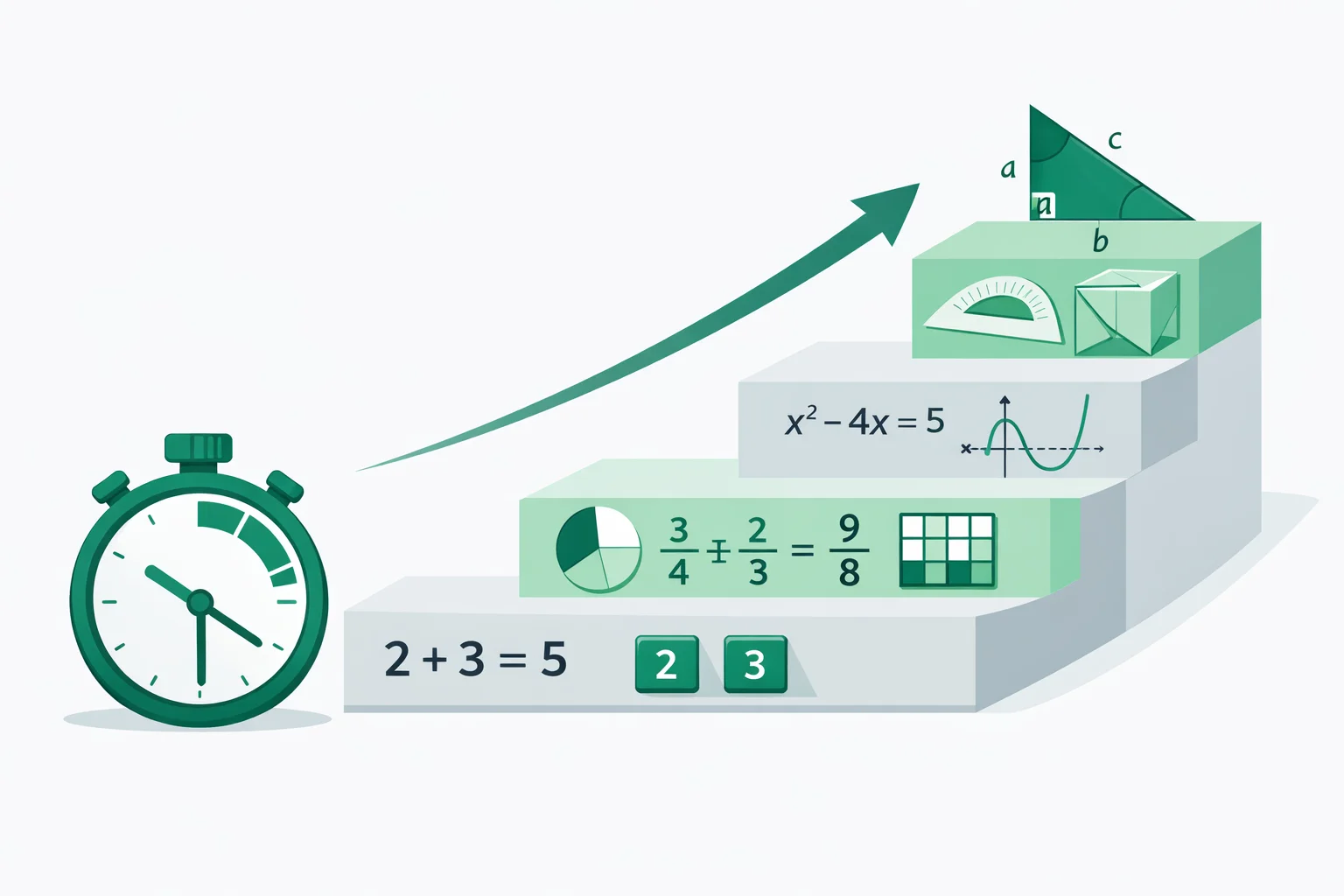
A single twenty-question ladder running from times tables to logarithms sounds comprehensive and measures almost nothing. Strong solvers max out the bottom eight and weaker ones never reach the top eight, so the entire signal ends up carried by the four or five questions in the middle. Splitting into three self-contained sets fixes that: each level is internally balanced across the same five strands, four questions each, so any level you pick returns a complete strand chart rather than a partial one.
| Level | Covers | Typical landing zone | Strand that hurts most |
|---|---|---|---|
| 🌱 Warm-Up | Times tables, place value, simple fractions, area and perimeter | 15–18 of 20 | Fractions & percents |
| 🎯 Standard | Stacked percentages, linear equations, Pythagoras, rates, probability | 13–15 of 20 | Geometry formulas |
| 🔥 Challenge | Logs, quadratics, exact trig, compound percentages, reasoning traps | 9–13 of 20 | Word problems & reasoning |
Four questions per strand is a deliberate floor and ceiling. Three cannot separate a real gap from one unlucky guess; five would push the quiz past the length where people abandon it halfway. Four is the smallest number that lets a 1/4 on geometry mean something. If you want the same diagnostic logic applied to non-mathematical recall, the general knowledge quiz splits its thirty questions across six domains on exactly the same reasoning.
Your Wrong Answers Are Worth More Than Your Score
Here is the part that makes this quiz different from the hundred other math quizzes online: none of the wrong options are padding. Every single one is the number you arrive at by making one specific, documented mistake. Pick 26 on 7 + 6 × 2 and you added before multiplying. Pick $56 on the stacked-discount question and you collapsed 20% and 10% into a flat 30%. The distractors are diagnostic instruments.
That design comes straight out of a piece of 1970s research. John Seely Brown and Richard Burton analysed the subtraction work of several thousand schoolchildren and found something counterintuitive: children were not producing random noise. They were executing procedures faithfully — just slightly wrong procedures. Brown and Burton catalogued around a hundred distinct systematic "bugs", the most famous being smaller-from-larger, where a child confronted with 43 − 27 subtracts the smaller digit from the larger in each column and confidently writes 24. That is not a child who cannot subtract. That is a child running a consistent algorithm with one broken line in it.
Adults do the same thing, with grown-up bugs. Here is the full taxonomy the quiz scores against:
| Error type | What it looks like | Where it fires in the quiz |
|---|---|---|
| Order of operations | Reading the line left to right instead of by rank | 2 + 3 × 4² ÷ 8 → 50 instead of 8 |
| Signs and inverse steps | A term crosses the equals sign wearing its old sign | 3x − 7 = 14 → x = 7/3 |
| Place value | Right digits, wrong decimal point | 0.7 + 0.35 → 0.42 |
| Percentage base | Taking the percent of the wrong starting number | $50 to $65 → 23% instead of 30% |
| Wrong rule recalled | A clean method, applied to the wrong shape | Circle area → 31.4, which is the circumference |
| Solved a different question | Correct arithmetic, wrong quantity handed in | Rectangle width → 12 cm, which is the length |
| Plain slip | No pattern, just a miscount under pressure | Anywhere, and it scales with your pace |
Your result names whichever of these fired most often. Five misses spread across five different types is rustiness and needs broad practice. Five misses all tagged percentage base is one wrong sentence in your head, and you can fix it this afternoon.
Here's Where Going Faster Stops Helping
The quiz times you and then refuses to score you on it, which annoys some people. The reason is that speed and accuracy answer two different questions. Speed tells you how much of your arithmetic has become automatic — recalled rather than computed. Accuracy tells you whether you know the right method at all. Someone at 40 seconds a question with 17 correct has a completely different problem from someone at 6 seconds with 9 correct, and a combined score would hide both.
The reported figure is your median, not your mean, and that is not pedantry. Answer the door mid-quiz and one 90-second question drags a mean upward far enough to relabel a fast solver as deliberate. A median shrugs that off.
On two Challenge questions, though, being fast is precisely what makes you wrong. The bat and ball costing $1.10, and the lily pads doubling to cover the lake on day 48, are both items from Shane Frederick's Cognitive Reflection Test, published in 2005. Intuition supplies a confident answer — ten cents, day 24 — before arithmetic has started, and the test measures whether you override it. Frederick ran it across 3,428 people at universities including MIT, Harvard and Princeton. MIT students averaged 2.18 correct out of three, Princeton 1.63, Harvard 1.43. A third of the whole sample got none of the three. These are not people who cannot do the algebra. They are people who never checked whether they needed to.
If your result put you in The Bolter square — quick, but under fourteen correct — that is the pattern the quadrant is pointing at. The fix is embarrassingly cheap: add two seconds before committing to an answer that arrived instantly.
Five Tricks That Actually Move Your Median
Mental math shortcuts get taught as party pieces. Two of these five will genuinely change how you handle money and time; the other three mostly help on quizzes like this one, and I would rather say so than pretend otherwise.
- Complements for subtraction. For 1000 − 674, take each digit from 9 and the last from 10: 3, 2, 6 → 326. No borrowing, no crossed-out columns. This is the one that pays off at a till.
- The 5% anchor for percentages. 10% is a decimal shift, 5% is half of that, 1% is two shifts. An 18% tip on $46: ten percent is 4.60, five percent is 2.30, one percent is 0.46, and three of those is 1.38. Total 8.28. This is the second trick worth real life, and it kills percentage-base errors as a side effect.
- Multiply by 11 by adding neighbours. 43 × 11 → 4, then 4+3, then 3 → 473. When the middle exceeds 9 you carry: 87 × 11 → 8, 15, 7 → 957.
- Squares ending in 5. Multiply the leading digits one step apart and tack on 25. 65² → 6 × 7 = 42, then 25 → 4225. Works every time, for any length.
- Double and halve. 35 × 14 is awkward; 70 × 7 is not. Both give 490. Whenever one factor is even and the other is ugly, move a factor of 2 across.
Notice which strands these help. Tricks buy you time on arithmetic and percentages. They do nothing at all for algebra or geometry, where the win comes from recalling the right rule rather than computing faster — which is why a strand chart with a tall arithmetic bar and a short geometry bar needs revision, not drills. If geometry and trig are your short bars, the unit circle quiz drills exactly the exact values that Challenge question 13 tests.
Is Anyone Actually Bad at Math?
Far fewer people than claim to be. Dyscalculia — a specific learning difference in number processing, the numerical counterpart of dyslexia — affects somewhere around 3 to 7% of the population. The share of adults who describe themselves as bad at maths is many times that, so most of the gap is something else.
Mark Ashcraft's work on math anxiety identified the mechanism, and it is mechanical rather than mystical. Anxiety occupies working memory. The worrying itself consumes the exact cognitive resource multi-step arithmetic needs, so an anxious solver is not less able — they are attempting the problem with less capacity available at the moment it matters. Which explains the familiar experience of the method arriving, uninvited and perfectly intact, ten minutes after the test ends.
It also transmits. A 2010 PNAS study by Sian Beilock and colleagues followed first- and second-graders and found that their female teachers' math anxiety predicted the girls' achievement by the end of the year — and the effect ran through the girls adopting the belief that boys are better at maths. Boys in the same classrooms were unaffected. Being bad at maths is, to an uncomfortable degree, something that gets handed down.
This is why the clock on this quiz never penalises you. Sit on a question for two minutes and you lose exactly nothing; the stopwatch is there to be measured, not to squeeze. If you want another practice format, the reasoning practice quiz gives separate correct-answer totals for patterns, logic, spatial reasoning, words, and numbers, with explanations for all 30 questions.
All 6 Score Bands and 4 Speed Profiles
🏆 Clean Sweep (19–20). Every strand cleared, which is rarer than the number suggests — most strong solvers still drop one formula swap or percentage base. At this point there is nothing left to diagnose on the level you took. Around 6% of players land here, and the only meaningful next test is a harder set or a faster median on the same one.
🎯 Sharp (16–18). Top quarter. At this score the misses are rarely knowledge gaps; they are one procedural habit turning up in three different disguises, which is exactly what the error signature is built to expose. Roughly 17% finish here, and most of them are one twenty-minute fix away from a clean sweep.
✅ Solid Ground (13–15). The most common outcome, and a genuinely decent one. You have the methods — what you do not yet have is all of them at speed and under pressure simultaneously. About a quarter of players land here, and the gap to Sharp is usually one strand rather than five.
🧩 Patchy (10–12). Roughly half landed, and the shape matters more than the total. Two strong strands beside one collapsed strand is a highly fixable profile. Misses spread thinly across all five is a different diagnosis and points at general rustiness rather than a specific hole.
🛠️ Rusty (6–9). Almost always retrieval rather than capacity. These procedures were learned once and then went a decade unused, so they surface slowly instead of not at all — which is good news, because relearning something dormant is far quicker than learning it cold. Drop a level, clear it, come back.
📘 Ground Floor (0–5). Under six says the level was the wrong entry point, not much else. Warm-Up sticks to arithmetic, fractions and first shapes, and the explanation after each question is written to teach rather than to grade.
⚡ Calculator Brain. Fast and accurate. Your procedures run automatically, which leaves working memory free for the problem rather than the arithmetic inside it. The only open question is whether it survives one level up.
🔍 The Verifier. Slow and accurate, and a better position than the reverse. You know the methods and you check them; what is missing is automaticity, which is the single most trainable thing on the whole result screen.
🏃 The Bolter. Quick and paying for it. You are committing before the question has finished loading, which is the exact failure the bat-and-ball problem was designed to catch. Two extra seconds per question typically converts three or four misses.
🧱 The Rebuilder. Slow and still missing, which points at method rather than pressure. Time is not the constraint — the right procedure is. Drop a level, clear it cleanly, and the speed arrives on its own.
What to Do With Your Chart
Take the shortest bar on your strand chart and ignore the other four. Broad practice across all five strands feels productive and moves nothing, because the four you already clear absorb most of the effort. One strand, one week.
Then retake the same level in a fortnight rather than in five minutes. An immediate retake measures how well you remember this specific set of twenty questions, which is not a thing worth knowing. Two weeks is long enough for the spacing effect to do its work and short enough that the fix is still fresh. Only step up a level once you clear 16 on the current one — a low Challenge score cannot tell you whether the problem is logarithms or the arithmetic underneath them.
And if the Warm-Up level surprised you, that is worth sitting with rather than dismissing. Grade-school material feels trivially easy right up to the moment someone asks you to produce it cold, on a clock, with four plausible wrong answers staring back — which is more or less the premise of the Are You Smarter Than a 5th Grader quiz, and it catches out more adults than anything on the Challenge set.