50 States Quiz: Tips, Tricks, and Facts to Help You Name Every US State
The 50 states quiz sounds simple — just name every US state from memory. But here's the thing: a 2019 survey by the Pew Research Center found that only 36% of Americans could correctly identify more than 40 states on a map, and naming them from memory is even harder. The average first-attempt score on timed recall challenges sits around 38. That gap between "I definitely know all 50" and actually typing them out is what makes this quiz so addictive.
Why This Quiz Is Harder Than You Think
You learned all 50 states in school. You can probably picture the rough shape of the US map. So why do people consistently blank on 8 to 12 states when put on the spot?
It comes down to something psychologists call the tip-of-the-tongue phenomenon. Your brain stores information in networks — California connects to Hollywood, beaches, Silicon Valley. Those rich associations make it impossible to forget. But states like Delaware or Vermont have fewer mental hooks. They're stored in memory, but the retrieval pathway is weaker.
Time pressure makes it worse. Under a countdown, your brain prioritizes states with strong associations and skips the ones that need a little more digging. That's why the first 30 states come quickly and the last 10 feel impossible.
How the 50 States Quiz Works
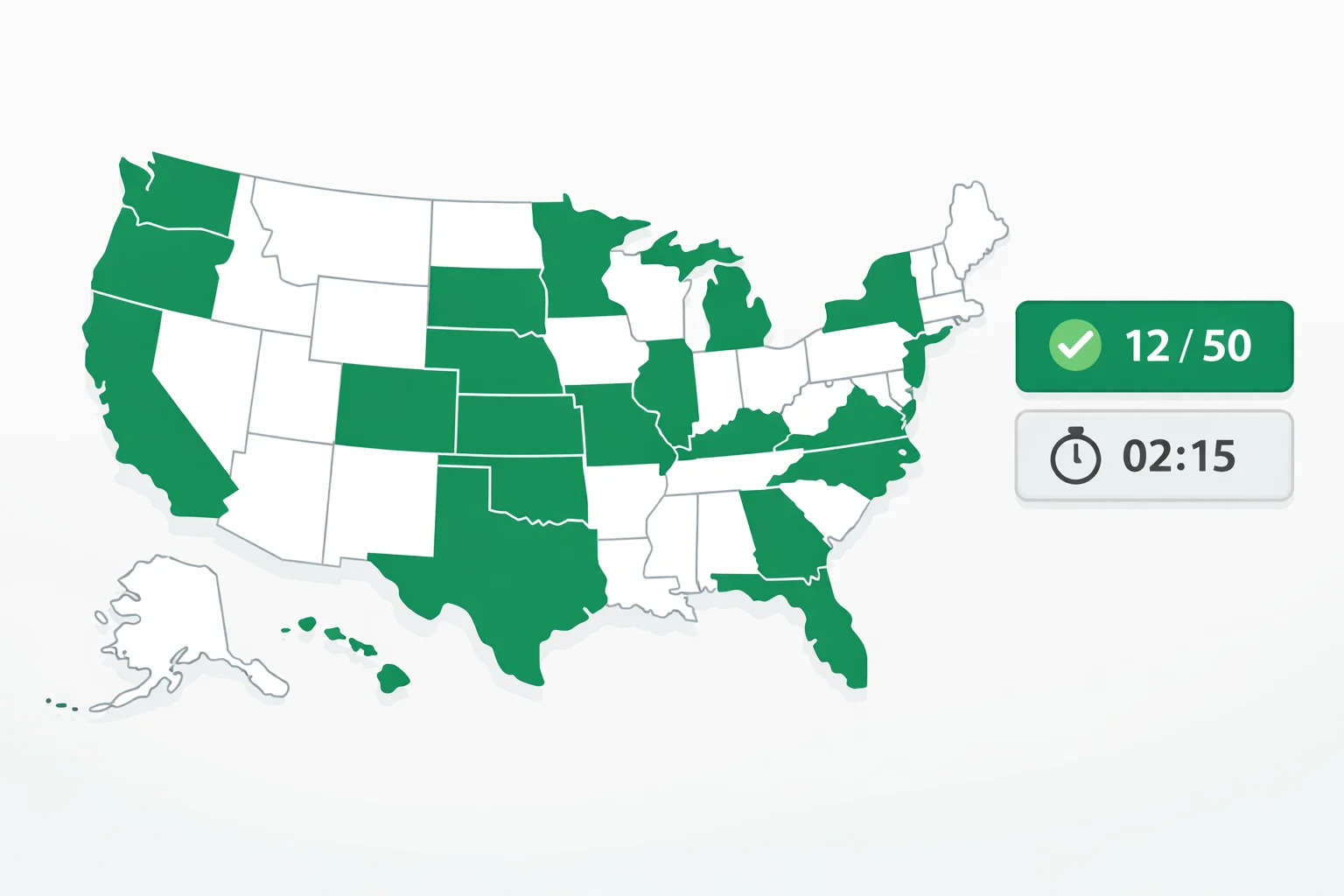
This quiz gives you 10 minutes to type as many US states as you can from memory. States are recognized instantly as you type — full names, two-letter postal abbreviations, and common shortened forms all work. No multiple choice. No hints. Just you and your memory.
Your progress shows up in real time across five US regions: Northeast, Southeast, Midwest, Southwest, and West. A visual grid fills in as you go, and milestone celebrations pop up at 10, 25, 40, and 50 states to keep you motivated. When time runs out (or you give up), you see a full breakdown of what you got, what you missed, and how your regional knowledge stacks up.
If you enjoyed this kind of timed recall challenge, you might also like our US Presidents Quiz which uses the same type-and-recall format for all 46 presidents, or our 13 Colonies Quiz to test whether you can name the original settlements that started it all. For cognitive challenges, try our reasoning practice quiz for untimed questions with worked explanations.
The 10 Most Forgotten US States
After analyzing thousands of quiz attempts across the web, a clear pattern emerges. These are the states people forget most often, ranked by miss rate:
| Rank | State | Region | Why People Forget It |
|---|---|---|---|
| 1 | Missouri | Midwest | Overshadowed by Mississippi — similar name, different state |
| 2 | Connecticut | Northeast | Tricky spelling, small state, clustered with neighbors |
| 3 | Delaware | Northeast | Second smallest state, few cultural touchpoints |
| 4 | New Hampshire | Northeast | Blends with Vermont and Maine in memory |
| 5 | Maryland | Northeast | Small, wedged between bigger neighbors |
| 6 | Wyoming | West | Smallest population of any state (under 600K) |
| 7 | Vermont | Northeast | Confused with New Hampshire, both small New England states |
| 8 | Rhode Island | Northeast | Smallest US state by area — easy to overlook |
| 9 | Nebraska | Midwest | Low media presence, blends with Kansas and Iowa |
| 10 | Arkansas | Southeast | Pronunciation confusion with Kansas |
Notice a pattern? Seven of the ten are in the Northeast. That region has 11 states packed into a small area, making each one individually harder to recall. If you're missing states, that's where to focus.
The Region-by-Region Strategy That Works
The single best tip for this quiz: don't try to think of states randomly. Work through the map systematically, region by region. Here's the exact order that produces the highest scores:
Start with the West Coast — Washington, Oregon, California. These are gimmes. Then sweep inland: Nevada, Arizona, Utah, Colorado, Montana, Idaho, Wyoming, New Mexico. That's 12 states in under a minute.
Hit the big southern states next — Texas, Florida, Georgia, Louisiana, Alabama, Mississippi, Tennessee, the Carolinas, Virginia, West Virginia, Kentucky. These have strong cultural associations.
Cross the Midwest — Ohio, Michigan, Indiana, Illinois, Wisconsin, Minnesota, Iowa, Missouri, Kansas, Nebraska, the Dakotas. Think of the MIMAL shape (Minnesota, Iowa, Missouri, Arkansas, Louisiana — they form a chef along the Mississippi River).
Finish with the Northeast — This is where most people stall. Count on your fingers: Maine, New Hampshire, Vermont, Massachusetts, Rhode Island, Connecticut, New York, New Jersey, Delaware, Maryland, Pennsylvania. That's 11 states. If you're practiced at rattling off all 11, you won't lose points here.
Don't forget the outliers — Hawaii and Alaska. People often remember these either first or dead last.
For a shorter regional recall exercise, try the Canadian provinces and territories quiz. Its 13 names split into five geographic groups, with separate totals for the ten provinces and three northern territories.
Why Recall Quizzes Beat Flashcards
If you're using this quiz to study, you're doing it right. Cognitive science research — particularly a landmark 2008 study by Karpicke and Roediger published in Science — proved that active recall (retrieving information from memory) produces significantly stronger long-term retention than passive review methods like re-reading or flashcards.
The mechanism is straightforward: every time your brain successfully retrieves a fact, the neural pathway to that fact gets reinforced. Failed retrieval attempts are valuable too — when you see Missouri on the "missed" list after the quiz, the surprise of having forgotten it creates a stronger memory trace than simply reading it on a flashcard would.
This is called the testing effect, and it's why students who quiz themselves outperform students who study twice as long by re-reading. Taking this quiz three times will teach you more than spending an hour staring at a map. Once you've mastered naming the states, level up with our state capitals quiz — it tests whether you know each state's capital across four difficulty tiers. Or try our GED practice quiz which tests knowledge across four academic subjects.
Surprising Facts About US States
Anchoring states to surprising facts makes them stick in memory. Here are some that might help:
- Alaska is so big that if you placed it over the contiguous US, it would stretch from coast to coast. Yet it has fewer people than Columbus, Ohio.
- Rhode Island could fit inside Alaska over 425 times. It's only 48 miles long and 37 miles wide.
- Kentucky has more bourbon barrels aging in warehouses (over 11 million) than it has people (4.5 million).
- Wyoming's entire population is smaller than the city of Nashville. Its main Interstate can go hours without a gas station.
- Michigan has more coastline than any state except Alaska — over 3,200 miles, thanks to the Great Lakes.
- Missouri borders eight states, tied with Tennessee for the most of any state. That should make it memorable, but somehow it doesn't.
Mental hooks like these are exactly what your brain needs to build retrieval pathways. The weirder or more surprising the fact, the stronger the memory anchor.
National parks work well as hooks too, and they're unevenly spread in a way that helps: California has nine, Alaska eight, and roughly twenty states have none at all. Our national parks quiz leans on exactly that — it describes a landscape and asks you to name the park, which quietly drills the state map alongside it.
All 6 Score Tiers Explained
Your quiz result falls into one of six tiers based on how many states you named. Here's what each level means and where you stand compared to other players:
🏆 Perfect Score (50/50): You named every US state. Only about 8% of first-time quiz takers pull this off. If you did it in under 5 minutes, you're genuinely exceptional — most perfect scores come in the 6 to 8 minute range. Geography teachers and trivia night regulars dominate this tier.
⭐ Geography Expert (45-49): You know your states cold but blanked on a few — probably small northeastern states or the Mountain West oddball (Wyoming, Montana). Top 15% of players. One more focused practice run should push you to 50.
🎯 Above Average (38-44): You beat the national average of 38. The states you're missing likely cluster in one region — check your regional breakdown to find the gap. Most people in this tier reach 45+ on their second attempt.
👍 Solid Effort (30-37): You've got the major states down. The gap is usually in either the Northeast (11 small states) or the central corridor (Kansas, Nebraska, the Dakotas, Iowa). Switching to the region-by-region strategy typically adds 8 to 10 states immediately.
📚 Getting There (20-29): You know the headline states — California, Texas, Florida, New York. Building outward from those anchor states is the fastest way to improve. Try naming all the states that border Texas, then all the states that border those.
🗺️ Just Getting Started (0-19): No shame here. The coast-to-coast sweep method works wonders for beginners: start at Washington state and mentally travel east, naming every state you pass through. You'll surprise yourself on the second attempt.
How to Go From 35 to a Perfect 50
The jump from "pretty good" to "perfect" comes down to drilling the states you keep forgetting. Here's a targeted approach:
After your first attempt, screenshot your missed states list. You'll probably see 3 to 4 clusters — a group of Northeast states, a couple Midwest states, and maybe one or two outliers. Those clusters are your practice targets.
Use the border trick: For each missed state, learn which states border it. Missouri borders eight states. Delaware is wedged between Maryland, New Jersey, and Pennsylvania. Placing a state in its geographic context creates retrieval pathways from multiple directions — even if you can't recall "Delaware" directly, thinking "what's between Maryland and New Jersey?" will trigger it.
Take the quiz again immediately. Spaced repetition research shows that re-testing shortly after a failed retrieval is the single most effective way to cement a memory. Your second attempt will typically jump 8 to 12 states. By your third attempt, most people hit 47 or higher.
For a different kind of geography challenge that tests visual recognition instead of recall, try our US map quiz — it shows you a state name and you click where it is on a blank map. Same 50 states, completely different brain workout. Stranger still is our US license plate quiz, which hides the state name on 20 real plate designs and makes you name each state from its slogan, its silhouette or just its colours — the one place where "Famous Potatoes" is worth as much as a border. Want to go international? Our Europe map quiz applies the same click-the-map format to 44 European countries, and it's considerably harder once you hit the Balkans. Or scale up to our countries of the world quiz — 197 countries, 15 minutes, and a completely different level of difficulty.