Spanish Quiz: What 20 Questions Reveal About Your Real CEFR Level
The best argument for taking a Spanish quiz before you book flights to Madrid is a guy I'll call Daniel. He walked into a bar in Lavapiés carrying a 741-day Duolingo streak, ordered a caña with real confidence — and then the waiter answered. Forty-five seconds of rapid-fire castellano later, Daniel pointed at the menu and ate whatever showed up. His app dashboard said he was 61% fluent. The waiter, apparently, hadn't seen the dashboard.
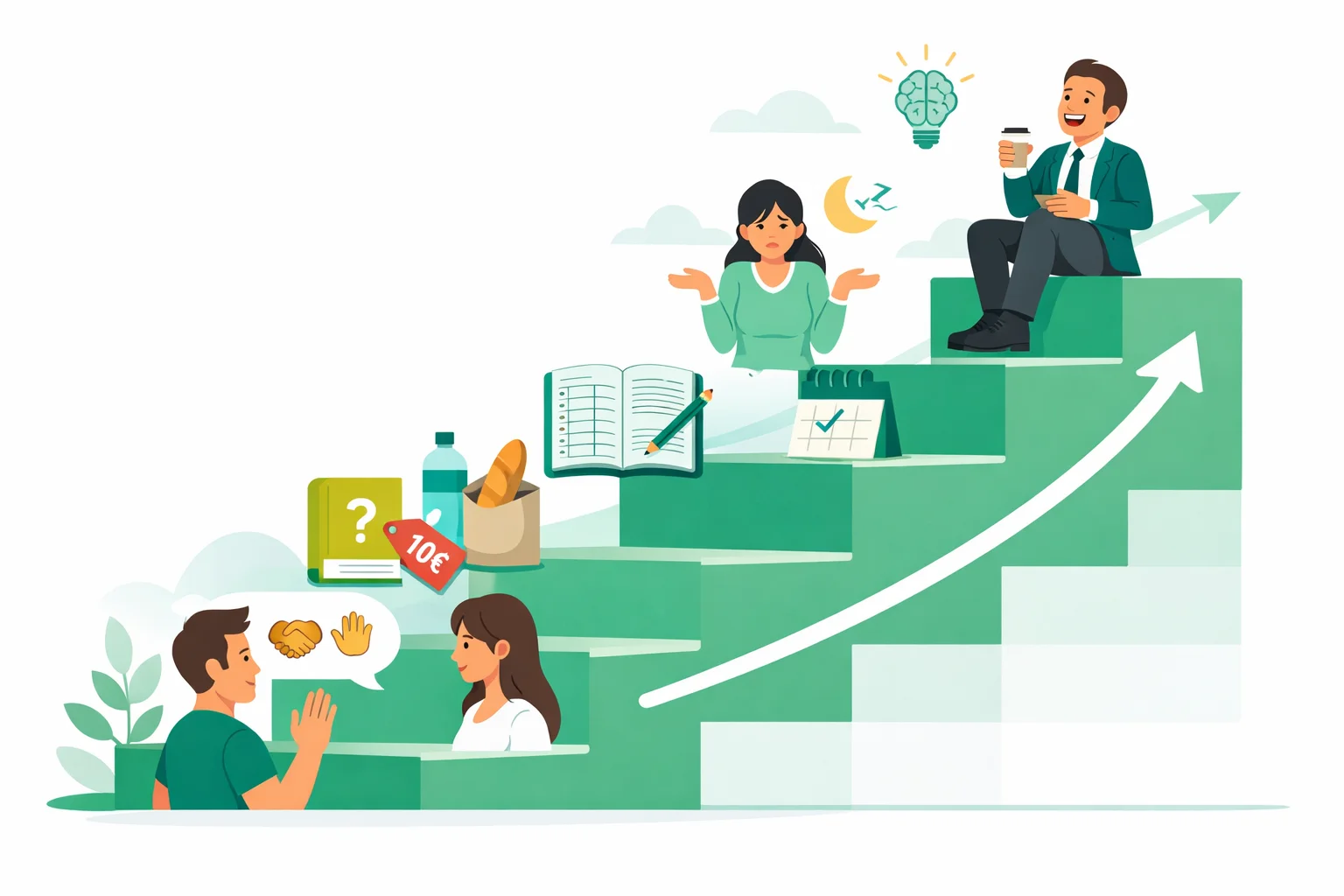
That gap — between what an app claims and what your brain produces under pressure — is exactly what the 20 questions above measure. They climb from A1 basics (perro, buenos días) through the grammar filters that stop most learners cold (preterite or imperfect? por or para?) and finish in C1 territory: compound conditionals and idioms like tomar el pelo. Where you stall tells you your level. What you miss tells you what to drill next.
The 741-Day Streak That Couldn't Order Lunch
Daniel's problem wasn't effort. It was that app exercises mostly test recognition — you see four options, one has a picture of a dog, and your brain picks perro without ever having to produce it. Real conversation runs the pipeline in reverse, at speed, with background noise. The research backs this up: the well-known Vesselinov and Grego study (2012) found that about 34 hours of Duolingo covered roughly one university semester of material — but it measured that with a placement test, not a conversation. Placement material and street Spanish are different sports.
This Spanish quiz splits the difference. It's still multiple choice — nobody's grading your accent through a browser — but the wrong answers are engineered traps. Question 9 doesn't ask if you know the verb ver; it asks whether you can discriminate vi from veía, which is the exact decision your mouth has to make mid-sentence. If you felt several questions come down to a coin flip between two options, that feeling was the test working.
Your Score Maps to a CEFR Level — Here's the Ladder
The five result bands mirror the Common European Framework of Reference (CEFR) — the same A1-to-C2 scale the Instituto Cervantes uses for its official DELE certificates. The quiz can't replace a proctored exam with writing and speaking sections, but because its questions are tiered (four per level, in ascending order), the point where your answers turn into guesses is a surprisingly honest level estimate.
| Quiz score | CEFR band | What it looks like in the wild |
|---|---|---|
| 0–4 | A1 · Principiante | Greets, counts, orders slowly — pointing still required |
| 5–8 | A2 · Elemental | Handles taxis, shops, and small talk about the weather |
| 9–12 | B1 · Intermedio | Travels independently, gives opinions, watches with subtitles |
| 13–16 | B2 · Avanzado | Argues, gets jokes, follows native series (mostly) unpaused |
| 17–20 | C1 · Dominio | Catches irony and idioms; could sit a work meeting in Spanish |
One honest caveat: a 20-question snapshot has noise in it. If you landed one point from the next band, you're a borderline case — the per-skill breakdown on your result screen is more diagnostic than the headline number.
Embarazada Does Not Mean What You Hope It Means
Two of the twenty questions are false friends — Spanish words that look like English words and mean something else entirely — and they were placed there deliberately, because false friends do more damage than missing vocabulary. An unknown word makes you pause and ask. A false friend sails straight through, wrapped in confidence. Daniel, three months into his Madrid year, told a colleague he was embarazado about a scheduling mistake. He was trying to say embarrassed. He announced a pregnancy.
Question 7 tests exactly that trap (embarrassed is avergonzado), and question 11 tests its quieter cousin: actualmente means currently, not actually. The full rogues' gallery is longer — éxito is success, not an exit; ropa is clothing, not rope; sopa is soup, not soap; carpeta is a folder, not a carpet. What makes these worth drilling is that they cluster in high-frequency vocabulary. You can go weeks without needing the word for "scaffolding." You cannot go a day without "currently."
Ser or Estar? The Filter That Never Fully Closes
The six grammar questions aren't random — they're the four filters that Spanish runs every learner through, in the order the language imposes them. First comes ser vs. estar (question 3): two verbs where English has one "to be," split roughly along identity versus state. Then the past-tense fork (question 9): vi for a completed event, veía for a habit or backdrop — a distinction English marks weakly, so your instincts arrive untrained. Third, por vs. para (question 10), which no single English preposition maps onto.
And then there's the subjunctive — questions 13 and 17 — the filter that turns B1 students into B2 students or into ex-students. It's not exotic: espero que vengas is dinner-table Spanish. But it requires accepting that Spanish grammatically marks hopes, doubts, and hypotheticals as a different mood, which means rewiring a reflex rather than memorizing a rule. Nobody fully finishes this rewiring. Advanced speakers still hesitate on edge cases — which is why a ser/estar question sits in A1 and a conditional-perfect question sits in C1, and both still feel like filters.
The 20,000-Word Head Start You Already Have
Here's the flip side of the false-friend problem, and it's much bigger: by most estimates, 30 to 40 percent of English words have a recognizable Spanish relative, thanks to their shared Latin inheritance. The patterns are almost mechanical. English -tion becomes -ción (nación, información, celebración). English -ty becomes -dad (universidad, realidad, curiosidad). English -ous becomes -oso (famoso, curioso, delicioso). Learn three suffix rules and you've effectively imported thousands of words you never have to study.
Borrowing runs in every direction, and not only between spoken languages. American Sign Language imports English words by spelling them out, and the ones it borrows most often stop behaving like spelling at all — letters drop, movement gets added, and the word quietly becomes a sign in its own right. The ASL alphabet quiz covers how that happens.
This head start is the main reason Spanish sits in Category I — the easiest tier — of the U.S. Foreign Service Institute's language difficulty rankings, at roughly 600–750 classroom hours to professional working proficiency. For comparison, Japanese sits in Category IV at around 2,200 hours — if you want to feel that difference in your own brain, try our hiragana quiz right after this one. Spanish hands you the alphabet, a third of the dictionary, and nearly phonetic spelling on day one. The quiz's C1 questions are hard despite all that, which tells you where the real work lives: not in words, but in structures.
How Long Until You'd Pass the C1 Questions?
Realistic timelines, assuming 30–45 minutes of daily practice: A2 arrives in three to six months, B1 around the one-year mark, and B2 — the level where natives stop switching to English on you — typically takes two to three years. Those FSI hour counts assume intensive classroom immersion; self-study stretches the calendar but not the total hours. The encouraging part is that the curve front-loads its rewards. The Instituto Cervantes counts roughly 500 million native Spanish speakers — second only to Mandarin — so every band you climb unlocks conversations with tens of millions more people.
One pattern worth knowing: reading comprehension outruns everything else. Most learners pass question 14 (llevo tres años viviendo...) on paper a full year before they'd catch the same sentence at native speed in a noisy bar. That's normal, not a defect — but it means a strong Comprensión score with a weak Frases score is a signal to trade some reading time for listening time, not to celebrate.
All 5 Spanish Quiz Levels, Explained
🌱 Principiante (A1, 0–4 points) — You recognize survival words and greetings, but conjugation is still guesswork. Strength: everything you learn this month will feel like doubling your Spanish. Weakness: false friends will betray your confidence before your vocabulary catches up.
☕ Elemental (A2, 5–8 points) — Ordering, shopping, and present-tense small talk are solid. You likely cleared vamos and ¿qué desea? but stumbled at the past-tense fork. Strength: you can survive a trip alone. Weakness: every story you tell still happens in the present tense.
🗺️ Intermedio (B1, 9–12 points) — The preterite and por/para filters didn't stop you, which puts you past the point where most self-taught learners plateau. Strength: real conversations, real opinions. Weakness: the subjunctive still reads as decoration rather than meaning.
🎬 Avanzado (B2, 13–16 points) — Subjunctive triggers, llevar + gerund, and common idioms are in your toolkit. Strength: native media is genuinely enjoyable instead of homework. Weakness: compound conditionals and regional slang — the exact ground the C1 questions stand on.
🏆 Dominio (C1, 17–20 points) — You parsed sino, the pluperfect subjunctive, and tomar el pelo without blinking. Strength: you think in Spanish under pressure. Weakness: at this height the remaining gaps — accent, register, dialect — are ones no multiple-choice quiz can even see.
What to Do With Your Level (Tonight, Not Someday)
Whatever band you landed in, the result screen already named your weakest skill — start there tonight, not someday. Principiantes should ignore everything except the top 100 words and four verbs (ser, estar, tener, ir). A2 and B1 learners get the most from switching subtitles to Spanish and drilling the past-tense fork out loud. B2 and above: your gap is idioms and speed, and only unsubtitled audio closes it. If you want to feel how your native-language instincts compare, run the same experiment in English with our vocabulary quiz — most people are shocked at how much of their own lexicon is recognition rather than recall, which is exactly the app-fluency trap in reverse.
As for Daniel: a year of weekly tutoring after the Lavapiés incident, he retook this style of test and landed a clean B2. He can order in Madrid now. The waiter still switched to English once — but only once, and Daniel answered in Spanish anyway, which is the whole game. Retake the quiz in six weeks, watch which skill bar moves, and if you just want a victory lap in your own language first, the general knowledge quiz is waiting.