NFL Quiz: The Records, Logos, and Arguments Every Football Fan Should Know
Almost everyone walks into an NFL quiz braced for the statistics, and almost everyone gets ambushed by something else entirely. The record book is memorable — big round numbers, famous names, highlight reels attached. What actually breaks people is the stuff sitting in plain sight every Sunday: which helmet has no logo on it, which one has a logo on only one side, and which four franchises have somehow never played in a Super Bowl. Those answers have been on your television for years. You just never had a reason to notice.
Every GOAT Argument Starts With the Same Broken Stat
There are two camps, and they never talk past each other by accident. One side opens with career totals: Tom Brady threw for 89,214 yards and seven Super Bowl rings, and that is the end of the conversation. The other side answers that Brady played 23 seasons in the most pass-friendly era the sport has ever had, and that raw totals reward longevity and a rule book rather than greatness.
Both camps are holding real evidence. The totals camp can point out that longevity is itself a skill — nobody accidentally plays until 45, and Brady's five Super Bowl MVP awards came across a 17-year span, which no rule change hands you. The era camp can point out something equally hard to argue with: Joe Montana never threw for 4,000 yards in a season and won four titles anyway, while quarterbacks in the 2010s cleared 4,000 routinely and lost in the wild card round. When the same number means two different things in two different decades, it is a weak instrument for settling an argument.
This matters for the quiz because it explains why the record-book questions are worth different yardage. Career passing yards is a 10-yard question — practically everyone knows it. Career interceptions is a 40-yard question, because the answer belongs to a player whose era nobody quotes.
Did the 1978 Rulebook Write the Modern Record Book?
In 1978 the league did two things in one offseason. It banned contact with a receiver more than five yards past the line of scrimmage — the change everyone calls the Mel Blount rule, after the Steelers cornerback whose physical coverage it was designed to stop. And it let offensive linemen extend their arms and open their hands when pass blocking, which had been illegal holding the year before.
The effect was not subtle. Dan Marino threw for 5,084 yards in 1984 and it was treated as a freak event; the record stood for 27 years. Then in 2011 alone, three quarterbacks passed 5,000 yards in the same season — Drew Brees, Tom Brady and Matthew Stafford — something that had happened exactly once in the previous 91 years of professional football. Nobody seriously believes 2011 produced three of the four greatest passing seasons ever played. The rules simply moved.
The counter-argument deserves its hearing too. Defenses adapted, coverage schemes got far more sophisticated, and every quarterback since 1978 has faced faster, larger, better-coached pass rushers. A rule that opens the field also creates the film study, the disguised coverages, and the situational substitution packages that make modern quarterbacking harder in ways a stat line never shows. If you want the long version of how the league arrived here, the Britannica history of the NFL is the least partisan account you will find.
The Records That Refuse to Move
Here is the useful thing about era arguments: they only apply to records that keep falling. A handful have not moved in decades, and those are the ones worth committing to memory, because they will still be correct answers a decade from now.
| Record | Holder | Year set | Closest anyone has come since |
|---|---|---|---|
| Passing yards, single game (554) | Norm Van Brocklin | 1951 | 527 — Warren Moon (1990) and Matt Schaub (2012) |
| Career interceptions (81) | Paul Krause | 1979 | 71 — Rod Woodson |
| Rushing yards, single season (2,105) | Eric Dickerson | 1984 | 2,097 — Adrian Peterson (2012) |
| Career receiving touchdowns (197) | Jerry Rice | 2004 | 156 — Randy Moss |
| Career sacks, official era (200) | Bruce Smith | 2003 | 198 — Reggie White |
Two of those deserve a footnote. Van Brocklin's 554 yards came in the first game of the 1951 season, in an era when teams threw the ball roughly half as often as they do now — which makes it the least era-adjusted record on the list and the most likely to survive another 75 years. And Bruce Smith's sack record has an asterisk of a different kind: sacks were not an official statistic until 1982, so Deacon Jones, credited by researchers with about 173 and a half, does not appear on the league list at all. That single technicality is responsible for more wrong answers on this quiz than any other fact.
Every sport that started counting late has this hole. Basketball's version is worse: the NBA did not treat blocks or steals as official statistics until 1973-74, which leaves Bill Russell — the most famous shot blocker in the sport's history — with a career total of zero. Our NBA quiz builds a three-point question around exactly that gap, and it catches basketball fans the same way Deacon Jones catches football ones.
Here's Why the Helmet Questions Trip Up Lifelong Fans
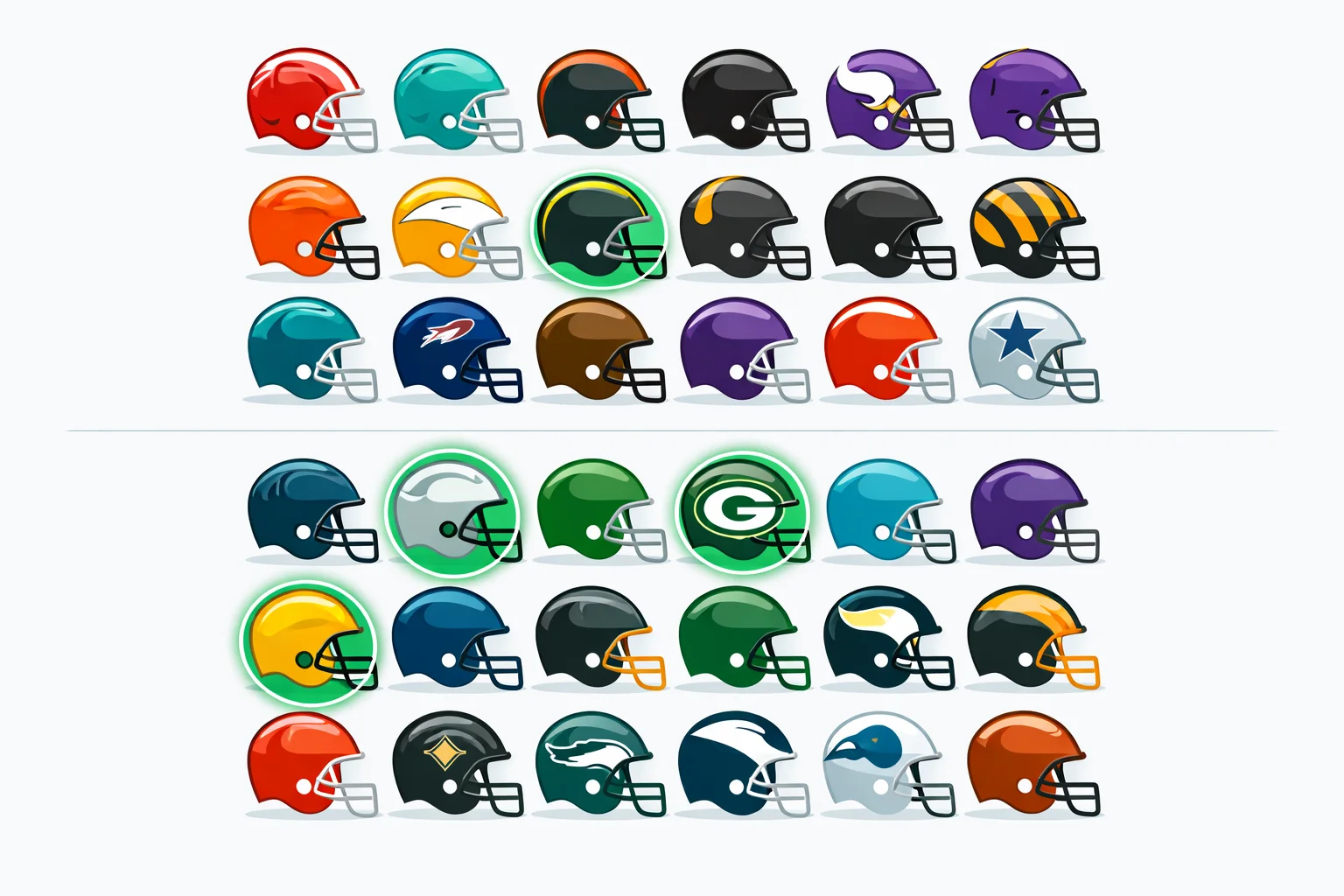
Watching football teaches you players and outcomes. It does not teach you design history, which is why the second quarter of this football trivia quiz has the lowest scoring rate of the five. Take the Steelers. In 1962 the team was handed the Steelmark — the logo of the American Iron and Steel Institute, three hypocycloids standing for coal, iron ore and scrap — and the equipment staff put it on the right side of the helmet only, to see how it looked before committing to both sides. Pittsburgh then had the best season in franchise history to that point. Nobody was going to touch the left side after that, and 60-odd years later nobody has.
Cleveland goes the other way: a plain orange shell with stripes and nothing else, the last logo-free helmet in the league. There is a structural reason for it. The Browns are named after a person — Paul Brown, their first head coach — so there was never an animal, weapon or mascot to draw in the first place. Atlanta hid its answer in plain sight instead, bending the falcon in the 2003 redesign so the bird's body traces a capital F. And New England replaced Pat Patriot, a crouching minuteman, with a profile that fans immediately christened the Flying Elvis — a nickname that has comfortably outlived whatever the design agency intended.
If reading symbols is your strength rather than reading stat sheets, the logo quiz runs the same skill across 30 consumer brands with a shrinking blur radius, and it is the natural follow-up for anyone whose best quarter here was the helmets.
17–0 or 18–1: Which Season Was Actually Better?
The 1972 Dolphins are the only team to finish a season unbeaten and win the Super Bowl. The 2007 Patriots went 16–0 in the regular season, won two playoff games, and lost Super Bowl XLII. Every February the argument restarts, and both sides have numbers.
The Dolphins camp has the only fact that ultimately counts: they finished. Nobody else has, in more than a century of professional football. Miami outscored opponents 385 to 171 and did it with a backup quarterback, Earl Morrall, starting nine games after Bob Griese broke his ankle in week five.
The Patriots camp has the schedule. Miami's 1972 opponents had a combined losing record, and the Dolphins played a 14-game season. New England scored 589 points in 2007 — a league record at the time — with a point differential of plus-315, and beat two teams that finished with double-digit wins in January before losing the last game of the year by three points. The honest verdict is that they measure different things: one season is a record of perfection, the other is a record of dominance, and the two only overlap if you insist on collapsing them into one number.
Four Franchises, Zero Super Bowls
Cleveland, Detroit, Jacksonville and Houston. That is the whole list, and it is one of the most-searched NFL facts there is, largely because people confuse it with the list of teams that have never won one. Buffalo and Minnesota have each been four times and lost four times — the Bills in four consecutive seasons from Super Bowl XXV through XXVIII, which is its own kind of achievement.
The pattern underneath the four is not really about talent. The Browns won four NFL championships before the Super Bowl existed, the last in 1964, then had the franchise relocated out from under them in 1996 and rebuilt from an expansion roster in 1999. Detroit went 32 seasons between playoff wins, from January 1992 to January 2024. Jacksonville and Houston are simply young: the Jaguars arrived in 1995 and have reached three AFC Championship games, and the Texans are the newest team in the league at 2002. Three different causes, one identical line in the record book. The full ledger of who has been and who has won is kept on the list of Super Bowl champions.
Worth knowing if you like the geography angle: those 32 franchises are spread across 24 states and two dozen metro areas, and placing them on a map is a genuinely different skill from naming them. The US states map quiz is the fastest way to find out whether you actually know where the league lives.
Why This Quiz Keeps Score in Points, Not Percentages
Most NFL trivia quizzes hand you a percentage, which tells you almost nothing. Getting 15 easy questions right and 15 hard ones right produce the same 60%, even though they describe two completely different fans. So this quiz scores drives instead.
Every question carries a yardage value tied to how many players actually get it right. A rookie-level question — eleven players on the field, two points for a safety — gains 10 yards. A Hall of Fame question, like the career interception record or the only man to win Super Bowl MVP for the losing team, gains 40. You start each drive on your own 25, so a touchdown needs 75 yards of correct answers and pays 7 points. Get one wrong and the drive dies immediately — but if the ball is past the opponent's 40 when it happens, the kicker still banks you 3.
Two consequences fall out of that design, and both are deliberate. First, a run of hard answers is worth roughly four times a run of easy ones, so the score separates depth of knowledge from breadth. Second, near-misses are rewarded — getting three hard questions right and then missing is worth more than missing three easy ones in a row, exactly as it would be in a real game. Perfect play tops out at 42 points rather than some round number, because touchdowns waste the yardage that overshoots the goal line. Your opponent, the average fan, finishes on 24.
All Six Final Scores, Explained
🏆 Canton Bound (38+ points). The rarest finish on the board, reached by roughly 3% of players. You cannot get here without clearing at least one 40-yard question, and those three — Bruce Smith's official sack record, Paul Krause's 81 interceptions, Chuck Howley's losing-team MVP — are the questions most lifelong fans have simply never encountered. This score says you read about football as well as watch it.
🎯 Franchise Quarterback (28–37). Four touchdown drives and change, in the top 12% or so. Almost everyone in this band is strong on the record book and the Super Bowl ledger and gave points back in the helmet quarter, because logo history is the one part of this quiz that watching every Sunday for 20 years teaches you nothing about.
⭐ Pro Bowl Alternate (21–27). Roughly one player in four lands here, right on the edge of the average fan's 24. Scores in this band tend to be lumpy rather than random — one whole quarter collapses while the other four hold, and the drive chart will show you which one it was.
📺 Sunday Regular (14–20). The most common finish. You know the modern game — the 17-game season, the current stars, the 28–3 collapse — and the pre-1990 record book is where every drive stalled. It is also the easiest score to move, because the fixes are five specific facts rather than a general lack of interest.
🍗 Thanksgiving Fan (7–13). One touchdown, a couple of field goals, a lot of punts. This is the score of someone who enjoys the game socially — the highlights, the big moments, the playoff weekends — without following it as a subject. The first quarter of the quiz alone is worth double this score once those five answers are locked in.
🚧 Practice Squad (0–6). Fewer than 8% finish here, and the drives never left your own half. The encouraging part is how quickly it moves: eleven players a side, two points for a safety, 32 teams, 17 games, and 158.3 for a perfect passer rating are five facts you can hold after reading them once.
Go Win the Next Bar Argument
Pick the three facts from your missed list that would come up in conversation and drop the rest. Realistically that means the Steelers' one-sided helmet, the four teams that have never made a Super Bowl, and whichever record surprised you most — those three come up constantly and none of them takes any effort to hold onto. Retake the quiz a week later and watch the drive chart rather than the score: three touchdown drives instead of five field goals is a bigger jump in knowledge than the final number suggests.
And if the appeal here was the Sunday-night spectacle rather than the statistics, the WWE quiz runs the same format on the other great American live event, booked pre-show to main event. For the version of football the rest of the planet means by the word, the soccer quiz drops the drive chart and runs you through a World Cup bracket instead — clear the group stage or your tournament ends in nine questions. And if it was the record book that held you rather than the spectacle, the MLB quiz scores you as a hitter: twenty at-bats, a nine-inning line score, and a final batting average that catches most people out.
And when you want the uncomfortable version, the sports trivia quiz spreads 25 questions across eight sports and caps football at 12% of the board. Clearing the drive chart here proves you know football. That one tells you whether you know sports.