Weekly News Quiz: What Testing Yourself Reveals That Reading the News Doesn't
A friend brings up a story at dinner — a resignation, a currency collapsing, a summit that went badly — and you nod along with complete confidence right up until someone asks which country. That gap is what a news quiz measures, and it is the reason this format splits people into two camps who have been talking past each other for decades.
Two Camps, and Both Are Half Right
The first camp treats current events quizzes as civic hygiene. If you cannot name the body that has to approve a treaty, you cannot meaningfully hold an opinion about the treaty, and a weekly test is a cheap way to find out which of your opinions are floating free of any facts. Newspapers have run these things for a century for exactly that reason.
The second camp calls it trivia with a civic costume on. Knowing that COP29 happened in Baku tells you nothing about climate finance; it tells you that you can retain proper nouns. Worse, the critics argue, quizzes reward the kind of news consumption that is already broken — skimming forty headlines instead of reading two stories properly.
Here is what makes the argument resolvable rather than eternal: both camps are describing measurable things, and researchers have measured them. A quiz is a bad instrument for testing understanding. It is an outstanding instrument for testing whether anything you read last month is still in your head — and it turns out those two are much further apart than almost anyone assumes.
Four in Ten People Now Actively Avoid the News
The Reuters Institute's Digital News Report, which surveys tens of thousands of people across dozens of markets each year, has been tracking something it calls selective news avoidance: people who say they sometimes or often go out of their way not to encounter the news. That figure has climbed from under three in ten in 2017 to roughly four in ten in recent editions. The most-cited reasons are not disinterest. They are that the news is relentlessly negative, and that it wears people out.
That matters for a quiz because the avoiders are not the people scoring zero. Plenty of them are ex-news-junkies who burned out — they carry a large stock of knowledge and have stopped topping it up. Meanwhile the people who feel most informed are often the ones consuming the highest volume of the lowest-nutrition format: notifications, clips, headlines read at a glance while walking.
Reading Isn't Remembering — Here's How You Tell Them Apart
The cleanest evidence comes from a place with nothing to do with journalism. In 2006, Henry Roediger and Jeffrey Karpicke published experiments in Psychological Science in which students either reread a passage repeatedly or read it once and were tested on it. The rereaders felt more confident. A week later, the tested group remembered substantially more. The effect has been replicated so many times it now has its own name — the testing effect — and the confidence gap is as reliable as the memory gap. Repetition feels like learning because familiarity is easy to mistake for knowledge. Psychologists call that the fluency illusion, and news is practically engineered to produce it.
Think about what daily news consumption actually is. You see the same story eight times in four days across a feed, a push alert, a podcast intro and a friend's repost. Each exposure raises your sense of familiarity without ever requiring you to produce a single fact from memory. Then a quiz asks you which country, and the answer is not there — not because you never knew it, but because you never once retrieved it. Recognition and recall run on different machinery, which is also why our general knowledge quiz feels harder than the same facts do in a pub conversation.
So Who Actually Ends Up Better Informed?
The Pew Research Center spent more than a decade running public news-knowledge quizzes and publishing how many people got each item right. The recurring pattern across those surveys was not that Americans knew nothing. It was that recognition of a story ran far ahead of knowledge about it — large majorities had heard of an event that only a minority could answer a single question about.
A 2012 Fairleigh Dickinson University survey pushed the point further and got itself quoted for a decade: after controlling for education and other factors, people who named certain cable news programmes as their main source answered no more current-affairs questions correctly than people who reported consuming no news at all. Hours spent did not predict knowledge. Format did.
This is the part that settles the argument between the two camps. Camp two is right that a quiz cannot measure understanding. Camp one is right that something needs to check whether your news habit is depositing anything, because volume plainly does not guarantee it. A weekly news quiz is a smoke alarm, not a diagnosis — cheap, fast, and worth having on the ceiling.
Why Your Score Splits Across Five Beats
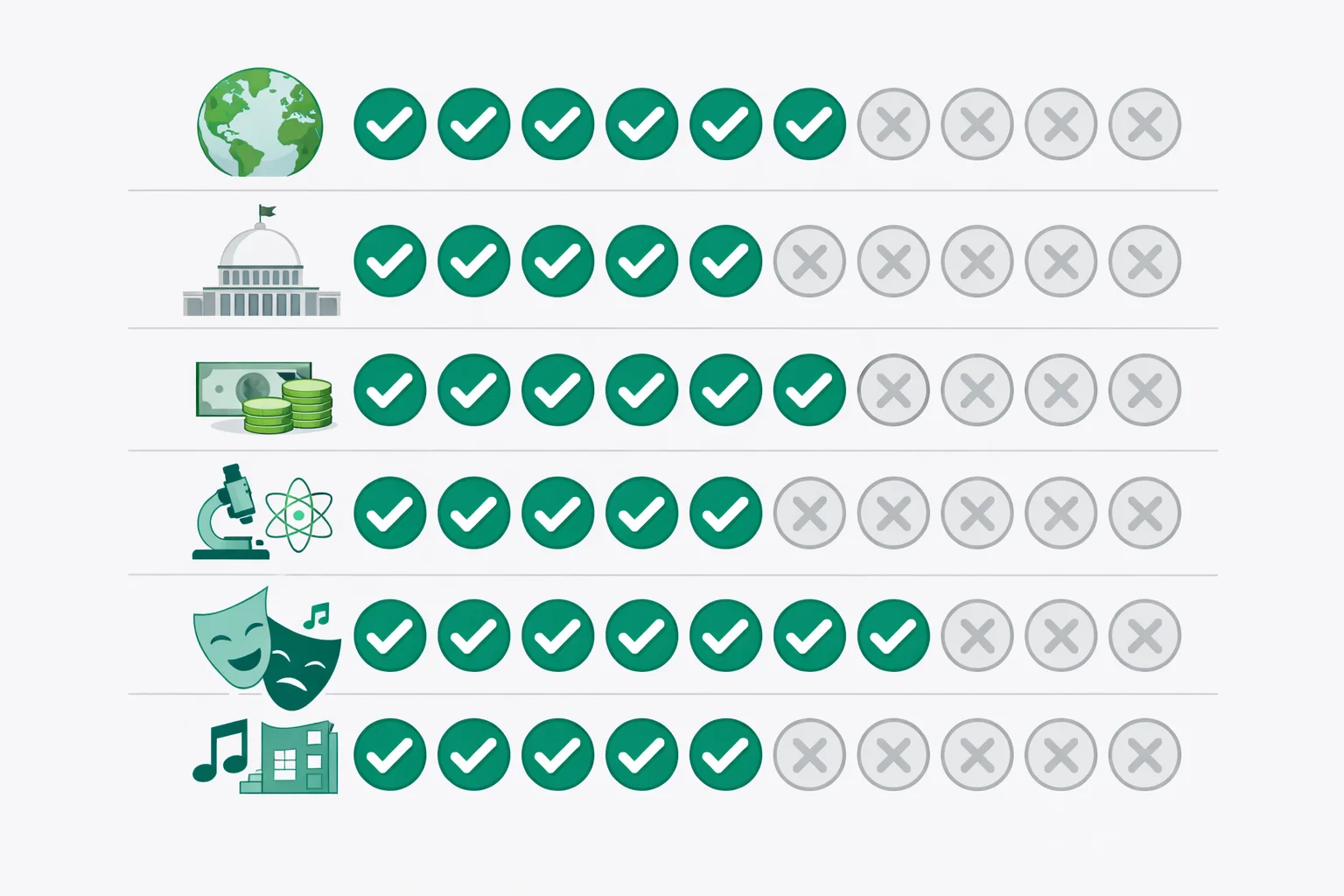
A single number out of ten hides the only genuinely useful thing in your result. Someone who scores 6 by getting every world and culture question and missing every money question has a completely different problem from someone who scores 6 evenly. So every edition here takes exactly two questions from each of five beats — world and conflict, politics and policy, money and business, science and health, culture and sport — and your result decomposes into a row per beat.
A beat, in newsroom language, is a reporter's assigned territory. Splitting scores this way exposes a pattern that shows up constantly: money is the beat most readers are blind in. Business coverage is written in a private vocabulary — core inflation, quantitative tightening, soft landing, basis points — that assumes you already have the vocabulary. So readers skip it, the deficit compounds, and a year later a third of the front page is effectively in another language. The encouraging news is how small the fix is. Eight or nine terms unlock most business stories, and every one of them appears in this quiz's money rotation with a plain-English explanation attached.
The running order matters too. The ten questions rotate through all five beats, then rotate through them again, so you never get two money questions back to back. Batching by topic primes you — the first question hands you the frame for the second — and inflates scores without teaching anything.
What Actually Changes Every Monday
Each edition is selected by a seed derived from the calendar week, drawing two questions per beat from a pool of sixty. Everyone who plays between Monday and Sunday sees the same ten, which is the whole point: comparing your score with a colleague's only means something if you sat the same paper. At midnight on Monday the seed changes and a new edition opens. Our pop quiz makes the opposite trade with a similar vault: it reshuffles its sixty questions on every single run, so scores aren't comparable between players — but no two attempts are ever the same test.
There is one deliberate design decision here that separates this from the BBC or New York Times weekly news quizzes, and it is worth being upfront about. Nothing in the pool is drawn from a story that is still moving. A quiz about a two-day-old headline mostly tests whether you looked at your phone that morning — you can ace it with zero retained knowledge and fail it having read three long features about the same region. Fast-moving stories also revise their own facts, so a quiz written on Tuesday can be quietly wrong by Friday. Ours is built from the parts of a story that have stopped moving: the treaty that got signed, the number that got confirmed, the word that entered the language. Today's live story is next decade's history quiz question, and the version worth knowing is the one that survives the week.
Roughly a sixth of the questions test how news itself works rather than what happened — what a dateline tells you, what a source means by "on background", why an embargo exists, how a correction differs from a clarification. Those are the highest-value items in the pool. Knowing that COP29 was in Baku helps you once. Knowing that a dateline reveals whether the reporter was actually in the country helps you every day for the rest of your life. The third layer, the one no news quiz can score, is what you bring to the story before you read it — our political typology quiz plots that on two axes, and the gap between what you know and what you assume is usually wider than anyone expects.
Running a Weekly News Quiz in a Classroom
Current events quizzes have been a classroom staple since the 1920s, and they fail in the same way every time: they become a Friday ritual that rewards whoever watched the news the night before. Three adjustments fix most of it.
| Common approach | What to do instead | Why |
|---|---|---|
| Quiz after the discussion | Quiz first, discuss second | Being tested on something you don't yet know primes you to absorb the answer — the pretesting effect. Failed guesses improve later recall. |
| Grade it | Keep it ungraded and visible | Low-stakes retrieval produces the memory benefit without the anxiety that suppresses it. Grades push students to memorise the quiz, not the news. |
| Move on to next week | Re-ask three questions a fortnight later | Spacing is what converts a fact into long-term memory. A repeat five minutes later does almost nothing; a repeat two weeks later does most of the work. |
Then spend the discussion on three questions, not on the score: what is the source here, who benefits from me believing this, and what would change my mind? A quiz that ends in those three questions is doing something no amount of headline exposure achieves.
All 6 Score Bands Explained
Scores land in six bands. The band names are newspaper jokes; the descriptions are not.
🗞️ Front Page Editor (10/10) — a clean sweep across five unrelated beats, which roughly 4% of readers manage. This is not luck. It means you read past the headline into the paragraphs where the numbers and caveats live, and you do it in at least two subjects you have no professional reason to follow.
📰 Newsroom Sharp (8–9) — about one reader in six. You follow the news properly and it shows. The gap between this and a perfect score is almost always a single beat you skim rather than read, which is why the two questions you dropped tend to sit in the same row of the beat map.
☕ Well Briefed (6–7) — the most common result, roughly three readers in ten. You know what is going on, you can hold a conversation about most of it, and you lose points on specifics: the figure, the acronym, the city the summit was actually held in. That is a retrieval gap, not an interest gap.
📱 Headline Skimmer (4–5) — around a quarter of readers. You recognise nearly every story but the detail has slid off. This band is the fluency illusion made visible: seeing a headline six times feels like knowing something, right until a question asks you to produce it.
🔔 Notification Reader (2–3) — roughly one reader in eight. Your news arrives as alerts you swipe away, which is honestly how most people consume it now. The encouraging part is how quickly this moves: one deliberate ten-minute sitting a week lifts most people two bands inside a month.
🌵 Off the Grid (0–1) — fewer than one reader in twenty. Either you have deliberately stepped back from the news cycle, which is an increasingly common and not unreasonable decision, or this particular edition's beats missed you completely. Play a practice set before you draw any conclusion — a single edition of ten questions is a small sample.
Build the Streak, Not the Doomscroll
The counterintuitive finding in all of this is that scoring better on a current events quiz has almost nothing to do with consuming more news. The people who improve fastest usually consume less of it, more deliberately. One long piece read properly beats forty headlines, because only the long piece gives your memory something structured enough to hold.
So: pick a fixed ten minutes on Monday. Read one substantial story from the beat your map says you are weakest in — for most people that is money, and for most people it is the one they will be tempted to skip again. Then close the tab and, without looking, say out loud what happened and why it matters. That last step is the entire mechanism; everything else is input. If you want a second habit that runs on the same machinery, the daily geography challenge does it in ninety seconds a day.
Come back next Monday and see whether the beat that was red is green. That is the only scoreboard here that actually measures anything.