Hypothyroid vs. Hyperthyroid: How to Read Your Own Symptoms
Most thyroid quizzes are built to catch one half of the problem. Cold hands, weight gain, exhaustion, a head full of fog — that's the underactive list, and it's the common one. The other half is the woman who has lost seven pounds she never meant to lose, sweats through a shirt sitting still, and wakes at three in the morning with her heart going. Same gland. Opposite direction. Almost none of the symptom checkers she'll find online will even ask.
That asymmetry is the whole design of the quiz above. Roughly half the questions offer you a slow answer, a fast answer, a both answer and a nothing-has-changed answer, and the result is a needle on a two-sided axis rather than a risk score. A third channel runs alongside it for the neck itself, because a thyroid can be visibly enlarged while its blood work comes back immaculate — and that combination sends you to a different test entirely.
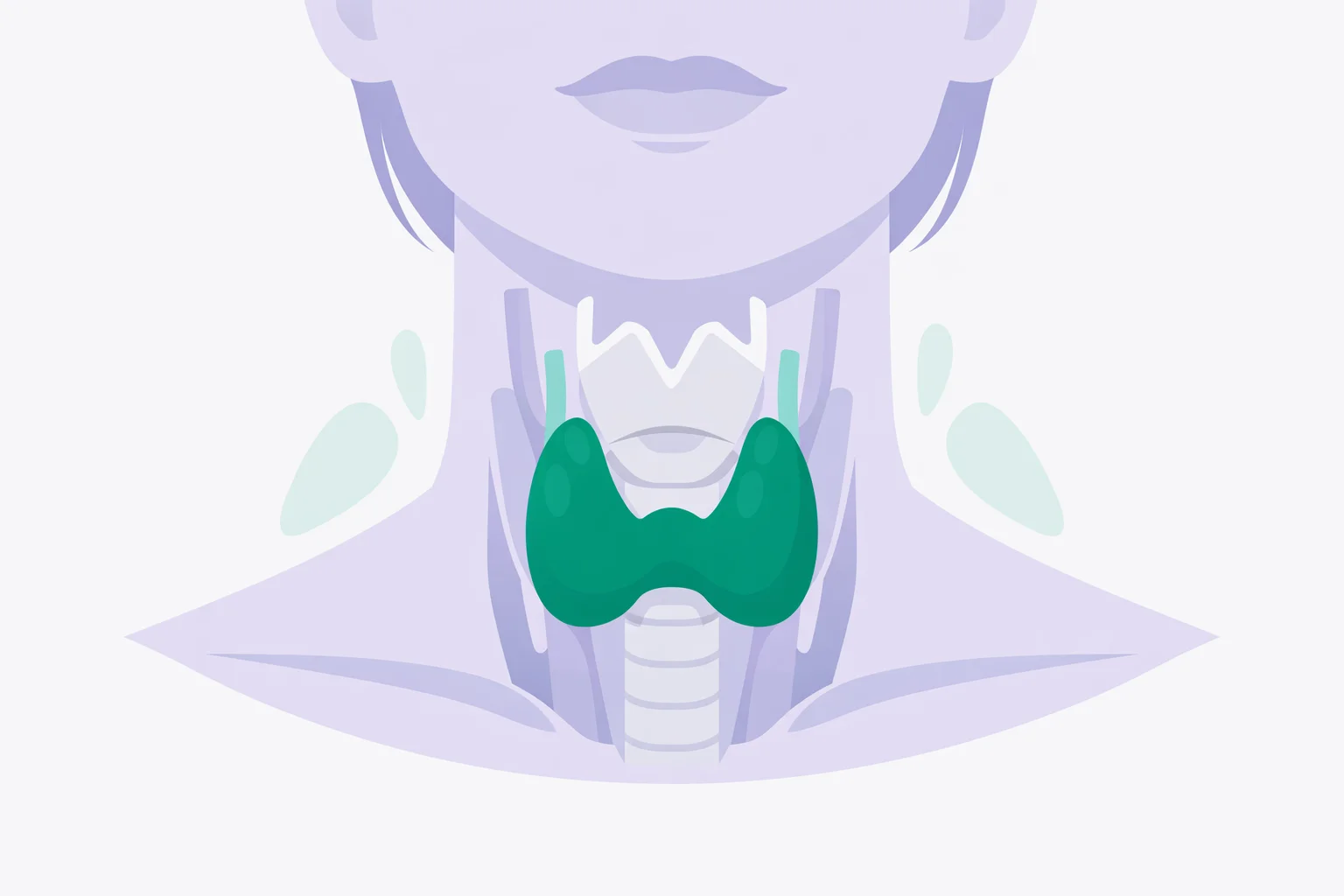
Cold Hands or Hot Flushes? The Symptom List Runs Both Ways
The thyroid sets your metabolic tempo. Too little hormone and everything slows: heart rate, gut transit, speech, thought, the rate at which you generate heat. Too much and the same systems overshoot. That's why the two symptom lists aren't merely different — for most body systems they're precise inversions of each other.
| System | Underactive (hypothyroid) | Overactive (hyperthyroid) |
|---|---|---|
| Weight & appetite | Gains despite eating less | Loses despite eating more |
| Temperature | Cold intolerance, low sweating | Heat intolerance, drenching sweats |
| Heart | Slow pulse, often under 60 | Fast pulse, palpitations, atrial fibrillation |
| Bowels | New constipation | Frequent, looser stools |
| Skin | Dry, coarse, thickened | Thin, warm, moist |
| Sleep | Sleeps long, wakes unrefreshed | Can't fall asleep, wakes at 3am |
| Mind | Slowed, forgetful, flat | Anxious, restless, irritable |
| Periods | Heavier and longer | Lighter, shorter or absent |
| Eyes | Puffy lids | Staring, bulging, gritty, light-sensitive |
| Nails | Brittle, slow-growing | Lifting off the nail bed |
Two entries on that table are worth pointing at. The eyebrow detail in question 7 — thinning of the outer third — has been a bedside sign of hypothyroidism for over a century, and while it isn't specific enough to diagnose anything on its own, it's the kind of thing people notice for months without connecting it to fatigue. Nails lifting away from the bed is the mirror image, associated closely enough with an overactive thyroid that it carries its own eponym. Neither symptom sounds like a hormone problem. Both are.
The bowel row is the one that most often gets a different label first. A slow gland produces new constipation and a fast one produces loose, frequent stools, so either direction can be filed as irritable bowel syndrome — and it usually is, because the gut symptom is the one people find hardest to ignore. The tell is company: thyroid bowel change arrives alongside temperature, pulse and skin moving the same way, while IBS ties the change to abdominal pain and leaves the rest of you alone. If your gut is the loudest thing on your list, the IBS symptom quiz scores that pattern against the Rome IV criteria directly, and one TSH settles which of the two you're looking at.
The Four Symptoms That Tell You Nothing
Here's the awkward part. Four of the symptoms people most often bring to a thyroid quiz appear on both lists: fatigue, hair loss, muscle weakness and a changed menstrual cycle. An underactive thyroid causes them. So does an overactive one. In scoring terms they carry magnitude but almost no directional information, which is why several answer options in the quiz above deliberately add a point to each side rather than picking a winner.
Those same four are also the symptoms with the longest list of non-thyroid causes, and that's the trap. Iron deficiency, low B12, low vitamin D, depression, perimenopause, coeliac disease and untreated sleep apnoea all produce exhaustion that feels identical from the inside. Sleep apnoea is a particularly cruel one, because unrefreshing sleep sits at the top of every hypothyroid symptom list and is far more commonly caused by an airway than a gland — if that's your main complaint, the sleep apnea quiz is a better use of ten minutes. On the fast side, an overactive thyroid gets filed as an anxiety disorder so routinely that it's worth scoring the anxiety symptoms separately and comparing the two results.
The practical rule: the symptoms that separate a thyroid problem from its impersonators are the boring physical ones. Temperature tolerance. Bowel habit. Resting pulse. Skin texture. Nobody arrives at an appointment leading with "my skin got coarse" — but that's the detail that moves the needle.
Why a High Number Means a Slow Gland
When results come back, the first number almost everyone sees is TSH, and almost everyone reads it backwards. TSH isn't thyroid hormone. It's thyroid stimulating hormone, made by the pituitary gland in your skull, and its job is to shout at the thyroid to work harder. So a high TSH means the pituitary is shouting — which means the thyroid isn't responding — which means you're underactive. A suppressed, near-zero TSH means the pituitary has gone quiet because there's already too much hormone in circulation: overactive.
Most labs report a reference range of roughly 0.4 to 4.0 mIU/L, though it varies by assay and drifts upward with age. Where the top of that range should sit has been argued over for two decades; some professional bodies pushed for a ceiling nearer 2.5, on the grounds that the population used to set the range quietly included people with undiagnosed autoimmune thyroid disease. It was never fully settled, and the consequence is real: the same result can be called normal by one lab and borderline by another.
The word subclinical gets used a lot here, and it means something precise. An abnormal TSH with a normal free T4 is subclinical — the pituitary has noticed a problem the hormone levels don't show yet. It isn't "nothing." Around 4.3% of adults sit in subclinical hypothyroidism and roughly 0.7% in subclinical hyperthyroidism, and a slice of each group progresses to overt disease every year.
Two Ways to Get a Wrong Answer From a Real Blood Test
A blood test beats a quiz every time. It can still hand you the wrong answer, and there are two ways that happens often enough to plan around.
The first is biotin. In 2017 the FDA issued a safety communication about biotin interfering with immunoassays, and thyroid panels are among the most affected. The hair, skin and nail supplements sold at 5 or 10 mg contain doses hundreds of times the daily requirement, and because most thyroid assays are built on streptavidin-biotin chemistry, the excess biotin hijacks the reaction. The classic false pattern is a low TSH with high free T4 and free T3 — which is exactly what Graves' disease looks like on a printout. People have been worked up for hyperthyroidism they never had. Stopping the supplement two to three days before the draw clears it for most people, and question 19 exists purely to catch this.
The second is the clock. TSH follows a daily rhythm: highest in the small hours, lowest in the late afternoon, with enough variation between the two that a borderline morning result can look unremarkable at four in the afternoon. If your first test was done at 8am and your repeat at 3pm, part of any "improvement" is the appointment slot. Book the repeat at a similar time of day. Worth knowing too: acute illness distorts thyroid numbers through a separate mechanism entirely, so a panel drawn mid-hospital-admission or during a bad flu usually needs repeating once you've recovered.
An Entire Disease Was Deleted From American Salt in 1924
The thyroid is the only organ in the body that runs on a trace element you have to eat. Iodine was discovered by accident in 1811, when the French chemist Bernard Courtois added too much sulfuric acid to seaweed ash while making saltpetre for Napoleon's army and got a cloud of violet vapour. Within a decade a Geneva physician was using it to shrink goitres, without anyone understanding why it worked.
The proof came in Ohio. Between 1917 and 1922, David Marine and O.P. Kimball ran a trial on schoolgirls in Akron, in the middle of what Americans then called the goitre belt — the Great Lakes, the Appalachians, the Pacific Northwest, where the soil had been stripped of iodine by glaciation. Girls given sodium iodide almost stopped developing goitres; among the untreated controls, hundreds did. Switzerland began iodising salt in 1922. Morton followed in Michigan in 1924. An endemic disease that had shaped whole regions was engineered out of existence by a food additive.
Which is why the modern trend deserves attention. American urinary iodine levels fell by roughly half between the national surveys of the early 1970s and those of the early 1990s, and the drift has continued for an unglamorous reason: the salt people actually eat has changed. Sea salt and kosher salt — the ones sitting on most kitchen counters now — are generally not iodised, and the bulk of dietary sodium comes from processed food, which mostly isn't either. For most adults this is a non-issue. In pregnancy it isn't, because requirements climb to about 220 micrograms a day and fetal brain development depends on it.
When the Same Gland Does Both, Inside One Year
If your symptoms flipped — anxious and hot in the spring, exhausted and cold by autumn — you probably assumed you'd misremembered, or that two unrelated things happened. There's a third explanation, and it has a name.
An inflamed thyroid leaks. Damaged follicles dump stored hormone into the bloodstream all at once, producing weeks of genuinely overactive symptoms, and then the gland — now depleted and still inflamed — swings underactive. Postpartum thyroiditis is the textbook case: it affects an estimated 5 to 10% of women, usually running thyrotoxic around one to four months after delivery and hypothyroid around four to eight months, with most people recovering by 12 to 18 months and a meaningful minority staying permanently underactive. Subacute thyroiditis follows the same arc after a viral illness, typically with a tender, painful neck that sets it apart.
This is the single strongest argument against trusting one blood draw. A woman tested at ten weeks postpartum can be told her thyroid is fine and be underactive by month six, and the symptoms she gets blamed for in between — exhaustion, low mood, brain fog — are the ones most easily attributed to having a new baby. Question 18 asks about the last twelve months for exactly this reason, and question 20 asks whether things flipped.
Who Actually Gets Screened, and Who Slips Through
The American Thyroid Association estimates around 20 million Americans have some form of thyroid disease and that as many as 60% of them don't know it. Women are five to eight times more likely to be affected than men, and about one woman in eight will develop a thyroid disorder in her lifetime. Risk climbs with age, with a first-degree family history, after neck radiation, and with any personal autoimmune diagnosis — type 1 diabetes, coeliac disease, vitiligo, rheumatoid arthritis. Lithium, amiodarone and cancer immunotherapy disturb the gland directly. Those are the questions in the last round, and they aren't filler: risk factors change what a borderline number should prompt.
Now the part that determines whether you actually get tested. There is no professional consensus on screening healthy adults. The US Preventive Services Task Force concluded there was insufficient evidence to recommend it in non-pregnant adults without symptoms. The American Thyroid Association has long suggested testing from age 35, every five years. Both positions are defensible, and the practical result is that whether a routine TSH lands on your chart depends heavily on which guideline your clinician follows.
That's worth knowing before you walk in, because it changes how you ask. "Should I be screened?" invites a policy answer. "I have these four symptoms, this family history, and I'd like a TSH and free T4" invites a test. If your cycles are the main issue, note that irregular periods sit on the symptom list for both thyroid dysfunction and polycystic ovary syndrome, and thyroid disease is one of the conditions doctors are meant to exclude before confirming PCOS — the PCOS symptom quiz covers the other half of that overlap.
All 7 Thyroid Quiz Results, Direction by Direction
🧊 Underactive lean — strong. The metabolic slowdown showed up across several systems at once, not just as tiredness: cold, slow, dry, constipated, gradual in onset. This is the common failure mode of the gland by a wide margin, and the one people rationalise for years because each symptom individually has a mundane explanation.
🌘 Underactive lean — early. A readable tilt without much volume behind it. This is what subclinical hypothyroidism feels like from the inside, and equally what a low ferritin or a rough winter feels like. The value here is having a baseline number on paper so next year's result means something.
🔥 Overactive lean — strong. Heat, tremor, a pulse that won't settle, weight coming off while appetite climbs. Graves' disease drives most cases, and it's the direction most likely to be misfiled as stress or anxiety for years before anyone checks a TSH.
⚡ Overactive lean — early. Some fast-direction signals without the full package. Subclinical hyperthyroidism produces this, and so do caffeine, stimulant medication and an anxiety disorder. The physical tiebreakers are a resting pulse that stays elevated for weeks and genuine intolerance of a warm room.
🔀 Mixed signals. Meaningful scores in both directions, or a flip over time. Thyroiditis does exactly this — leak, then deplete — and a single blood draw can only photograph one phase of it. This result argues for two tests six to eight weeks apart rather than one.
🔎 Neck-first pattern. The strongest signal was structural: visible fullness, a lump that rises on swallowing, a collar that fits differently, food catching. Blood tests measure function and cannot see shape, so this result routes toward ultrasound. Nodules are common and the overwhelming majority are benign.
🌱 Low thyroid signal. Nothing built a thyroid-shaped picture in either direction. Take that seriously — around 95% of adults have normal thyroid function — and then take the symptoms seriously too, because ferritin, B12, vitamin D, sleep quality and mood are more likely culprits and are generally easier to fix.
One Blood Draw Settles What Twenty Questions Can Only Suggest
The honest limit of any thyroid quiz, including this one, is that symptoms are a proxy for a hormone level and a fairly noisy one. What twenty questions can do is tell you which test to ask for and how to avoid wasting it.
Ask for TSH and free T4 together — TSH alone is the standard screen but it measures the pituitary's opinion rather than your actual hormone level, and the pairing is what distinguishes overt disease from subclinical. If the TSH comes back abnormal, TPO antibodies are the follow-up that names Hashimoto's rather than merely confirming the effect. If your neck answers scored, say the words "it moves when I swallow" out loud, because that phrase is what gets an ultrasound ordered. Book the draw in the morning, pause any high-dose biotin for two to three days first, and if a repeat is needed, book it at a similar hour.
One last thing, and it's the piece most people skip. Before the appointment, write down your three worst symptoms with the month each one started, and your resting pulse measured on three different mornings before getting out of bed. That takes four minutes and converts a vague complaint into a pattern with dates attached. A clinician can act on a pattern. "I've been tired" is much harder to test.