Everyone Starts With the Shape. Botanists Start Somewhere Else.
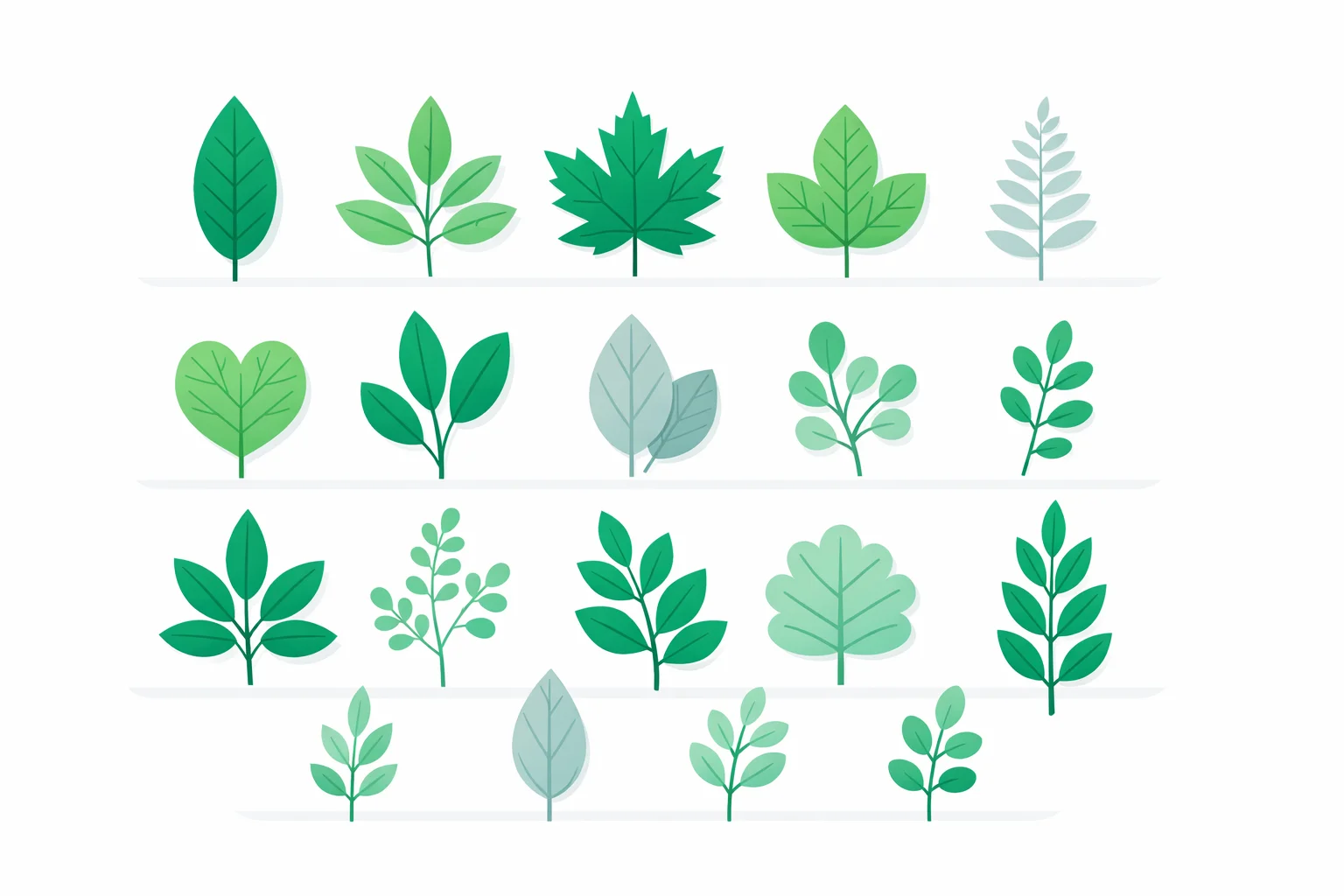
A tree identification quiz sounds like it should be a memory test, and almost every one online is built that way: here is an outline, name it. But there is a problem sitting underneath the whole exercise that nobody mentions, and it is worth thirty seconds before you start memorising leaf shapes. A tree is not a kind of plant. There is no group of organisms called trees the way there is a group called birds or a group called beetles.
There Is No Such Thing as a Tree
Being a tree is a habit — a way of making a living that involves getting tall and woody and staying put — and plants have arrived at it independently, over and over, from completely unrelated starting points. A palm is a monocot, more closely related to a blade of grass than to an oak. A tree fern is not a flowering plant at all. A banana "tree" has no wood in it whatsoever. If you built a family tree of plants and coloured in every lineage that produced something tall and woody, you would end up with colour scattered all over it, not one tidy branch.
This matters practically, not just pedantically. It means identifying a tree is not like identifying a warbler, where you learn the group and then learn its members. You are being handed something from one of dozens of unrelated lineages that have converged on the same general shape. Which is precisely why field botanists do not ask "what tree is this?" They ask a series of small structural questions in a fixed order, and the order is the part almost everyone gets wrong.
The First Thing to Look At Is Not the Leaf
Here is the thing that separates someone who keys from someone who guesses. Look at how the leaves attach to the twig before you look at the leaf. If they come off in matched pairs directly across from each other, that is opposite arrangement, and in North America it is rare enough to have its own mnemonic: MAD Cap Horse — Maple, Ash, Dogwood, the Caprifoliaceae, and Horse chestnut. Everything else staggers up the twig one leaf at a time. One glance at the stem, and you have either eliminated the overwhelming majority of species or narrowed to a shortlist you could recite.
Plate 4 in the quiz above exists entirely to make this point. A sweetgum leaf and a red maple leaf are both five-pointed stars and can be genuinely hard to separate on outline — people who have looked at leaves for years still hesitate. But sweetgum is alternate and every maple in the world is opposite, so the twig settles in one second what the blade might never settle at all.
This habit transfers to anything you identify in the field. Birders run the identical routine — bill against head, tail shape, wing shape, posture — and treat plumage colour as confirmation rather than evidence, because colour is the first thing lost to bad light and moult. The bird species identification quiz strips the colour out of all twenty entries to make that point the hard way.
| Feature, in order | What it actually does | Where it appears above |
|---|---|---|
| Arrangement (opposite / alternate) | Splits the flora into a short list and everything else | Plates 1, 4, 8, 9 |
| Simple or compound | Separates whole families; also catches people counting leaflets as leaves | Plates 1, 8 |
| Venation | Pinnate, palmate, arcuate or dichotomous — often genus-level on its own | Plates 2, 9 |
| Margin (toothed, doubly toothed, entire) | Narrows within a genus, and encodes climate (see below) | Plates 6, 7 |
| Overall outline | The least reliable feature, and the one everybody starts with | Plate 3, where it happens to be conclusive |
The same logic — read the structural feature, not the impression — is what makes the cloud types quiz work, and it is the reason both quizzes use drawn plates instead of photographs. A photo of a sweetgum in October gives the answer away with autumn colour before you have looked at anything diagnostic.
The Leaf That Has No Midrib
Every rule above has one spectacular exception, and it is the second plate in the quiz. Pick up almost any broadleaf and you will find a single central vein with side veins branching off it. A ginkgo has no central vein. The veins leave the stalk and fork in twos, again and again, and never rejoin — the pattern is called dichotomous venation, and it is the reason a ginkgo leaf looks like a folded paper fan.
The German physician Engelbert Kaempfer ran into the tree in Japan in the early 1690s and published a description in 1712; Linnaeus gave it the name Ginkgo biloba in 1771, with biloba for the notch that splits the top of the blade. What neither man could have known is quite how alone it was. Ginkgo is the only living species not just of its genus but of its entire division. Everything else on its branch of the plant family tree is a fossil, and its relatives were already forking their veins this way in the Jurassic. When you match with Ginkgo in the quiz — and only about 6% of answer paths do — that is what the result is describing: durability with nothing beside it.
And it really is durable. Ginkgo tolerates road salt, compacted soil and city air that kills every other tree in this quiz, which is why it lines streets on four continents. Several ginkgos within two kilometres of the Hiroshima hypocentre survived 1945 and are still standing today. The catch is the thing nobody puts on the nursery label: almost nothing lives on it. A native oak can host over 500 species of caterpillar. A ginkgo hosts a handful. It is the most successful survivor on the list and the emptiest habitat on it.
Why Do Cold Forests Grow Toothier Leaves?
Look back at plate 7, the elm, and its doubly serrate margin — big teeth with smaller teeth riding on them. Then look at plate 9, the dogwood, whose edge is completely smooth. That difference is not decorative, and in 1915 two Harvard botanists, Irving Bailey and Edmund Sinnott, noticed something odd about how it is distributed. Walk into a warm tropical forest and most woody species have smooth-edged leaves. Walk into a cold temperate one and most of them are toothed. The proportion shifts with mean annual temperature, reliably enough that you can run it backwards.
So that is what paleobotanists do. Take a fossil leaf assemblage, count what fraction of the species have entire margins, and you can estimate the mean annual temperature of a place that has not existed for 30 million years, usually to within a couple of degrees. The method is called leaf margin analysis and it is still in active use. The leading explanation for why it works is that teeth are metabolically active early in the season — they sit at vein endings and appear to give a cold-climate leaf a head start on photosynthesis in a short growing season. A tooth on an elm leaf, in other words, is a thermometer reading you can hold in your hand.
Some Trees Can Wait Fifty Years. Others Can't Wait Five.
The second half of the quiz stops asking what you know and starts asking how you grow, and the four dials it reads are not invented for the occasion — foresters measure all four. Shade tolerance is the best documented: Ülo Niinemets and Fernando Valladares scored 806 temperate trees and shrubs from 1 to 5 for it in 2006, and the spread on that scale is enormous. Sugar maple sits near the ceiling at roughly 4.8. Quaking aspen sits near the floor at about 1.2. Those two numbers describe two completely different lives.
A sugar maple seedling can germinate under a closed canopy in near-darkness and simply hold — adding a couple of centimetres a year, sometimes for decades — waiting for a windthrow or a dead limb to open a gap above it. Foresters call the accumulated pool of these stalled seedlings a seedling bank, and when the gap finally comes, the bank is what fills it. Aspen cannot do any of that. It cannot germinate in its own shade, let alone anyone else's, so it gambles entirely on getting to disturbed open ground first and growing hard. Neither strategy is better. They are answers to different questions, in the same way that the pollination and defence strategies behind the what flower am I quiz are answers to different questions rather than points on one scale.
Grime Put Every Plant on Earth Inside One Triangle
The triangle in your result is not decoration either. In 1974 the British ecologist Philip Grime argued that everything a plant does can be positioned against just two pressures: stress, meaning anything that limits growth, and disturbance, meaning anything that destroys what has already grown. That gives three viable strategies. Competitors thrive where both pressures are low and the fight is with the neighbours. Stress-tolerators persist where conditions are chronically bad. Ruderals specialise in getting in fast after the disruption and finishing before the next one.
The elegant part is the corner that is missing. High stress plus high disturbance should be a fourth strategy, and it is not — because a place that is repeatedly wrecked and too poor to fund a recovery cannot support a plant at all. There is no strategy for it because there is nothing to be a strategy about. That is why Grime drew a triangle rather than a square, and it is a rare case of a diagram whose shape is itself the argument.
Your position on that triangle is scored from your answers directly, not derived from whichever tree you matched, which means the two readings are free to disagree — and they do, roughly two times in three. That is deliberate. The species match is asking what you are like. The triangle is asking what your current conditions are. Someone with a stress-tolerator's temperament having a ruderal year is a real thing, and forcing the two outputs to agree would have hidden it.
The Heaviest Living Thing Is a Grove That Thinks It's One Tree
The fourth dial — connection — has the strangest data behind it. In Utah's Fishlake National Forest there is a stand of quaking aspen called Pando, roughly 47,000 stems across about 43 hectares. Genetically, every one of those stems is identical, because they are not separate trees. They are shoots from a single root system: one organism, weighing an estimated 6,000 tonnes, which makes it one of the heaviest living things known. Individual stems live perhaps 100 to 150 years. Nobody is confident how old the organism is, and published estimates disagree by an order of magnitude.
Connection is not just an aspen trick. Coast redwoods send roots down only three or four metres to hold up trunks that pass 115, and they manage it by spreading thirty metres sideways and grafting into their neighbours' roots. The grove holds the individual upright. Willow does something different again: a snapped twig carried downstream and lodged in wet silt roots and becomes a tree, so being broken up is its distribution method. A bristlecone pine, at the other end of the dial, stands alone on bare dolomite and always has.
All Ten Trees, and What Each One Reads As
The ten results are not evenly weighted, and the weighting is the most opinionated thing on this page. Each tree is aimed at a share roughly proportional to how much other life it supports, using Doug Tallamy and Kimberley Shropshire's ranking of how many butterfly and moth species can complete their life cycle on each genus — oaks over 500, willows and cherries just over 450, birches around 410, poplars and aspens near 370, maples 285, pines around 200, dogwoods around 120, ginkgo essentially none. Every share below was measured by running all 390,625 possible answer combinations, not estimated. If you want to see the same relationship from the insect's side, the butterfly quiz is built on the host plants half these trees provide.
White Oak (14.6%) — the most common result, and the keystone. Slow, drought- tough, three or four centuries of standing still, and supporting more insect life than any other genus on the continent. The cost is inertia: slow to commit, slower to change, and quietly load-bearing for people who never formally asked.
Black Willow (12.4%) — fast, wet-footed, and able to restart from a broken piece of itself. It holds the unstable flooded ground almost nothing else will hold, and it recovers from damage by using the damage. It is not built for a long settled century.
Quaking Aspen (11.9%) — the colony rather than the individual. One root system, many stems, near-impossible to remove and genuinely endangered by isolation. Needs full light and disturbance, and gets both by being first onto burned ground.
Paper Birch (10.9%) — the first responder. Cannot germinate in its own shade, so the whole strategy is speed and timing: forty fast years, enormous quantities of tiny seed, and no pretence of holding the site once the slower species arrive.
Sugar Maple (10.6%) — the most patient thing in the forest. Near the ceiling of the shade scale, capable of holding in near-darkness for decades on almost nothing, then taking the canopy gap the moment it opens. The risk is that the waiting becomes the whole plan.
Eastern White Pine (9.5%) — balanced on every dial except height, which it maximises. Better in shade than the pioneers, faster than the hardwoods, tolerant of more ground than most, and it converts all of it into altitude. Reads as unremarkable up close.
Flowering Dogwood (8.6%) — the understory specialist that never competes for height at all. Ten metres and it stops. Its edge is timing: it flowers in the short window after the light warms and before the canopy above closes over it.
Coast Redwood (8.0%) — the tallest living thing, standing on shallow roots grafted into its neighbours'. Reaches further than looks structurally possible, because it is not doing it alone. Take it out of its narrow fog belt or its network and the architecture stops working.
Bristlecone Pine (7.5%) — the endurance extreme. Growth measured in fractions of a millimetre a year, wood too dense and resinous for rot or insects, roughly 4,850 years on ground so hostile nothing competes. It has optimised so hard for survival that growth became optional.
Ginkgo (6.0%) — the rarest result, the only survivor of an entire division, and the toughest urban tree here. Structurally unlike everything around it, which is both why it survives what others cannot and why almost nothing can live on it.
Winter Is the Easiest Time to Learn Trees
Most people assume trees are a summer skill and give up in November. It is the wrong way round. Every feature the front half of a key depends on is still there in January: whether the buds are opposite or alternate, how many scales cover each bud, the shape and colour of the leaf scars, the bark, the branching form. With no foliage in the way, arrangement is actually easier to read, not harder — nothing is hanging over it.
Winter twigs also hand you something a leaf never can. Each year's growth ends in a ring of bud scale scars, so you can run a finger back along a twig and count the seasons: this much last year, that much the year before, and there is the bad summer where the tree barely moved. Ash buds are matte black and opposite and unmistakable from three metres. Oaks cluster several buds at the tip of the twig rather than one. Sycamore hides its bud completely inside the base of the old leaf stalk, so the scar is a ring around it. None of that is available in July, when everything is green and everything looks the same.