Every FNAF Animatronic's Personality, and the 2014 Accident That Created Them
The FNAF quiz above matches you to an animatronic using the four behaviours Scott Cawthon coded into a game that reached Steam on 8 August 2014 — and that game only exists because reviewers told him his cartoon animals moved like terrifying robots. He agreed with them. Then he built an entire franchise on the complaint.
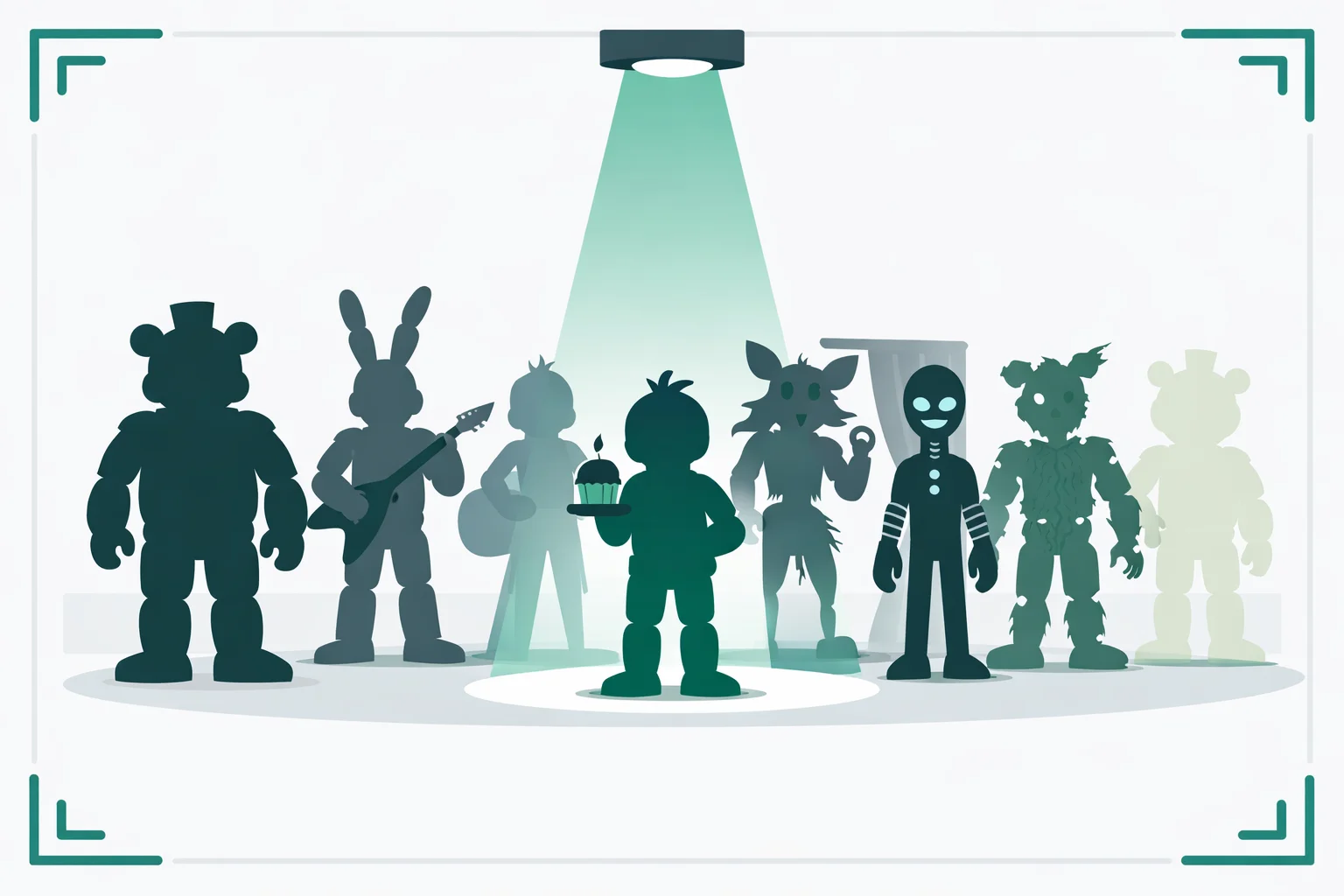
The One-Star Problem That Built a Pizzeria
Before Freddy Fazbear's Pizza existed, Cawthon was making wholesome family games that nobody was buying. His 2013 release Chipper & Sons Lumber Co. starred a cheerful cartoon beaver, and the reception was brutal in a very specific way: players didn't say the game was boring, they said the characters were unsettling. Stiff limbs. Fixed stares. Movement that looked mechanical rather than alive. More than one reviewer compared them to animatronics.
That's the part of the story worth sitting with. Cawthon was in his thirties, supporting a family, and by his own account close to giving up on games entirely. The feedback he got wasn't “make better animation.” It was “your characters are creepy.” So he stopped fighting it. He took the exact quality people disliked, moved it to the centre of the design, and built a game where the stiff, dead-eyed, mechanically-moving cartoon animals are the threat. Five Nights at Freddy's went up on Desura in late July 2014 and hit Steam that August. Within weeks it was the most-watched game on the internet.
The design constraint mattered as much as the idea. Cawthon was working essentially alone with limited animation ability, so the animatronics barely move on screen — they teleport between static poses while you flip cameras. What should have been a technical limitation became the scariest thing in the game, because a robot that's two rooms closer every time you look is far worse than one you watched walk there.
Nine Games, Twelve Years, and a Cast That Kept Multiplying
The roster this quiz draws from wasn't designed in one go. It accumulated across a decade of releases, each one adding characters with genuinely different behavioural rules — which is exactly why they work as personality types.
| Year | Release | Roster additions that stuck |
|---|---|---|
| 2014 | Five Nights at Freddy's (August) | Freddy, Bonnie, Chica, Foxy, Golden Freddy |
| 2014 | FNAF 2 (November) | The Puppet, Mangle, Balloon Boy, the Toy line-up |
| 2015 | FNAF 3 (March) | Springtrap — the only real animatronic in the whole game |
| 2015 | FNAF 4 (July) | The Nightmare variants, and a shift to the house |
| 2016 | Sister Location (October) | Circus Baby, Ennard, and voiced characters |
| 2017 | Pizzeria Simulator (December) | The salvage cast; the lore's intended ending |
| 2019 | Help Wanted (VR) | Glitchtrap, and the series in first person |
| 2021 | Security Breach (December) | The Glamrock band, Vanny, an open mall to run through |
| 2023 | The live-action film (October) | Roughly $297m worldwide from a reported $20m budget |
Eight results is a deliberate cut from a cast of well over a hundred. Everything on the list above earned its place by having a distinct behavioural signature; the ones left out — Balloon Boy, most of the Toys, the Nightmares — mostly repeat a pattern another character already owns. If you want the full franchise history rather than the personality reading, Wikipedia's franchise overview tracks every release and spin-off in order.
Why Freddy Waits and Bonnie Never Does
Here's the thing most people never notice about the original game: the animatronics have personalities in code before they have any in the story. Each one runs on an AI value from 0 to 20 that determines how often it rolls to move. Crank all four to maximum and you get 20/20/20/20, the famously punishing custom night. Set them to 1/9/8/7 and you trigger the Golden Freddy easter egg — a nod to the Bite of '87 that fans decoded within days of release.
The values differ, but so do the rules, and those rules are the real character sheets:
- Bonnie is the most active animatronic in the game and only ever comes down the west hall. Constant motion, one direction, no hesitation.
- Chica takes the east side and clatters around the kitchen — the one camera that gives you audio and no picture. You always hear her first.
- Foxy inverts the entire mechanic. He gets more active the less you check Pirate Cove, and watching him resets his progress. Neglect is what activates him.
- Freddy barely moves at all early on, follows a fixed route, and advances mainly when the cameras are down or the room is dark. He is the last one to reach you and the hardest one to stop.
Read that list again as descriptions of people rather than robots and the quiz basically writes itself. Impatience, warmth-with-volume, needing to be seen, strategic patience — those are personality traits that happened to ship as movement code in 2014.
Games hide their real character sheets in numbers like these all the time, and players absorb them without ever reading them. The Clash Royale quiz tests the same kind of buried knowledge from the opposite direction — elixir costs, King Tower activation rules, and the interactions the game never puts on screen. And the genre Scott Cawthon accidentally invented is still producing heirs: the Dandy's World quiz covers the Roblox mascot horror that took FNAF's animatronic dread and turned it into a six-stat co-op game, where the character you pick decides which teammate gets chased.
Here's Where the Quiz Actually Gets Its Numbers
Each of the fourteen questions maps to one animatronic per answer, and every character appears exactly seven times across the shift, so no result is easier to reach by accident. Underneath that, each animatronic carries a five-trait profile you see on your Endoskeleton Readout:
- Stage Presence — how much of you the room gets. Freddy sits at 92, the Puppet at 38.
- Patience — your tolerance for waiting. Question 5, the one where the power hits 20%, is the cleanest read on this.
- Aggression — how directly you close distance on a problem, not how hostile you are.
- Loyalty — the Puppet tops the roster at 98 because the character exists to protect somebody. Springtrap sits at 30 for the opposite reason.
- Unpredictability — how easily someone who knows you can call your next move.
One rule worth knowing: ties break toward the rarer character. If your answers split evenly between Chica and Golden Freddy, you get Golden Freddy, because a genuinely split answer set is itself unusual and rounding it down to the common result throws away the interesting information. It's the same reasoning behind the two runners-up shown at the bottom of your report — nobody is one animatronic, and the blend tends to be more accurate than the headline.
Almost Everyone Hopes for Foxy. Almost Nobody Answers Like Him.
Foxy has been the fan favourite since roughly week two of the franchise's existence. He's the one with the hook, the sprint, the out-of-order sign — everything about him reads as cool. So most people take a FNAF character quiz quietly hoping for him.
Then they answer honestly and get Chica. Which stings, and shouldn't, because Foxy's actual behaviour isn't the flattering thing people assume. Strip away the pirate aesthetic and his mechanic is this: he sits behind a curtain waiting to be checked on, gets progressively more agitated the longer he's ignored, and then arrives all at once at full speed. That's not confidence. That's someone keeping a private tally of who noticed them, which is a far more uncomfortable thing to see in a quiz result.
The gap between the character you want and the one you match is the most useful output the quiz produces, and it isn't unique to this franchise — the same split shows up on our Stranger Things character quiz, where an overwhelming number of people expect Eleven and land somewhere much more grounded. Wanting to be the dramatic one is nearly universal. Behaving like them is rare.
Are You Matching the Robot, or the Kid Inside It?
This is the question that separates casual players from the lore crowd, and the honest answer is that FNAF has never fully settled it. The series' central premise is that the animatronics behave the way they do because of the Missing Children Incident — the suits are occupied. Bonnie's relentlessness, the Puppet's protectiveness, Springtrap's refusal to stop existing: none of that is servo programming in the fiction. It's grief, or vengeance, or a promise nobody kept.
Which means when your result says you're the Puppet, it's reading a personality that the story attributes to a murdered child who came back to protect other children. Dark for a pizzeria mascot. That tension is a big part of why the franchise held teenagers for twelve years rather than twelve months — the surface is a jump-scare game, and about three layers down there's a genuinely sad story about people who weren't looked after.
One other indie series pushes that same split further, and in the opposite direction. Where FNAF asks whether you matched the suit or the child inside it, Deltarune makes the occupant the player — you steer a character who then reaches into their own chest, removes the soul you were using, and locks it in a cage. Our Deltarune character quiz is built on that distinction, scoring how much of the wheel you take rather than which character you like. If the Puppet result landed for you, that one is worth twenty questions of your evening.
Fandoms that decode rather than watch tend to share one habit, and FNAF invented the modern version of it. The other place it shows up wholesale is Gravity Falls, which spent two seasons hiding a cipher under every set of end credits and escalating the difficulty as the audience got better — so our Gravity Falls character quiz hands your result back as an encoded message with the key withheld, rather than a paragraph.
There's also a decent scientific explanation for why the designs get under our skin at all. The uncanny valley, first described by roboticist Masahiro Mori in 1970, holds that our comfort with a human-like figure rises with realism up to a point, then collapses sharply when something looks almost alive but moves wrong. Freddy's cast lives at the bottom of that curve on purpose: friendly proportions, warm colours, kids' entertainment shapes — and then a fixed stare and an eight-frame walk cycle. If you want to see how differently a creature roster reads when it's built for warmth instead of dread, our Pokémon personality quiz runs on a nearly identical trait model with the uncanny valley removed.
Every Animatronic, Side by Side
The fastest way to sanity-check your result is to read the in-game behaviour column and ask which one describes a bad week in your life.
| Animatronic | Debut | In-game behaviour | What that reads as in a person |
|---|---|---|---|
| 🎩 Freddy Fazbear | FNAF 1 | Moves last, only in darkness, on a fixed route | Strategic patience; composure mistaken for passivity |
| 🎸 Bonnie | FNAF 1 | Most frequent mover, always the west hall | Acts first, one direction, no hesitation |
| 🧁 Chica | FNAF 1 | East hall and the kitchen; audible before visible | Loud, warm, care expressed as action |
| 🏴☠️ Foxy | FNAF 1 | Activates when you stop watching Pirate Cove | Needs to be seen; punishes being forgotten |
| 🦴 Mangle | FNAF 2 | Dismantled daily, approaches via the ceiling | Rebuilt wrong and thriving on it; adaptable, chaotic |
| 🎁 The Puppet | FNAF 2 | Stays put only while the music box is wound | Protective, justice-driven, keeps everyone's score |
| 🐇 Springtrap | FNAF 3 | Still active thirty years after the site closed | Endurance and calculation; guarded to a fault |
| ✨ Golden Freddy | FNAF 1 | No route, no camera, simply appears in the office | Skips the expected steps; unreadable, self-contained |
All 8 FNAF Animatronic Results, Decoded
🎸 Bonnie — The First Mover (16%). The most common result, and the one most likely to be reading this before finishing the quiz. Bonnies break inertia: they send the message, make the call, start the conversation. Groups get things done around them because nothing is allowed to sit still. The cost is arriving before thinking, and attacking problems head-on when a side door was open the entire time.
🧁 Chica — The Host (15%). Care that shows up as food, noise and a refusal to leave. Chicas notice who hasn't eaten and who has gone quiet, and they fill silences rather than let them get heavy. Their loyalty is practical, not sentimental. The flaw is total: they look after everyone so thoroughly that nobody clocks them running on empty.
🎩 Freddy Fazbear — The Frontman (14%). Calm that other people misread as passivity. Freddys hold position, watch, and commit exactly once, at the moment it counts — which makes them extremely hard to stop when they finally move. Being underestimated suits them. The risk is waiting so long for perfect information that doors close, and reading as cold to people who needed them now.
🏴☠️ Foxy — The Wildcard (13%). Intense in bursts rather than continuously, and genuinely unable to sit with being overlooked. Foxys give everything to people who make them feel seen and go silent in a way that reads as fine when they don't. When they commit, they commit at full speed and it lands more often than it should. The private tally of who checked in is the thing that eventually causes trouble.
🦴 Mangle — The Rebuilt One (12%). Taken apart repeatedly and reassembled differently every time, which produced someone who improvises better than anyone in the room. Mangles are at their best when the plan collapses. They're hard to categorise and stopped trying to fit years ago. The danger is that chaos now feels like home, so they tolerate situations that keep breaking them.
🎁 The Puppet — The Guardian (11%). The one who remembers. Injustice sticks to Puppets, and they gravitate toward whoever has the least power in the room — the new person, the younger one, the one being talked over. Soft-spoken until a line gets crossed, then immovable. They give far more than they take and almost never mention it, which is precisely the problem.
🐇 Springtrap — The Survivor (10%). Written off and still here. Springtraps outlast things that end other people, think several moves ahead, and keep most of those moves private because broadcasting a plan invites interference. Frequently misread as intimidating when the real trait is stillness. Self-reliance is their gift and, left unchecked, their isolation.
✨ Golden Freddy — The Anomaly (9%). The rarest result, for someone who skips the sequence everyone else follows and simply turns up where they decided to be. Goldens process privately and surface with conclusions, which reads as depth or distance depending on the day. Their failure mode is disappearing: when things get heavy they go silent instead of saying so.
What to Do With Your Night Shift Report
Read the System Glitch section twice, and skip the flattering part. The description of your animatronic is designed to be enjoyable; the glitch is the bit doing actual work. If you got Freddy, the useful sentence isn't “your timing is your weapon,” it's that you sometimes wait until the door has closed. If you got the Puppet, it's that you appoint yourself guardian of situations nobody asked you to fix.
Then compare your top match against the two runners-up on your report. Someone who reads Freddy with Springtrap underneath is a very different person from someone who reads Freddy with Chica underneath, and the second name usually explains the thing the first one can't. If the whole exercise has you curious about how you'd be written outside a haunted pizzeria, the fictional character archetype quiz runs the same idea across every story ever told rather than one franchise.
And if you got Foxy — genuinely, actually Foxy, not the one you were hoping for — take the hint. Somebody in your life has no idea you've been waiting behind the curtain to be checked on. Tell them. It works considerably better than the alternative, which is sprinting down the hallway at 5 AM.