The Ledger Problem: How Nine People Solve One Moral Dilemma
Almost everyone taking a D&D alignment quiz arrives believing lawful good means nice and chaotic means unpredictable. Neither is true, and the rules have never said so. Gygax described lawful good characters as holding that a strong, well-organised society is the best route to helping people — which is a political argument, not a personality trait. Chaotic good says the opposite about the same goal. They agree on the destination and would cheerfully sabotage each other on the way there.
That gap is the whole reason this alignment quiz is worth eighteen questions instead of five. A single "how good a person are you" score can't tell those two apart, and the difference between them explains far more about how somebody behaves in a crisis than the goodness score ever will. So rather than explain the grid abstractly, let's run one problem through all nine boxes and watch them come apart.
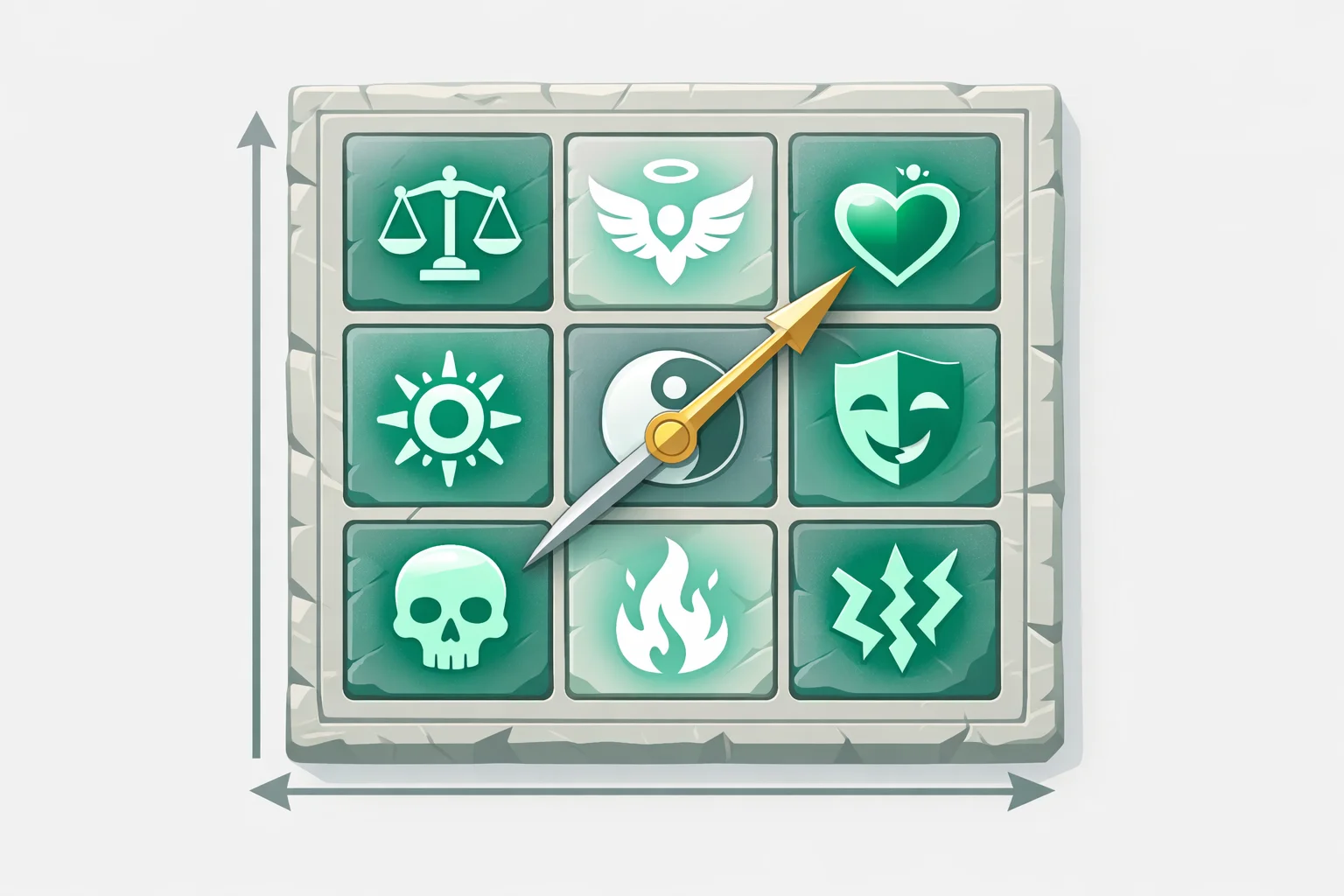
Lawful Good Doesn't Mean Nice (and Chaotic Doesn't Mean Random)
The law–chaos axis is not about how well-behaved you are. It asks a single question: when your conscience and an agreed rule point in different directions, which one do you treat as the tie-breaker? Lawful answers "the rule, and if the rule is wrong I'll change the rule." Chaotic answers "my conscience, and the rule can catch up." Both of those are principled. Neither one is politeness.
Good and evil is a separate question entirely, and it has one useful test: who ends up carrying the cost of your decision? Good absorbs cost to spare someone else. Evil lets the cost land on somebody who didn't choose it. Notice that neither definition mentions cruelty. Most of what reads as evil in real life is just cost being quietly redirected by someone who was very reasonable about it.
Meet Halvard, Who Has Been Shorting the Grain for Eleven Years
Halvard owns the only grain scale in a town of four hundred people. For eleven years he has kept it about four percent light — never enough to notice in one sack, more than enough to have bought him a second barn. You have just found the ledger where he tracks it, because Halvard is meticulous, and meticulous people write things down.
Here is what turns it from arithmetic into an actual dilemma. Halvard is also the only person in town who extends credit through winter. Twenty families are carrying his paper right now. Ruin him in March and the fields don't get planted in April. You have the ledger, it's Thursday night, and whatever you do on Friday is the thing you do.
One Ledger, Nine Different Fridays
This is where the grid earns its keep. Nine people, one ledger, and no two Fridays that look remotely alike:
| Alignment | What they do with the ledger | What it costs |
|---|---|---|
| Lawful Good | Takes it to whatever authority exists, on the record — then organises the winter credit himself so the families aren't collateral. | It is slow, and slow has a body count. |
| Neutral Good | Confronts Halvard alone with one demand: repay the town, keep the credit line open, or the ledger goes public. | She is now the only person who knows. That is a weight. |
| Chaotic Good | Nails the numbers to the mill door overnight, unsigned. | The town gets the truth and no plan. April is someone else's problem. |
| Lawful Neutral | Files it. The scale is a matter for whoever regulates scales; the credit question is a separate matter for whoever regulates credit. | Two correct processes, neither in any hurry. |
| True Neutral | Makes Halvard fix the scale, and says nothing about the eleven years. | Nobody is punished and nobody is repaid. The town stays exactly as broken as it was. |
| Chaotic Neutral | Keeps the ledger. Doesn't use it. Enjoys knowing. | Nothing. Yet. |
| Lawful Evil | Keeps the ledger and becomes Halvard's silent partner. Every rule still obeyed, in writing. | To the town, ongoing and compounding. |
| Neutral Evil | Sells it to whoever pays most — Halvard, a rival merchant, or the families themselves. | Whatever it costs them. That was never the deciding factor. |
| Chaotic Evil | Burns the mill. | The grain, the credit, the winter, everyone. |
Read the first three rows again. All three want the identical outcome — Halvard stops stealing and the families survive to spring — and not one of them can stand the others' method. The lawful good route looks like cowardice to the chaotic one. The chaotic good route looks like arson-adjacent recklessness to the lawful one. That disagreement is invisible to any test that gives you a single morality score, and it is the single most useful thing the alignment grid does.
Now read rows four to six. Not one of those people is cruel. Read the cost column anyway. This is why "neutral" is the hardest row to sit in honestly, and why our quiz spends six full questions in Act III trying to find out whether your neutrality is a position or an average.
Why Two Axes Beat One Score
Every question in this quiz carries two numbers: one on law–chaos, one on good–evil, each running from −2 to +2. Both totals are converted to a 0–100 scale, and the bands are set at 46 and 54 — below 46 you are lawful (or good), above 54 you are chaotic (or evil), and the eight points in between are the neutral column.
One design decision matters more than all the others, and most alignment tests skip it. Every question's four options sum to exactly zero on both axes. Without that constraint, whichever alignment is touched by more answer options wins by default. Our first draft of this quiz had no such rule, and it handed out chaotic good 22% of the time — not because chaotic good is common, but because we had accidentally written more chaotic-flavoured options than lawful ones. Balancing every question fixed it. Across 300,000 simulated answer paths, the nine alignments now land between 9.5% (true neutral, the rarest) and 12.7% (lawful good, the most common). No box is a trap and no box is a default.
If you like this kind of axis-based sorting, the MBTI quiz runs the same logic across four axes measuring how you take in information rather than what you do with a moral problem, and the Enneagram quiz reaches nine types by a completely different route — core motivation and core fear rather than method and cost. And if you want the other half of the character sheet, the D&D class quiz sorts on the six ability scores instead of the moral grid — alignment is what you do with power, class is what kind of power you have in the first place. For a three-axis version of the same argument, the Legend of Zelda character quiz scores Courage, Wisdom and Power and then reads the gap between your highest and lowest rather than the totals — which is how it can tell Ganondorf apart from Impa on the same dominant virtue. The Arcane character quiz borrows this page's zero-sum rule outright and then does something the nine-box grid can't: it plots you and all ten characters on the same map, so you can see the distance between where you landed and where Jinx or Caitlyn actually sits. Alignment tells you which box you're in; that one shows you how far you are from the edge of it.
The Number Most Alignment Tests Don't Bother Measuring
Here's a problem nobody talks about. Two people both score 50 on good–evil and both get told they're neutral. The first weighed every question carefully and genuinely declined to pick a permanent side. The second answered saintly on questions 1 through 9 and ruthless on 10 through 18, and the average happened to land in the middle. Those are opposite people, and almost every alignment test on the internet gives them the same result with the same description.
So we measure a second thing: swing, the mean deviation of your individual answers from your own average. Low swing means you answered from a settled position. High swing means your label is an arithmetic artefact of very different answers. Under random answering, swing clusters between 56 and 71 — so anything below 42 is a real signal that you have a consistent stance, and it is essentially impossible to reach by clicking at random.
Conviction is the companion number: how far your dot sits from dead centre of the grid. Under random answering the median conviction is 21%. If yours came out under 25, you are close enough to two or three borders that a bad week would relabel you — which is the honest answer for a lot of people, and far more useful than a confident label the quiz has no business giving you.
Psychologists Rebuilt This Grid Without Meaning To
Here's the part that surprised us while building this. Shalom Schwartz's Theory of Basic Human Values, developed from 1992 onward and since tested in more than 80 countries, arranges ten universal human values on a circle defined by two opposing pairs. One pair is self-transcendence against self-enhancement — benevolence and universalism on one side, power and achievement on the other. The second pair is openness to change against conservation — self-direction and stimulation against tradition, conformity and security.
Those are the alignment axes. Self-transcendence versus self-enhancement is good versus evil with the moralising removed. Openness versus conservation is chaos versus law almost word for word. A group of cross-cultural psychologists working from survey data reconstructed, in the 1990s, the same two-dimensional space a wargamer had sketched out for a fantasy rulebook in 1977. Moral Foundations Theory lands in a similar place from another direction: its care/harm foundation tracks the good axis, while loyalty and authority track the lawful one.
That doesn't make alignment a validated psychological instrument. It does mean the grid isn't arbitrary. It survived fifty years of use because it happened to carve moral decision-making close to where the joints actually are.
Where the Grid Came From, and Why It Nearly Disappeared
Original D&D in 1974 had three alignments, not nine: lawful, neutral, chaotic. It borrowed them nearly wholesale from Poul Anderson's Three Hearts and Three Lions and Michael Moorcock's Elric stories, where Law and Chaos are literal cosmic armies rather than personality descriptors. Being "lawful" in 1974 meant enlisting on a side of a metaphysical war, which is why reading it as "follows rules" produces such odd results.
The good–evil axis arrived with Advanced D&D. By the 1977 Monster Manual, creatures were already being tagged across all nine boxes, and the 1978 Player's Handbook set the grid out properly. For a couple of decades alignment carried real mechanical weight — spells, magic items and class eligibility all keyed off it.
Then it was quietly dismantled. Fifth edition in 2014 kept alignment on the character sheet while stripping nearly all its teeth; the spell Protection from Evil and Good famously doesn't check alignment at all, it checks creature type. More recent monster books dropped alignment lines from stat blocks entirely, and the current rules treat it as descriptive flavour. The full design history is worth a read if you want the arguments in detail. The short version: alignment failed as a rule and thrived as a lens — which is exactly the job it does here.
Gygax wasn't the first person to try this, either. Fourteen centuries earlier, Gregory the Great settled on seven appetites and ranked them by severity — a single ordered list where D&D uses two crossed axes. Our seven deadly sins quiz scores you against that older taxonomy, and running both is genuinely instructive: alignment asks what you would choose, the sins ask what you already want. Lawful good people with a loud envy score are the most interesting readers of both pages.
All 9 Alignments, Described
Percentages below are the share of 300,000 simulated answer paths through these eighteen questions that land in each box. They describe how the quiz behaves, not how humanity is distributed — real people answer considerably more "good" than random chance does.
⚖️ Lawful Good — The Crusader (12.7%). Believes the right thing and the correct procedure are usually the same thing, and when they aren't, fixes the procedure. Wins slowly and cleanly by preference. Its weakness is loyalty to systems past the point where they work, because taking one apart feels like vandalism.
🕊️ Neutral Good — The Benefactor (10.0%). The hardest alignment to fake, because it has no ideology to shelter behind. Uses a rule when the rule helps and drops it when it doesn't, with no feelings about rules either way. The cost is that every decision has to be made from scratch, forever.
🔥 Chaotic Good — The Rebel (11.4%). Treats every rule as a claim that must earn its keep and routes around the ones that can't. Fast, direct, personally involved. What it loses is leverage: people who agree with it completely still can't predict it, and unpredictable allies get handed fewer keys.
📜 Lawful Neutral — The Judge (11.4%). Holds that consistency is itself a moral good, because a rule that bends for sympathetic people bends for powerful ones too. Not cold — principled in a way that is easy to mistake for cold. Its blind spot is that a process can run perfectly while pointed at entirely the wrong thing.
☯️ True Neutral — The Balance (9.5%). The rarest result here. Refuses to hand any single principle the whole steering wheel. Arrives either by deliberate case-by-case weighing or by swinging between poles until the average lands in the middle — and the swing figure on the result card is what separates those two very different people.
🎲 Chaotic Neutral — The Free Agent (11.3%). Defends its own freedom consistently and treats everything else as negotiable. The coherent version has concluded that nobody steering it has its interests at heart. The arithmetic problem is that someone who won't be relied on eventually stops being asked.
♟️ Lawful Evil — The Sovereign (11.1%). The most functional alignment on the grid, which is what makes it frightening. Uses contracts, hierarchies and procedure as the instrument, so every step is defensible on paper while the cost lands elsewhere. In fiction it runs empires. In practice it mostly writes the terms and conditions.
🐍 Neutral Evil — The Opportunist (10.2%). The alignment with the least theatre: no code, no chaos, no plan, just a steady willingness to let the bill land on someone else. Most people who score here answered as pragmatists in bad situations, which is exactly what neutral evil looks like from the outside.
🩸 Chaotic Evil — The Destroyer (12.5%). Gives neither rules nor conscience a veto, and would rather it were loud. It is the alignment nobody claims and the one this quiz produces most often, which usually means the entertaining answer was picked over the honest one. Check your swing figure before you take it personally.
What Your Result Is Actually Good For
Don't use the label. Use the border reading. Knowing you're lawful good is mildly interesting; knowing you are 2.3 points from neutral good tells you precisely where you stop trusting process, and that is a thing you can actually watch for. Everybody has a border they slide across under pressure, and it is almost always the more revealing half of the result.
If you're building a character rather than examining yourself, take both axis numbers rather than the box. A lawful good paladin sitting at 44 on law–chaos plays completely differently from one sitting at 11, and the border reading hands you a ready-made arc to drift along across a campaign. For a sorting system that deletes the good–evil axis entirely and asks only which single virtue you would build a society around, the Divergent faction quiz is the closest cousin to this one — and your lightsaber colour is the same moral question with the saturation turned all the way up.
And if the result annoyed you — genuinely, not performatively — that is worth more than agreeing with it. Go back to the three questions in Act III that were hardest to answer. The alignment grid was never a diagnosis. It is a way of noticing what you reach for when every available option costs somebody something, and there is no version of Friday where you get to keep the ledger and the town both. For the same question with the stakes raised to lethal — and a grid that swaps good-versus-evil for four measured axes — the Death Note morality quiz asks whether you would use the notebook, and then asks what your yes was actually made of.