Five Things Everyone Gets Wrong About Boggarts
The boggart quiz above sorts you on fear, which is funny, because the creature it is named after had nothing whatsoever to do with fear for about four hundred years. In Lancashire and Yorkshire folklore a boggart was a household nuisance. It soured the milk, lamed the dog, and pulled the blankets off you at three in the morning. It was closer to a bad tenant than a monster.
Rowling kept the name, kept the habit of living in dark enclosed spaces, and threw out everything else. What she put in its place is one of the most psychologically precise creatures in the books — and almost everything people believe about it is slightly wrong, including the part that makes this quiz work. Here are the five misconceptions worth clearing up before you argue with your result.
The Boggart You Can't Move House to Escape
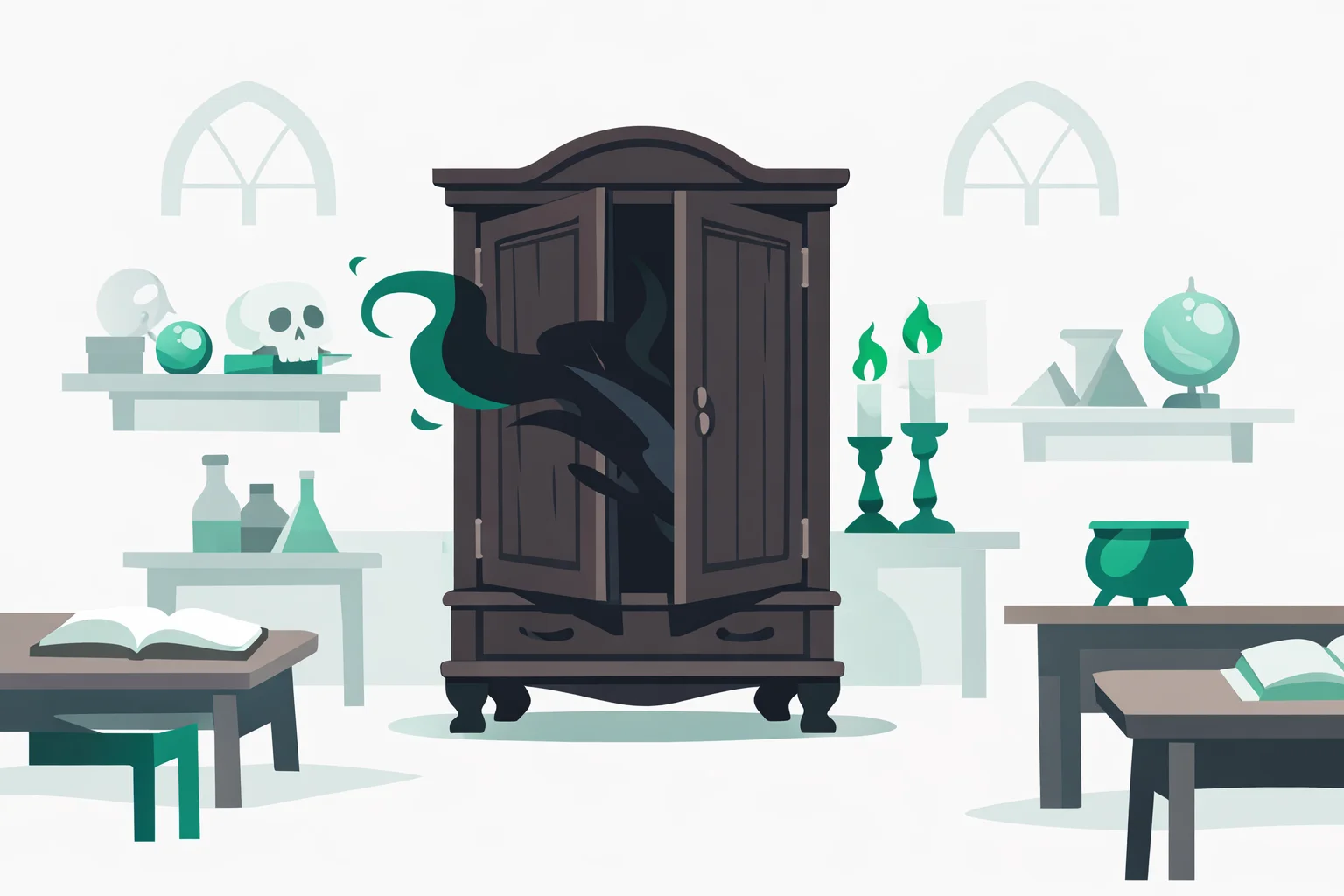
The old stories are worth two minutes because they explain the one detail Rowling did keep. In the folklore, a boggart attaches to a household rather than a place, and the most repeated tale in the collections — it turns up in nineteenth-century folklore anthologies and has been retold ever since — involves a farming family who finally give up and load the cart to move away. As they set off, a voice pipes up cheerfully from among the pots and pans: Aye, we're flitting. The boggart packed itself. There is a public park in north Manchester still called Boggart Hole Clough, named after one that supposedly lived in the valley.
That is the bit that survives into the Wizarding World intact. A Boggart is not something you can leave behind by changing address, and Lupin's list of hiding places — wardrobes, the gap beneath the bed, the cupboard under the sink, one he personally met lodged in a grandfather clock — is a list of places inside your own home. The fear is already living with you. The quiz just opens the door.
Myth 1: A Boggart Shows Your Worst Fear
It shows your nearest fear, and the difference is the whole engine of the scene in Prisoner of Azkaban. Harry's Boggart becomes a Dementor. Voldemort is unambiguously the worse thing in Harry's life — he murdered Harry's parents and has tried repeatedly to murder Harry — and yet the Boggart does not reach for him. It reaches for the cold drop Harry felt on the Hogwarts Express a few weeks earlier.
Lupin reads this correctly and generously: what Harry fears most is fear itself, and that is wise rather than cowardly. But there is a mechanical lesson underneath the compliment. Boggarts read your current state, not your biography. Hermione's exam Boggart is McGonagall telling her she failed everything — a fear that would have been nowhere near the top of her list six months earlier, and was sitting right at the surface the moment she walked out of an examination room.
This is why the quiz asks about last night, this week, and the last thing that went wrong, rather than asking you to nominate your greatest fear. Nominated fears are curated. If you want a result that would actually match the wardrobe, answer as the version of you that exists today, not the version who has had time to think about it.
Myth 2: Courage Is What Beats a Boggart
Riddikulus does not require bravery. It requires you to hold a specific, absurd, deliberately constructed image in your head while something frightening is standing in front of you — and to laugh. Those are completely different skills, and the second one is much stranger than the books let on.
Psychology has a name for the manoeuvre: reappraisal. You do not suppress the emotional response, you change the meaning of the thing producing it, and the response follows. Andrea Samson and James Gross published a study in Cognition & Emotion in 2012 splitting humour into positive and negative varieties and testing them as regulation strategies — and found that good-natured, benevolent humour produced better emotional outcomes than the mean-spirited kind. That is Riddikulus described in a lab. Neville does not humiliate Snape by imagining something cruel. He imagines his grandmother's clothes, which is affectionate, ridiculous, and completely disarming.
The queue in front of the wardrobe is the second half of the method. Lining students up to face a fear repeatedly, in a controlled setting, with a rehearsed response ready, is a rough sketch of exposure therapy as the American Psychological Association describes it. Lupin gets one thing wrong, though, and it costs Harry: he tries to skip Harry's turn. Avoidance handed out as kindness is still avoidance.
Myth 3: Everyone's Boggart Is Basically a Spider
Ron's Acromantula is the most famous Boggart in the series and the least representative one. Instinctive fears — spiders, heights, the dark — feel like the obvious Boggart material because they are the ones with a physical reaction attached. But when researchers actually survey what adults are afraid of, those objects rank surprisingly low. Chapman University has run an annual Survey of American Fears since 2014, and the top of that list is reliably occupied by fears about corruption, security, and things happening to people you love. Spiders come nowhere near it. Ron's is also not really about spiders: Fred turned his teddy bear into one after Ron broke a toy broomstick, which makes it a sibling injury wearing eight legs — the sort of thing the Weasley family quiz is built to pick apart.
That gap is what the scoring model on this page is built around. Rather than sorting you straight into a creature, every answer feeds six fear axes, and the Boggart form is derived from which two are carrying the most weight:
| Fear axis | What it sounds like at 2 a.m. | Boggart forms it produces |
|---|---|---|
| Losing People | “I haven't heard from them in too long.” | The Covered Bodies, The Empty House |
| Not Being Enough | “Eventually somebody qualified will check my work.” | The Failing Mark, The Stopped Clock |
| Losing Control | “They decided it without me in the room.” | The Door That Won't Open |
| Being Seen | “The room went quiet after I said it.” | The Silent Crowd |
| What You Might Become | “That sounded exactly like my father.” | Your Own Face, The Full Moon |
| The Old Animal Fear | “Something moved and I was already on my feet.” | The Acromantula |
There is one piece of arithmetic behind that table worth admitting to, because the first version of this quiz got it wrong. Six axes spread across seventy-three answer options never divide evenly — instinct turns up in noticeably fewer of them than self-directed fear does — and if you score the raw totals, the axis that simply gets asked about more often wins by default. That first draft handed out the Acromantula 1.4% of the time, which is not a finding about human fear, it is a finding about badly weighted questions. Every score on this page is now read as distance from the quiz's own baseline instead, which puts the Acromantula at roughly one taker in twelve — low, but low for a real reason. Instinctive fear is genuine; it is just rarely the loudest thing in an adult head. If you want the version of this that measures which character you resemble rather than what frightens you, the Harry Potter character quiz runs on an entirely different set of questions.
Myth 4: Facing It Alone Is the Braver Version
Lupin teaches the opposite, explicitly, and the plot proves him right twice. A Boggart is at its most dangerous with a single person in the room because it has exactly one mind to read. Put a class in front of it and it becomes confused about who to frighten — which is precisely why the lesson is run as a group exercise rather than a series of private appointments. It is also why the wardrobe scene is set in Defence Against the Dark Arts and not assigned as homework.
The proof of the rule is Molly Weasley at Grimmauld Place in Order of the Phoenix. She goes into a room alone to deal with a Boggart, it shows her the bodies of her children one after another, and she cannot finish the spell. Lupin has to step in and cast it for her. Nobody in that scene thinks less of her — the point being made is structural. Some fears cannot be made ridiculous by the person holding them, and the fix is not more willpower. It is another person in the room.
Myth 5: Your Boggart Is Fixed for Life
Fear content moves, and it moves in a direction that is well documented. Small children are frightened of animals, the dark, and imaginary figures. Adolescents shift hard toward social evaluation — being watched, judged, excluded. Adults migrate again, toward loss, illness, money, and things happening to people they are responsible for. The object changes; the machinery underneath does not.
So a nine-year-old whose Boggart would have been a spider can absolutely become a forty-year-old whose Boggart is an empty house, and nothing has gone wrong in between. That is just the ordinary migration. What it means practically is that this quiz has a shelf life. Take it again in three years and the most common outcome is not a brand-new result — it is your top two fear axes swapping places, which usually tells you more than the headline result did.
So What Does a Boggart Look Like When Nobody's Watching?
Nobody knows, and Lupin says so outright when Hermione asks. The moment a Boggart is observed it becomes whatever the observer fears, so its unobserved form has never been witnessed by anyone in a position to report it. It is the closest thing the Wizarding World has to a genuine measurement problem — the act of looking is what creates the thing you see.
There is a small logical trapdoor here that the books never pick at. A person who could not see would presumably encounter something else entirely, and a Boggart alone in a dark cupboard for a decade has no shape at all, which raises the mildly horrible question of what it is doing in there. The honest answer is that Rowling built the creature as a mirror rather than a monster, and mirrors are not interesting when the room is empty.
Your Boggart and Your Patronus Are the Same Question
These two pieces of magic are the only ones in the series that read your interior life directly and then hand you a picture of it. One shows you the shape of what you cannot control. The other shows you the shape of what you reach for when it turns up. Harry is the case study: his Boggart is a Dementor and his Patronus is the stag that drives Dementors off. The fear and the defence are pointed at the same target.
For most people the pairing is less tidy, and the mismatch is the interesting part. People whose Boggart is the Silent Crowd often produce loud, showy Patronuses, because a guardian tends to compensate for the fear rather than echo it. If you want the other half of your reading, the Harry Potter Patronus quiz runs the same fifteen-minute honesty test from the opposite direction — and comparing the two results is where this stops being a quiz and starts being a slightly uncomfortable conversation with yourself.
There's a third angle on the same interior, and it's much older than either spell. Medieval theologians sorted people by appetite rather than fear — the seven deadly sins quiz asks what pulls at you instead of what corners you. The two readings are related far more often than chance allows: a Boggart shaped like the Silent Crowd tends to sit above a pride or envy result, because both are answers to the same question about being watched.
All 10 Boggart Results and What They Mean
🕯️ The Covered Bodies — Molly Weasley's Boggart, and the one that fights back hardest against Riddikulus. Your fear lives in other people rather than in you, which is why it has no floor. You are the person who notices when someone has gone quiet, and also the person who has already imagined the phone call. The cost is that rehearsing a loss is not preparing for it; it is paying for it early, in instalments, at full price.
🏚️ The Empty House — Not death, departure. You are far more afraid of being left than of being hurt, and the tell is that you keep a private ledger of who initiated the last three conversations. It makes you excellent at the unglamorous maintenance work of friendship. It also means you will take being needed over being loved for years rather than risk asking for the second one.
📜 The Failing Mark — Hermione's, and the result people argue with hardest. The fear is not failure itself but the verdict, delivered by someone qualified to deliver it, on the record. It buys you real standards applied to yourself first. It costs you the ability to hear a compliment as anything other than a stay of execution.
⏳ The Stopped Clock — There is an age in your head by which certain things were meant to have happened, and every birthday quietly audits it against a timetable nobody gave you. This one is cruel because it looks like ambition from the outside, so people keep congratulating you for the thing eating you. Your urgency does convert, though. You finish while others are still deciding whether to begin.
🚪 The Door That Won't Open — Not the room; the handle that turns and does nothing. Being trapped bothers you more than being hurt, and you can name the exact situations that do it. You build exits for a living — contingency plans, side doors, second options nobody asked for — and roughly once a year that habit saves everyone involved. The risk is mistaking having options for having a life.
👁️ The Silent Crowd — Neville's territory, and worth remembering how his story ends. The fear is not public speaking but the verdict afterwards, which is why you replay conversations at 3 a.m. with the audio slightly wrong. You read rooms with real accuracy. You also edit yourself down to something safe and then resent the room for never meeting the unedited version.
🪞 Your Own Face — The only result where your fear is entirely about you. Somewhere there is a trait you watched in a parent or a boss, and you made a private promise about it, and you have been checking ever since. That checking is the single best predictor that you will not become it — people who do become it are famously not checking. The cost is that you have never been on your own side without a caveat attached.
🌕 The Full Moon — Lupin's exact Boggart, described in the books as a silvery-white orb. Your fear is not of what the world does to you but of a capacity you know you have: a temper with a shape, an appetite, a version of you that surfaces under specific pressure. Lupin's whole arc is the argument against panicking about it — he built a life around managing the thing rather than pretending it was not there. It is also the reason three of his friends taught themselves an illegal transformation rather than let him face it alone, which the Marauders era quiz builds its whole scoring model around.
🕷️ The Acromantula — Ron's, and the easiest Riddikulus in the book because instinctive fear has no argument to make. Your alarm fires before your reasoning does and the reasoning never quite catches up. There is a genuine advantage in that: your fear system is honest, uncomplicated by self-image, and already moving while everyone else is asking what the noise was.
🌑 The Dementor — The rarest result, at roughly five takers in a hundred, and the only one you cannot earn by being afraid of something specific. It appears when all six fear scores come out level, so no single fear carries the load and the Boggart cannot commit to a shape. What is left is the sensation underneath all of them: the cold that arrives a few seconds before the reason. Lupin called that wisdom, and he was not being polite.
The Wardrobe Doesn't Stay Shut
Do one thing with this result rather than screenshotting it and moving on. Look at your second-highest fear axis — not the leading one, the runner-up. The leading axis is usually the fear you already know about and have some language for. The runner-up is the one doing quiet work in the background, and it is almost always the better explanation for a specific decision you have made recently and cannot quite justify.
Then take the thing Lupin actually taught, which was never really about wardrobes. Fears shrink when they are named out loud, given a ridiculous shape, and faced with somebody else standing next to you. That is three separate instructions and most people only ever manage the first. If your result was one of the hard ones — the Covered Bodies, the Dementor — the third instruction is not optional advice, it is the actual mechanism, and Molly Weasley alone in that room at Grimmauld Place is the proof.