How Ilvermorny Sorting Actually Works (and Why It Isn't Hogwarts)
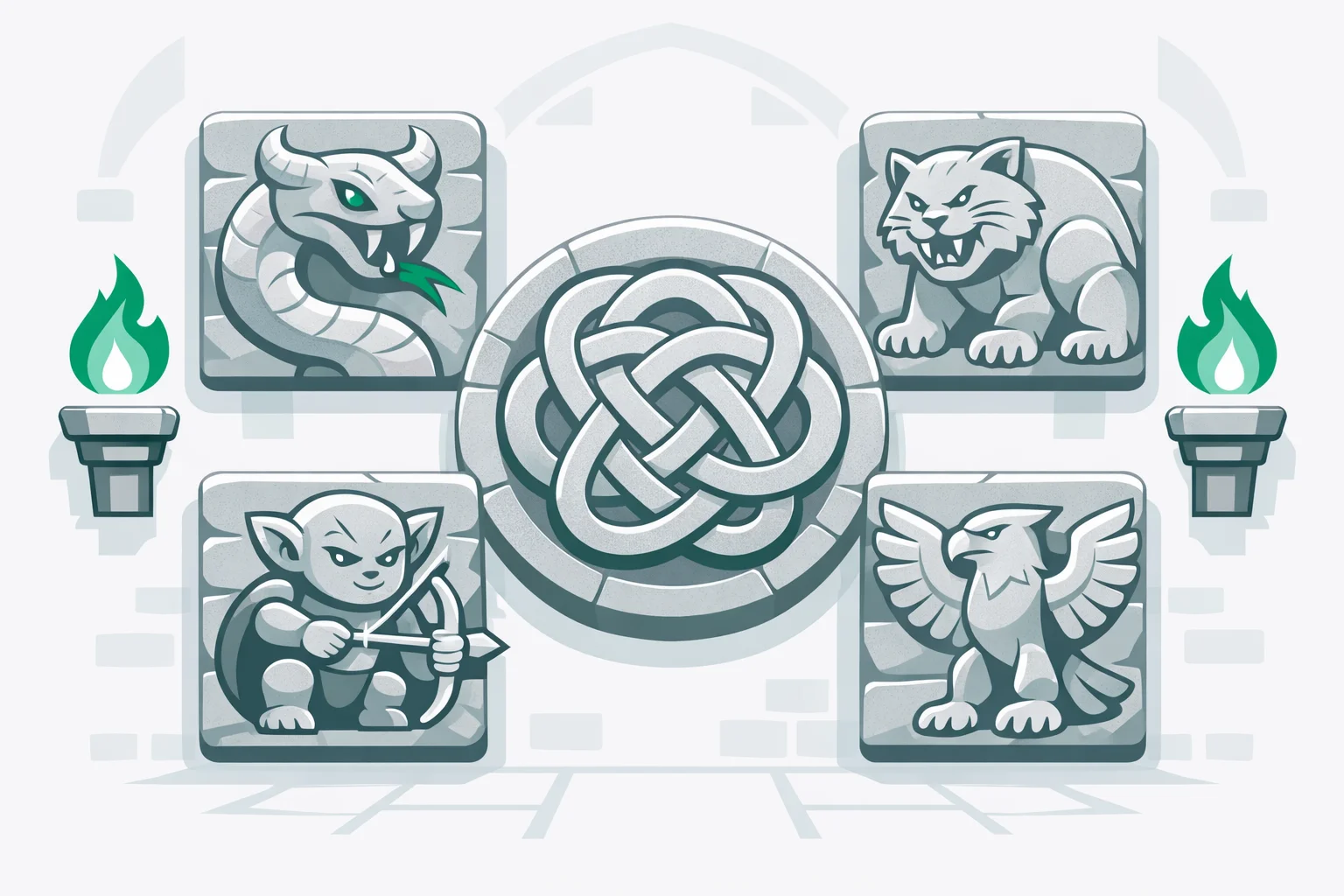
The Ilvermorny house quiz above sorts you the way the school actually does it, which is nothing like the Sorting Hat. Picture the real thing: you are eleven, you have just come up Mount Greylock, and you are standing on a Gordian Knot carved into the granite floor of the entrance hall. Nobody puts anything on your head. Nobody asks you a single question. Four wooden creatures are mounted around the walls, and the entire school watches in silence to see whether any of them move.
Then the crystal in the Horned Serpent's forehead lights up. Or the Wampus roars. Or the Pukwudgie raises its arrow, or the Thunderbird beats its wings. And here is the part almost every sorting quiz on the internet quietly leaves out — sometimes two of them react. Sometimes more. When that happens, the school does not break the tie. You do.
Four Founders, Four Ideas About Magic
Hogwarts named its houses after the four people who founded it. Ilvermorny did the opposite, and the difference matters more than it sounds.
Isolt Sayre fled Ireland in the 1620s to escape her aunt Gormlaith Gaunt, ended up on Mount Greylock in Massachusetts, and built a school out of a granite cottage with her No-Maj husband James Steward and two adopted sons, Chadwick and Webster Boot. When it came time to name the houses, they did not name them after themselves. Each of the four picked a magical creature they admired — and that choice said everything about what they personally thought magic was for.
Isolt chose the Horned Serpent, whose shed horn had become the school's first wand core. Chadwick chose the Thunderbird. Webster chose the Wampus. And James Steward — a man with no magic at all, helping found a wizarding school — chose the Pukwudgie, after the small, foul-tempered creature that had saved his family and never once admitted to liking them. Four houses, four completely different answers to the same question.
The Axis Hogwarts Doesn't Use
This is the thing to understand before you argue with your result. Hogwarts sorts you on values — bravery, ambition, wit, loyalty. Those are things you admire and, as the Sorting Hat is happy to remind you, things you can choose. Ilvermorny sorts you on something else entirely: which faculty you lead with. Mind, body, heart, or soul. Not what you value. What fires first.
| House | Represents | Favours | Named by | How the carving reacts |
|---|---|---|---|---|
| 🐍 Horned Serpent | The mind | Scholars | Isolt Sayre | Crystal in its forehead lights |
| 🐆 Wampus | The body | Warriors | Webster Boot | It roars |
| 🏹 Pukwudgie | The heart | Healers | James Steward | It raises its arrow |
| ⚡ Thunderbird | The soul | Adventurers | Chadwick Boot | It beats its wings |
Look at question 5 in the quiz — the classmate who collapses in the corridor. Every option is a decent thing to do. The quiz is not asking which is right. It is asking which one your body does before your brain catches up. Going to the person is heart. Going to the source of the spell is body. Reconstructing what went wrong is mind. That is the whole design, repeated twenty times from different angles so you cannot game it.
Three of These Creatures Were Real First
Here is something most Ilvermorny articles never mention. These are not invented creatures with invented names. Three of the four come from Indigenous North American traditions that pre-date the Harry Potter books by centuries.
The Pukwudgie comes from Wampanoag folklore in southeastern New England — a knee-high, grey-faced being, sometimes helpful and sometimes lethal, famous for taking offence. The Thunderbird appears across a huge range of traditions, from the Plains to the Pacific Northwest, as a being whose wingbeats are the thunder itself. Horned serpents run through Mississippian and Southeastern iconography, including the Cherokee Uktena, usually as water-dwelling beings with a jewel or crest on the head. Only the Wampus cat comes from a more recent and much more tangled Appalachian tradition.
Why does this matter for your sorting? Because it explains the tone of each house. These creatures were not designed as tidy mascots for four personality types — they arrived with their own baggage. The Pukwudgie is prickly and independent, which is why Pukwudgie house is nothing like Hufflepuff no matter how many charts say otherwise. The Thunderbird brings storms, which is why Thunderbird students tend to be disruptive rather than merely curious.
When Two Carvings Wake at Once
At Hogwarts, a long deliberation is called a Hatstall and it still ends with one house. At Ilvermorny, multiple houses can simply want you at the same time, and the rule is that the student chooses. It is the single most interesting mechanic in either school and almost nobody builds a quiz around it.
The most famous case is Seraphina Picquery, who would go on to become President of MACUSA. All four carvings reacted for her — the only recorded instance in the school's history. She chose Horned Serpent. Note what that story actually says: the school did not decide she was a Horned Serpent. She decided.
The quiz above reproduces this. Instead of tallying one point per answer and crowning a winner, it scores all four houses on every question, with most options awarding a primary house three points and a secondary house one. Any house that finishes within 8% of the leader also claims you — and then you get the same screen an eleven-year-old gets on Mount Greylock, with two or three or four carvings awake and a decision to make.
We ran 200,000 simulated sortings through that scoring model to check the ceremony was actually rare rather than just theatrical. One carving woke 78.6% of the time. Two woke 18.8%. Three woke 2.5%. And all four — the Picquery — came up 0.13% of the time, or roughly once in every 770 sortings. Answer consistently and your odds of a single clean sort go up, because the ceremony is triggered by genuinely split answers rather than by luck.
Why the Choosing Is Harder Than the Sorting
People find the ceremony screen genuinely uncomfortable, and that reaction is worth paying attention to. Being handed a result is passive — you can accept it, argue with it, or shrug. Being asked to pick your own identity out of two true options is a different thing entirely, because whichever you take, you are also declaring what you are not.
Psychologists studying self-concept have a decent name for what makes this hard: identity claims feel binding in a way preferences do not. Saying you enjoy solving problems costs nothing. Saying "I am someone who leads with my mind, not my heart" sounds like a confession about every relationship you have ever had. That is why people stall on the screen, and it is also why the choice tells you more than the score does. Notice which one you reached for and which one you had to talk yourself out of.
If you want the reverse experience — a sorting that gives you no say whatsoever — the Percy Jackson cabin quiz is the purest version of it. At Camp Half-Blood you are claimed by a parent you did not pick and cannot refuse. Taking both back to back is a surprisingly good way to find out which model of identity you actually believe in.
Your Hogwarts House Doesn't Predict This
There is a chart that circulates every few months mapping each Hogwarts house onto one Ilvermorny house. It is wrong, and it is wrong for a structural reason rather than a fandom-opinion reason: the two schools sort on different axes, so there is no clean function from one to the other.
| Hogwarts house | The assumed match | Why it breaks |
|---|---|---|
| Ravenclaw | Horned Serpent | Ravenclaw is about valuing knowledge. Plenty of Ravenclaws value it precisely because they lead with feeling and want a defence against it — those land in Pukwudgie. |
| Gryffindor | Wampus | Splits almost evenly. Courage that shows up as physical nerve is Wampus; courage that shows up as refusing the life you were handed is Thunderbird. |
| Hufflepuff | Pukwudgie | The weakest mapping of the four. Hufflepuff is loyalty and fair play; Pukwudgie is emotional perception, which plenty of blunt and difficult people have in excess. |
| Slytherin | Thunderbird | The most contested. Ambition aimed at status reads Horned Serpent or Wampus far more often than Thunderbird, which is about restlessness rather than climbing. |
The honest version is that about a third of people get a combination that breaks the chart entirely. If you want to test it on yourself, take the Harry Potter house quiz and compare the two results side by side. The pairs that feel contradictory are usually the most accurate, because they are picking up two different things about you rather than the same thing twice. And if you want the third data point, your wand core maps onto Ilvermorny more tightly than either house system — three of the four great American wandmakers built cores from these exact creatures.
All 4 Ilvermorny House Results
🐍 Horned Serpent — the mind, favours scholars. Named by Isolt Sayre herself, after the river serpent whose shed horn became the school's first wand core. Horned Serpents reach for the mechanism before anything else and find a half-explained answer physically uncomfortable. That is not the same as being clever; it is about what your first move is. The cost is real, though — you can model a decision so completely that the window to make it closes while you are still working.
🐆 Wampus — the body, favours warriors. Named by Webster Boot for the six-legged magical cat whose hair became one of America's four great wand cores. Wampus students trust their body's read on a situation faster than their reasoning about it, and would rather be wrong at speed than right too late. The house is broader than "fighter" — it is anyone who steps forward and absorbs the impact. The weakness is that momentum becomes the default answer to every kind of discomfort, including the kind that needed stillness.
🏹 Pukwudgie — the heart, favours healers. Named by James Steward, the No-Maj who helped found a wizarding school, after a creature from Wampanoag legend that saved his family and stayed rude about it. Pukwudgies register the temperature of a room before the content of it, and cannot switch that off. Warmth is optional here; perception is not, which is why plenty of blunt people belong in this house. The danger is absorbing other people's states as if they were your own weather.
⚡ Thunderbird — the soul, favours adventurers. Named by Chadwick Boot for the storm-bringing bird, and his own Thunderbird-feather wand was famously difficult for anyone else to handle. Thunderbirds are pulled rather than pushed — their sense of self depends on movement, new problems, new versions of the work. Standing still does not bore them so much as slowly stop feeling like them. The flaw is a trail of projects abandoned at ninety percent, right where the interesting part ended.
After the Carvings Go Quiet
Do not stop at the house name. The genuinely useful output of this quiz is the faculty breakdown underneath it — four bars showing how your twenty answers distributed across mind, body, heart, and soul. A 40/30/20/10 spread describes a very different person than a 28/26/24/22 spread, even when the top house is identical.
A tight spread means you switch faculties depending on the situation, which is a real advantage and a real problem. It makes you adaptable and it makes you inconsistent, and the people who work with you will have noticed the second thing before you noticed the first. A wide spread means your lead faculty is doing almost all the work — powerful in the situations it fits, genuinely costly in the ones it does not.
So the useful question is not which house claimed you. It is your second bar. That is the faculty you have available but do not reach for by default, and it is almost always the one the difficult parts of your life are asking you to use.