Hogwarts Class Quiz: Every Hogwarts Subject Ranked and Explained
The Hogwarts class quiz above just sorted you into a magical discipline — but the system behind it has roots deeper than most fans realize. Picture a fourteen-year-old sitting in Snape's dungeon classroom, steam rising from a cauldron that's about to explode because they added the porcupine quills before taking the potion off the fire. That student isn't failing Potions because they're stupid. They're failing because their brain works in a way that Potions doesn't reward — and a different Hogwarts classroom would light them up entirely.
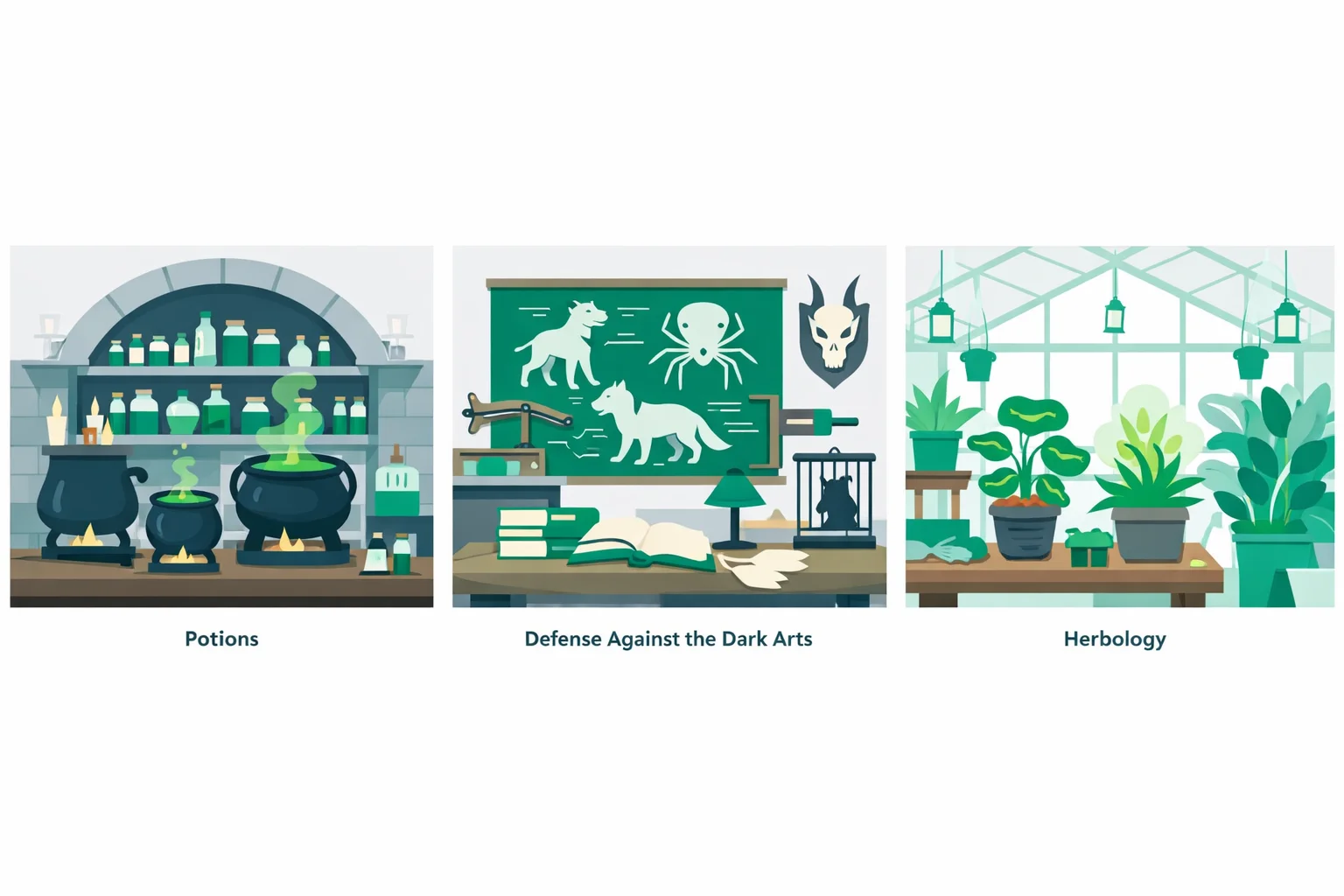
The Hogwarts Curriculum Wasn't Random — It Was a Medieval Guild System
J.K. Rowling didn't invent the seven-subject structure out of thin air. British boarding schools like Eton and Winchester — both founded in the 1300s and 1400s — organized their curricula around a medieval trivium and quadrivium model: grammar, rhetoric, logic, arithmetic, geometry, music, and astronomy. Hogwarts mirrors this almost exactly, swapping Muggle subjects for magical equivalents. Transfiguration maps to the logical-mathematical discipline. Charms corresponds to the creative arts. History of Magic is the grammar/rhetoric tradition. Potions follows the alchemical guild apprenticeship model that predates formal universities entirely.
That isn't a coincidence. In a 2004 Edinburgh Book Festival Q&A, Rowling confirmed she researched British boarding school traditions when designing Hogwarts. The result is a curriculum where every subject doesn't just teach magic — it teaches a fundamentally different way of thinking. Which is exactly why the quiz above works: it's not testing what you know, it's testing how your brain approaches problems.
Seven Subjects, Seven Thinking Styles
Here's where the Hogwarts class system gets interesting. Each of the seven core subjects — the ones students sit O.W.L. exams in — rewards a distinct cognitive profile. You can see this play out in which characters excel at what:
| Subject | Core Thinking Style | Who Thrives | Who Struggles |
|---|---|---|---|
| Potions | Sequential precision | Snape, Slughorn, Lily | Neville, Harry (under Snape) |
| DADA | Reactive instinct | Harry, Lupin, Moody | Lockhart (faked it entirely) |
| Charms | Creative adaptation | Flitwick, Lily, Hermione | Goyle, Crabbe |
| Transfiguration | Abstract systems | Dumbledore, McGonagall | Neville (early years) |
| Herbology | Patient cultivation | Neville, Sprout | Draco (too impatient) |
| History of Magic | Pattern across time | Hermione, Dumbledore | Everyone else (blame Binns) |
| Care of Magical Creatures | Empathic intuition | Hagrid, Newt Scamander | Draco (feared Buckbeak) |
Notice the pattern: Neville fails at Potions and Transfiguration but excels at Herbology. That's not random. Potions punishes hesitation, Transfiguration demands abstract visualization, but Herbology rewards patient observation and physical care — a completely different skill set. The subject didn't change. The student was always talented; he was just in the wrong classroom. If you took our Harry Potter character quiz, your character match probably aligns with your top subject here.
The Hidden Logic Behind O.W.L.s and N.E.W.T.s
If Charms or Defence Against the Dark Arts is your subject match, try the Harry Potter spells test next. It checks incantation knowledge rather than subject preference: distinguishing Protego from Stupefy asks a different question from whether you enjoy defensive magic.
Here's something that gets overlooked: O.W.L.s (Ordinary Wizarding Levels) and N.E.W.T.s (Nastily Exhausting Wizarding Tests) aren't just exams — they're career gatekeepers with strict minimum grades per profession. Rowling designed this as a direct parallel to the British GCSE and A-Level system, where your exam results at 16 and 18 determine which university courses and careers are open to you.
The grading scale runs Outstanding, Exceeds Expectations, Acceptable (passing), then Poor, Dreadful, and Troll (failing). What's fascinating is how different careers demand different subject combinations. To become an Auror, the Ministry requires at least five N.E.W.T.s including Potions, DADA, Transfiguration, Charms, and Herbology — all at "Exceeds Expectations" or higher. Harry nearly couldn't pursue his dream career because Snape only accepted "Outstanding" Potions students. Slughorn's lower bar of "E" literally changed Harry's life trajectory.
The quiz result you got? Think of it as the O.W.L. you'd score highest on. That single subject says more about your wizarding career path than your Hogwarts house ever could.
Why Students Hate the Wrong Classes (And What That Really Means)
There's a concept in educational psychology called "cognitive fit" — the idea that students don't just learn content, they learn through a particular cognitive mode, and when the mode matches their natural style, everything clicks. When it doesn't, even a brilliant student looks mediocre.
Harry Potter is practically a case study. Harry hates Potions — not because it's hard, but because Snape's rigid, sequential teaching style collides with Harry's reactive, intuitive processing. Put Harry in a DADA class with Lupin, who teaches through physical practice and real-world scenarios, and suddenly he's the best in the year. Ron struggles academically across the board but has the strategic spatial reasoning to be the best wizard chess player at Hogwarts — a skill no class measures.
The "aha moment" in the quiz isn't getting a result you expected. It's getting one you didn't — and realizing it explains why you've always been drawn to certain types of challenges over others.
The Professor Problem — Can a Bad Teacher Kill Your Best Subject?
This is the most underrated factor in the entire Hogwarts curriculum: teacher quality varies wildly, and it distorts how students perceive their own abilities. Defense Against the Dark Arts cycled through seven teachers in seven years — Quirrell (incompetent fraud), Lockhart (narcissistic fraud), Lupin (excellent), fake-Moody (Dark wizard pretending to teach), Umbridge (deliberately sabotaging education), Snape (good wizard, bad teacher for this subject), and the Carrows (literal Death Eaters).
Students who happened to have third year with Lupin got a fundamentally different DADA education than those stuck in other years. Meanwhile, History of Magic has had the same teacher — Professor Binns, a ghost — for centuries, and the subject is so poorly taught that Hermione is the only student who stays awake. Is History of Magic boring, or is Binns boring? The books strongly suggest it's Binns. The actual content — goblin rebellions, the Statute of Secrecy, the rise of dark wizards — is genuinely fascinating when Hermione references it outside class.
If you scored low on a subject in the quiz, it might not mean you lack the aptitude. It might mean the professor in your head — shaped by the books — was so bad that you wrote off the entire discipline.
Which Classes Actually Lead to Which Careers?
Rowling gave scattered career guidance throughout the series, and fans have compiled a surprisingly detailed picture. Here are the key paths, reconstructed from canon conversations (particularly the career advice scenes with McGonagall in Order of the Phoenix):
- Auror: DADA + Potions + Transfiguration + Charms + Herbology (all at N.E.W.T. level)
- Healer (St. Mungo's): Potions + Herbology + Charms + Transfiguration + DADA
- Curse-Breaker (Gringotts): Charms + DADA + Ancient Runes
- Magizoologist: Care of Magical Creatures + Herbology + DADA
- Potioneer: Potions + Herbology
- Ministry official: Varies — but History of Magic and Charms appear most often
- Hogwarts professor: Mastery of the subject + presumably a teaching qualification (never specified)
Notice that Charms appears in almost every career track. If you matched with Charms, you didn't get the "boring safe option" — you got the most universally employable magical skill. It's the wizarding equivalent of communication skills: technically everyone should have them, but the people who genuinely excel at Charms have career options others don't. Curious how your wand choice interacts with your top subject? Try the wand quiz and compare — your wand wood often reflects the same cognitive style as your best class.
All 7 Hogwarts Subject Results
Whether you're comparing with friends or want to understand every possible outcome, here's a breakdown of all seven Hogwarts subject matches:
🧪 Potions — The Precise Alchemist. You approach problems step by step, thrive under pressure, and notice the detail everyone else misses. Your patience for complex sequences is genuine, not forced. Snape and Lily Evans both had this talent — it's the mark of someone who understands that shortcuts lead to exploding cauldrons and there's no substitute for doing the work correctly.
🛡️ Defense Against the Dark Arts — The Instinctive Protector. You act first and theorize later, not because you're reckless but because you read situations faster than most people process them. Harry's ability to produce a corporeal Patronus at thirteen wasn't memorization — it was raw protective instinct channeled through a wand. You share that wiring. It's worth noting that Lupin's first DADA lesson wasn't a duel — it was a wardrobe, and the assignment was to look at your own fear and make it ridiculous. The Boggart quiz puts you in that queue and tells you what the wardrobe would open on.
✨ Charms — The Creative Enchanter. Where others see a closed door, you see seventeen possible solutions and pick the most elegant one. Lily Potter's charm work was legendary, and Flitwick was a champion duelist — Charms students are dangerously versatile, because creativity doesn't run out the way brute force does.
🔮 Transfiguration — The Structural Thinker. You understand systems at their foundation and can rebuild them into something new. This is the hardest subject at Hogwarts for a reason — it demands the ability to hold abstract transformations in your mind while executing precise wand movements. Dumbledore published Transfiguration papers as a student. McGonagall became an Animagus. The bar is high, and you clear it.
🌿 Herbology — The Patient Cultivator. You know that the most important work is often the least glamorous. Neville was invisible in every other class but found his entire identity in the greenhouses. Herbology students supply the ingredients every other discipline depends on — without them, there's no Potions, no healing, no Wolfsbane.
📜 History of Magic — The Pattern Seeker. You see connections across time that others miss entirely. While your classmates nap through Binns' lectures, you're connecting the 1612 Goblin Rebellion to the Gringotts power dynamics Harry encounters in Deathly Hallows. Your strength is strategic foresight — you see crises forming before they arrive.
🐉 Care of Magical Creatures — The Empathic Naturalist. You communicate with beings that can't use words, and you do it through body language, patience, and genuine respect. Newt Scamander got expelled from Hogwarts but became the world's foremost magizoologist. Your emotional intelligence with non-human creatures is a rare and powerful skill that most wizards undervalue.
What Your Top-Two Pairing Actually Reveals
Your primary subject is your headline talent, but the combination of your top two subjects reveals something more nuanced about how you'd actually navigate the wizarding world. Potions + Herbology? You're a healer at heart — both Neville and Slughorn respected this combination. DADA + Charms? Classic Auror profile, the Harry-and-Lily archetype. Transfiguration + History of Magic? You're a researcher, a Dumbledore — someone who understands both how magic works and why it developed the way it did.
The most unusual pairing is probably Care of Magical Creatures + Transfiguration: someone with both deep animal empathy and the structural thinking to transform living beings. In the Potterverse, that's the profile of an Animagus researcher — someone who bridges the gap between understanding creatures and becoming one. If you landed on that combination, you might be rarer than you think.
Your Hogwarts class result isn't a personality label — it's a cognitive fingerprint. The subject you matched with reflects how your brain tackles problems when nobody's watching. Share it with someone who knows you well and see if they agree. And if you haven't already, take our Patronus quiz — there's a surprising amount of overlap between your best class and the form your Patronus takes.