State Capitals Quiz: Why Everyone Gets the Same 12 Capitals Wrong (And How to Fix It)
A state capitals quiz sounds simple until you're staring at "What is the capital of Kentucky?" and your brain confidently screams Louisville. It's not. It's Frankfort — a city of 28,000 that most Americans couldn't locate on a map. And you're not alone: according to data from Sporcle's most-played geography quizzes, Frankfort ranks in the bottom five for correct responses every single year.
The problem isn't your memory. It's that your brain uses a mental shortcut called the availability heuristic— you default to the most famous city in a state because that's the one you hear about most. This quiz is built to break that shortcut by progressing from the capitals everyone knows to the ones that stump even geography teachers.
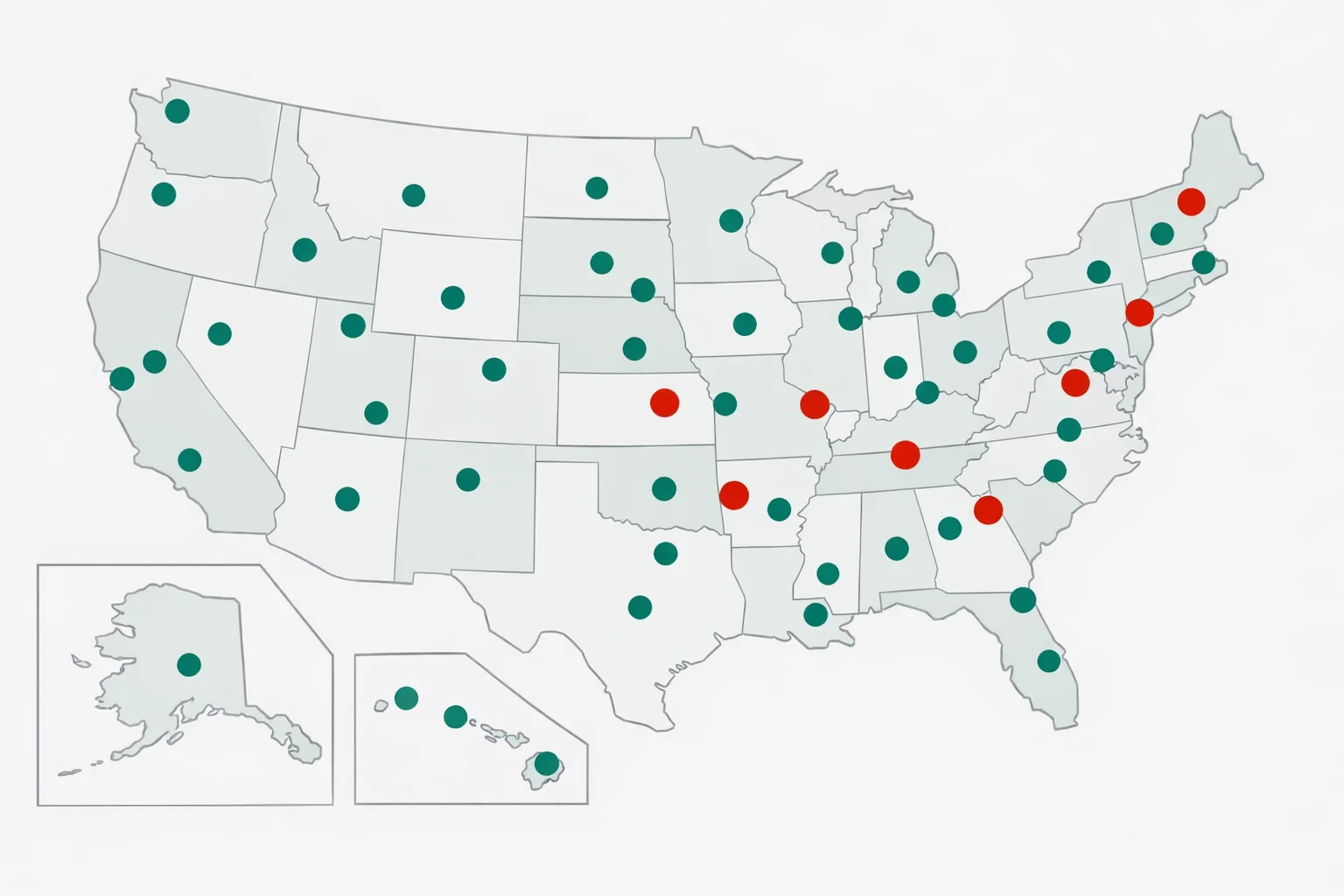
Why You Keep Getting the Same Capitals Wrong
Here's what's going on in your head: when someone asks "capital of New York," your brain retrieves "New York City" because that's the association with the most neural pathways. NYC is in movies, news, songs — it's everywhere. Albany? Not so much. Psychologists call this the frequency illusion combined with the availability heuristic.
The same pattern repeats for Illinois (you think Chicago, not Springfield), Michigan (Detroit, not Lansing), and Washington (Seattle, not Olympia). In every case, the state's economic or cultural hub eclipses the actual capital. A 2019 survey by the Annenberg Public Policy Center found that only 36% of Americans could name the three branches of government — state capitals fare even worse.
The fix? You need to build a separate association pathway between the state and its capital. That's exactly what active recall testing does, and it's why taking this quiz repeatedly works better than staring at a list. If you already tried our 50 States Quiz, you've built the state-name pathways. This quiz builds the capital pathways on top of those.
How This State Capitals Quiz Works
The quiz pulls 25 questions from a pool of all 50 state capitals, organized into four difficulty tiers. Warm-up questions give you capitals that are also the state's largest city (like Phoenix and Atlanta). By the expert tier, you're dealing with capitals like Montpelier, Pierre, and Jefferson City — places with populations smaller than a typical high school.
Harder questions earn more points: warm-ups are worth 1 point, expert questions are worth 4. So you can't coast on the easy ones — to score in the top tier, you need to nail the tricky stuff too. Each wrong answer shows the correct capital plus a fun fact, because contextual learning sticks better than raw memorization.
The quiz randomizes which 25 states you see each time, so retaking it gives you a fresh set. After three rounds, you'll have encountered most of the 50 and built genuine recall pathways for the hard ones.
The 10 Hardest US State Capitals
Based on aggregate quiz data and error rates, these ten capitals trip up the most people. If you can memorize these ten, you'll jump from average to expert territory.
| State | Capital | Common Wrong Guess | Why People Get It Wrong |
|---|---|---|---|
| Vermont | Montpelier | Burlington | Montpelier has ~8,000 people — smallest capital in the US |
| South Dakota | Pierre | Sioux Falls | Pierre has 14,000 residents; Sioux Falls has 200,000+ |
| Kentucky | Frankfort | Louisville | Louisville and Lexington are both far larger and more famous |
| Missouri | Jefferson City | St. Louis or Kansas City | Both St. Louis and KC are 10x larger than Jefferson City |
| Maryland | Annapolis | Baltimore | Baltimore has 600,000 people; Annapolis has 40,000 |
| Montana | Helena | Billings | Billings is the largest city; Helena was a gold rush town |
| Maine | Augusta | Portland | Portland is the cultural hub; Augusta is a quiet river town |
| Connecticut | Hartford | New Haven | Yale makes New Haven more recognizable nationally |
| Minnesota | Saint Paul | Minneapolis | Twin Cities confusion — they're adjacent but only one is capital |
| New Hampshire | Concord | Manchester | Manchester is 2x the size of Concord |
Memorization Tricks That Actually Work
Forget rote repetition. Cognitive science research — specifically Roediger and Butler's 2011 study on the testing effect — shows that active recall paired with spaced repetitionoutperforms every other memorization strategy. Here's how to apply it to state capitals:
Mnemonic linking: Create a vivid mental image connecting each state to its capital. For Frankfort, Kentucky, picture a frankfurter (hot dog) wearing a Kentucky Derby hat. For Pierre, South Dakota, imagine a French guy named Pierre standing on Mount Rushmore. The weirder the image, the stronger the memory.
The presidential trick:Four capitals are named after presidents — Jackson (Mississippi), Jefferson City (Missouri), Lincoln (Nebraska), and Madison (Wisconsin). That's four capitals memorized in one pattern.
Same-name pairs:Two states share the capital name Charleston — West Virginia's capital is Charleston, and South Carolina's capital is Columbia (but Charleston, SC is a major city there). Knowing this confusion point prevents the mix-up.
The "not the biggest city" rule: If you're guessing and you think of the state's most famous city, it's probably not the capital. This heuristic is right about 66% of the time — only 17 of 50 state capitals are also the state's largest city. When you're ready to test your broader US geography knowledge, the US Map Quiz lets you click states on a blank map for a different kind of challenge.
Why Most State Capitals Aren't the Biggest City
This pattern has a historical explanation. When early American states chose their capitals in the late 1700s and early 1800s, they deliberately picked centrally located towns over coastal ports or large commercial cities. The reasoning was practical: legislators from rural districts didn't want to travel days to a distant port city, and they feared that a large city's political machine would dominate state politics.
Pennsylvania is a textbook case. Philadelphia was both the state capital and the nation's capital until 1799. When the state legislature moved the capital to Lancaster in 1799 and then Harrisburg in 1812, it was specifically to put the seat of government in the geographic center of the state, away from Philadelphia's influence.
California followed the same logic fifty years later. During the Gold Rush, the capital bounced between San Jose, Vallejo, and Benicia before landing in Sacramento in 1854 — not because Sacramento was the biggest city (San Francisco was far larger), but because it was centrally located in the agricultural heartland.
This pattern is uniquely American. In most countries, the capital is the largest city (London, Paris, Tokyo). The US tradition of small, central capitals is a direct result of early American distrust of concentrated power.
Regional Patterns to Speed Up Recall
Instead of memorizing 50 individual pairs, group capitals by region. Your brain encodes spatial clusters faster than isolated facts. Here are the five regions with their trickiest picks:
Northeast (11 states): The hardest cluster. Small states packed together, and the capitals are often overshadowed by nearby cities. Key stumpers: Albany (NY), Trenton (NJ), Hartford (CT), Concord (NH), Montpelier (VT). Two that people DO get: Boston (MA) and Providence (RI).
Southeast (12 states): A mix of easy and hard. Atlanta, Nashville, and Raleigh are well-known. But Frankfort (KY), Tallahassee (FL), and Columbia (SC) trip people up regularly. Memory trick: the southeastern capitals that start with the same letter as their state are the easy ones — the rest need special attention.
Midwest (12 states): Four presidential capitals live here (Jefferson City, Lincoln, Madison, Jackson). Des Moines and Lansing are the other common misses. If you're strong on the Midwest, try our Countries of the World Quiz for a global-scale geography challenge.
Southwest (4 states): The easiest region. Phoenix (AZ), Santa Fe (NM), Austin (TX), and Oklahoma City (OK). Santa Fe is the only mild trip-up because people sometimes guess Albuquerque.
West (11 states): Olympia (WA), Salem (OR), and Carson City (NV) are the common misses. Denver, Honolulu, and Boise are usually fine. Helena (MT) and Juneau (AK) are expert-level.
All 5 Quiz Result Tiers
🏆 Capital Genius (96%+):You nailed nearly every state capital, including expert-level stumpers like Montpelier, Pierre, and Jefferson City. Fewer than 3% of quiz takers reach this tier. You either have an exceptional memory for geography or you've studied this topic thoroughly. Either way, you're in rare company.
⭐ Geography Expert (80-95%): You breezed through easy and medium capitals and held strong on the hard tier. The expert-level questions may have cost you a few points, but you clearly know US geography well above average. About 12% of quiz takers land here, and most of them miss 2-3 of the same notoriously tricky capitals.
🎯 Solid Knowledge (60-79%):You've got the fundamentals — famous capitals and medium-difficulty picks don't faze you. The hard and expert tiers are where gaps show, particularly with small northeastern capitals and obscure midwest picks. This is the most common tier for people who paid attention in school but haven't actively studied capitals.
📚 Getting There (40-59%):You know the capitals that are also the biggest city in their state, but the "trick" capitals caught you off guard. This is completely normal — most American adults score in this range on their first attempt. The good news: a single focused study session using the regional approach bumps most people into the next tier.
🗺️ Room to Grow (under 40%):State capitals are one of those facts that fade fast after school. Don't be discouraged — your score reflects lack of recent practice, not lack of ability. The memorization tricks in this article will help, and retaking the quiz 2-3 times with the mnemonic approach dramatically improves recall.
What to Do With Your Score
If you scored below 60%, start with the regional approach: pick the region you know best and master those capitals first. Then expand outward. The presidential-name trick (Jackson, Jefferson City, Lincoln, Madison) gives you four freebies.
If you scored 60-80%, your gaps are probably concentrated in 2-3 regions. Check your regional breakdown from the quiz results — that tells you exactly where to focus. Most people in this range are weak on the Northeast and strong on the Southwest and Southeast.
If you hit 80%+, you're already in expert territory. The last stretch is the hardest because it's all about memorizing tiny capitals in unexpected states. Retake the quiz a few times until you see all 50 states, and you'll have genuine mastery.
Whatever your score, the act of taking this quiz has already strengthened your memory. Research on the testing effect shows that attempting to recall information — even when you get it wrong — creates stronger memory traces than passive studying. Each retake makes you measurably better. And if you want to test a completely different kind of geographic knowledge, our Flags of the World Quiz challenges you to identify countries by their flags alone — a visual recognition skill that pairs well with capital recall.