Europe Map Quiz: The Trickiest Countries to Find and How to Master the Whole Continent
The Europe map quizis one of those challenges that humbles people fast. A 2023 YouGov survey asked 5,000 adults across the EU to identify European countries on a blank map — the median score was 27 out of 44. That's barely 61%. Respondents nailed France, Italy, and the UK but fell apart once they hit the Balkans. Montenegro? Only 11% got it right. This quiz puts your spatial knowledge of the entire continent to the test, one click at a time.
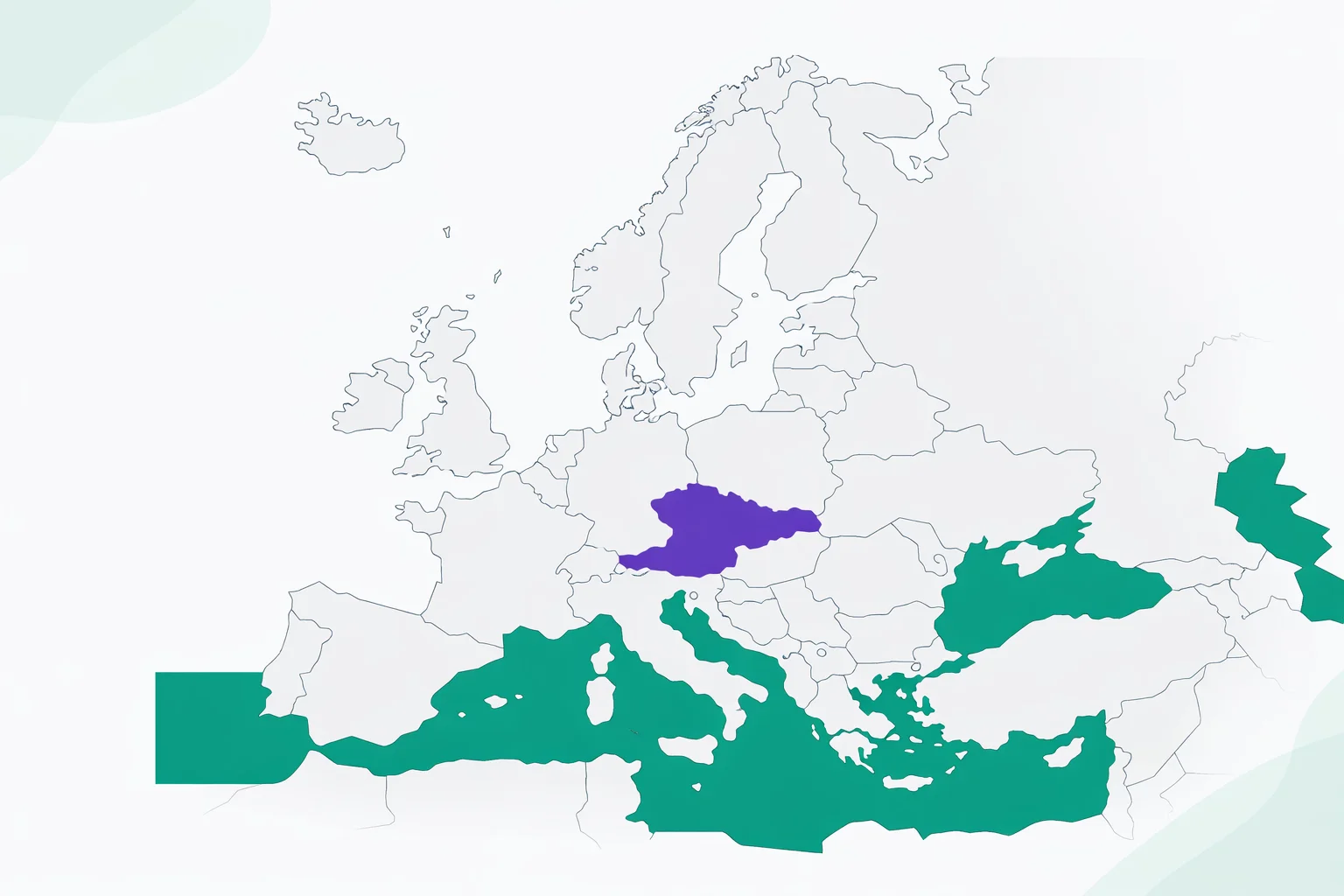
Why Europe Is Harder Than You Think
North America has 23 countries. South America has 12. Europe? Forty-four countries crammed into a landmass smaller than Canada. The density alone makes it brutal for map identification.
But the real problem isn't size — it's recency. Europe's political map has been redrawn more often than any other continent in the past 35 years. Yugoslavia dissolved into seven nations between 1991 and 2008. The Soviet Union's collapse created or re-established 15 independent states, many of them in Europe. Czechoslovakia split into two countries in 1993. People who learned European geography before the 1990s are essentially working from an obsolete map.
That matters for a map quiz because the "new" countries — Kosovo, Montenegro, North Macedonia, the Baltic states — haven't had decades to embed themselves in popular culture. Americans can picture the shape of Italy (a boot) or Scandinavia (the Scandinavian Peninsula) because those images have been reinforced thousands of times. But ask someone to picture the shape of Moldova or Slovenia, and they draw a blank. The visual imprint simply isn't there yet.
How This Europe Map Quiz Works
The quiz cycles through all 44 European countries in random order. Each round shows a country name at the top of the screen. Your job: click where that country sits on the blank map. You get instant color-coded feedback — green for correct, red for wrong, and the correct location always lights up so you learn even when you miss. There's no timer, which matters: research by Kornell and Bjork at UCLA demonstrated that untimed retrieval practice builds stronger spatial memories than time-pressured guessing.
Your final results break down by five sub-regions — Northern, Western, Southern, Eastern, and Southeastern Europe — so you can see exactly where your mental map falls apart. Each replay shuffles the country order, keeping subsequent attempts from devolving into pure sequence memorization. If you enjoyed our US map quiz, this is the natural next step.
The 10 Hardest European Countries to Identify
Data from multiple geography quiz platforms converges on the same pain points. Here are the countries that cause the most misclicks:
| Rank | Country | Avg. Error Rate | Commonly Confused With |
|---|---|---|---|
| 1 | Montenegro | 72% | Kosovo, Albania |
| 2 | Kosovo | 68% | North Macedonia, Montenegro |
| 3 | Slovenia | 65% | Slovakia, Croatia |
| 4 | Moldova | 62% | Romania (eastern edge) |
| 5 | North Macedonia | 58% | Albania, Kosovo |
| 6 | Latvia | 55% | Lithuania, Estonia |
| 7 | Lithuania | 52% | Latvia |
| 8 | Slovakia | 48% | Slovenia, Czech Republic |
| 9 | Bosnia and Herzegovina | 45% | Serbia, Croatia |
| 10 | Luxembourg | 42% | Belgium (southern sliver) |
Six of the top ten are former Yugoslav states. The Balkans are effectively Europe's Northeast — a cluster of small, similarly shaped countries packed into a tight space. The Baltics fill a similar role in Northern Europe.
The Balkan Problem: Why Everyone Gets Lost Here
The Balkans deserve their own section because they account for roughly half of all errors on European map quizzes. Seven countries — Slovenia, Croatia, Bosnia and Herzegovina, Serbia, Montenegro, Kosovo, and North Macedonia — occupy an area roughly the size of Spain. That's seven borders to distinguish in a space that could fit inside one Western European country.
There's a mnemonic that helps. Going roughly north-to-south and west-to-east: Slovenia sits at the top, tucked against Austria and Italy. Croatia wraps around Bosnia like a crescent. Bosnia fills the crescent's interior. Serbia sits east of Bosnia. Montenegro is the tiny country between Serbia and the Adriatic coast. Kosovo is Serbia's southern neighbor. And North Macedonia sits at the very bottom, touching Greece.
The first-letter pattern reads S-C-B-S-M-K-N, or: "Small Countries Bother Some Map Knowledge Novices."Not elegant, but it encodes the geographic stacking order and that's what your brain needs during the quiz.
Region-by-Region Learning Strategy
The fastest way to improve isn't trying to memorize all 44 at once. Attack one sub-region per practice session.
Northern Europe (8 countries) — Start with the anchor states: Iceland (island in the northwest), the UK and Ireland (islands in the west), and the Scandinavian trio (Norway on the west coast, Sweden in the middle, Finland on the east). Denmark hangs off the bottom of Scandinavia. The Baltics stack south-to-north: Lithuania, Latvia, Estonia — alphabetical order goes south to north.
Western Europe (8 countries) — The big five (France, Germany, Netherlands, Belgium, Switzerland) are the backbone. Austria sits east of Switzerland. Luxembourg is the tiny wedge between Belgium, France, and Germany. Most people nail these because Western European countries dominate pop culture and travel.
Southern Europe (6 countries)— Spain and Portugal on the Iberian Peninsula, Italy's boot, Greece in the southeast, plus tiny Malta and the island of Cyprus. The boot shape of Italy and the Iberian Peninsula's distinctive outline make these some of the easiest countries on the quiz.
Eastern Europe (11 countries) — Poland, Czech Republic, Slovakia, and Hungary form a central block. East of them: Ukraine (huge), Belarus (above Ukraine), Moldova (squeezed between Romania and Ukraine), and Russia (biggest by far). The Caucasus countries — Georgia, Armenia, Azerbaijan — sit at Europe's eastern edge. Our countries of the world quiz covers these in a global context if you want the full challenge.
Southeastern Europe (11 countries)— The Balkan seven (covered above) plus Romania, Bulgaria, and Turkey. Romania and Bulgaria stack on top of each other north of Greece. Turkey's European portion (Thrace) is a small slice west of Istanbul.
Country Pairs People Always Confuse
Certain mix-ups happen so often they're practically universal. Here's how to untangle them:
- Slovenia & Slovakia — Similar names, completely different locations. Slovenia is in the Balkans, touching Italy and Austria. Slovakia is in Central Europe, east of the Czech Republic. Even their embassies reportedly swap each other's misaddressed mail.
- Latvia & Lithuania — Both Baltic, both start with "L." Lithuania is the southern one (touching Poland). Latvia is in the middle. Remember: Lithuania = Lower.
- Austria & Australia — Not geographically confusing on a European map, but the name similarity trips people up in text-based contexts. Austria is the landlocked Central European country south of Germany.
- Montenegro & North Macedonia — Both small Balkan countries. Montenegro touches the Adriatic coast. North Macedonia is landlocked, sitting directly above Greece.
- Czech Republic & Slovakia — They were one country (Czechoslovakia) until 1993. Czech Republic is the western half, Slovakia the eastern. The Czech Republic borders Germany; Slovakia borders Ukraine.
For a totally different kind of identification challenge, our Greek mythology quiz tests whether you can match gods, heroes, and legends to their stories — fitting, since many of those myths originated in the very countries on this map.
All 6 Score Tiers Explained
Your quiz result places you in one of six tiers. Here's what each one actually means and how common it is:
🏆 Perfect Score (44/44): You clicked every country correctly. That includes Montenegro, Kosovo, and Moldova — the trio that trips up almost everyone. About 3% of first-time players pull this off. Your spatial memory for European geography is exceptional, full stop.
🌟 Continental Expert (40-43): Near-perfect. The 1-4 misses are almost always in the Balkans or Caucasus. You could comfortably navigate a physical map of Europe. Top 8% of all players.
🎯 Geography Enthusiast (33-39):Clearly above average. You know the big countries cold and have decent Balkan awareness. Check your regional breakdown — there's usually one sub-region dragging you down. Better than 65% of players.
🧭 Solid Navigator (25-32): This is where most people land on their first attempt. Western and Northern Europe are solid, but the East and Southeast are blurry. The region strategy above will push you past 35 on your next try.
📍 Getting Oriented (15-24):The large countries and famous shapes (Italy's boot, Scandinavia) are locked in. The small and mid-sized eastern countries need focused study. One sub-region at a time is the way forward.
🗺️ Exploring Europe (0-14): No shame — Europe packs 44 countries into a small space, and many borders have only existed for 30 years. The feedback system teaches you as you play. Two or three practice rounds typically double your score.
How to Actually Learn the Map of Europe
Flashcards and list memorization don't work well for geography. The research is clear on this: spatial learning requires spatial practice. Clicking countries on a map activates your hippocampus — the same brain region that London taxi drivers enlarged through years of spatial navigation (hippocampus on Wikipedia). Reading a list of country names engages verbal memory, which is a completely different system.
Use anchor countries. Every sub-region has 2-3 unmistakable countries. France, Italy, and the UK are obvious. Russia is unmissable. Spain and the Scandinavian countries have distinctive shapes. Anchor those first, then build outward — each anchor constrains its neighbors.
Focus on your misses. After each attempt, look at the "Countries You Missed" list. That's your study guide. If you missed four Balkan countries, spend two minutes just looking at the Balkans region. Targeted retrieval practice beats broad review, according to decades of memory research (Roediger & Butler, Trends in Cognitive Sciences, 2011).
Retake quickly.The testing effect — the finding that retrieval practice strengthens memory more than re-studying — is strongest when you retest shortly after errors. Your second attempt usually improves by 6-8 countries, and your third attempt locks most corrections into long-term memory. The quiz shuffles country order each time, so you're genuinely retrieving spatial information, not replaying a memorized sequence.
Connect geography to stories. Croatia's coastline was the filming location for King's Landing in Game of Thrones. Iceland is where much of Interstellar was shot. Greece is the birthplace of the Olympic Games. These associations create extra memory hooks that pure map study doesn't. Ready for the worldwide version? Our 50 states typing quiz tests recall rather than recognition — a different but equally valuable geographic skill.