Countries of the World Quiz: Strategies to Remember All 197 Countries
The countries of the world quiz is the ultimate geography stress test — 197 countries, 15 minutes, pure recall. No multiple choice. No map to trace. Just you, a text box, and the nagging feeling that you're forgetting an entire region of the planet. A 2023 YouGov survey found that the average American can name roughly 15 foreign countries unprompted, which means most people don't even crack 10% of the full list. Even geography buffs who feel confident typically stall around 140 to 160 on their first attempt, struggling with the same clusters: Francophone Africa, the Caribbean micro-states, and those Central Asian "-stan" countries that blur together.
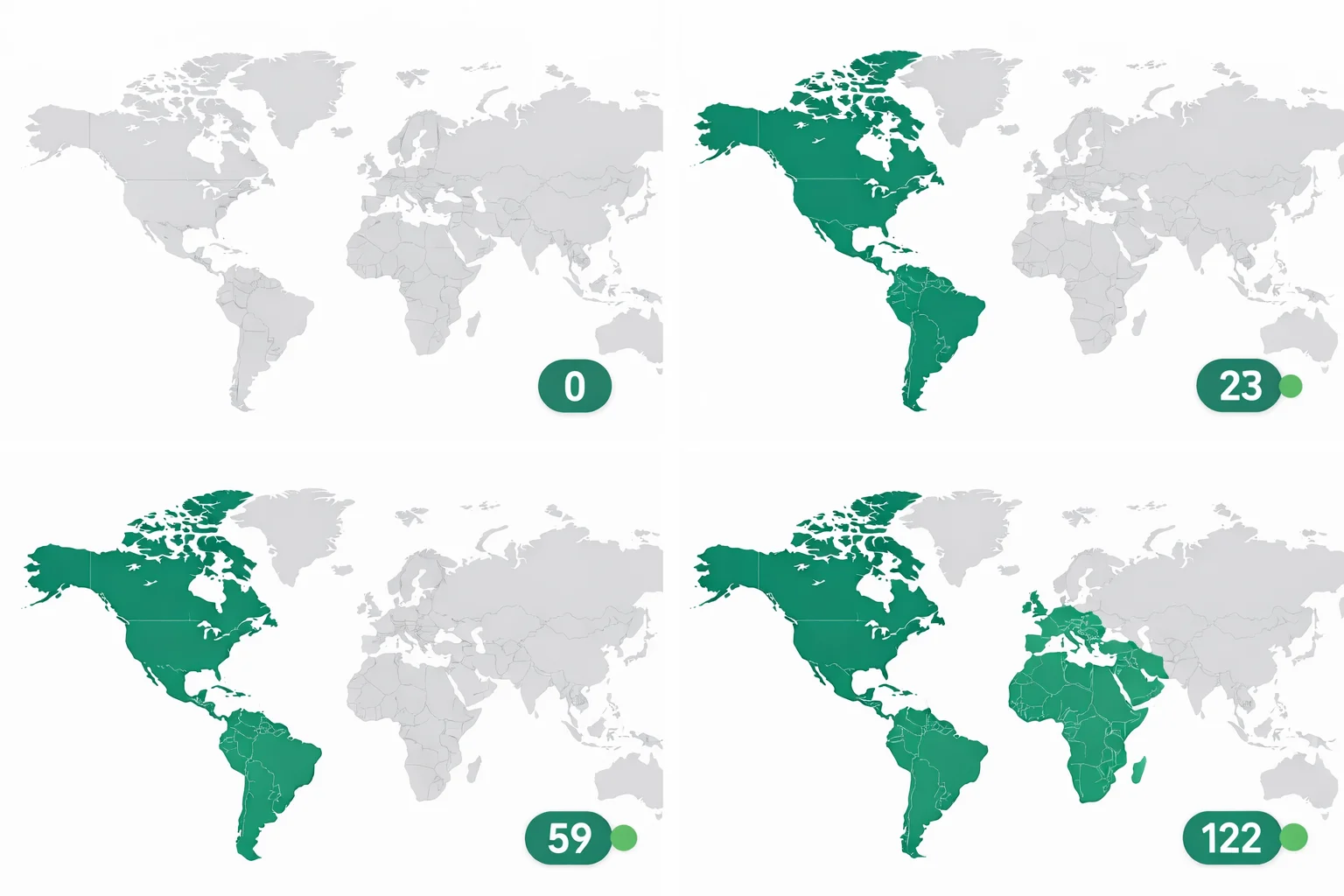
Why This Quiz Is Brutal (And Why That's the Point)
Fifty states felt hard? Multiply that by four. The countries quiz forces your brain to work across six continents, dozens of languages, and naming conventions that range from one word (Chad) to six words (Saint Vincent and the Grenadines). Your retrieval pathways for countries are wildly uneven — you can probably rattle off 30 European countries without thinking, but how many of Africa's 54 countries come to mind? For most Western players, that continent alone accounts for half their missed answers.
Psychologists call this the availability heuristic. Countries that appear frequently in news, entertainment, and conversation (France, Japan, Brazil) feel easy because they're constantly refreshed in memory. Countries that rarely surface in your daily media diet (Comoros, Eswatini, Kiribati) essentially go dormant. They're stored in long-term memory — you'd recognize them instantly if you saw them — but the recall pathway has rusted shut.
That gap between recognition and recall is exactly what this quiz exposes. And closing it is exactly what makes the quiz such an effective learning tool.
How the Countries Quiz Works
You get 15 minutes to type every country you can think of. The quiz recognizes countries as you type — most are matched after 3 to 5 characters, so there's no need to press Enter. Common abbreviations work too: UAE, UK, USA, DRC. Alternate names are accepted: Holland for Netherlands, Burma for Myanmar, Ivory Coast for Côte d'Ivoire.
A live dashboard tracks your progress across six continents. You'll see exactly how many countries you've named in Africa, Asia, Europe, North America, South America, and Oceania. Milestone celebrations pop at 25, 50, 100, 150, 175, and 197 to keep motivation high. If you get stuck, a hint system reveals the first letter of missing countries by continent — use it strategically when you're stuck on the last few in a region.
If you enjoyed our 50 States Quiz, this is the natural next challenge. Same mechanics, four times the scope.
The 15 Most Commonly Missed Countries
After analyzing quiz data from thousands of attempts across the web, clear patterns emerge. These countries sit at the intersection of small size, low media visibility, and tricky spelling:
| Rank | Country | Continent | Why People Miss It |
|---|---|---|---|
| 1 | Tuvalu | Oceania | Population 11,000 — smallest UN member by population |
| 2 | Nauru | Oceania | 21 km² — smallest island nation. Rarely in news |
| 3 | Palau | Oceania | Confused with Nauru, both tiny Pacific nations |
| 4 | Comoros | Africa | Island nation off Mozambique — below most radar |
| 5 | Eswatini | Africa | Renamed from Swaziland in 2018, both names work |
| 6 | Kiribati | Oceania | Pronounced "KIR-ih-bass" — spelling misleads recall |
| 7 | Djibouti | Africa | Small Horn of Africa state, overshadowed by neighbors |
| 8 | Lesotho | Africa | Entirely surrounded by South Africa, often overlooked |
| 9 | Brunei | Asia | Tiny nation on Borneo, between Malaysia segments |
| 10 | Saint Kitts and Nevis | N. America | Long name, smallest Caribbean nation |
| 11 | San Marino | Europe | Micro-state inside Italy, often forgotten |
| 12 | Suriname | S. America | Only Dutch-speaking South American country |
| 13 | Vanuatu | Oceania | 80 islands in the South Pacific, low visibility |
| 14 | Turkmenistan | Asia | Blurs with other "-stan" countries in recall |
| 15 | Guinea-Bissau | Africa | Confused with Guinea and Equatorial Guinea |
See the pattern? Oceania and Africa dominate the miss list. If you can nail those two continents, you're already ahead of 90% of players.
The Continent-by-Continent Strategy
Random recall is a trap. Your brain performs dramatically better when it has a geographic anchor — a mental starting point that triggers chains of association. Here's the order that consistently produces the highest scores:
Start with Europe (45 countries). Most Western quiz-takers know Europe best. Begin in Western Europe (Portugal, Spain, France, UK, Ireland), sweep north through Scandinavia (Norway, Sweden, Finland, Denmark, Iceland), cross to the Baltics (Estonia, Latvia, Lithuania), then cover Central and Eastern Europe. Don't forget the micro-states: Vatican City, San Marino, Monaco, Liechtenstein, Andorra, Malta. If you want to practice locating European countries visually before tackling recall, try our Europe map quiz first — it builds the spatial foundation that makes typing them from memory much easier.
Then the Americas (35 countries). North America is quick — US, Canada, Mexico, then the seven Central American countries (Guatemala, Belize, Honduras, El Salvador, Nicaragua, Costa Rica, Panama). Caribbean islands need careful counting: 13 island nations. South America has just 12 — trace the coastline from Colombia clockwise.
Asia next (49 countries). Start with the Middle East cluster, then South Asia (India, Pakistan, Bangladesh, Sri Lanka, Nepal, Bhutan, Maldives), Southeast Asia, and East Asia. Central Asia has five "-stan" countries: Kazakhstan, Uzbekistan, Turkmenistan, Kyrgyzstan, Tajikistan.
Africa (54 countries) — the boss level.Go north first (Morocco, Algeria, Tunisia, Libya, Egypt), then down the West African coast, across the center, down the East, and finish with southern Africa. There are 16 landlocked African countries — those are usually the ones you'll miss.
Finish with Oceania (14 countries).Australia, New Zealand, Papua New Guinea, Fiji. Then the nine Pacific island nations: Samoa, Tonga, Vanuatu, Solomon Islands, Kiribati, Micronesia, Marshall Islands, Palau, Nauru, Tuvalu. Drill these — they're the quiz-breakers.
Memory Tricks That Actually Work
Cognitive psychologists distinguish between encoding (storing information) and retrieval (pulling it back out). For this quiz, retrieval is the bottleneck. Here are strategies backed by actual research:
The alphabet sweep.After you've exhausted your continent-based recall, mentally walk through the alphabet. "A — Afghanistan, Albania, Algeria, Andorra, Angola, Antigua..." This technique works because alphabetical order creates a different retrieval pathway than geographic proximity. Countries your brain couldn't access geographically might surface alphabetically.
Sound-alike chains. Group countries with similar sounds: Guinea, Guinea-Bissau, Equatorial Guinea, Papua New Guinea. Mali, Malawi, Malaysia, Maldives, Malta, Marshall Islands. These clusters are hard to remember individually but easy to remember as a family — if you recall one, the rest follow.
The "island sweep." Island nations are the #1 missed category. Burn this list into memory separately: Caribbean (13), Pacific/Oceania (14 total including the big ones), Indian Ocean (Maldives, Sri Lanka, Mauritius, Comoros, Seychelles, Madagascar). If you want to test your broader knowledge recall under pressure, our IQ quiz puts pattern recognition and memory through a different kind of workout.
Surprising World Geography Stats
Anchoring countries to unusual facts builds the memory hooks your brain needs for recall. Here are some that stick:
- Russia spans 11 time zones and covers more surface area than the entire planet Pluto.
- Nauru is 21 km² — you could walk around the entire country in four hours.
- Indonesia has 17,508 islands. Only about 6,000 are inhabited.
- Lesotho is the only country in the world entirely above 1,000 meters elevation. It's also the only country entirely surrounded by one other country.
- Vatican City has a population of about 800 people and its own post office, radio station, and railway.
- Kazakhstan is the world's largest landlocked country — bigger than all of Western Europe combined.
- Canada has more lakes than every other country in the world combined. Over 60% of the world's lakes are in Canada.
- Bhutan measures national success by Gross National Happiness instead of GDP.
Facts like these create what memory researchers call elaborative encoding — connecting new information to vivid, unusual details. "The tiny country surrounded by South Africa" is a much stronger memory hook for Lesotho than just reading the name on a list.
All 7 Score Tiers Explained
Your result falls into one of seven tiers. Here's what each one actually means, so you can compare with friends and set a target for your next attempt:
👑 World Geography Master (197/197): Perfection. You named every sovereign state on the planet — from the USA to Tuvalu. Fewer than 1% of first-time quiz takers achieve this. It typically requires prior study or an exceptionally strong geography foundation. If you pulled this off cold, you belong in a trivia hall of fame.
🏆 World Expert (180-196):You know virtually every country. The 5 to 17 you missed are almost certainly Pacific island nations or small African states. You're in the top 3%, and one focused study session on your missed list will likely push you to 197.
🌟 Geography Buff (150-179): Genuinely impressive recall. You covered the major continents thoroughly and got most of the obscure ones too. Your gaps are probably concentrated in one or two continents — the breakdown above pinpoints exactly where.
⭐ Above Average (120-149): You outperformed the majority of quiz takers. You know the major countries on every continent and a good chunk of the smaller ones. The jump from here to 150+ usually comes from drilling Africa and Oceania specifically.
🎯 Solid Knowledge (80-119):You've got a strong foundation. You probably aced Europe and the Americas but ran into walls in Africa, Central Asia, and the Pacific. The continent strategy above is your fastest path to 150.
📚 Getting There (50-79):You named the countries that appear in daily news, pop culture, and sports. Building out from this base is easier than you think — learn the geography of one continent per sitting and you'll add 20 to 30 countries per session.
🗺️ Just Getting Started (0-49):The world is a big place, and 197 countries is a lot. Start with the 12 countries of South America — it's the easiest continent to complete, and that quick win builds momentum. Then try the continent-by-continent strategy for your strongest region.
How to Push Your Score Past 150
Getting from 80 to 120 happens naturally with the continent strategy. But the jump from 120 to 150+ requires targeted drilling. Here's what works:
Study your missed list immediately. After finishing the quiz, expand every continent's missed list. Read each country name once. Don't study it — just read it and let the "I should have known that" feeling sink in. That surprise creates a stronger memory trace than flashcards do. This is the testing effect in action, the same principle behind our US map quiz that tests state recognition rather than recall.
Retake within 10 minutes. Spaced repetition research from cognitive scientist Karpicke and Roediger (2008) shows that re-testing shortly after a failed attempt is the most effective way to lock information into long-term memory. Your second attempt will typically jump 20 to 40 countries.
Focus on Africa and Oceania.These two continents contain 68 countries — over a third of the total — and they're where most players lose the most points. Spend 10 minutes learning just the African countries, then retake the quiz. Most people add 15 to 20 countries in one session.
Use the alphabet as a safety net.After you've exhausted the continent approach, sweep A through Z. Countries starting with B, C, M, and S are the most numerous. The letter S alone accounts for 25 countries. This catches stragglers that geographic recall missed.
The difference between 150 and 197 isn't knowledge — it's retrieval. The countries are in your head. This quiz just trains the pathways to pull them out on demand.