The Year the World Ran Out of Names: A Greek Alphabet Story
A Greek alphabet quiz would have been a harmless bar-trivia question in 2019. Then September 2020 arrived, the Atlantic hurricane season burned through all 21 of its assigned names, and forecasters reached for a backup list that hadn't been touched since 2005: the Greek alphabet. Within days, a storm named Alpha did something no Atlantic system had done in recorded history — it made landfall in Portugal. By November, Hurricanes Eta and Iota had slammed into the same stretch of Nicaraguan coast thirteen days apart, and news anchors worldwide were stumbling over letters most of their viewers couldn't place.
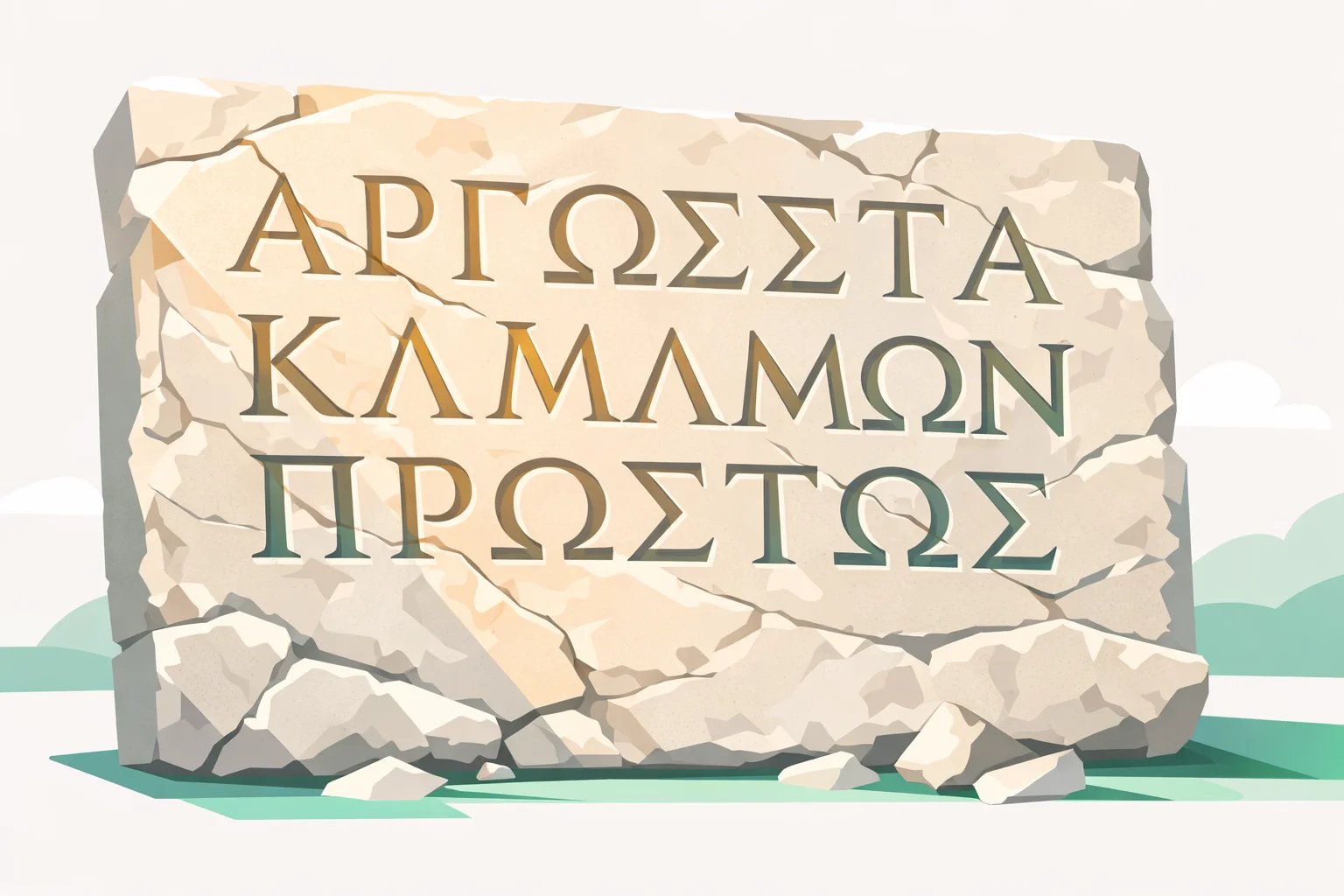
That season used nine Greek letters for a record-breaking 30 named storms, and it exposed something quietly embarrassing: institutions kept assuming the public knew these 24 letters, and the public kept proving otherwise. The quiz above measures exactly that gap. It walks you through the alphabet in canonical order, alpha to omega, and asks you to type each name from the glyph alone. Most people manage about 8.
The Two Letters the WHO Refused to Use
The naming experiment ended badly twice. In March 2021, the World Meteorological Organization retired Greek letters from hurricane naming permanently — partly because zeta, eta, and theta sound too alike when shouted over a weather warning, and partly because the novelty of the letters was upstaging the storms themselves. Two months later the WHO picked up the same alphabet for COVID variants, and by November it hit a wall at letter 13. The next two letters in line were nu and xi. Nu was skipped because "the new Nu variant" is a broadcasting disaster, and xi was skipped because it's a common surname. The world jumped straight to letter 15, omicron — and almost nobody noticed the gap.
That's the tell. You can only notice a skipped letter if you know the sequence, and the sequence is precisely what ambient exposure never teaches. It's why this quiz runs in order rather than shuffling: knowing that nu and xi sit at positions 13 and 14, right after mu, is a different skill from recognizing π on a math worksheet — and it's the skill the last two years of headlines quietly demanded.
Why You Already Know a Third of the Answers
Walk through a normal week and count the Greek letters you pass. Pi is on every circle you've ever measured and has its own holiday. Delta means change in any math class and named both a river mouth and a pandemic wave. Sigma sums series and fuels memes. Omega ends everything from Bibles to watch brands, mu hides inside every "µm" on a spec sheet, lambda fronts a video game and an AWS product, and alpha and beta describe half the software you use. That's the famous eight — and if you scored around 8 of 24, you now know exactly where your knowledge came from.
The catch is that ambient Greek is a lopsided teacher. It drills the celebrities relentlessly and never once shows you zeta, eta, or upsilon in context. Nobody fails this quiz randomly; the misses cluster in the same dead zones for almost everyone, which is why the score bands can predict which letters you missed almost as reliably as how many.
A Trade-Route Borrowing That Invented Vowels
The alphabet itself started as someone else's property. Around 800 BC, Greek traders adapted the Phoenician consonant script they encountered across the Mediterranean. The evidence of borrowing is hiding in the letter names: aleph meant "ox" and bet meant "house" in Phoenician, but "alpha" and "beta" mean nothing at all in Greek. They're loanwords — the sound of one culture reading another culture's labels out loud.
The Greek twist was the upgrade that changed everything: Phoenician wrote only consonants, and several of its letters stood for throat sounds Greek didn't use. Rather than discard them, the Greeks recycled those orphaned letters as vowels — making Greek the first alphabet to write vowels as full letters. Every alphabet you can read, Latin and Cyrillic alike, descends from that hack. Even the odd placement of Z in English traces back here: Rome dropped zeta as useless, then sheepishly re-borrowed it centuries later for Greek loanwords and bolted it onto the end of the line, where it still sits.
The Middle Sixteen Is Where Recall Dies
Here's where it gets interesting. When psychologist Bennet Murdock ran his classic free-recall experiments in 1962, he found the same U-shaped curve every time: people remember the start of a list, remember the end, and lose the middle. The effect has a name — the serial-position effect — and the Greek alphabet is a 25-century-old demonstration of it. Takers reel off alpha-beta-gamma-delta, land omega at the far end, and watch everything between epsilon and omicron dissolve.
English speakers also lose their usual crutch. You didn't memorize A-through-Z as 26 facts; you memorized it as a song, and the melody does the sequencing for you. There is no Greek ABC song in your head, so the middle sixteen have to survive on raw rehearsal — which, for most people, never happened. Learners of Japanese hit the same wall at four times the scale with 46 hiragana characters, and they solve it the same way the fix at the bottom of this page does: chunking the list into short runs with fixed anchor points. For Japanese's second kana script, the katakana quiz adds a separate word-reading challenge: recognizing コ alone doesn't test the vowel lengths in コーヒー.
Six Glyphs That Impersonate English Letters
Sequence isn't the only saboteur. Six lowercase Greek letters are near-perfect impostors of Latin ones, and every one of them lies about its sound:
| Glyph | Looks like | Actually is | Sounds like |
|---|---|---|---|
| ν | v | nu | n |
| ρ | p | rho | r |
| η | n | eta | long ee |
| χ | x | chi | kh |
| υ | u | upsilon | ü / ee |
| ω | w | omega | long o |
The capitals run the same con: H is eta, P is rho, X is chi, Y is upsilon. This is why a sorority's ΧΩ jacket reads "Chi Omega," not "XO," and why "Xmas" isn't lazy secularism — the X is chi, the first letter of "Christ" in Greek, an abbreviation monks were using a thousand years ago. Astronomers lean on the same letters to rank stars within each constellation: Betelgeuse is formally Alpha Orionis, the alpha of Orion. Once you clock the impostors, they flip from your worst enemies on this quiz to your easiest wins — a wrong-but-familiar shape is a stronger memory hook than a blandly foreign one.
Mu, Mi, or My — Which Spelling Counts?
Grading a typed answer sounds trivial until you meet the twelfth letter. English textbooks call it "mu," reconstructed ancient pronunciation says something closer to "my," and a modern Athenian says "mi." None of them is wrong — pronunciation drifted for two millennia, and the letter names drifted with it. Beta became "vita," eta became "ita," and the whole B-sound migrated to the letter combination "mp," which is why the Greek spelling of "bar" is μπαρ.
So the scoring here accepts the defensible variants for each letter: mu, mi, or my; xi or ksi; rho or ro; chi or khi; upsilon or ypsilon. What it doesn't forgive is naming a different letter — typing "nu" at the ν glyph is right, but typing "vee" is exactly the impostor trap the previous section warned you about. The quiz tests whether you know the letter, not which century's pronunciation your teacher preferred.
Every Score Band, Alpha to Omega
⛵ Phoenician Trader (0–4) is the starting line, and about 18% of takers stand on it — staring at borrowed symbols the way Greek merchants once stared at Phoenician ledgers. The letters aren't meaningless for long, though: most people in this band recognize several glyphs on sight and are missing only the names.
📰 Headline Greek (5–10) is the median result, covering roughly 41% of takers. It's the pandemic-and-math-class vocabulary: delta, omicron, pi, alpha, omega, maybe sigma. Scores here almost always come from recognition of famous letters rather than any systematic pass through the alphabet.
🏺 Fraternity Row (11–16) catches about 27% of takers — people who've absorbed campus letters, physics notation, and engineering symbols into something like half an alphabet. The misses in this band are strikingly consistent: zeta, eta, xi, and upsilon, the letters with no pop-culture career.
📜 The Scholar (17–21) is rare air, around 11% of takers. This band has genuinely studied — a classics elective, a math degree, a semester in Thessaloniki — and drops points only in the alphabet's deepest dead zone or on a spelling technicality the variant list didn't cover.
🏛️ Omega Tier (22–24) is the top 3%. Every letter named, the impostor glyphs seen through, the middle sixteen intact. Perfect scores are rarer still; if the grid came back all green, the only remaining challenge is reciting the sequence aloud, from memory, in under thirty seconds.
How to Have All 24 by Friday
Don't study the alphabet as one 24-item list — that just replays the serial-position collapse. Cut it into four runs of six: alpha through zeta, eta through mu, nu through sigma, tau through omega. Learn one run per sitting, always reciting from the start of the run, never from alpha. Then pin three anchors: alpha opens, omega closes, and mu-nu sits dead center at positions 12 and 13 — so from any anchor you're never more than five letters from solid ground. Recruit the impostors as landmarks ("the fake p starts run three"), and retake the quiz after each sitting; the grid at the end shows you exactly which run still leaks. Two or three evenings of that beats a month of passive re-reading. And if typed recall of a foreign symbol set turns out to be your kind of fun, the sign language alphabet has been hiding inside English this whole time, waiting for the same treatment.