From Temple Margins to Tokyo Menus: Reading Katakana
The characters in this katakana quiz began as reading aids in the margins of Buddhist texts, centuries before anyone needed to write "television" in Japanese. Around the ninth century, readers used pieces of Chinese characters as compact phonetic annotations. Those fragments became a script that now appears on coffee signs, product packaging, and computer screens. The angular shapes weren't invented for imported gadgets. Their job changed.
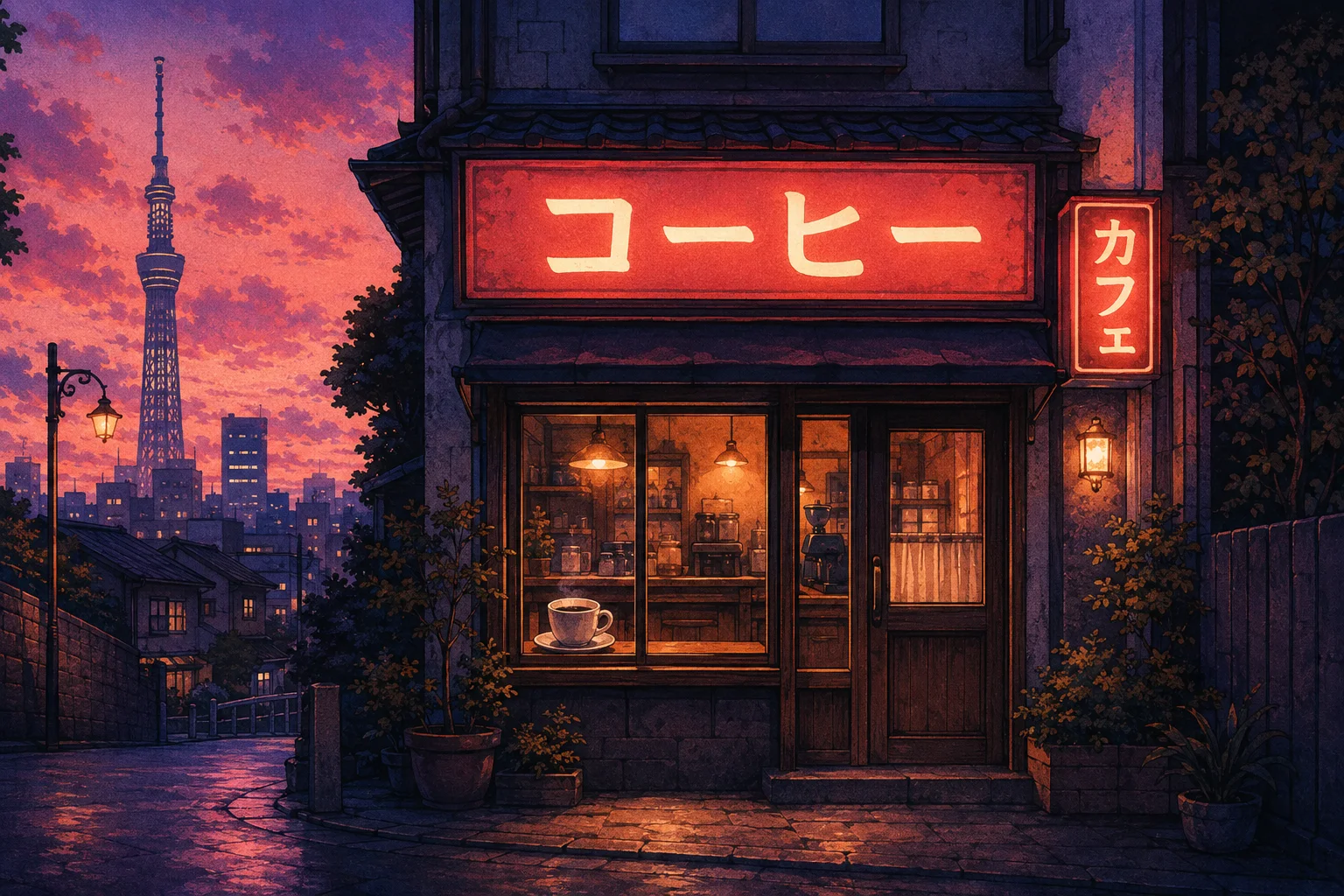
Small Annotations Became a Full Script
Katakana and hiragana solve a similar problem with different handwriting strategies. Hiragana developed through cursive simplification; katakana through selecting parts of characters. The contrast survives in their appearance: あ is rounded and flowing, while ア looks clipped and angular. Both represent a, but recognizing one doesn't guarantee recognition of the other. If the sounds themselves still feel unfamiliar, start with the hiragana quiz and return to these new shapes afterward.
The history and uses of katakana also explain why calling it the "foreign alphabet" is incomplete. It once appeared with kanji in official documents where modern readers would expect hiragana. Its modern visual identity developed over a long period; the script didn't begin with a rule that every imported word must look angular.
- Early Heian period: abbreviated character parts serve as compact reading annotations.
- Before World War II: katakana also carries grammatical material in official writing alongside kanji.
- Modern everyday print: loanwords become a highly visible use, alongside emphasis, sound effects, and technical naming.
Katakana Outgrew the Foreign-Word Label
A menu gives you コーヒー for coffee and ケーキ for cake. Neither spelling simply swaps English letters for Japanese ones. The borrowed word has a Japanese sound pattern, and the written form follows that pattern. Television becomes テレビ, a shortened form; restaurant becomes レストラン. Guessing the English source can help you understand a sign, but it can also make you skip the katakana that's actually there.
Nor does katakana always signal a loanword. A Japanese writer can use it for emphasis, and names of plants or animals often appear in katakana in scientific contexts. Manga sound effects give it another visible home. Treat the script as a clue about how the writer presents a word, not a guarantee of where that word came from.
That distinction shapes the questions above. The word section asks for a reading first and supplies the meaning afterward. Choosing "coffee" from a picture of a cup would test your ability to use context. Choosing koohii from コーヒー makes you attend to two long-vowel marks. Both are useful skills, but only the second shows whether those marks registered.
What Changed Between カツ and カッ?
Character size changes the sound. Full-size ツ is tsu; small ッ normally marks a held consonant before the next sound. In カップ, cup, that gives kappu rather than katsupu. The difference is visible in just one small shape, which makes it easy to overlook when you're concentrating on remembering カ.
Small ャ, ュ, and ョ work differently. シュ reads shu as a combined unit, while シユ has a full-size ユ and reads shiyu. Katakana also uses combinations such as ティ (ti) and チェ (che) for borrowed sounds. The Japan Foundation's kana reference puts base characters, marked forms, and combinations together, making it useful for checking exactly which small symbol you missed.
Keep three operations separate in your notes: ガ changes a consonant with dakuten; パ uses a small circle for a p sound; コー extends a vowel. Writing "I missed the accents" bundles different errors into one vague complaint. Writing "I read パ as バ" gives you a pair you can actually practice.
Four Shapes Deserve Their Own Page
シ, ツ, ソ, and ン are a compact lesson in visual discrimination. The first pair is shi and tsu; the second is so and n. For handwriting, watch the long stroke: シ and ン sweep upward, while ツ and ソ descend. In print, examine how the short strokes align as well. A stroke-order demonstration is more dependable than deciding every character looks like a smiling face.
Try a two-stage check with シ and ツ. First place them side by side and explain the distinguishing detail. Then cover one, move the remaining character elsewhere on the page, and name it alone. The second task removes the helpful contrast. If you can only tell which is which when both are visible, you've learned a comparison before you've learned independent recognition.
The ASL alphabet quiz gives you another kind of close visual contrast, involving handshape and orientation. Katakana's specific challenge is that a tiny stroke distinction can survive into a whole word: the last symbol of レストラン is ン. Reading it as ソ adds a sound that doesn't belong.
A Coffee Sign Exposes the Reading Gap
Knowing コ and ヒ is necessary for reading コーヒー, but it isn't the entire task. You must keep their order, notice both length marks, and assemble ko-o-hi-i. In Japanese timing, the extended vowels matter. Writing koohii in the answer options makes those two extensions visible without requiring readers to type macrons such as ō and ī.
Here's a useful personal comparison: cover the answer options, read コーヒー, and then uncover them. Did you already have koohii in mind, or did the options produce the answer? Multiple choice provides retrieval cues. Unprompted reading removes them. A correct click is evidence of recognition under those conditions, not proof that you could produce the same reading from a sign across the street.
The same separation matters for カップ and シャツ. You might identify every large character correctly and still miss the small ッ or ャ. That's why the mixed challenge doesn't reduce every error to "learn more katakana." A character problem calls for shape practice; a size or length problem calls for contrasting written forms. Your next exercise should change with the error.
Read the Three Scores Separately
The mixed katakana test contains twelve sampled base characters, five sound-mark or combination questions, and eight word questions. Each correct response earns one point. There's no speed bonus, and an incorrect answer doesn't subtract points. The three skill totals let you see whether a strong character score is carrying a weaker word score.
For example, 12/12 characters, 3/5 sound marks, and 4/8 words adds to 19/25, or 76%. That reader should examine the word corrections before recopying the entire character chart. Another reader could reach 19/25 with 6/12 characters, 5/5 marks, and 8/8 words. The same total suggests a different practice priority. These are illustrative score patterns, not findings about actual visitors.
Full-character mode instead tests all 46 base shapes once. It does not test combinations or words, and its result labels apply only to that character set. Targeted retry mode uses only the items you missed and labels the score as practice. No mode measures listening, handwriting, grammar, or general Japanese proficiency. Compare like with like when you retake this katakana quiz.
All 5 Katakana Quiz Results
Shape Explorer — below 40%. Many answers in this attempt still need a dependable shape-to-sound connection. Begin with ア, イ, ウ, エ, オ, then add a few missed characters. Recognizing a handful consistently gives you something concrete to build on; another long guessing session may hide what you've actually learned.
Pattern Finder — 40% to below 60%. You recognized a substantial part of the set, with gaps elsewhere. Look at whether those gaps concern isolated kana such as ヌ or combinations such as シュ. Give each missed item a specific note rather than assuming that every wrong answer has the same cause.
Reading Builder — 60% to below 80%. More answers held than failed, but some katakana still interrupt the reading process. The skill breakdown is especially useful here. Strong word performance doesn't erase missed individual characters, and a solid character score doesn't tell you whether you noticed vowel length.
Careful Decoder — 80% to below 96%. Most items were correct in this attempt. Use the remaining errors as a short contrast set: シ beside ツ, or カップ beside its incorrect reading. Then remove the comparison and check each item alone. Familiarity with the correct option can otherwise imitate independent recall.
Confident Recognizer — 96% and above. Almost every item was recognized correctly. In full mode, that means strong coverage of the 46 base characters; in mixed mode, it includes the selected words and combinations. Your next challenge is reading unfamiliar examples without options, not treating this score as a fluency certificate.
Bring Three Words Back Tomorrow
Choose one word with a long vowel, one with a small character, and one with a lookalike you missed. コーヒー, シャツ, and レストラン make a useful starting trio. Write the kana on one side of a card and the reading on the other. Attempt the reading before turning the card over, then check the precise feature that caused the error.
Return to those three words tomorrow before adding more. Once they feel familiar, find another word containing the same feature so you aren't only remembering one card. For a different script challenge afterward, the Greek alphabet quiz asks you to name symbols rather than select readings. For katakana, keep your immediate target smaller: read tomorrow's three words without borrowing the answer from the back.