What Color Am I? The Truth About Color Personality Types
If you searched “what color am I?” expecting a quiz that reads your favorite color and hands you back a personality, here's the twist: those two things have almost nothing to do with each other. Loving the color teal doesn't make you a teal person, and the what color am I quiz above never once asked which shade you like best. It asked how you decide, how you treat a crying friend, and what you do when a plan falls apart — because that is what actually maps to a color type. Let's bust a few stubborn myths about color and personality, then decode what your result really says.
Your Favorite Color Isn't Your Personality Color
This is the myth that trips up almost everyone: the belief that the color you're drawn to reveals who you are. It feels intuitive — the goth in all black, the optimist in sunny yellow — but preference and personality run on separate tracks. Your favorite color is shaped by fashion, nostalgia, what looked good on you at seventeen, and plain marketing. Your personality color is a behavior pattern: how you handle pressure, conflict, novelty, and other people.
That's why plenty of people score as a warm, empathetic Blue while their whole wardrobe is charcoal grey. The quiz doesn't care what you'd paint your bedroom. If you actually want to know which colors flatter your skin and hair rather than your character, that's a genuinely different tool — our color analysis quiz sorts you by undertone and season. Keep the two ideas apart and the rest of this makes far more sense.
So Where Did ‘Color Personalities’ Even Come From?
Assigning colors to temperament isn't a TikTok invention — it's a repackaging of an idea that's roughly 2,400 years old. Hippocrates split people into four humors (sanguine, choleric, melancholic, phlegmatic), and that four temperaments model never really died. It resurfaced in the 20th century through Carl Jung, then Myers-Briggs, then David Keirsey's temperament sorter.
The modern color version arrived in 1978, when educator Don Lowry turned Keirsey's four temperaments into the “True Colors” system — Blue, Gold, Green, and Orange — to make personality theory teachable to kids and corporate teams. A decade later Taylor Hartman's Color Code (Red, Blue, White, Yellow) sorted people by their core motive instead. Both borrow the same DNA as the MBTI personality quiz. The eight-color spectrum on this page widens that classic four-color model so your result lands with a little more precision.
What Color Psychology Actually Proves (and What It Doesn't)
Here's where honesty matters. Color psychology is a real field, but it's far smaller and messier than wellness blogs pretend. What research genuinely supports is that colors can nudge mood and behavior in the moment and in context — not that your soul has a permanent shade.
A famous 2008 study by Elliot and Niesta found men rated women as more attractive against a red background — the “romantic red” effect. Catchy, but later large-scale replication attempts found the effect weak or inconsistent, a reminder that a single flashy study isn't settled fact. Meanwhile, culture rewires everything: red means luck at a Chinese wedding and danger on a stop sign; white signals purity at a Western wedding and mourning at some East Asian funerals. If color meaning were hardwired, it wouldn't flip across a border. You can read the broader picture on color psychology.
| The myth | What's actually true |
|---|---|
| Your favorite color reveals your personality | Preference reflects taste and memory; behavior reflects temperament |
| Color meanings are universal | They're heavily cultural — the same color flips meaning across the world |
| Blue rooms make everyone calmer, permanently | Color affects mood briefly and in context, not as a fixed personality trait |
| A “Red person” is born that way | Temperament is partly stable, but the color label is a memory aid, not biology |
What Your Answers Are Really Measuring
Behind the paint, this quiz scores four behavioral dimensions and then translates the blend into a color. Drive is how forcefully you push toward goals (Red runs highest here). Warmth is how much you orient around people and feelings (Blue and Pink lead). Creativity is your pull toward novelty and unconventional ideas (Purple peaks). Structure is your need for order and control (Black and Green sit high).
Every question quietly loads onto those dimensions. When question 5 asks what you trust in a big decision, “my gut, fast” scores Drive, “the facts, slowly” scores Structure, and “how it affects people I love” scores Warmth. Each of the eight colors appears as an option exactly six times across the twelve questions, so no color has a head start — your result comes purely from the pattern you pick, not from the quiz nudging you anywhere.
The Mistake Almost Everyone Makes With Their Result
The biggest error isn't getting the “wrong” color — it's treating one color as the whole story. Real people are blends. You lead with a primary color and carry a strong secondary underneath, which is why the results screen shows both. A Red with a Blue streak leads like a general but privately agonizes over whether the team is okay; that's a completely different person from a Red with an Orange streak who leads by turning work into a game.
A second trap: answering as the person you wish you were. If you're quietly stewing after a bad week and you pick the “take charge” option because it sounds impressive, you'll get a result that flatters you instead of one that fits you. And here's the honest limit — this is a fun mirror, not a clinical assessment. It won't diagnose anything, and it shouldn't settle a real decision about your career or a relationship on its own.
Can Your Color Change Over Time?
Yes and no. Your core temperament is fairly stable across your life, but how it shows up shifts with age and circumstance. Long-term personality research points to a “maturity principle”: most people drift toward more conscientiousness and agreeableness as they get older. So the fiery Red who bulldozed through their twenties often reads as a steadier, Green-leaning Red by their forties — same engine, gentler throttle.
Big life events move the needle too. New parenthood tends to raise Warmth; a demanding leadership role can pull up Drive and Structure. If you retake this quiz a few years from now, expect your secondary color to shift more than your primary. To see the deeper motivation sitting under whichever color you landed on, pair this with the Enneagram quiz — it names the “why” behind the “what.”
All 8 Color Personalities, Decoded
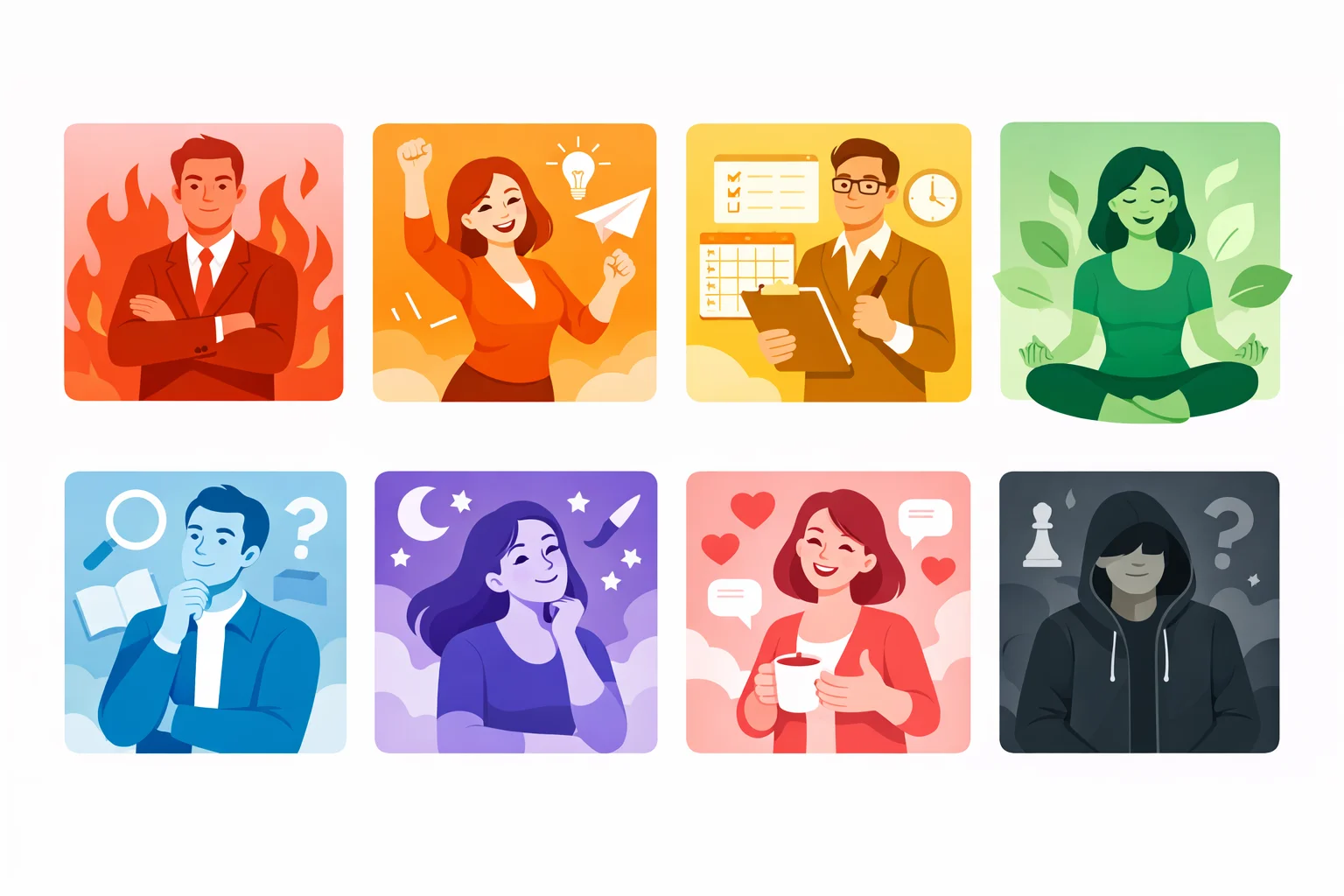
❤️ Red — The Trailblazer. Bold, competitive, and built for action, Reds decide fast and lead without waiting for permission. They thrive on challenge and hate stalling. The watch-out: steamrolling quieter people and treating everything like a contest.
🧡 Orange — The Spark. Spontaneous and endlessly curious, Oranges make ordinary days feel like adventures and adapt to anything. Boredom is their kryptonite. Their challenge is follow-through once the initial thrill wears off.
💛 Yellow — The Sunbeam. Warm, optimistic, and socially magnetic, Yellows pull the best out of a room and remember the little things. The flip side: they can mask their own struggles behind the cheerfulness so no one worries about them.
💚 Green — The Grounded. Calm, honest, and thoughtful, Greens stay clear-headed when everyone else spirals and value balance over status. Their growth edge is speaking up sooner instead of quietly waiting until they're certain.
💙 Blue — The Anchor. Loyal and deeply empathetic, Blues feel everything and show up for the people they love without being asked. The risk is chronic self-neglect — putting everyone's harmony ahead of their own needs.
💜 Purple — The Visionary. Imaginative and unconventional, Purples think in possibilities others can't see yet and would rather be original than agreeable. At their rarest (about 8% of people), they can struggle to ground big ideas into finished ones.
🩷 Pink — The Nurturer. Tender, playful, and generous, Pinks notice who's left out and quietly fix it. Their softness is real strength — but it needs boundaries, because they'll pour into others until there's nothing left for themselves.
🖤 Black — The Enigma. Independent and discerning, Blacks keep a small circle, value depth over noise, and live firmly on their own terms. The challenge: that carefully guarded mystery can read as distance to the people who want in.
What to Actually Do With Your Color
The point of knowing your color isn't to slap a label on your bio — it's to use it. Show a partner or teammate your trait profile and ask where they see it differently; the gap is usually more revealing than the match. Lean into your growth partner color when you feel stuck: a Blue who borrows a little Red assertiveness, or a Red who borrows Green patience, tends to unlock the thing they keep bumping into.
Most of all, hold the result lightly. A color is a starting conversation, not a verdict — the truest version of you lives in the blend of your primary and secondary, and in the parts no twelve-question quiz will ever fully capture. Curious how the same you shows up through a different symbolic lens? The spirit animal quiz is a fun place to check your result against your gut.