Gender Identity Quiz: Understanding Gender as a Spectrum Beyond the Binary
This gender quiz won't hand you a label and call it a day — it's built to do something more useful. By the time you finish, you'll be able to pull apart the three things people constantly tangle together: the sex you were assigned at birth, your internal sense of who you are, and how you express that to the world. Most "am I trans quiz" tools online mash all three into a single yes-or-no verdict, which is exactly why their results feel hollow. Separate them, and the question "what is my gender?" gets a lot clearer.
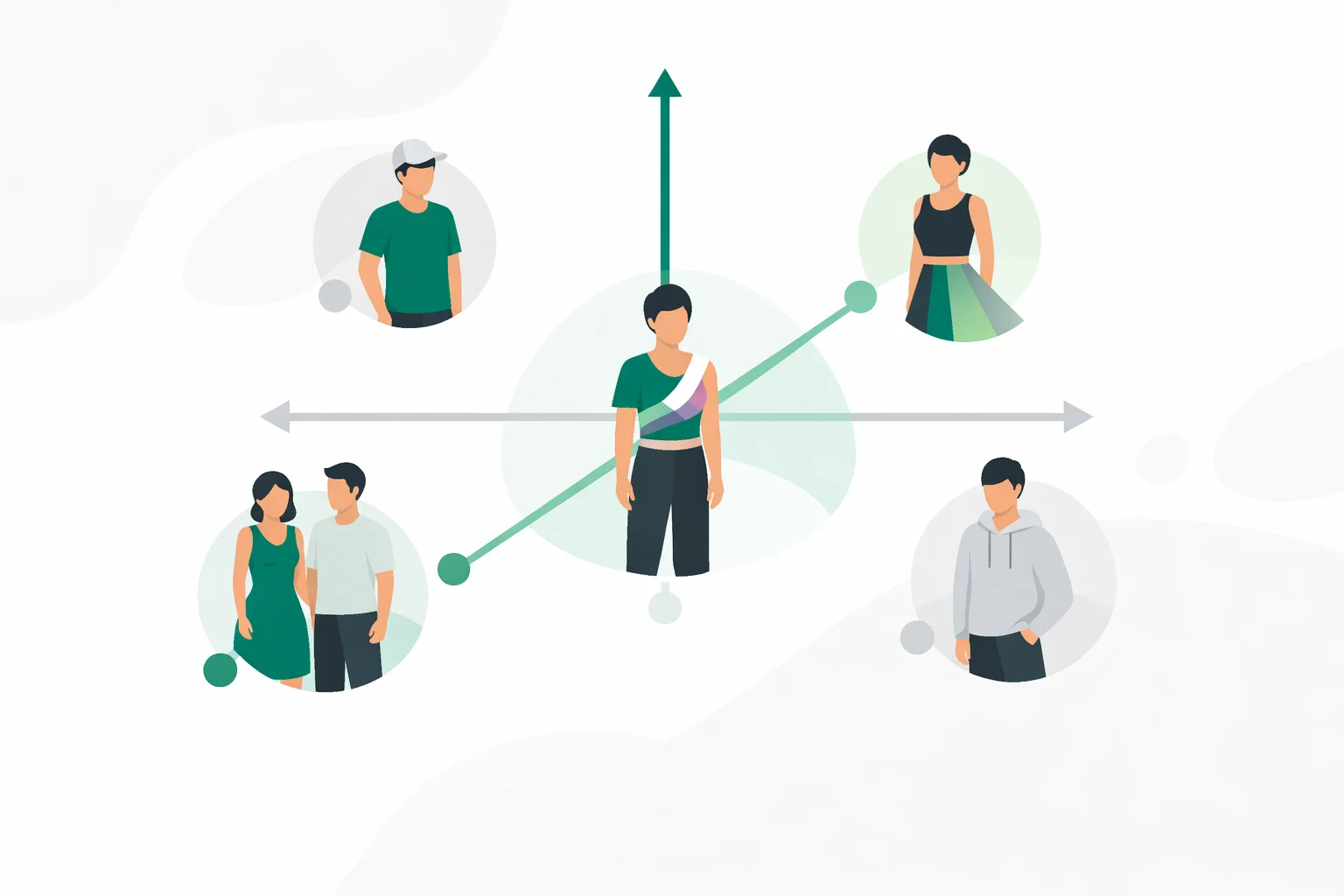
Gender Has at Least Three Moving Parts, Not One
Here's the single most useful thing you can learn about gender, and it's the reason this quiz is structured the way it is: gender is not one slider. It's at least three, and they move independently. The model sometimes gets taught as the "Genderbread Person," but you don't need the cartoon — you just need the three parts.
- Assigned sex — what a doctor wrote down at birth based on anatomy.
- Gender identity — your private, internal sense of being a man, woman, both, neither, or something else. Nobody can see it but you.
- Gender expression — the outward stuff: clothes, hair, voice, name, mannerisms.
Because they move separately, you can mix and match them in ways that surprise people who assume gender is one thing. Watch how four different people line up:
| Person | Assigned sex | Identity | Expression | What they are |
|---|---|---|---|---|
| Maria | Female | Woman | Short hair, suits, no makeup | Cisgender woman |
| Jordan | Male | Man | Painted nails, eyeliner, dresses | Cisgender man |
| Sam | Male | Woman | Jeans and T-shirts, plain | Trans woman |
| Alex | Female | Neither / in between | Varies day to day | Nonbinary |
Notice that Jordan's eyeliner says nothing about his identity, and Sam's plain wardrobe says nothing about hers. The American Psychological Association's definitions of gender identity and expression draw exactly this line. This quiz only measures the middle row — identity — because that's the part that actually answers the question you came here with.
Why Liking "Opposite-Gender" Things Doesn't Make You Trans
This is the trap that sends people in the wrong direction more than any other. A guy who loves skincare, cries at movies, and hates sports starts wondering if he's secretly a woman. A girl who skateboards, keeps her hair short, and never wears dresses wonders the same in reverse. Both are usually confusing expression with identity — and most of the time, the answer is that they're cisgender people who simply don't fit a stereotype.
That's why question 13 in the quiz asks you to separate the two directly. Disliking the rules handed to your gender is incredibly common and says nothing definitive. Feeling like you actually are a different gender, underneath the clothes and hobbies entirely, is a different signal. Gender expression is also separate from who you're attracted to — if that's the part you're untangling, our Am I Gay quiz works on orientation rather than identity, and the two answer genuinely different questions.
Dysphoria and Euphoria: The Two Signals Worth Trusting
If expression is the noisy, unreliable signal, dysphoria and euphoria are the quiet, reliable ones — which is why several quiz questions are built to detect them. Gender dysphoria is the distress that can come from a mismatch between your assigned gender and your sense of self: discomfort with your body, with being grouped as your assigned gender, with being called the wrong name or pronouns. The World Professional Association for Transgender Health treats it as a central concept in gender-affirming care.
Gender euphoria is the flip side, and people underrate it badly. It's the warm, almost startling rightness some people feel the first time they're read correctly — a new name, a haircut, a pronoun that lands. Here's the part that trips people up: you don't need dysphoria to be trans. Plenty of trans people barely felt distress but lit up the moment they imagined living as another gender. If question 10's "magic button" made you reach for it instantly, that's a euphoria signal — and it counts every bit as much as discomfort does.
What the Two Sliders in Your Result Actually Measure
Most gender quizzes try to plot you on a single line from "man" to "woman," and it falls apart immediately — because that line can't hold a nonbinary person, or an agender one, or someone whose gender moves. So this quiz uses two separate sliders, and your result shows both.
The first slider is alignment: how far your internal sense of gender sits from the one you were assigned at birth. The left end is "this fits, I'm comfortable" (cisgender); the right end is "this is wrong, I'm someone else" (transgender). The second slider is binary placement: whether you sit firmly inside the man/woman framework or somewhere between, beyond, or outside it. A binary trans woman scores high on alignment-difference but stays low on the second slider — she's firmly a woman. A nonbinary person climbs the second slider because both boxes feel too small. Reading them together is what lets the quiz tell apart six results instead of forcing everyone onto one impoverished line.
Nonbinary Genders Are Older Than the Gender Binary
One of the laziest dismissals of nonbinary people is that they're a recent invention — a 2010s internet fad. The historical record says the opposite. Cultures around the world recognized genders beyond two long before the strict male/female binary became the Western default. South Asia has hijra communities with roots stretching back centuries and legal recognition in several countries today. Many Indigenous North American nations recognize Two-Spirit people. Samoa has fa'afafine; the Zapotec of Mexico have muxes; pre-modern Hawaii had māhū.
What's actually new is the vocabulary in English — words like "nonbinary," "genderfluid," and "agender" that let people name an experience humans have reported for as long as we have records. So if your result landed outside the binary, you're not joining a trend. You're recognizing something with a very long history that finally has convenient names.
All 6 Results This Quiz Can Land On
🪞 Most Likely Cisgender. Your internal sense of gender matches the one you were assigned, and you feel at home there. Not fitting every stereotype doesn't change that — expression and identity are separate, and yours reads as settled.
🩵🤍🩷 Signs Point Toward Transgender. Your answers lean strongly toward a different gender than the one assigned, but still within the man/woman framework. This often comes with dysphoria, euphoria, or a long-running sense that something never fit — none of which require surgery or a particular wardrobe to be real.
💛🤍💜🖤 Leaning Nonbinary. Man and woman both feel too small. You might feel like a blend, like something in between, or off the map entirely. It's an umbrella, not a single fixed point, and words like genderqueer or bigender may fit underneath it.
🩷🤍💜 Likely Genderfluid. The defining feature isn't where your gender sits but that it moves — masculine some days, feminine others, neither at times. "It depends on when you ask" is a complete and honest answer, not indecision.
🖤🩶🤍💚 Possibly Agender. The whole idea of "having a gender" feels faint or simply irrelevant to you. It sits under the nonbinary umbrella but is distinct: less "in between" and more "outside the room entirely."
🧭 Still Exploring. Your answers pulled in different directions, or you chose a lot of "not sure." That's a real, common stage — not a broken result. You don't owe anyone a finished label to be taken seriously.
Your Result Felt Off? Here's What to Do Next
If the result missed, trust yourself over the quiz — you have decades of data on your own experience, and this had fifteen questions. The most useful thing a result can do is hand you a word to research, a feeling to sit with, or a question to bring to someone you trust. Notice when you feel most like yourself, and notice when you don't; that pattern teaches more than any quiz can.
If your answers pointed somewhere that resonates and you want to go deeper, a gender-affirming therapist is the right next step — not a website, and definitely not a one-time decision made off a result screen. And if any of this is bringing up real distress, skip the self-exploration for now and reach out: Trans Lifeline (877-565-8860) and The Trevor Project (1-866-488-7386) are free, confidential, and staffed by people who understand. If you're also working through who you're drawn to alongside who you are, the Am I Bisexual quiz and the Am I Asexual quiz map attraction the same way this one maps identity — one axis at a time, with room to land wherever is true.