The Am I Gay Quiz, Explained: Attraction as a Spectrum, Not a Verdict
It's 1 a.m., the search bar is glowing, and you finally type the three words you've been circling for months: am I gay. If you searched for an am I gay quiz tonight, you're in good company — that exact phrase gets typed into Google hundreds of thousands of times a month, by people of every age, all quietly asking the same thing. This page won't hand you a label. What it will do is give you a calmer, more honest way to look at feelings you might have been talking yourself out of.
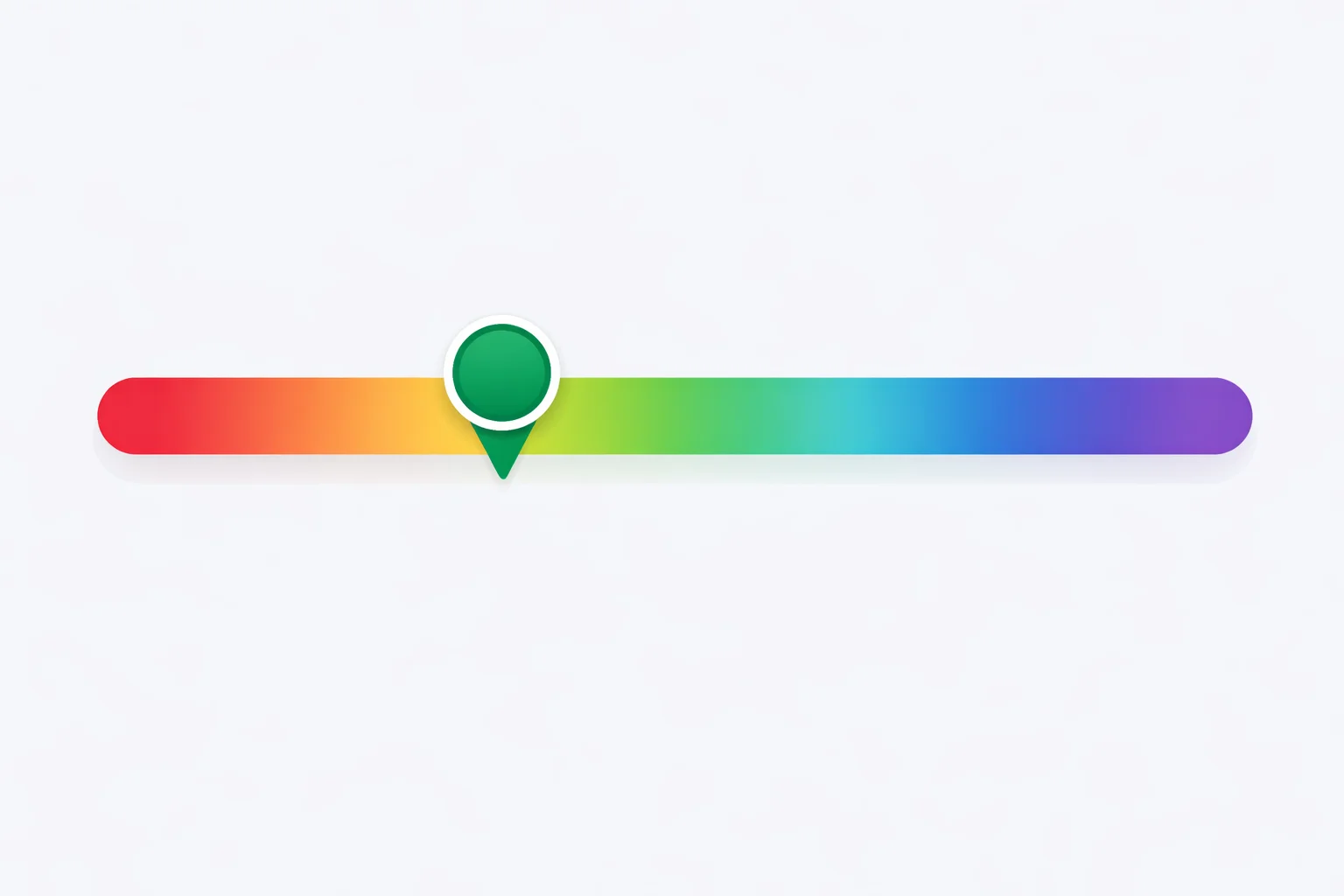
Sexual Orientation Is a Dial, Not a Switch
Most people grow up with a two-box model: gay or straight, on or off. That model is tidy, and it's also wrong. Decades of research describe orientation as a spectrum — a dial you can sit anywhere along, not a switch with two settings. Some people are at the far ends. Plenty of others land somewhere in between, and they're not confused or "going through a phase." They're just where they are.
That's why this quiz never spits out a flat yes or no. It places you on a continuum, because that's how attraction actually behaves. The single most freeing thing many people hear is that "mostly straight" and "mostly gay" are real, named places to stand — not rounding errors on the way to a real answer.
What Kinsey Found in 1948 Still Holds Up
Back in 1948, biologist Alfred Kinsey interviewed thousands of people and discovered something his era wasn't ready for: human sexuality didn't split cleanly into two groups. He built a 0-to-6 scale, where 0 meant exclusively heterosexual and 6 meant exclusively homosexual, and found most people weren't sitting neatly at either pole. You can read more about the framework at the Kinsey Institute.
The scale wasn't perfect — later researchers like Fritz Klein added dimensions for fantasy, emotional connection, and how attraction changes over a lifetime. But Kinsey's core insight has aged remarkably well, and it's the backbone of how this quiz scores your answers: not as a verdict, but as a position on a dial.
What Is This Am I Gay Quiz Actually Measuring?
Three things, really — and they don't always agree, which is the point. The first is who you're drawn to physically: the crushes, the double-takes, the daydreams. The second is emotional and romantic pull: who you imagine a future with, whose attention makes your stomach flip. The third is your own gut sense of identity — which word, if any, feels like home.
The quiz weighs all fifteen answers together rather than letting one dramatic moment decide everything. It also watches for honesty over certainty: if you keep choosing "I'm not sure" or "it depends," it won't shove you toward a label you didn't earn. It'll tell you you're questioning, because that's a real and respected answer. One curiosity-driven crush at summer camp doesn't define you; a consistent, years-long pattern is far more telling. The scoring is built to notice the difference.
Here's the Part Nobody Tells You About Attraction
Attraction can move. Psychologist Lisa Diamond spent more than a decade following the same group of women and documented what she called sexual fluidity — real, lasting shifts in who people were drawn to, especially across the teens and twenties. That doesn't mean orientation is a choice; nobody decides their attractions like picking a coffee order — the American Psychological Association is clear that orientation isn't something people choose or can will away. It just means a result you get today is a snapshot, not a sentence.
So if you take this quiz now and again in two years and land somewhere different, neither result was "wrong." You grew. For a lot of people, that's the most reassuring fact in this whole article: you're allowed to be a work in progress.
The Signs People Second-Guess the Most
A few patterns come up again and again from people who eventually realize they're gay, bi, or queer — and almost all of them got explained away for years. Here's a quick map of what often gets dismissed versus what it might actually be pointing at:
| What people tell themselves | What it might really be |
|---|---|
| "I just really admire how they look." | Admiration rarely comes with butterflies or jealousy. Attraction often does. |
| "Everyone gets crushes on celebrities of the same gender." | Some do — but the intensity and how often it happens is the real signal. |
| "I only felt that way because I was drunk / curious." | Lowered inhibition can reveal feelings, not invent them from nothing. |
| "I have a partner of a different gender, so I must be straight." | Plenty of bi people are in different-gender relationships. It doesn't cancel the rest. |
None of these prove anything on their own — that's exactly why the quiz looks at the whole picture instead of a single line. If you're a woman specifically wondering about attraction to other women, our Am I Lesbian Quiz adds a compulsory-heterosexuality lens this one doesn't. And remember that who you're attracted to is a separate question from who you are — if the second one is the live one for you, our Gender Identity Quiz maps identity instead of attraction.
All 6 Results This Quiz Can Give You
💙 Most Likely Straight — Your attraction pointed consistently toward a different gender. The fact that you were curious enough to take the quiz is normal and healthy; curiosity isn't a contradiction of being straight.
💜 Mostly Straight — Primarily drawn to a different gender, with a genuine thread of same-sex attraction running through it. Researchers treat "mostly straight" as a real, common position — not a hidden version of gay.
🌈 Somewhere in the Middle — Your answers reached toward more than one gender, which lines up with bisexual or pansexual attraction. It's a complete orientation, not a fence you're sitting on while you decide. If this is you, our Am I Bisexual Quiz scores each gender on a separate axis, so a lean doesn't get flattened into "just confused." To see the entire spectrum in one reading rather than testing a single orientation, the broader Sexuality Quiz maps direction and intensity together.
💗 Mostly Gay — Primarily drawn to the same gender, with a little flexibility at the edges. Many here ultimately identify as gay or lesbian; some find "mostly" simply fits them best.
🏳️🌈 Most Likely Gay — Nearly everything pointed the same direction: your romantic and physical attraction is for the same gender. If reading that felt more like relief than surprise, that's worth sitting with.
✨ Still Figuring It Out — You answered honestly with a lot of "not sure," and the quiz respected that. Questioning is its own legitimate stage, and there's no deadline for moving out of it.
What If Your Result Doesn't Feel Right?
Then trust yourself over the screen. A 15-question quiz can't see your whole history, your culture, the people you've loved, or the feelings you haven't admitted to anyone yet. If the result lands wrong, that mismatch is information too — sometimes a strong "no, that's not me" tells you as much as a yes would. Sit with which part felt off and why.
And one firm boundary: please don't use a result as your reason to come out. Coming out is about safety, timing, and the specific people in your life — none of which a quiz can weigh. Let this be a private first step, not a public one.
Where to Go From Here
If the quiz stirred something up, here's the gentle version of next steps. Give yourself permission to not know yet — certainty is not the entry fee for being valid. Notice your real-life reactions over the next few weeks without judging them. And if part of what's confusing is that you feel little sexual pull toward anyone rather than a particular gender, that's a different question entirely — our Am I Asexual Quiz reads sexual and romantic attraction on separate scales. If you want to talk, reach out to a confidential resource like The Trevor Project or a counselor who's affirming of LGBTQ+ people. You don't have to have an answer to deserve support — you just have to be willing to be honest with yourself, which, if you made it this far, you already are.