The Am I Bisexual Quiz That Stops Treating Attraction as a Tug-of-War
Bisexuality is not being half-gay and half-straight. That definition has been quietly wrong for decades, and it's the single biggest reason so many people typing "am I bisexual" into a search bar at midnight end up more confused than when they started. If you came here looking for an am I bisexual quiz, the most useful thing you'll read all day is this: your attraction to one gender and your attraction to another aren't fighting over the same slice of pie. They live on separate scales. That one shift is why the quiz above plots you on a grid instead of a line — and why a result can say "bisexual" even when your feelings are nowhere near balanced.
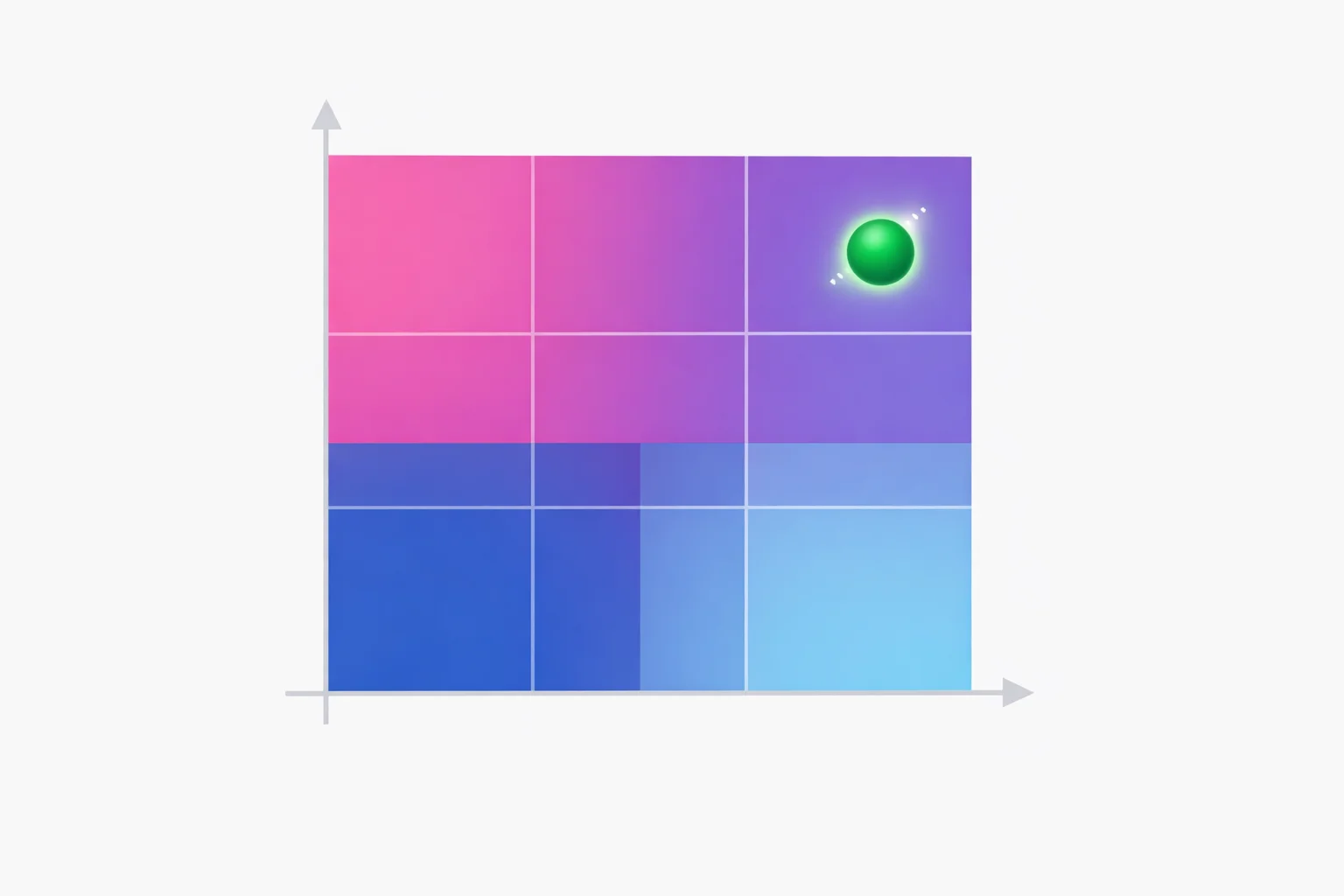
Bisexuality Isn't Half-Gay and Half-Straight
Picture the usual sexuality test. A slider runs from "straight" on the left to "gay" on the right, and you're supposed to find your spot somewhere along it. The problem is baked into the design: every bit of attraction you feel toward one gender mathematically subtracts from the other. On that line, a bisexual person can only ever be a compromise — the mushy middle between two "real" answers. No wonder bi folks come away feeling like a rounding error.
Real attraction doesn't work that way. Wanting a different gender intensely doesn't turn down the volume on wanting the same gender. The two can both be loud. They can both be quiet. One can be loud while the other hums in the background. The only model that captures that is two independent dials, which is exactly what this quiz measures — one score for attraction to a different gender, a separate score for the same gender, neither stealing from the other.
Five Myths That Keep Bi People Doubting Themselves
Bisexuality attracts more bad folk-wisdom than almost any other orientation, and the myths aren't harmless — they're the exact thoughts that make people second-guess a result. Here are the five that come up most, and what's actually true.
Myth 1: "You have to be 50/50." Nope. Attraction leans for almost everyone, and a 70/30 or even 90/10 split is still bisexual as long as both sides are genuinely there. Balance was never the requirement; the presence of attraction to more than one gender is.
Myth 2: "It's a phase on the way to gay or straight." Studied directly and repeatedly. Longitudinal work, including a well-known decade-long study by psychologist Lisa Diamond, found plenty of people hold a stable bisexual identity across their entire adult lives. Some labels shift, sure — but bisexuality is a destination, not a layover.
Myth 3: "If you haven't dated both, you're not really bi." Orientation is about attraction, not your résumé. A straight person doesn't need to date to know they're straight. Neither do you.
Myth 4: "Bi people are just greedy or can't commit." Being attracted to more than one gender says nothing about monogamy. Bi people cheat, stay faithful, and get bored at the same rates as everyone else — which is to say, it's about the person, not the orientation.
Myth 5: "A relationship cancels it out." A bi woman with a husband is still bi. A bi man with a boyfriend is still bi. Your orientation isn't reset by whoever you're currently kissing — attraction doesn't evaporate because you settled down.
Why This Quiz Uses Two Rulers, Not One
Back in the 1970s, psychologist Fritz Klein built something called the Klein Sexual Orientation Grid because he thought the famous Kinsey scale — that single 0-to-6 line — was too flat to describe how people actually work. His insight, and the one this quiz borrows, is that attraction is multidimensional. You can rate your pull toward each gender separately, and the interesting truth lives in the combination.
So the quiz quietly sorts its questions into two stacks. Some ask about attraction to a different gender than yours — the crushes, the chemistry, the can-you-picture-a-future pull. Others ask the identical things about the same gender. Each stack becomes its own percentage, and those two numbers turn into your coordinates on the grid. High on both? That's the bisexual quadrant, top-right. High on one and low on the other puts you near "straight" or "gay." The beauty is that a lean doesn't erase you — it just slides your dot toward one edge of a zone you're still firmly inside. If you'd rather run the simpler one-line version of this exploration, the Am I Gay Quiz uses a classic straight-to-gay spectrum instead.
Am I "Bi Enough" If My Attraction Leans?
This is the question I'd bet brought half of you here, so let's be blunt about it. "Bi enough" is not a real category. There's no panel, no minimum same-gender experience, no quota of crushes you have to hit. If you feel genuine attraction to more than one gender, you clear the entire bar — that's the whole bar.
The doubt usually shows up for predictable reasons. Maybe your attraction leans hard, so the smaller side feels "not enough." Maybe you're in a relationship that reads as straight or gay from the outside, so people assume — and you start assuming too. Maybe you've only ever acted on one side. None of that subtracts from the other axis. The quiz is built to notice exactly this: it places a strongly leaning person in the heteroflexible or homoflexible zone, both of which sit squarely under the bi umbrella, precisely so a real but smaller attraction doesn't get rounded down to zero.
Bi, Pan, Fluid, Queer: Sorting Out the Words
One reason this gets tangled is that several words describe overlapping experiences, and people use them differently. Here's a quick map of how most folks draw the lines — though plenty of people mix and match, and that's allowed.
| Label | What it usually means | Often chosen by people who... |
|---|---|---|
| Bisexual | Attraction to more than one gender | Feel pulled toward multiple genders, with or without a lean |
| Pansexual | Attraction regardless of gender | Say the person matters and gender barely factors in |
| Fluid | Attraction that shifts over time | Notice their pull moving across years or seasons of life |
| Queer | An umbrella term, deliberately open-ended | Want a word that resists a precise box |
If the quiz handed you a "pansexual" flavor, it's because you kept saying gender itself barely registers. That's a real and common bi-umbrella experience, not a different species. You can wear "bi" and "pan" on different days if you like. Labels are tools for being understood and finding your people — not exams you can fail. And if you noticed that sexual attraction itself rarely factors in, no matter the gender, that's a separate thread worth pulling — our Am I Asexual Quiz maps attraction and romance as two different scales.
The Quiet Cost of Bi Erasure
Here's the part that turns this from a vocabulary lesson into something that matters. Bisexual people are the largest single group in the LGBTQ+ community — the Williams Institute consistently finds bi people outnumber gay and lesbian people combined. And yet bi folks report worse outcomes than either straight or gay peers on several mental-health measures, including higher rates of anxiety and depression. The driver isn't the orientation. It's erasure: being told by both straight and gay communities that you're confused, greedy, or faking, until you start to wonder yourself.
That's the real stakes behind "am I bi enough." The doubt isn't a quirk; it's a learned response to a culture that keeps insisting you don't exist. Naming that can be oddly freeing — a lot of the uncertainty people bring to this quiz isn't uncertainty about their attraction at all. It's the residue of being told their attraction couldn't be real. If you're a woman specifically untangling whether your attraction to men was ever genuine, our Am I Lesbian Quiz adds a compulsory-heterosexuality lens this one doesn't. And if the question underneath it all is about your own gender rather than who you're drawn to, our Gender Identity Quiz maps identity on its own two axes. And if you'd rather step back and see the whole orientation spectrum at once instead of zeroing in on bisexuality, the broader Sexuality Quiz places you across every reading from straight to asexual in one pass.
All 7 Results This Quiz Can Give You
💗💜💙 Most Likely Bisexual — Real, recurring attraction showed up on both axes. The quiz didn't need a 50/50 split to land you here; it just needed both pulls to be genuine. Leaning is normal and changes nothing about the label fitting.
💛💗💙 Bisexual / Pansexual — You're firmly in the bi-umbrella zone, but you kept saying gender barely factors in — the person matters more. That pattern is what many people call pansexual. Bi and pan overlap heavily; pick whichever feels like home.
💙💜 Heteroflexible — Your strongest pull runs toward a different gender, with a genuine, recurring same-gender thread alongside it. That still sits under the bi umbrella, often as "bi with a lean." The smaller side is real, not noise.
💗💜 Homoflexible — Mostly drawn to the same gender, with a real different-gender thread too. Some people here eventually settle on gay or lesbian; others claim bi proudly. Both pulls registered as genuine.
💙 Most Likely Straight — Attraction pointed clearly toward a different gender, with the same-gender axis staying low. Curiosity about this question doesn't contradict that — lots of straight people wonder.
🏳️🌈 Most Likely Gay or Lesbian — Strong same-gender attraction, low different-gender attraction. That lines up with gay or lesbian rather than bisexual. If it matches a long-held feeling, that recognition is worth honoring.
✨ Still Figuring It Out — You answered honestly with a lot of "not sure," or neither axis registered strongly. Questioning is a legitimate stage with no deadline attached.
If You Got "Bisexual," What Happens Next
Probably less than you fear and more than you expect. A result is information, not an assignment — nothing about your week has to change. You don't owe anyone an announcement, and you definitely shouldn't treat a quiz as a green light to come out; that decision belongs to you, on a timeline shaped by your own safety and the people in your life. Bi people in particular sometimes meet doubt from both directions, so let this be a private first step.
What you can do is stop arguing with your own attraction. If both axes lit up, that's data about you worth trusting more than a culture that profits from your confusion. Notice your real reactions over the next few weeks without grading them. Read a couple of first-person bi accounts and see what lands. And if the question is sitting heavy, talk to an affirming counselor or a confidential line like The Trevor Project. You don't need a finished answer to deserve support. You just need to be honest with yourself — and if you made it this far, you already are.