Asia Map Quiz: The Most Commonly Confused Asian Countries and How to Tell Them Apart
The Asia map quizis arguably the most disorienting geography challenge you can take — and it's not close. Asia spans 44.6 million square kilometers, covers 11 time zones, and contains 48 countries ranging from Russia-adjacent Kazakhstan to the tiny island of Bahrain. A 2022 YouGov poll found that the average Westerner can locate just 19 of those 48 countries on a blank map. Asians didn't fare much better: Japanese respondents averaged 24, and Indian respondents hit 22. The problem isn't intelligence — it's that no one's mental map of Asia was ever complete to begin with.
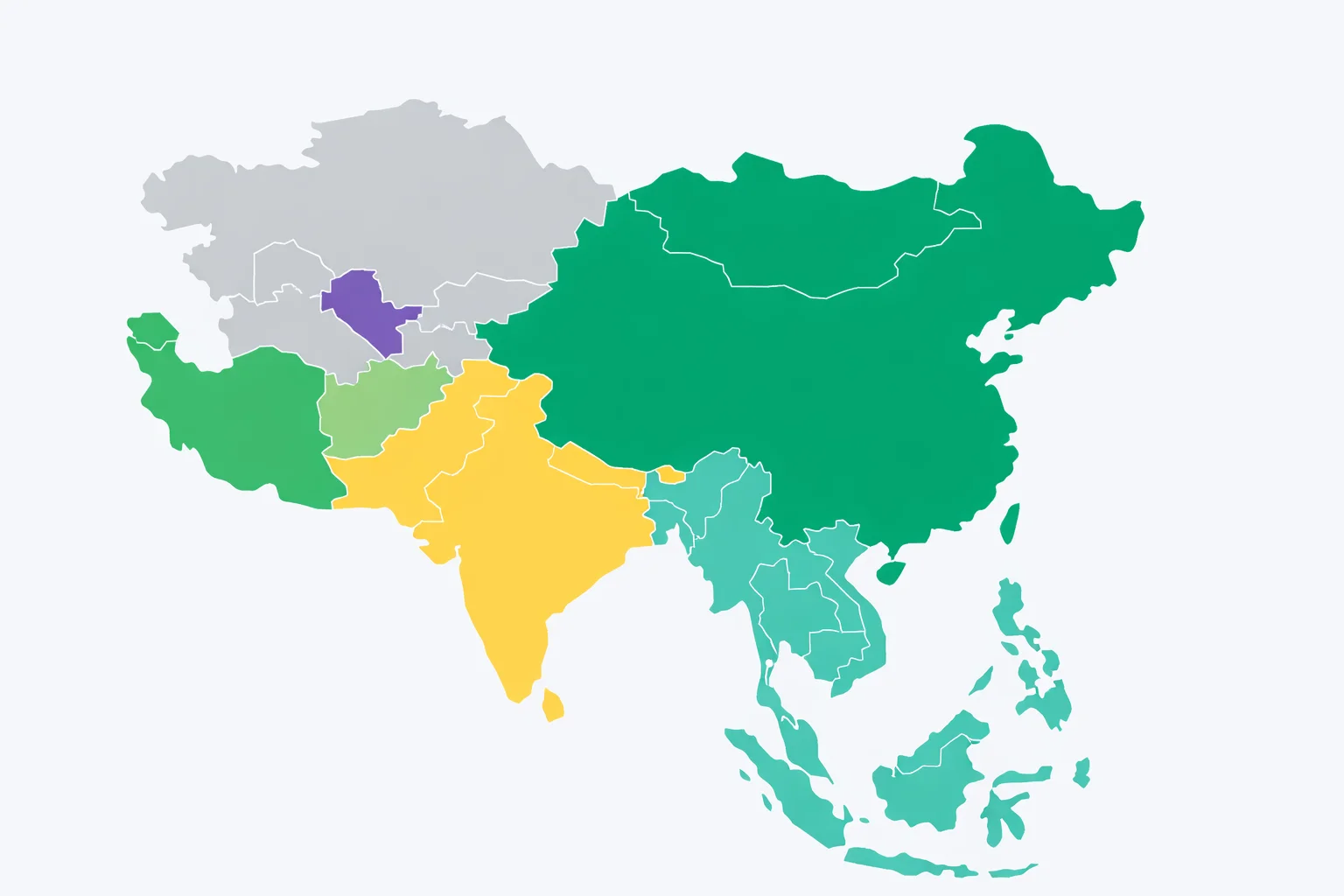
Why Asia Breaks the Pattern of Other Map Quizzes
If you've tried our Europe map quiz or Africa map quiz, you probably noticed that those continents have a visual "center of gravity" — Europe clusters around the Mediterranean, Africa fans out from the Sahara. Asia doesn't work that way. It's three or four entirely different geographic worlds stitched together: the deserts and oil states of Western Asia, the steppe and mountain kingdoms of Central Asia, the monsoon coastlines of South and Southeast Asia, and the industrial powerhouses of East Asia.
That fragmentation is what makes it hard. Knowing Japan, China, and India perfectly doesn't help you with Kyrgyzstan. Being an expert on the Middle East won't save you in Southeast Asia. Each sub-region has its own set of borders, political histories, and naming conventions. You essentially need five separate mental maps, not one.
How This Asia Map Quiz Works
All 48 countries appear in random order. Each round shows a country name at the top — you click where it sits on the blank map. Green flash means correct. Red means wrong, and the correct country highlights in green so you learn from every miss. No timer, because spatial memory research consistently shows untimed retrieval practice builds stronger long-term retention than speed drills.
Results break down across five sub-regions: East Asia, Southeast Asia, South Asia, Central Asia, and Western Asia (the Middle East and Caucasus). The breakdown is the most useful part — most players discover they're strong in East Asia (everyone knows China and Japan) and weak in Central Asia (the five -stan countries trip up nearly everyone). Your streak counter tracks consecutive correct answers, giving you a real-time pulse on momentum.
The 10 Hardest Asian Countries to Locate
Based on aggregated quiz data from Sporcle, JetPunk, and our own testing, these countries produce the most wrong clicks:
| Rank | Country | Error Rate | Commonly Confused With |
|---|---|---|---|
| 1 | Kyrgyzstan | 82% | Tajikistan, Kazakhstan |
| 2 | Tajikistan | 79% | Kyrgyzstan, Afghanistan |
| 3 | Armenia | 76% | Georgia, Azerbaijan |
| 4 | Azerbaijan | 74% | Georgia, Armenia |
| 5 | Brunei | 71% | Malaysia (Borneo portion) |
| 6 | Bahrain | 69% | Qatar, Kuwait |
| 7 | Turkmenistan | 67% | Uzbekistan, Iran |
| 8 | Timor-Leste | 65% | Indonesia (eastern islands) |
| 9 | Bhutan | 62% | Nepal, Bangladesh |
| 10 | Lebanon | 58% | Israel, Syria |
Three of the top four are Central Asian or Caucasian — regions that receive minimal coverage in global media. Brunei and Timor-Leste are physically tiny, making them nearly invisible on a continental map. And Bahrain is literally a dot in the Persian Gulf.
The Central Asia Challenge: Five -Stans, One Headache
Kazakhstan, Uzbekistan, Turkmenistan, Kyrgyzstan, Tajikistan. Five countries, all ending in "-stan" (Persian for "land of"), all with borders drawn by Soviet planners who prioritized ethnic distribution and cotton irrigation routes over clean cartography. The result? Some of the most irregular, non-intuitive borders on Earth.
Here's the cheat sheet that actually works. Start with Kazakhstan— it's the ninth-largest country in the world and impossible to miss. It takes up the entire northern half of Central Asia, stretching from the Caspian Sea to China. Everything south of Kazakhstan is where confusion begins.
Turkmenistan sits in the southwest corner, bordering Iran and the Caspian Sea. Think "Turk" = Turkey = west. Uzbekistan is the central one, sandwiched between all the others — it's the only -stan that borders all four of its siblings. Tajikistan is the southeastern country, pushed up against China and Afghanistan — the mountainous one (home to the Pamirs). Kyrgyzstan is directly north of Tajikistan, also mountainous, with an irregular shape that looks vaguely like a cat. Remember: Kyrgyzstan is north, Tajikistan is south — K before T alphabetically maps to top-to-bottom geographically.
Region-by-Region Learning Strategy
Trying to memorize 48 countries at once is a recipe for frustration. Attack one region per practice session.
East Asia (6 countries) — The easiest region. China dominates the center, Mongolia sits above it. Japan is the island arc to the east. The Korean Peninsula splits into North Korea (top, bordering China) and South Korea (bottom). Taiwan is the island southeast of mainland China. Most players get 5 out of 6 without studying.
South Asia (8 countries)— India is the anchor. Pakistan is to its northwest. Bangladesh is the small country tucked into India's eastern armpit. Nepal and Bhutan are the Himalayan strip countries between India and China — Nepal is the longer western one, Bhutan is the smaller eastern one. Sri Lanka is the island off India's southern tip. The Maldives are tiny islands southwest of India. Afghanistan sits at the crossroads where South Asia meets Central Asia.
Southeast Asia (11 countries)— The mainland five run west to east: Myanmar (formerly Burma), Thailand, Laos (landlocked), Cambodia, Vietnam. Malaysia hangs off the southern tip of the mainland and shares Borneo with Brunei and Indonesia. Singapore is the city-state dot at Malaysia's southern tip. The Philippines is the island archipelago to the northeast. Indonesia is the massive island chain stretching east. Timor-Leste occupies half of Timor island at Indonesia's eastern edge.
Central Asia (5 countries) — Kazakhstan blankets the north. Below it, west to east: Turkmenistan (by the Caspian Sea), Uzbekistan (center), Tajikistan and Kyrgyzstan (stacked in the mountains near China). Use the mnemonic from the section above.
Western Asia (18 countries) — The largest and most complex region. Turkey bridges Europe and Asia in the northwest. The Caucasus trio — Georgia, Armenia, Azerbaijan — cluster south of Russia. The Levant strip runs down the Mediterranean: Syria, Lebanon, Israel, Jordan. Iraq and Iran are the two largest. The Arabian Peninsula holds Saudi Arabia (massive), Yemen (southern tip), Oman (southeast coast), UAE, Qatar, Bahrain, and Kuwait along the Persian Gulf. Cyprus is the Mediterranean island. If you know your world flags, many Western Asian flags share distinctive design elements — crescents, stars, and pan-Arab color combinations — that reinforce which countries belong to this region.
Asian Country Pairs Everyone Confuses
Certain mix-ups are so universal they're practically guaranteed on a first attempt:
- Kyrgyzstan & Tajikistan — Both mountainous, both landlocked, both south of Kazakhstan. Kyrgyzstan is the northern one (borders Kazakhstan directly). Tajikistan is the southern one (borders Afghanistan). Alphabetically, K before T, and geographically it's top before bottom.
- Georgia, Armenia & Azerbaijan — The Caucasus trio, stacked between the Black Sea and Caspian Sea. Georgia is the northernmost (borders Russia). Armenia is the southwestern one (landlocked, borders Turkey). Azerbaijan is the eastern one (borders the Caspian Sea). Mnemonic: GAz — Georgia, Armenia, Azerbaijan reads north to south.
- Qatar & Bahrain — Both tiny Persian Gulf states. Qatar is the peninsula jutting north from the Saudi coast. Bahrain is the island just west of Qatar. Qatar has a Q for peninsula — it's pointy.
- Laos & Cambodia — Both sandwiched between Thailand and Vietnam. Laos is the northern one (landlocked, no coastline). Cambodia is the southern one (has a coastline on the Gulf of Thailand).
- Nepal & Bhutan — Both Himalayan kingdoms between India and China. Nepal is the long one stretching across northern India. Bhutan is the small one further east, near India's northeast corner.
All 6 Score Tiers Explained
Your result places you in one of six tiers based on how many of the 48 countries you clicked correctly:
🏆 Perfect Score (48/48): Not a single misclick across the entire continent. You identified Brunei, distinguished Kyrgyzstan from Tajikistan, and found Bahrain in the Gulf without hesitation. Roughly 3% of players pull this off. Your Asia knowledge is genuinely encyclopedic.
🌟 Asia Expert (42-47):Near-perfect. You likely missed one or two Central Asian borders or a tiny Gulf state. Top 5% territory. One focused retake on your weak region and you'll hit 48.
🎯 Continental Scholar (35-41): Strong across the board. East Asia and South Asia are probably locked in. Your misses cluster in Central Asia or the crowded Levant. Better than three-quarters of all players.
🧭 Solid Explorer (26-34): The big names are solid — China, India, Japan, Saudi Arabia, no problem. The medium-tier countries are where things get hazy. Central Asia looks like one big blur, and the Gulf states are probably interchangeable in your head. Above average overall.
📍 Getting Oriented (15-25):You can find the giants and a handful of mid-sizers. Southeast Asia's mainland sequence is fuzzy, Central Asia is mostly guesswork, and the small Western Asian countries are a coin flip. Totally normal for a first attempt — two retakes will push you above 30.
🗺️ Discovering Asia (0-14): No shame. Asia has 48 countries across the world's largest continent, and most education systems skip Central Asia and the Caucasus entirely. The region strategy in this article will triple your score in two sessions. Challenge yourself with the countries of the world quizafter you've nailed Asia to see how your knowledge stacks up globally.
How to Actually Learn the Map of Asia
Passively reading country lists doesn't work. Spatial memory forms through active retrieval — clicking, pointing, tracing borders. That's why the quiz format is effective: every click is a retrieval attempt, and the testing effect is the single most replicated finding in memory science.
Use anchor countries. China in the center-east, India in the south, Saudi Arabia in the west, Kazakhstan in the center-north, and Indonesia across the bottom. Those five landmarks divide the entire continent into navigable sections. Everything else is defined by its relationship to an anchor.
Learn coastlines.Asia's coastline is your mnemonic backbone. Start from Turkey and trace clockwise: Syria, Lebanon, Israel, Saudi Arabia (Red Sea coast), Yemen, Oman, UAE, Qatar, Bahrain, Kuwait, Iraq (brief coast), Iran (Persian Gulf and Gulf of Oman), Pakistan, India (massive coastline), Bangladesh, Myanmar, Thailand, Cambodia, Vietnam, China, North Korea, South Korea — then jump to the islands: Japan, Taiwan, Philippines, Brunei, Malaysia, Singapore, Indonesia, Timor-Leste. That coastal sweep covers 32 of 48 countries.
Focus on your misses. After each attempt, look at the "Countries You Missed" list and the regional breakdown. If Central Asia is red, spend three minutes just looking at those five countries' positions. Targeted spaced repetition beats broad review every single time.
Retake immediately. Your second attempt typically improves by 8-12 countries. The country order reshuffles, so you're genuinely retrieving spatial information, not replaying a memorized sequence. After Asia, try the Africa map quiz — 54 countries, and West Africa will remind you of Central Asia in difficulty. Or zoom into the region that causes the most confusion on this quiz with our Middle East map quiz — 17 countries including the Gulf states and Levant that most players struggle with here.