13 Colonies Quiz: History, Map, and Facts About America's Original States
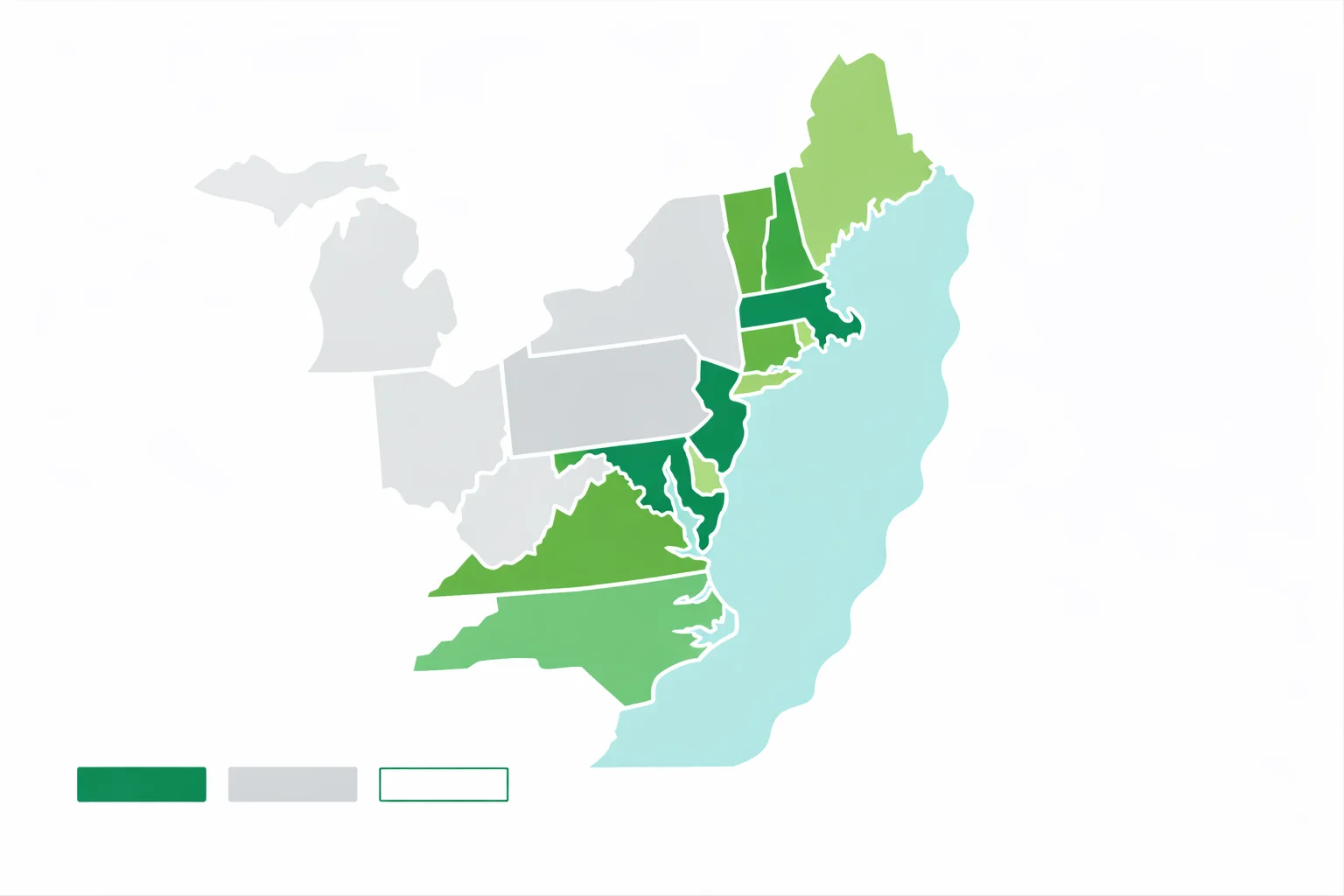
The 13 colonies quiz seems like it should be easy — there are only 13 answers. But in a 2024 YouGov survey, just 36% of American adults could name all 13 original colonies without help. The average person gets stuck somewhere around 9. If you scored below that, you're in bigger company than you think. If you beat it, you genuinely know your colonial American history better than most.
Why a 13 Colonies Quiz Is Harder Than You Think
There's a reason this quiz trips people up. The human brain stores categories in "chunks," and 13 sits in an awkward spot — too many to hold in working memory at once (which tops out around 7 items), but too few to justify the kind of mnemonic systems people use for longer lists. You think you know them all, so you don't build a memory strategy, and then you blank on Delaware.
The other issue is naming overlap. North Carolina and South Carolina feel like "one thing." New York, New Jersey, and New Hampshire all start with "New," which helps you remember the pattern exists but not which specific colonies fill it. And smaller colonies like Rhode Island and Delaware get mentally overwritten by their more famous neighbors.
Cognitive psychologists call this retrieval interference— similar items compete with each other in memory, making each one harder to pull up. It's the same reason people can name 48 states but consistently forget the same two.
How This Quiz Works
You have 5 minutes to type the names of all 13 original colonies. The quiz accepts full colony names (like "Massachusetts"), modern state abbreviations (like "MA"), and common shortened forms (like "Mass"). Matching is instant — the moment you type a correct answer, it locks in and the input clears for the next one.
The 13 colony cards at the bottom show founding years as clues. Correctly guessed colonies flip to reveal their name, founding year, and colony type. A hint system is available if you're stuck — it gives you the founding year, first letter, and colony type without outright telling you the answer.
Your results break down by colonial region (New England, Middle, Southern) and by colony type (royal, proprietary, charter), so you can see exactly where your knowledge is strongest. If you're also curious about modern US geography, try the 50 States Quiz— it's the same format but with 50 answers and 10 minutes on the clock.
The 5 Most Forgotten Colonies
Based on quiz data across thousands of attempts, these colonies are the ones people miss most often — and it's almost always the same five, in roughly this order:
| Rank | Colony | % of Players Who Miss It | Why It's Forgotten |
|---|---|---|---|
| 1 | Delaware | 55% | Tiny state, overshadowed by Pennsylvania |
| 2 | Rhode Island | 48% | Smallest colony, easily overlooked |
| 3 | New Hampshire | 42% | Confused with Vermont (which wasn't a colony) |
| 4 | Maryland | 35% | Gets mentally grouped with Virginia |
| 5 | Connecticut | 30% | Overshadowed by Massachusetts in the New England group |
Notice a pattern? Four of the five are either the smallest colonies by area or sit in the shadow of a more famous neighbor. Delaware existed almost entirely in Pennsylvania's orbit — it actually shared Pennsylvania's governor for most of the colonial period.
New England, Middle, and Southern Colonies Explained
Learning the colonies by region is far more effective than memorizing a flat list. Each region had distinct reasons for settlement, different economies, and unique cultural identities that make them easier to remember as groups.
New England colonies (4): Massachusetts, Connecticut, Rhode Island, and New Hampshire. These were settled primarily by Puritans and other religious dissenters seeking to build communities according to their faith. The economy ran on fishing, shipbuilding, and small-scale farming on rocky soil. Think church steeples, rocky harbors, and town meeting halls.
Middle colonies (4):New York, New Jersey, Pennsylvania, and Delaware. These were the most ethnically diverse from the start. Dutch, Swedish, English, and German settlers mixed together. The economy was built on grain farming (earning the nickname "breadbasket colonies"), trade, and manufacturing. Philadelphia and New York City were already major port cities by the mid-1700s.
Southern colonies (5):Virginia, Maryland, North Carolina, South Carolina, and Georgia. Plantation agriculture dominated — tobacco in Virginia and Maryland, rice and indigo in the Carolinas. These colonies had the largest enslaved populations and the most unequal distribution of wealth. Georgia, the youngest colony (1733), was originally intended as a buffer against Spanish Florida.
Remembering the count — 4, 4, 5 — is a useful check. If you've named three New England colonies but think you're done, you know you're missing one.
Royal vs. Proprietary vs. Charter Colonies
This distinction rarely appears in pop-culture history, but it shaped daily life in the colonies more than most people realize. The colony type determined who held power, how laws were made, and how much freedom colonists actually had.
Royal colonies (7):Virginia, New Hampshire, New York, New Jersey, North Carolina, South Carolina, and Georgia. Governed directly by the British crown through an appointed royal governor. The crown could veto any colonial law. By 1776, most colonies had become royal colonies — it was Britain's preferred way to tighten control.
Proprietary colonies (3):Maryland, Delaware, and Pennsylvania. Granted by the king to a private individual or family who served as the "proprietor." William Penn's Pennsylvania is the most famous example — he literally owned the colony and could set its laws, subject to crown approval.
Charter colonies (3): Massachusetts, Connecticut, and Rhode Island. Operated under written charters that gave colonists the most self-governance. Connecticut and Rhode Island elected their own governors — a genuine rarity in the colonial world. When Britain tried to revoke these charters in the 1680s, Connecticut literally hid its charter inside an oak tree rather than surrender it.
A Timeline of Colonial Founding Dates
The 13 colonies weren't founded all at once. The process stretched across 126 years — from the struggling Jamestown settlement in 1607 to Georgia's founding in 1733. Understanding the timeline helps you remember which colonies came when, and why.
| Year | Colony | Founded By | Key Motivation |
|---|---|---|---|
| 1607 | Virginia | Virginia Company | Commercial profit (gold, trade) |
| 1620 | Massachusetts | Pilgrims & Puritans | Religious freedom |
| 1623 | New Hampshire | John Mason | Fishing & trade |
| 1634 | Maryland | Lord Baltimore | Catholic refuge |
| 1636 | Connecticut | Thomas Hooker | Religious & political autonomy |
| 1636 | Rhode Island | Roger Williams | Complete religious liberty |
| 1638 | Delaware | Swedish settlers | Trade & agriculture |
| 1653 | North Carolina | Virginian settlers | Land & farming |
| 1663 | South Carolina | Lords Proprietors | Plantation agriculture |
| 1664 | New York | Duke of York | Seized from Dutch |
| 1664 | New Jersey | Berkeley & Carteret | Land grants |
| 1681 | Pennsylvania | William Penn | Quaker haven |
| 1733 | Georgia | James Oglethorpe | Debtor rehabilitation & Spanish buffer |
The 52-year gap between Pennsylvania (1681) and Georgia (1733) is striking. By the time Georgia was founded, Virginia had been established for over a century. Some historians argue this age difference contributed to the tension between older, more independent-minded colonies and the crown's later attempts at centralized control. For a deeper dive into who led these colonies — and the nation that followed — try the US Presidents Quiz.
From 13 Colonies to 13 States
The transition from colonies to states wasn't instantaneous. The Declaration of Independencein 1776 declared all 13 colonies free, but it took the Revolutionary War (1775–1783) to make that independence stick, and the Constitution (ratified 1788) to form an actual government.
Delaware was first to ratify the Constitution on December 7, 1787 — which is why it still calls itself "The First State." Pennsylvania followed five days later. Rhode Island, true to its contrarian nature, was the last of the original 13, not ratifying until May 29, 1790 — nearly three years after Delaware.
Here's what surprises most people: the 13 colonies didn't become the first 13 states in the order they were founded. They became states in the order they ratified the Constitution. Virginia, the oldest colony, was the 10th state. Georgia, the youngest colony, was the 4th state to ratify. The founding order and the statehood order are almost completely different — which is why knowing your state capitals is a separate challenge entirely.
All 6 Score Tiers Explained
🏆 Colonial Scholar (13/13):Perfect recall. You named every colony without missing a single one. This puts you in the top 22% of quiz takers. Most people who hit 13 either have a strong history background or used the regional grouping strategy — remembering 4 + 4 + 5 is easier than a flat list of 13.
⭐ History Buff (11–12/13):You missed one or two, likely Delaware, Rhode Island, or New Hampshire. These are the colonies that even history teachers sometimes pause on during recall. You're in the top 15% of all players.
🎯 Above Average (9–10/13): Right at or slightly above the average score. You remembered the heavy-hitters and most of the mid-tier colonies. The gaps are typically in the smallest or most geographically obscure colonies.
👍 Solid Effort (7–8/13):You know the colonies people think of first — Virginia, Massachusetts, New York, Pennsylvania. The middle colonies and smaller New England entries are where most people at this level lose a few.
📚 Getting There (4–6/13):You got the big names. The colonial period covers a lot of ground and the smaller colonies are genuinely easy to forget. One attempt with the hint system usually pushes this score up by 3–4 points.
🗺️ Just Getting Started (0–3/13):No judgment — colonial history isn't something most people think about regularly. The missed colonies section below your results gives you exactly what you need for a second attempt. Most people in this range improve dramatically on their second try.
How to Remember All 13 Colonies
The single most effective technique is regional chunking. Don't try to memorize 13 items — memorize three groups. Start from the top of the map (New England) and work south. Within each group, use a short phrase:
- New England (4): "Mass Connects Rhode Island to New Hampshire" — Massachusetts, Connecticut, Rhode Island, New Hampshire
- Middle (4): "New York & New Jersey host Penn's Delaware" — New York, New Jersey, Pennsylvania, Delaware
- Southern (5): "Virginia & Maryland above the Carolinas, Georgia below" — Virginia, Maryland, North Carolina, South Carolina, Georgia
The key insight from memory research is that recall practice beats rereading. Taking this quiz multiple times — actively retrieving the names from memory — strengthens the neural pathways far more than staring at a list. Psychologists call this the testing effect, and it's one of the most robust findings in learning science.
Give yourself three attempts across two days. Most people go from 9 to a perfect 13 within three rounds. The colonies you miss on attempt one become the ones you specifically look for on attempt two, and by attempt three, they're locked in.