Career Quiz for Teens: How to Start Exploring Careers While You're Still in High School
A career quiz for teens is one of the most useful tools a high schooler can use to start figuring out what they actually want to do with their life — before spending four years and thousands of dollars studying something that turns out to be wrong. Unlike adult career assessments that assume years of work experience, this quiz uses your school subjects, hobbies, social instincts, and everyday choices to reveal which career clusters match the way your brain naturally works. The result is not a single job title but a direction — a career spark that lights the way toward dozens of possible futures.
Why Take a Career Quiz as a Teenager?
Most adults will tell you they wish they had started exploring career options earlier. A 2023 Gallup survey found that only 34% of American workers feel engaged in their jobs, and a major reason is that they ended up in careers that do not match their natural interests. Taking a career quiz in high school does not lock you into anything — it opens doors you did not know existed.
Here is what makes teen career exploration different from adult career guidance: your brain is still developing, your interests are still forming, and you have the rare luxury of time. Research from the National Career Development Association shows that students who explore career clusters before college are 2.5 times more likely to report satisfaction with their major by sophomore year. That is not because the quiz predicts the future — it is because exploring early helps you make better decisions when it matters.
How This Teen Career Quiz Works
This quiz asks 18 scenario-based questions about your real life — how you spend your free time, what school subjects pull you in, how you react when a friend is in trouble, and what kind of compliments actually mean something to you. Each answer maps to one of eight Career Spark Types. Your responses accumulate into a complete profile, and your top two types combine to form your unique career fingerprint.
The questions are designed to bypass what you think you should want and reveal what genuinely energizes you. That distinction matters. Many teens choose career paths based on what their parents suggest, what looks prestigious on social media, or what pays well — but research consistently shows that interest alignment predicts career satisfaction more reliably than salary or status. This quiz finds your authentic interests, not your borrowed ones.
If you are curious how your general personality connects to career potential, our Personality Quiz can reveal complementary insights about how you process the world.
The 8 Career Spark Types Explained
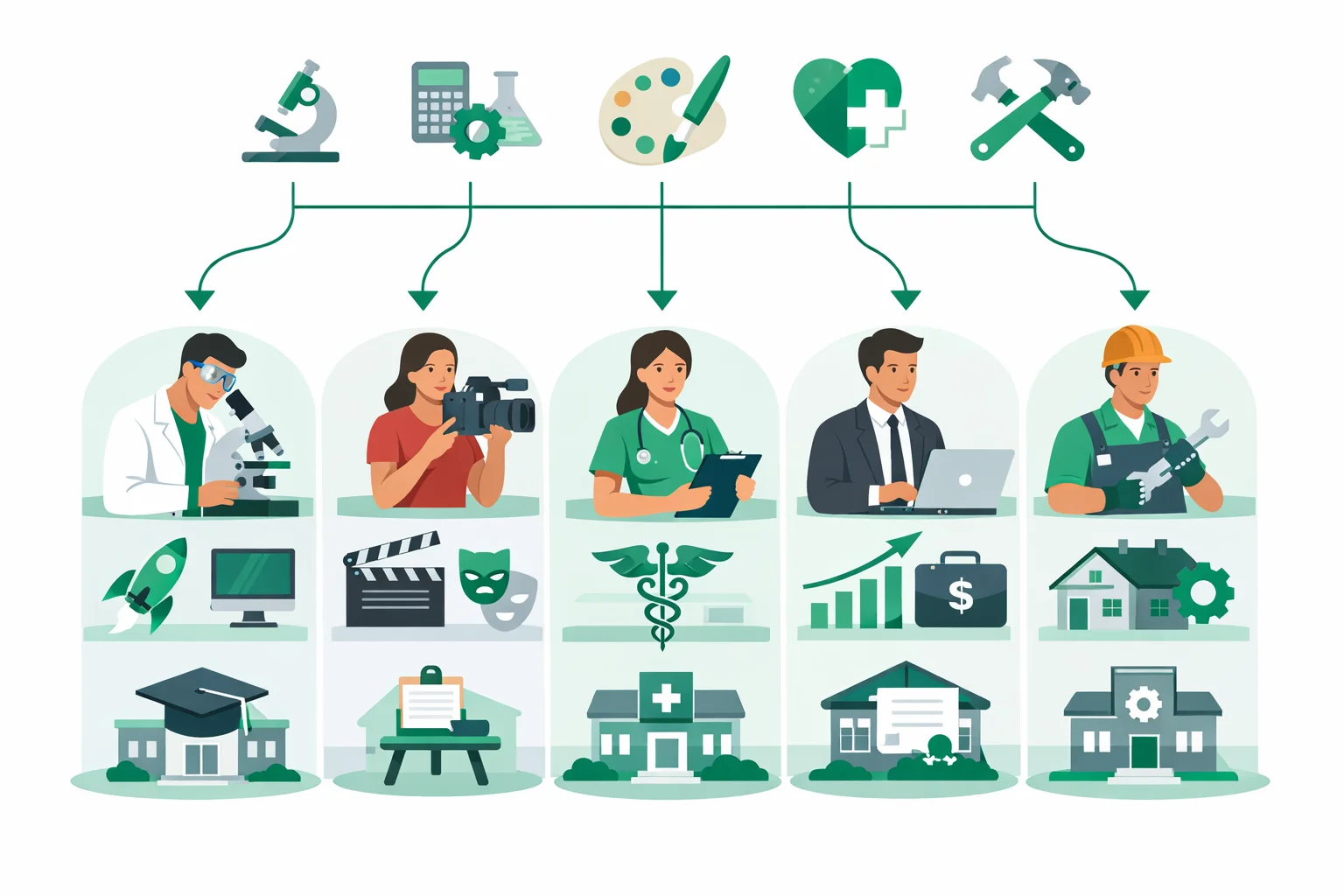
Each Career Spark Type represents a cluster of careers that share common skills, environments, and personality fits. Here is a quick comparison:
| Spark Type | Core Drive | Loves in School | Career Direction |
|---|---|---|---|
| 💡 Innovator | Build the future | CS, math, physics | Tech, engineering, AI |
| 🩺 Healer | Help & heal | Biology, psychology | Medicine, therapy, veterinary |
| 🎨 Creator | Express & design | Art, media, design | Design, film, fashion |
| 🚀 Leader | Organize & win | Economics, debate | Business, law, finance |
| 🔬 Analyst | Investigate & understand | Science labs, research | Research, forensics, pharmacy |
| 🔧 Builder | Make & fix | Shop class, hands-on | Trades, engineering, aviation |
| ✍️ Storyteller | Communicate & persuade | English, history, debate | Journalism, PR, teaching |
| ⚖️ Advocate | Fight for justice | Government, social studies | Law, policy, social work |
Most teens score high in two or three types, not just one. That is normal and actually helpful — career paths that combine multiple spark types (like an Innovator-Creator becoming a UX designer, or a Healer-Advocate becoming a public health lawyer) tend to be the most fulfilling.
The Science Behind Teen Career Interests
Teenage career interests are not random. Research from developmental psychology shows that career-related interests begin stabilizing around age 14-16, and by age 18, most people have a relatively stable interest profile that persists into adulthood. A landmark study published in the Journal of Vocational Behavior tracked 1,200 teens over 10 years and found that interests measured at age 16 predicted career satisfaction at age 26 better than GPA, test scores, or parental income.
This does not mean your interests are locked in forever. It means that what excites you right now is a meaningful signal worth exploring, not a random phase to ignore. The quiz captures these signals through scenario-based questions rather than asking you to rate abstract skills, which research shows is a more accurate method for teenagers who have limited work experience to reference.
Curious about what drives you at a deeper motivational level? The Enneagram Quiz uncovers your core fears and desires — understanding these helps you avoid careers that look great on paper but drain you emotionally.
What to Do in High School Based on Your Type
Your quiz result is only valuable if you act on it. Here are concrete steps for each Career Spark Type that you can start this semester:
- Innovators — Join a hackathon, start a coding project, or take an online CS course. Build something you can show to a college admissions officer or future employer.
- Healers — Volunteer at a hospital, animal shelter, or crisis hotline. Get CPR certified. Shadow a doctor or therapist for a day.
- Creators — Build a portfolio. Start a design Instagram or YouTube channel. Enter art competitions. Learn Figma, Procreate, or Premiere Pro.
- Leaders — Run for student government. Start a school business. Join DECA or FBLA. Practice pitching ideas to adults.
- Analysts — Enter a science fair. Read research papers in a field that fascinates you. Ask a professor if you can assist with a research project.
- Builders — Take shop class or auto tech. Get involved in stage crew. Learn to weld, wire, or use 3D printers. Research apprenticeship programs.
- Storytellers — Write for the school paper. Start a blog or podcast. Join debate club. Read three books a month in genres you love.
- Advocates — Volunteer for causes you care about. Attend city council meetings. Organize a school fundraiser or awareness campaign.
Career Clusters vs. Specific Job Titles
One of the biggest mistakes teens make is fixating on a single job title — "I want to be a doctor" or "I want to be a YouTuber" — instead of exploring the career cluster that job belongs to. Career clusters are families of related careers that share common skills and interests. When you explore a cluster instead of a single job, you discover dozens of paths you never considered.
For example, if you scored as The Healer, you might immediately think "doctor." But the Healer cluster also includes physical therapists, occupational therapists, genetic counselors, veterinarians, speech pathologists, mental health counselors, and public health researchers. Some of these require 12 years of school. Others require 4 to 6. All of them let you use your healing instinct in different ways with different lifestyles and salary ranges.
Similarly, if you scored as The Innovator, software engineer is just one option. The cluster also includes data scientists, cybersecurity analysts, AI researchers, robotics engineers, game developers, and technical product managers. Thinking in clusters keeps your options open while still giving you a clear direction.
Common Career Mistakes Teens Make
Knowing what not to do is sometimes more valuable than knowing what to do. Here are the most common traps:
- Choosing based on salary alone. High-paying jobs mean nothing if you hate every Monday morning. Research shows that once basic needs are met, career satisfaction depends far more on interest alignment than income.
- Following parents' dreams instead of your own. Your parents want the best for you, but their idea of the "best career" is shaped by their generation's job market. Many of the fastest-growing careers today — AI engineering, UX design, content strategy — did not exist when they were in school.
- Assuming you need to decide now. You do not. The purpose of career exploration in high school is to narrow your options and build relevant skills, not to make a permanent commitment. It is completely okay to be exploring.
- Ignoring skilled trades. Electricians, welders, and HVAC technicians earn strong salaries, have high job security, and skip the crushing student debt that plagues many college graduates. If you scored as The Builder, trade careers deserve serious consideration.
- Thinking college is the only path. Trade schools, apprenticeships, coding bootcamps, military service, and gap years are all legitimate pathways that lead to fulfilling careers. The right path depends on your type, not on a one-size-fits-all rule.
Want to understand your instincts at a more primal level? Our What Animal Am I quiz maps personality traits to animal archetypes — many teens find it surprisingly accurate and fun to compare with their career spark result.
All 8 Career Spark Results
Whether you want to explore every possible outcome or compare your result with a friend, here is a complete guide to all eight Career Spark Types you can get on this quiz.
💡 The Innovator. Innovators are tech-driven problem solvers who see the world as a system to be optimized. They gravitate toward coding, engineering, robotics, and anything that lets them build solutions from scratch. In high school, they are the ones running coding clubs and winning hackathons. Their biggest career risk is getting so deep into technology that they forget to develop the people skills needed to lead teams and communicate their ideas.
🩺 The Healer. Healers are empathetic caretakers driven by a deep need to ease suffering and protect wellbeing. Medicine, nursing, psychology, veterinary science, and physical therapy are natural fits. They notice when someone is hurting before a word is spoken. Their main challenge is setting emotional boundaries so they can sustain a long career in high-intensity caregiving roles without burning out.
🎨 The Creator. Creators express themselves through visual art, music, design, film, or fashion. They think in images, textures, and aesthetics, and they notice design details that most people miss entirely. Graphic design, UX/UI design, animation, photography, and interior design attract Creators. Their biggest risk is not finishing projects — creative minds tend to start ten things and complete two.
🚀 The Leader. Leaders are born entrepreneurs and strategists who naturally step into positions of authority. They organize group projects, start side hustles, and think in terms of goals and outcomes. Business, law, marketing, and finance attract Leaders. Their growth area is learning to listen before deciding — the best leaders combine decisiveness with genuine curiosity about other perspectives.
🔬 The Analyst. Analysts need to understand how things work at the deepest level before they trust any conclusion. They love research, data, evidence, and intellectual debate. Science, forensics, economics, and pharmacy attract Analysts. About 10% of teens match this type, making it one of the rarer results. Their risk is getting stuck in analysis paralysis — sometimes good enough data is enough to act.
🔧 The Builder. Builders learn by doing, not by reading. They are hands-on, resourceful, and physically skilled — the teens who fix things, build things, and customize things for fun. Electricians, mechanical engineers, carpenters, pilots, and welders are natural Builder careers. Their biggest advantage is that skilled trades offer strong salaries, high demand, and freedom from student debt.
✍️ The Storyteller. Storytellers have a gift for words — written or spoken. They captivate their friend groups with stories, write essays their teachers remember, and instinctively understand what makes communication land. Journalism, content strategy, public relations, screenwriting, and teaching attract Storytellers. Their growth edge is developing business or technical skills alongside their communication gift.
⚖️ The Advocate. Advocates are justice-driven changemakers who cannot sit still when something is unfair. They organize, campaign, speak up, and fight for causes bigger than themselves. Civil rights law, social work, nonprofit leadership, policy analysis, and community organizing attract Advocates. Their risk is burnout from taking on too many causes simultaneously — effective advocates learn to focus their energy strategically.
Next Steps After the Quiz
Your career spark result is a starting point, not a destination. Here is how to use it:
- Research your career cluster. Search your spark type plus "careers" and spend 30 minutes exploring job descriptions, salary ranges, and education requirements on sites like O*NET or the Bureau of Labor Statistics.
- Talk to your school counselor. Bring your quiz result and ask which courses, AP classes, or dual-enrollment options align with your career cluster. Counselors love when students show up with direction.
- Find one person doing work in your cluster. Reach out via LinkedIn, a school connection, or a family friend. Ask them what they wish they had known in high school. One conversation with a real professional is worth more than 100 Google searches.
- Join one extracurricular this semester. Pick the one from your results page that excites you most. Colleges and employers both value depth over breadth — one club you are deeply involved in beats five you barely attend.
- Retake the quiz in six months. Your interests will evolve as you gain new experiences. Tracking how your career spark changes over time is one of the most powerful self-discovery habits a teenager can build.
Whether you landed on the analytical depth of The Analyst, the creative vision of The Creator, or the justice-driven fire of The Advocate, your result reflects real patterns in how you engage with the world. The teens who build the most fulfilling futures are not the ones who pick the "right" career at 16 — they are the ones who start exploring early, follow their genuine interests, and keep adjusting as they grow. Your career spark is not a label. It is a launchpad.