Emotional Intelligence Quiz: What Your EQ Score Actually Reveals
What does an emotional intelligence quiz actually measure — your kindness, your maturity, or something you've never quite had a word for? Most people assume it scores how warm or sensitive they are. That guess is wrong, and it's the exact reason so many thoughtful, caring people open their result and find a number lower than they expected. EQ isn't about being a good person. It's about how skillfully you notice, manage, and work with emotions — yours and everyone else's.
Before we unpack your result, it's worth clearing away the three myths that distort what people think their score should be. Each one quietly shaped how popular culture talks about EQ — and each one is, on closer inspection, false.
EQ Doesn't Beat IQ — It Does Something Different
Myth #1: "EQ matters more than IQ." You've probably seen the headline. It traces back to Daniel Goleman's 1995 bestseller, which popularized the claim that emotional skills predict success better than raw intelligence. It made for a great book cover. The research is messier. Decades of meta-analyses show IQ remains the single strongest predictor of how well people perform cognitively demanding work — coding, surgery, analysis. What EQ predicts is different: how you handle conflict, lead teams, recover from failure, and keep relationships intact under stress.
So the honest framing isn't "EQ beats IQ." It's that they measure separate things, and the two barely overlap. A brilliant analyst can have a low EQ; a person of average IQ can have an exceptional one. That's why this quiz never asks you to solve a puzzle — it asks how you'd respond when a plan collapses or a friend goes quiet. The term itself, by the way, predates Goleman: psychologists Peter Salovey and John Mayer coined "emotional intelligence" in a 1990 academic paper, defining it as the ability to monitor and use emotional information to guide thinking.
Were You Born With Your EQ?
Myth #2: "Some people are just naturally emotionally intelligent." Half true, and the half that's false is the important one. Temperament — how reactive or calm you are by default — does have a genetic component. But emotional intelligence is mostly a learned set of skills, which is the single biggest way it differs from IQ. Your IQ stays roughly stable across your life. Your EQ tends to climb, and the steepest gains often come in your thirties and forties, after life has handed you enough hard conversations to practice on.
This matters for how you read your result. A low score on any dimension isn't a fixed trait you're stuck with — it's a skill you haven't built yet. Studies on emotion-regulation training in adults show measurable improvement in a matter of weeks, not years. If your self-regulation came back low, that isn't who you are. It's a muscle nobody taught you to train.
The Five Things This Quiz Actually Measures
Rather than spit out a single number, this personality-style assessment scores you across the five dimensions Goleman identified, because lumping them together hides the most useful information about you. Here's what each one captures and the kind of question that targets it.
| Dimension | What it measures | A telling sign of strength |
|---|---|---|
| Self-Awareness | Noticing and naming your own emotions as they happen | You can tell you snapped because of work stress, not the friend in front of you |
| Self-Regulation | Steering your reactions instead of being driven by them | You pause and respond in an argument rather than firing back |
| Motivation | Inner drive, optimism, and bouncing back from setbacks | A rejection becomes information you use, not a reason to quit |
| Empathy | Reading what other people feel, often before they say it | You catch the "I'm fine" that obviously isn't |
| Social Skills | Managing relationships, persuading, and repairing conflict | You help two tense people find middle ground |
Each of the 20 scenarios maps to one of these five, with four questions apiece. Your answers are scored from 1 (the least emotionally intelligent response) to 4 (the most), then normalized so each dimension lands on a clean 0–100% scale. That's why your breakdown can look uneven — and that unevenness is the whole point.
High EQ Isn't the Same as Being Nice
Myth #3: "Emotionally intelligent people are sweet and agreeable." This is the misconception that trips up the most people on this quiz. Niceness is a personality trait. EQ is a skill set — and skills can be used however you choose. Some of the most emotionally intelligent people you'll ever meet are also the most direct, because they know precisely when to push, when to hold back, and when a hard truth will land better than a soft one.
A great negotiator reads the room and stays unflappable under pressure — that's high empathy and high self-regulation, used to win. A skilled manager who delivers tough feedback without crushing morale is using EQ, not avoiding conflict. If you scored high but worry you're "too blunt," relax: bluntness paired with awareness is a feature, not a bug. The same emotional skill that helps you connect also helps you hold a boundary, which is why EQ shows up so strongly in leadership style.
When Your Empathy Is High but Your Regulation Is Low
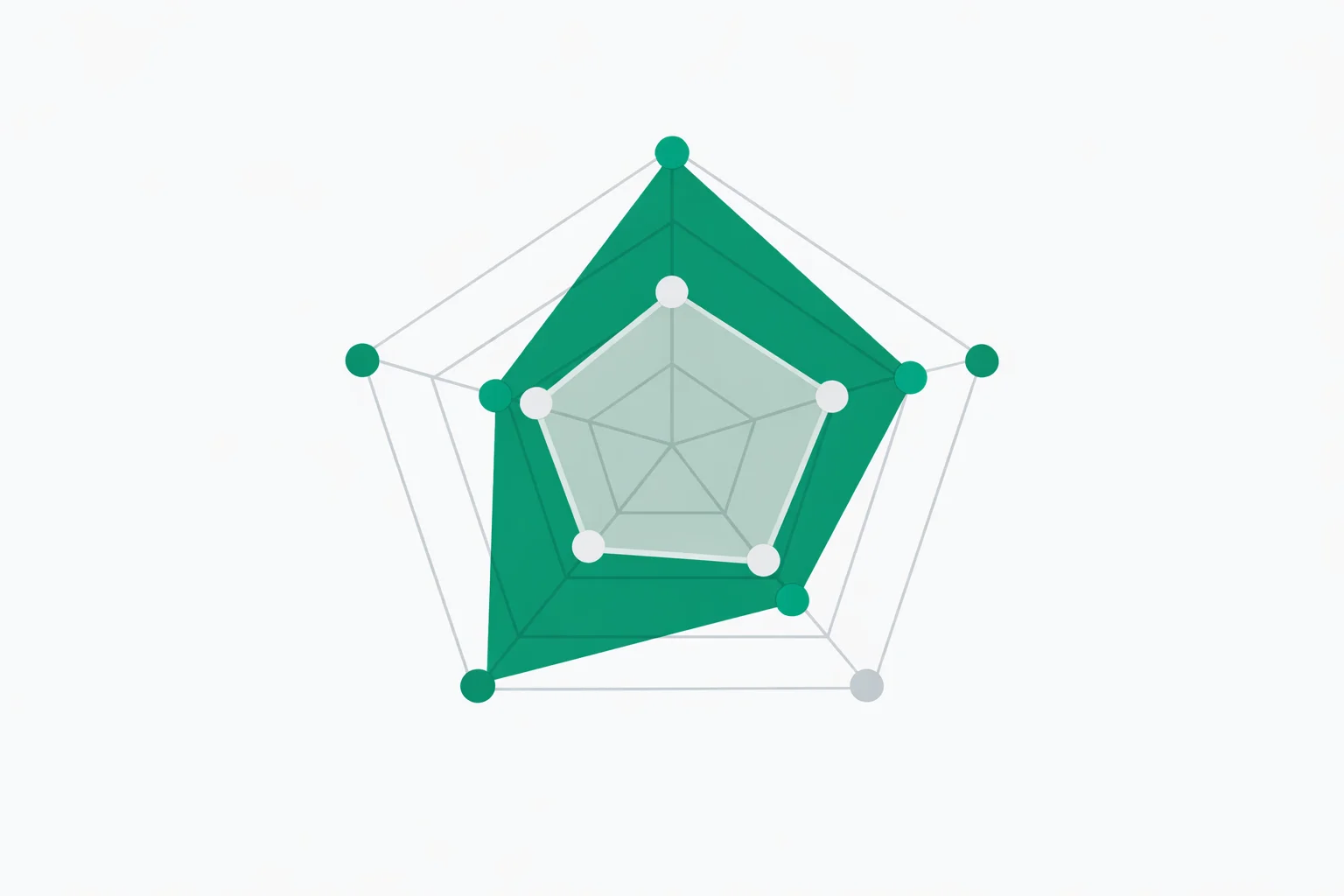
Here's where the five-dimension breakdown earns its keep. Picture a common result: empathy at 88%, self-regulation at 42%. On a single-number test, those would average into a forgettable "okay" score. Split apart, they tell a vivid story — you feel everything intensely, you soak up the emotional weather of every room you walk into, but once those feelings are running hot, you struggle to bring yourself back down.
That profile is extremely common among deeply empathetic people, and it explains a lot: why you can comfort a friend brilliantly yet melt down over your own bad news, or why you read others perfectly but say things you regret in arguments. The fix isn't "feel less" — your empathy is a gift. It's building the regulation skill that lets you hold strong feelings without being swept away by them. The reverse profile exists too: high regulation, low empathy — the calm, capable person who never quite notices that a teammate is struggling. Different gap, different fix. A single EQ number would have hidden both.
There's a third pairing worth naming, because it surprises people: high self-awareness alongside a flat refusal to credit yourself for anything. You can read your own emotional state with real precision and still insist every result came from luck or timing. That's not an EQ deficit — it's an attribution habit, and the imposter syndrome quiz scores it on a separate scale from the one used here.
All Four EQ Score Ranges Explained
Your overall score places you in one of four ranges. Here's what each one actually means in day-to-day life — and the trap that tends to come with it.
🌱 Emerging EQ (0–50%). Emotions tend to lead and you tend to follow, often realizing what happened only after the moment has passed. This is a starting line, not a sentence. People who begin here frequently grow the fastest, because every skill is new territory. The move that helps most: build self-awareness first, since the other four dimensions are hard to develop until you can name what you're feeling in real time.
🌤️ Developing EQ (51–68%). The most common range, and a genuinely workable one. You handle everyday emotional situations fine; it's the high-pressure or high-stakes moments that can still get the better of you. Your fastest progress comes from targeting your single lowest dimension rather than trying to improve everywhere at once.
⭐ Strong EQ (69–84%). You've got a reliable emotional toolkit — you usually know what you're feeling, keep your composure, and read others well. Your growth edge is no longer your average but the gap between your best and worst dimension. Closing that one gap produces an outsized payoff.
🏆 Exceptional EQ (85–100%). Rare air. You don't just feel emotions, you work with them deftly across all five dimensions. The risk here isn't low skill — it's burnout. People at this level often carry everyone else's emotional load and forget to guard their own. Your challenge is protecting your bandwidth, not building more skill.
Can You Actually Raise Your EQ?
Yes — and unlike most quiz results, this one comes with a clear lever. Because emotional intelligence is learnable, the practical question is simply where to aim. Look at your breakdown and start with your lowest bar, not your average. If self-awareness is weakest, try naming one emotion out loud every time it shows up for a week; the labeling alone reduces its grip, a phenomenon researchers call "affect labeling." If regulation lags, build a single pause habit — one slow breath before you respond when you feel heat rising. If empathy trails, practice asking one curious question before you offer a single piece of advice.
You can read more about the science and history of the concept on the Wikipedia overview of emotional intelligence or the American Psychological Association's definition. When you're ready to see how your emotional skills interact with the rest of who you are, the introvert or extrovert quiz pairs well with this one — your social energy and your social skill are related, but they're not the same thing. Retake the EQ quiz in a few months and watch which bars have moved. That movement, more than any single score, is the real measure of emotional intelligence.