How Quidditch Positions Map to Real Team Roles
Can a Quidditch quiz tell you anything real about how you behave on a team? That depends on an argument the fandom has never settled — whether Quidditch is a sport at all, or a three-hour warm-up act for one player with unusually good eyesight.
Pick a side and you have already told me which position you'd play. That isn't a trick, it's the design of the quiz above. The four positions on a pitch aren't four skill sets. They're four answers to one question: when a match starts getting away from you, where should the team put its faith?
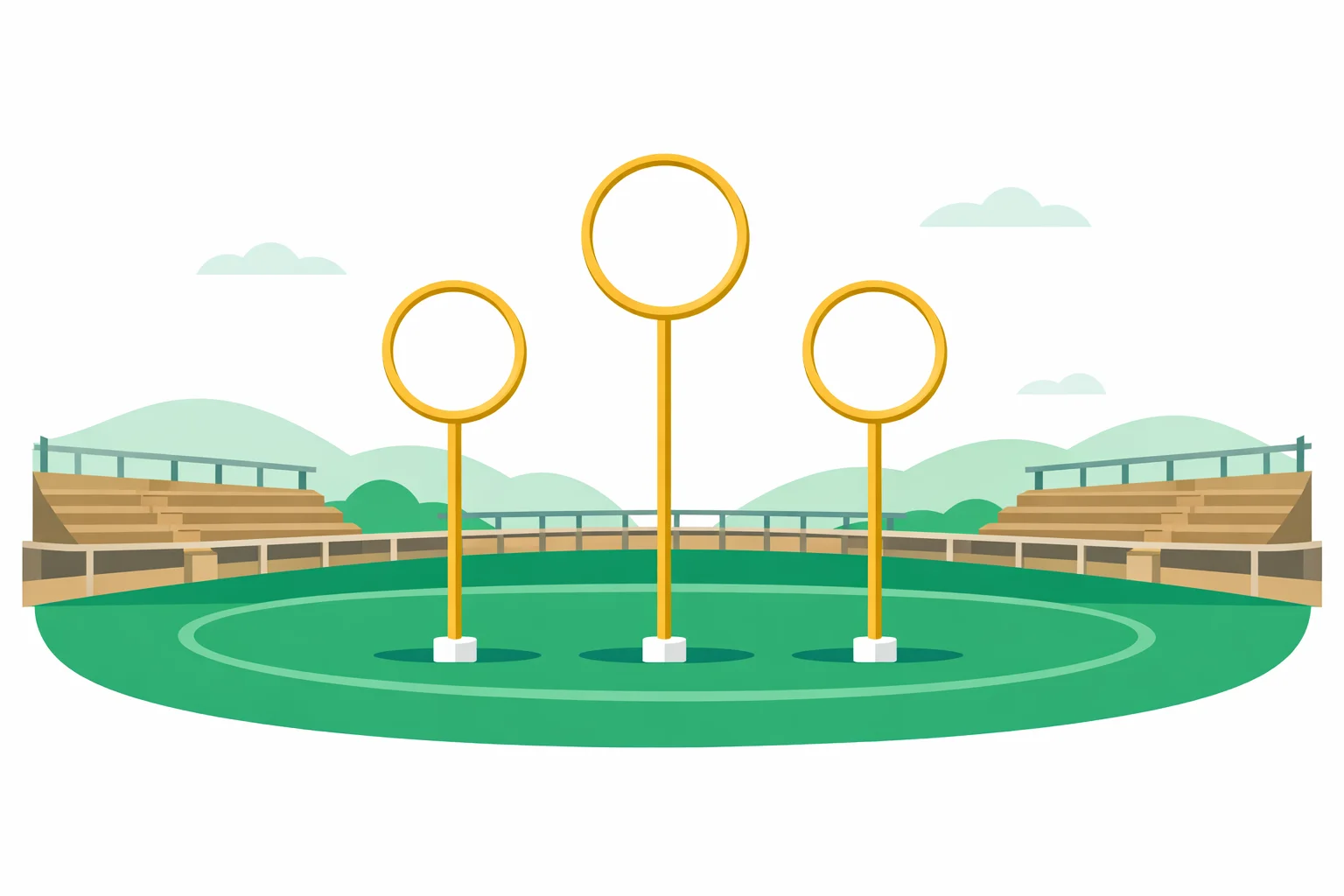
One Hundred and Fifty Points, One Pair of Hands
Camp one runs the arithmetic and finds it absurd. A goal is worth ten points. The Golden Snitch is worth a hundred and fifty. So fourteen players spend three hours, sometimes three days, assembling a margin that one player can erase in four seconds without having touched the Quaffle once. On that reading, Chasers are set dressing and the whole match is a coin flip with excellent choreography.
Camp two points at the rulebook. Catching the Snitch does not win the match — it ends it. If you're a hundred and sixty points behind and you catch, you have personally sealed your own defeat. The Snitch stops the clock. It doesn't decide the winner.
Both are correct, and that's the interesting part. A hundred and fifty points is fifteen goals, and very few matches ever reach a fifteen-goal spread. So camp two is right about the rule while camp one is right about nearly every actual game. The Seeker controls when. The Chasers control whether. Everything else on the pitch exists to buy those two groups time.
Both Camps Have Canon on Their Side
The best evidence against Snitch supremacy is the most famous match in the books. Ireland beat Bulgaria 170–160 in the 1994 Quidditch World Cup final despite Viktor Krum catching the Snitch. Troy, Mullet and Moran had already scored seventeen goals between them, and Krum could see that the gap was widening faster than he could close it. He caught it to end the humiliation on his own terms. A Seeker used the most decisive act in the sport as damage control — which is only possible if the Chasers had already won.
Then the other side of the ledger. Quidditch Through the Ages records a match that ran for three months because nobody caught the Snitch, and a 1473 World Cup final in which all seven hundred known ways of committing a foul were used. Both facts point the same direction: the game does not end until one specific player decides it does. Give fourteen people an unbounded clock and no way to stop it themselves, and you have handed extraordinary power to the fifteenth.
The Real Sport Had This Problem and Fixed It
Here's the part most Quidditch quizzes never mention: humans actually built this sport, played it for two decades, and had to rebalance it almost immediately.
The real-world game started at Middlebury College in Vermont in 2005 as a broomstick joke and turned into a full contact sport with international governing bodies. In July 2022 it was renamed quadball, partly to separate the sport from J.K. Rowling's public statements and partly because Warner Bros. owns the "quidditch" trademark, which was blocking sponsorship deals.
The scoring change matters more than the name. In quadball a snitch catch is worth 30 points, not 150. Goals are still worth 10, so the catch is worth three goals instead of fifteen. On top of that, the snitch runner isn't released until the seventeenth minute and seekers can't pursue until the eighteenth, so the entire opening stretch of every match is pure chaser and beater play with no way for anyone to end it early.
Read that as a verdict. The moment real people had to play this game competitively, they demoted the Seeker from "decides the match" to "breaks a tie" and forced the other six players to matter for a third of the game before the glamour position was even allowed on the field. Camp one won the argument, and it won it in a rulebook rather than a forum thread.
So What Is Each Position Actually For?
Once you stop asking which position is best, a better question opens up: what human trait is each one actually testing? That's the axis the quiz above scores you on.
| Position | On the pitch | What it really measures | Closest real-sport job | Fails by |
|---|---|---|---|---|
| Chaser | 3 of 7 | Sustained output and shared rhythm | Midfielder, point guard | Taking the shot the extra pass had already beaten |
| Beater | 2 of 7 | Reading danger before it lands | Blocker, defensive enforcer | Swinging at everything and protecting nothing |
| Keeper | 1 of 7 | Tolerance for asymmetric blame | Goalkeeper | Leaving the line a half-second too early |
| Seeker | 1 of 7 | Patience first, nerve second | Closing pitcher, penalty taker | Chasing every glint of gold on the pitch |
Look at the second column again. Three Chasers, one Seeker. The sport itself is telling you where the work lives, and it has been telling you since 1473. If you scored Chaser and felt vaguely disappointed, that's the Seeker mythology talking, not the rulebook.
The Second Question This Quiz Asks
Most Quidditch position quizzes hand you one of four answers and stop. Ours has eight, because knowing you're a Beater tells a captain almost nothing about how you'd play the role.
The second axis is improviser versus systems player: do you solve the problem as it arrives, or before it arrives? Fred and George Weasley played Beater as improvisation — find the rhythm, break the rhythm. A Beater who spends three hours flying a shadow route beside their own Seeker, the way Bulgaria's pair did around Krum in that 1994 final, is playing exactly the same position as a defensive system. Neither is wrong. They are barely the same job.
The same split runs through Keeper. Oliver Wood drew diagrams and rehearsed positioning until saves became arithmetic. Ron Weasley, on the days it worked, threw himself at things.
Mechanically, five of the eighteen questions — 5, 9, 10, 16 and 17 — do nothing but measure that axis. They award no position points at all, which is deliberate: it means your method answers can never accidentally drag you toward a different position, and your position answers can never decide what kind of player you are within it. The other thirteen questions work the other way round and carry no method weight. Question 10, where your captain calls something you think is wrong, is the cleanest single item on the whole quiz. If your variant surprised you, that's the one to look back at.
Belbin Ran This Experiment on Managers in the 1970s
There's real research underneath all of this. Meredith Belbin spent nine years running business simulations at Henley Management College and, at one point, deliberately built teams entirely out of the highest scorers on mental-ability tests. He expected them to dominate. They finished near the bottom, so consistently that he named the effect the Apollo syndrome: everyone chased the interesting problem, everyone argued, and the dull necessary work went undone.
His conclusion, published in Management Teams: Why They Succeed or Fail in 1981, was that role diversity beats raw ability, and he mapped out nine distinct team roles to prove it. Quidditch is that finding in costume. A team of seven Seekers — seven people who all want the decisive moment — would be unwatchable and would lose every match, because somebody has to guard three hoops for three hours and get chanted at for it. If you want to see the same instincts measured off the broom, the leadership style quiz runs a similar split across meeting rooms instead of pitches.
Nobody Wants Keeper, and That Is the Tell
Ask a room of fans which position they'd play and count the Keepers. There won't be many. The job is uniquely thankless: fourteen saves earn a nod, one goal earns a chant, and there is nobody behind you to absorb the mistake. Ron Weasley's entire arc is about that asymmetry — the crowd literally wrote a song to make it worse.
Which is why Keeper is the most revealing result on this quiz. It isn't scored on caution, the way people assume. It's scored on willingness to take uncredited responsibility, which is a completely different trait. Question 11's fourth option — being handed the responsibility nobody else wants — is the single clearest Keeper tell in the whole set. If you chose it and still came out Chaser, look at your reserve position in the results panel; Keeper is probably sitting second by two or three points. The Weasley family quiz is worth a look here too, because one household produced two Beaters, a Keeper and a Chaser, and the differences between those siblings are exactly the differences this quiz measures.
All Eight Quidditch Position Results
Four positions, each split by the improviser–systems axis. Here is every outcome the quiz can produce and what it says about you.
🌠 Seeker — The Diver. You commit before the situation is legible, on the grounds that legibility usually arrives too late to act on. Divers are the players teams hand the final chance to, and the ones who then have to live with it publicly. Enormous nerve, low tolerance for hesitation, and a permanent vulnerability to feints aimed specifically at people like you.
🔭 Seeker — The Hunter. Same position, opposite method. You treat the catch as the last step of a plan rather than the plan itself, and you spend most of a match denying the other Seeker a clean line rather than taking a poor one yourself. Wins long matches, struggles in short chaotic ones, and looks passive from the stands right up until it doesn't.
🎯 Chaser — The Finisher. You want the ball to end with you, and you'd rather accelerate a move than complete a pattern. Finishers score goals the training ground never designed, thrive when structure collapses, and quietly shoot from positions where the extra pass was sitting right there.
🧭 Chaser — The Playmaker. The least glamorous result here and the first one a captain would pick, which is the whole point of a sport that fields three Chasers per Seeker. You measure yourself in second-order consequences: the pass that caused the pass that caused the goal. Teams score more with you on the pitch even when your own name never appears on the scoresheet.
💥 Beater — The Disruptor. You read a match as a set of rhythms to be broken and you are genuinely comfortable in chaos, which almost nobody is. Excellent against well-drilled opposition, dangerous to your own side when a Bludger gets spent on nobody in particular. Deliberately unpredictable rather than reckless — the distinction matters more than it sounds.
🛡️ Beater — The Guardian. A protective instinct holding a bat. You fly where your most exposed teammate is rather than where the fight is, and your best matches are the ones where nothing memorable happened to anybody. It is the most tactical job on the pitch and nobody keeps a statistic for it.
🧤 Keeper — The Sweeper. The strangest combination the quiz produces, because it needs two instincts that usually cancel out: a willingness to be last in line and an unwillingness to wait there. You come off the hoops to kill attacks early. When it works, the move never existed. When it doesn't, three hoops are standing empty and every single person saw you leave.
🧱 Keeper — The Wall. You took the most asymmetric job in the sport and made it survivable by turning it into a system — position first, reflexes second. Crowd noise stops registering around the second save. Chronically undervalued by fans, never by captains, and the reason a team can afford to attack at all.
Play the Position You'd Want at Sixty Points Down
The number worth reading isn't your top position — it's the gap between first and second. A three-point gap means you're a utility player, and a captain would move you around all season without much loss. A fifteen-point gap means you have exactly one position and you'd resent being taken out of it, which is useful to know before you join anything that has a roster.
Then run the harder test on yourself. Sixty points down, an hour left, nothing going right: which job do you still want? Most people answer Seeker when the score is level and something else entirely when it isn't. The position you'd take on the bad day is the one you actually play. If you want the other half of the picture, the Hogwarts house quiz asks what you value, while this one asks what you'd do about it at altitude with a Bludger incoming.