Why ORD Stands for Chicago
Every airport codes quiz eventually throws LAX at you, and LAX doesn't actually stand for anything. Not exactly. The L and the A are Los Angeles; the X is padding, a filler letter bolted on in the 1940s because the two-letter system that came before had run out of room. That's the whole story. There is no third word.
Fifteen of the twenty codes in the quiz above refuse to spell out their own city, and they refuse for four reasons — only four. Learn to tell those four apart and you stop memorising codes one at a time and start reasoning your way to ones you have never seen printed on a bag tag.
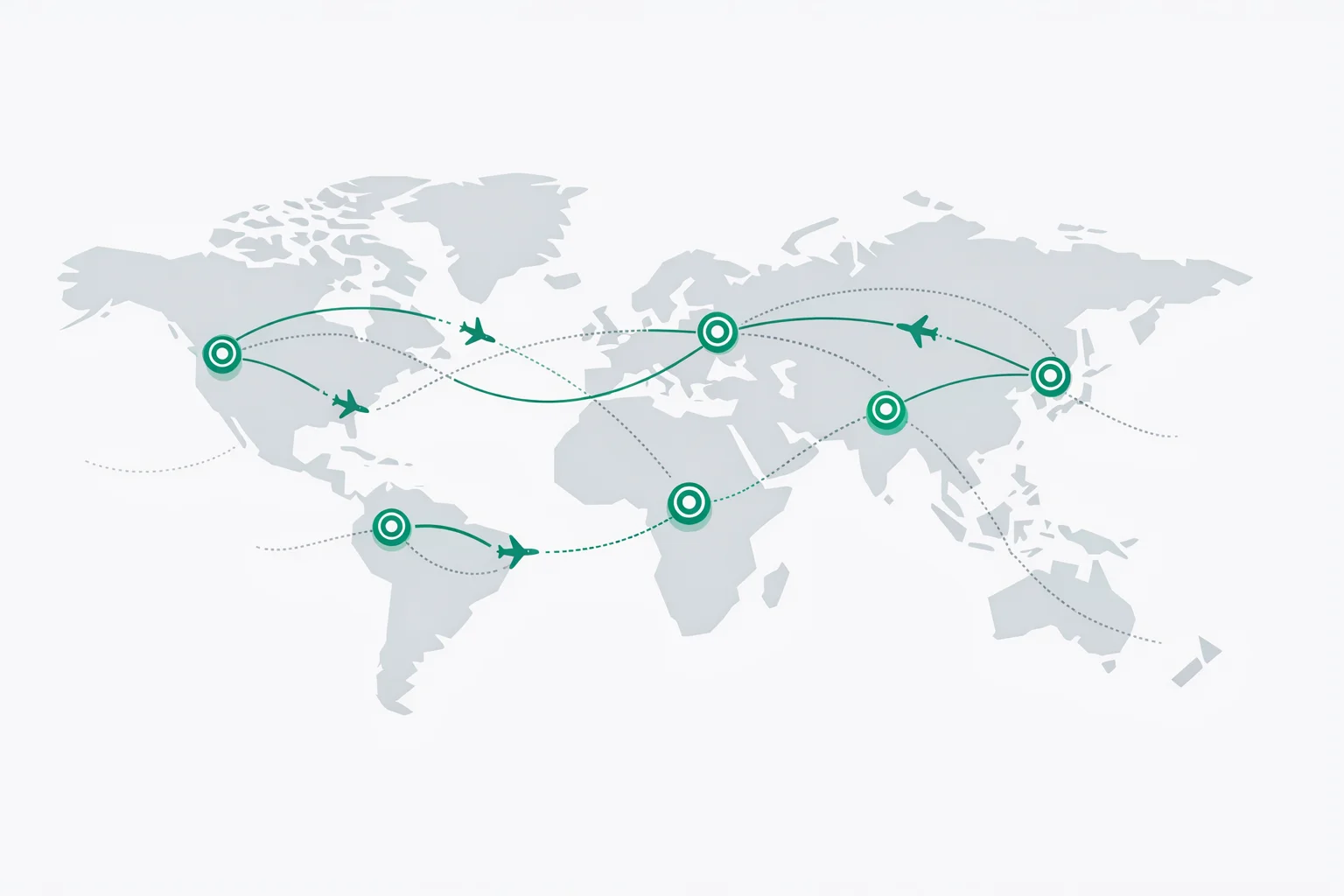
Four Rules Decode Almost Every Airport Code
Sort any three-letter code into one of these four buckets and you have already done most of the work. The quiz scores each bucket separately, which is why your result comes with a second number underneath the first.
| Rule | What's happening | In the quiz | The tell |
|---|---|---|---|
| Name match | The code compresses the city's own name | AMS, CPH, IST, JNB, AKL | Reads like the city with the vowels stolen |
| Ghost name | It preserves a name nobody uses any more | ORD, MCO, MSY, LED, CVG | Shares no letters with the modern city at all |
| Airport, not city | It names the airport, its district or a suburb | CDG, HND, FCO, GRU, ARN | Matches a place near the city on your ticket |
| System quirk | The identifier system itself forced the letters | PDX, YYZ, EWR, IAD, EYW | A leading Y, a trailing X, or a missing first letter |
The fourth bucket is the interesting one, and it's the one nearly everybody scores worst on. The other three reward things you happen to know. That one rewards understanding how the codes were assigned in the first place — and unlike the other three, it works on codes that weren't in the quiz.
Work Through ORD, MSY and CVG the Slow Way
Here's the three-step walk, run out loud on the codes people find hardest. Take ORD. Step one: does it compress Chicago? There's no C and no H, so no. Step two: is it a system quirk — leading Y, trailing X, a suspiciously absent first letter? Also no; O, R and D are ordinary letters in an ordinary order. Step three: is there somewhere near Chicago called Ord-something? Not today. Which leaves the ghost name, and it is: Orchard Field, a Douglas Aircraft plant that built C-54 transports through the war. The field was renamed for a Navy pilot in 1949 and the code simply never caught up.
Now MSY. Same walk, same dead ends, same answer — a ghost. The land under New Orleans' airport was Moisant Stock Yards, named after John Moisant, a stunt flier who crashed and died on that spot on the last day of 1910. The airport honours Louis Armstrong now. The code still honours a man most people in the terminal have never heard of.
CVG is the one that makes people argue. Covington is the source, and the detail underneath it is better than the code: Cincinnati's airport isn't in Ohio. It sits across the river in Boone County, Kentucky, and when it opened in 1947 Covington was the nearest town worth naming. Three letters, one river, two states.
Compress, quirk, neighbour. Those three questions resolve the overwhelming majority of codes you will ever meet, and when all three come up empty you are almost certainly looking at something that used to be called something else.
The Letters an American Airport Isn't Allowed to Use
This is the rule that explains the codes that look broken. In the United States, several letter blocks were claimed before commercial aviation got to them:
- N — the Navy, and also the registration prefix painted on the tail of every US-registered civil aircraft.
- W and K — broadcast call signs. Every radio station in the country starts with one or the other.
- Q — reserved for international radio and telegraph shorthand.
Newark is the famous casualty. It couldn't be NEW or NWK, so it skipped its own first letter and took the next three: EWR. Key West did the same dance and landed on EYW, because KEY and KYW were unavailable — and KYW isn't a hypothetical, it's a Philadelphia news station that first went on air in 1921. Once you know this rule, a code that appears to be missing its opening letter stops looking like a mistake and starts looking like a workaround.
Why Does Every Canadian Airport Start With Y?
Because of a telegraph convention nobody bothered to retire. Before the war, Canadian stations carried two-letter identifiers, and a Y in front meant the station had a radio and weather facility on site — genuinely useful if you were deciding whether to fly there. Malton, outside Toronto, was YZ. Add the prefix and you get YYZ.
The pattern runs right across the country: YVR for Vancouver, YYC for Calgary, YUL for Montreal, YEG for Edmonton, YHZ for Halifax, YOW for Ottawa. The prefix means nothing at all now, but changing it would mean rewriting every timetable and reservation system in the country to fix a letter that costs nobody anything. So it stays. Rush, being from Toronto, turned the Morse for Y-Y-Z into the opening bars of a 1981 instrumental named after the code — probably the only airport identifier with a Grammy nomination attached to it.
IATA vs ICAO: Two Codes for the Same Runway
Every airport has at least two identifiers, and they were designed by different people for different readers. The three-letter IATA code is for passengers — tickets, boarding passes, bag tags. The four-letter ICAO code is for aviation itself: flight plans, air traffic control, navigation charts. They rarely resemble one another.
| Airport | IATA (your bag tag) | ICAO (the flight plan) | What the ICAO prefix means |
|---|---|---|---|
| Los Angeles | LAX | KLAX | K — contiguous United States |
| Toronto Pearson | YYZ | CYYZ | C — Canada |
| London Heathrow | LHR | EGLL | EG — United Kingdom |
| Tokyo Haneda | HND | RJTT | RJ — Japan |
| Sydney | SYD | YSSY | Y — Australia |
Look at the last two rows together. Canada is Y in the passenger system and C in the pilot system; Australia is the exact reverse. Two organisations, two vocabularies, one strip of tarmac — and the reason a code that feels wrong to you is perfectly ordinary to the person flying the aircraft. If you enjoy this kind of layered naming, the same thing happens to countries themselves: half the names on the countries of the world quiz are endonyms nobody outside the country actually uses.
Some Codes Are the Last Trace of a Vanished Name
Codes are stubborn in a way place names are not, and that stubbornness has accidentally preserved a small museum of discarded history.
| Code | City today | What the letters remember | Gone since |
|---|---|---|---|
| LED | St Petersburg | Leningrad | 1991 |
| BOM | Mumbai | Bombay | 1995 |
| SGN | Ho Chi Minh City | Saigon | 1976 |
| MCO | Orlando | McCoy Air Force Base | 1975 |
| ORD | Chicago | Orchard Field | 1949 |
| MSY | New Orleans | Moisant Stock Yards | 1946 |
Why don't they get fixed? Because a code isn't a name, it's an address in about forty interlocking computer systems. Changing one means reissuing tickets, reprogramming reservation and baggage handling, reprinting schedules and retraining the people who read the tags — an enormous amount of risk to correct a spelling nobody is confused by. Johannesburg has been Jan Smuts International, Johannesburg International and O. R. Tambo International since 1994 and has been JNB throughout all three.
Codes do move, though, when the passengers move. In 2019 IST transferred from Istanbul Atatürk to the new Istanbul Airport north of the city, and Atatürk was handed ISL instead. The rule of thumb: a code follows traffic, never sentiment.
There Are Only 17,576 Codes, and the Good Ones Are Gone
Three letters from a 26-letter alphabet gives 26 × 26 × 26 = 17,576 combinations. That sounds like plenty until you remember the same pool covers airports, metropolitan areas, rail stations and bus terminals worldwide, and that IATA has been assigning from it since the 1930s. Well over half of it is spoken for.
Which is why airports built this century get the leftovers. Beijing Daxing opened in 2019 and could not have PEK, because Beijing Capital had been sitting on it since the Peking era, so it took PKX. São Paulo's main airport is GRU, for the neighbouring city of Guarulhos, because nothing resembling "São Paulo" was available by the time it opened. New airports increasingly name a suburb, a district or a road because the city itself was claimed decades ago — a pattern worth keeping in mind on the world capitals quiz, where the same problem shows up as capitals that are nowhere near a country's biggest city. Some 19,000 airports of all sizes operate in the United States alone, according to the FAA, and only a fraction will ever need a passenger code — which is the one thing keeping the system from filling up entirely.
All Six Result Bands and the Score Underneath Them
🛫 Dispatcher (19–20). The rarest result, because it requires two unrelated skills at once. Ghost names reward general knowledge about people and places; quirk codes reward knowing the rules of the identifier system. Almost nobody carries both, and anyone scoring here is either an aviation obsessive or has read a page much like this one before.
✈️ Long-Haul Regular (16–18). The score of somebody who reads bag tags for fun. The international block goes down cleanly and at least a couple of the airport-not-city codes get reasoned out. What slips is usually a ghost name, because no rule on Earth walks you to Moisant or Covington — you either know it or you don't.
🌤️ Window Seat Veteran (12–15). Comfortably above the middle. The hub codes are locked in and anything compressing a city name gets solved on sight, but codes pointing at a demolished airfield or a blocked letter are still landing as coin flips. This band improves fastest, because the four rules do most of the remaining work.
🎒 Carry-On Only (8–11). The self-explanatory codes land, the famous ones land, and everything requiring you to know why a code refuses to match its city goes the other way. Perfectly fair — that part is a system with rules, not a memory test, and nobody is taught the rules.
⌛ Standby List (4–7). Airport codes are something everybody looks at several times per trip and nobody reads. This is the honest version of that: hits on the codes that are essentially the city name, misses on anything shaped by history or regulation.
🧭 Wrong Terminal (0–3). Fifteen of the twenty codes deliberately refuse to spell their own city and four are built around letters American airports are not permitted to use. A first run here mostly measures how thoroughly the system hides its own logic. Second runs are typically ten points higher.
Underneath the band sits a second reading — which of the four code classes you actually read best. The Literalist spots the city hiding inside the letters and is fastest of the four, but collapses the moment a code stops describing its city. The Archivist wins on ghost names, which is really general knowledge arriving through a side door and doesn't transfer to codes you haven't met. The Border Crosser knows where airports physically sit rather than which city sells the ticket — the most practically useful of the four if you actually travel. The Systems Thinker is the rarest and the only one that generalises, because reading a leading Y or an absent N works on every code, including ones invented after you read this. An even spread across all four scores as Even Cruise, which usually means you were classifying each code rather than fishing for the ones you already knew.
Read the Next Code You See Backwards
The next time a departures board or a bag tag puts three letters in front of you, resist the urge to translate them into a city. Ask the other question instead: what kind of code is this? If it compresses the city name, fine, move on. If it doesn't, you are looking at either a place near the city, a rule the system imposed, or a name somebody stopped using decades ago — and that third answer is usually a small piece of history the airport itself has quietly stopped mentioning. If you like identities compressed down to something almost unreadable, the US license plate quiz runs the same trick at 70 mph, with the state name blacked out.