Meet the insects behind your match
There is more than one way to be useful, curious or creative. These six characters give those preferences an insect-sized form. The character names and human interpretations are our own playful inventions. The natural-history notes below describe real insects; they do not prove that people have insect personalities.
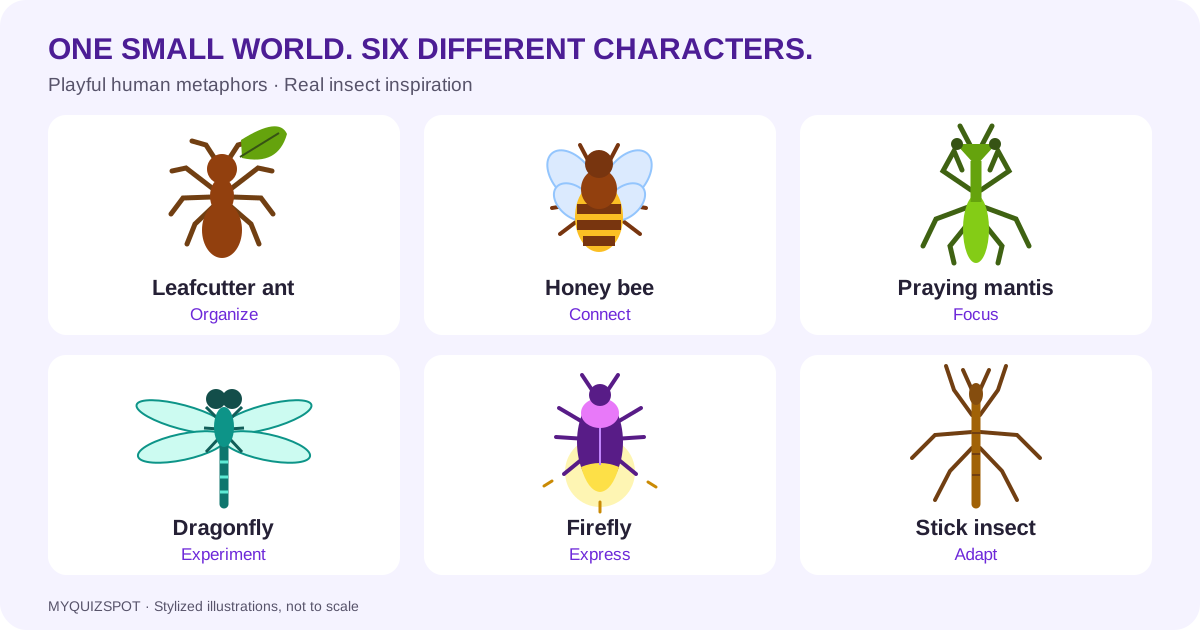
The practical organizer
Leafcutter ant
Your choices favor useful jobs, clear plans and shared progress. In this quiz, the ant is the person who turns a good idea into something the group can actually finish.
In nature: Leafcutter ants carry plant material to cultivate fungus for food. Their colonies divide work such as foraging, tending young and maintaining the fungus garden. AMNH Insectarium.
The social connector
Honey bee
Your choices put communication and participation first. The honey bee character checks who needs an invitation, shares useful information and helps people work together.
In nature: Honey bees cooperate in a hive, where different groups carry out different tasks. This colony life inspires our connector metaphor; it does not establish a human personality type. AMNH Insectarium.
The focused observer
Praying mantis
Your choices favor understanding a situation before making a deliberate move. The mantis character enjoys concentration and would rather investigate one useful detail than rush past it.
In nature: Praying mantises often wait motionless for prey and seize it with specialized grasping forelegs. They are usually solitary predators. Australian Museum: praying mantises.
The curious experimenter
Dragonfly
Your choices favor trying, exploring and adjusting as you learn. The dragonfly character likes a concrete experiment more than a long debate about what might happen.
In nature: Adult common green darners catch prey in flight. Like other dragonflies, they begin life as aquatic nymphs that also hunt prey. Our experimenting character is a human metaphor inspired by the adult's movement. National Park Service: common green darner.
The expressive maker
Firefly
Your choices favor making an idea visible through a story, image or personal touch. The firefly character wants a message to feel memorable and recognizably their own.
In nature: Fireflies are beetles. Their light signals vary among species: some flash in distinctive patterns, while male blue ghost fireflies produce a sustained glow. National Park Service: firefly flash patterns.
The quiet adapter
Stick insect
Your choices favor flexibility, a comfortable pace and contributing without a spotlight. The stick insect character notices the surroundings and finds a low-friction way to fit the task.
In nature: Stick and leaf insects eat leaves and resemble vegetation. Their shapes and colors can make them difficult for predators to detect; some sway like a twig or leaf in a breeze. Australian Museum: leaf and stick insects.
For the ant's fungus farming, see AMNH's ant video and transcript. For fireflies' place in the beetle family Lampyridae, see the National Park Service's firefly guide. We use “bug” in its everyday sense here.
How your insect match is scored
Each of the 12 questions has four choices. Your selected choice adds one point to one insect character. Every character appears as a choice in eight questions, so all six have the same maximum of eight points. Every answer has equal weight. The highest count wins; all characters tied for the highest count appear as joint matches.
- 1. Choose one answer
- 2. Add one insect point
- 3. Compare all six totals
The bars show raw points on the same 0–8 scale. There is no extra normalization, hidden bonus, random winner or adjustment to make a result rarer. Equal scoring opportunities do not mean equal real-world result frequencies. This quiz has not been validated as a psychological test.
A worked example you can reproduce
Imagine selecting these characters in question order: ant, bee, ant, ant, mantis, bee, ant, dragonfly, firefly, bee, stick insect, ant. That gives the ant 5 points, the bee 3, and each other character 1. The ant wins with 5 of its 8 available points. That is five contributing answers, not a 62.5% probability of being an ant.
Change only question 12 from ant to bee and the totals become 4 ant, 4 bee, and 1 each for the others. The result is a joint ant–bee match. Your last answer matters just as much as your first. A result requires all 12 answers; review lets you change any of them, and retake clears the entire attempt.
What if two insects both sound like you?
The ant and bee both help a group, but the ant choices emphasize organizing the work and the bee choices emphasize connecting the people. The mantis and stick insect both have quieter roles; mantis answers lean toward concentrated investigation, while stick insect answers lean toward a flexible, unobtrusive way of participating. Dragonfly choices favor trying something new; firefly choices favor giving an idea a distinctive expression.
Those distinctions describe how this quiz was written. They are not rules for your relationships, abilities or future. Read your contributing answers and ask which still feels accurate. You might organize a project like the ant and spend a free afternoon like the firefly. A close score can be a good reason to read two profiles rather than treat one as a permanent identity.
For a narrower winged theme, try the butterfly personality quiz. For a different set of animal characters, explore the animal personality quiz. Their scoring systems differ, so their scores are not directly comparable.
Take one real observation away
Choose a natural-history detail that surprised you, then look for it in a museum video or in an insect you can watch without handling it. Can you distinguish a mantis's grasping forelegs from a stick insect's twig-like outline? Does a firefly signal flash or glow? Record what you actually see separately from what you imagine the animal is “thinking.” That distinction makes both the observation and the personality game more interesting.