Leadership Style Quiz: The 6 Leadership Styles and When Each One Works Best
A leadership style quiz reveals how you instinctively lead when the stakes are real — not what you think you do, but what you actually do when a project is behind schedule, a team member is struggling, or the company announces a pivot that scares everyone. Understanding your leadership style is not a personality exercise — it is a performance tool. Research by Daniel Goleman published in the Harvard Business Review found that leaders who consciously employ multiple leadership styles create work environments where employee engagement and business results are measurably stronger than leaders who rely on a single default approach.
What Is a Leadership Style?
A leadership style is the pattern of behaviors a leader consistently uses to influence, motivate, and direct others. Unlike personality traits that remain relatively stable throughout life, leadership styles are learned behaviors that can be developed, modified, and expanded. Think of it this way: your personality is who you are, but your leadership style is what you do with who you are when others are watching and depending on you.
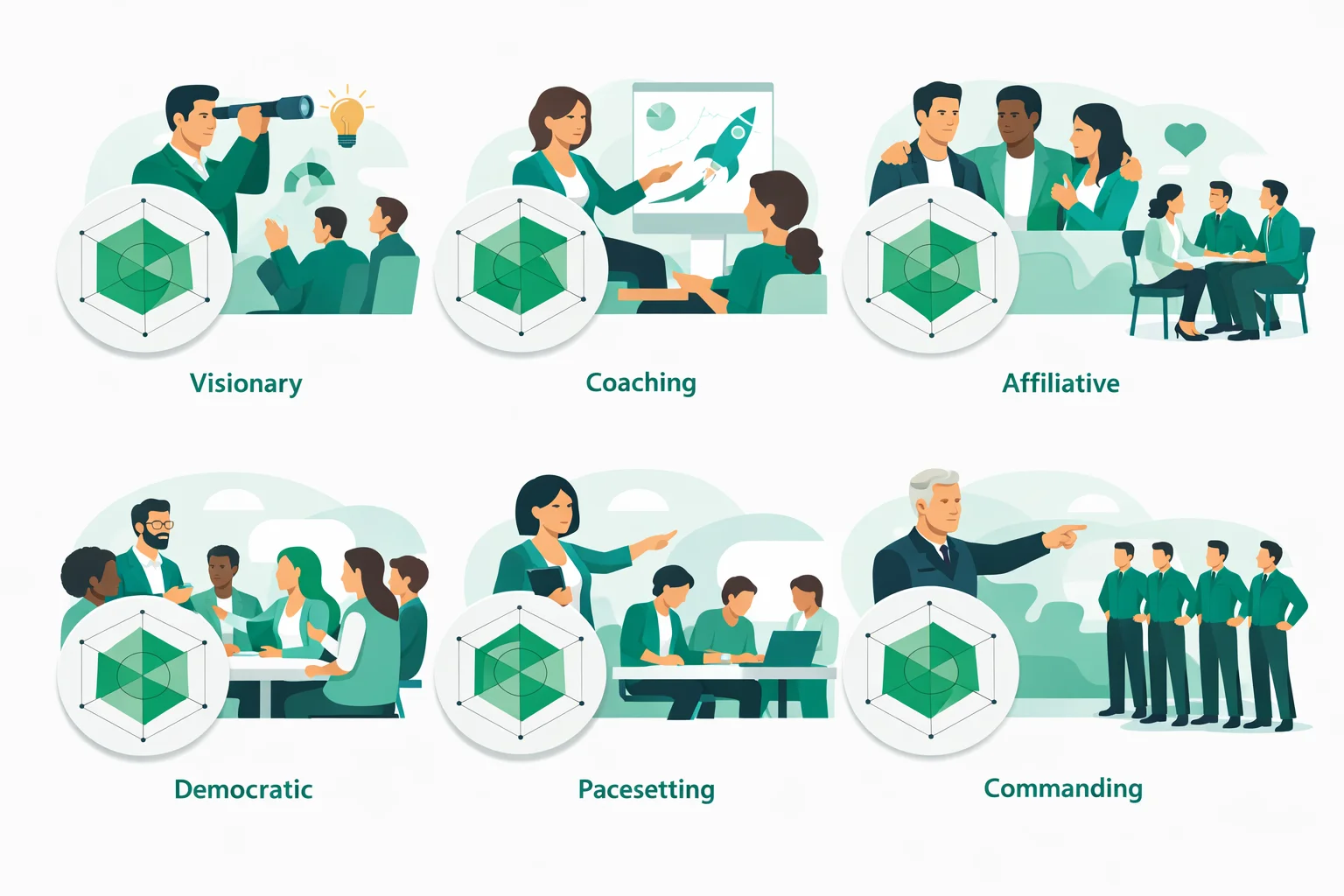
Daniel Goleman identified six distinct leadership styles based on two decades of research with over 3,000 executives. Each style is rooted in different emotional intelligence competencies, and each creates a measurably different organizational climate. The visionary style creates the most positive climate overall, while the commanding style can create the most negative climate if misapplied — but even commanding leadership is essential during genuine crises. The key finding is not that some styles are good and others bad, but that effective leaders develop a repertoire of at least four styles and switch between them based on the situation.
How This Leadership Style Quiz Works
This quiz presents 15 realistic workplace scenarios that force you to choose between competing leadership responses. Each scenario is designed to surface your instinctive approach — the behavior that comes naturally before your rational brain can override it with what you think you should do. The quiz measures your tendencies across six dimensions: visionary, coaching, affiliative, democratic, pacesetting, and commanding. Your primary style is your strongest instinct, and your secondary style reflects the approach you use when your primary does not fit the situation.
Unlike many leadership quizzes that use abstract agree-disagree scales, this assessment uses scenario-based questions because research on behavioral prediction shows that contextual questions are significantly more accurate at predicting real-world behavior than trait-based self-reports. If you are curious about how your leadership tendencies relate to your broader career direction, you may also want to take our career quiz to see which career type best matches your overall professional profile.
The 6 Leadership Styles Explained
Understanding all six styles is essential because even though you have a dominant one, you will encounter situations that require each of them. Here is how they break down:
| Style | Motto | Climate Impact | Best Used When |
|---|---|---|---|
| 🔭 Visionary | "Come with me" | Most strongly positive | Direction is unclear or change is needed |
| 🌱 Coaching | "Try this" | Highly positive | Developing individual performance |
| 🤝 Affiliative | "People come first" | Positive | Rebuilding trust or healing team wounds |
| 🗳️ Democratic | "What do you think?" | Positive | Complex decisions needing buy-in |
| ⚡ Pacesetting | "Do as I do" | Often negative if overused | High-performers needing a challenge |
| 🛡️ Commanding | "Do what I tell you" | Most negative if misapplied | Genuine crises requiring swift action |
The four "resonant" styles (visionary, coaching, affiliative, democratic) generally drive positive workplace climate and performance. The two "dissonant" styles (pacesetting and commanding) are powerful in specific contexts but damage culture when used as a default. If your quiz result shows pacesetting or commanding as your primary style, that does not make you a bad leader — it means you may benefit from developing your resonant styles so you have more tools at your disposal.
The Science Behind Leadership Styles
Goleman's leadership style framework is grounded in decades of emotional intelligence research. A study of over 3,871 executives conducted by the Hay Group (now Korn Ferry) found that leadership style accounted for up to 30% of the variance in organizational climate, which in turn predicted 20-30% of business performance. That means how you lead is not just a soft skill — it directly affects revenue, retention, and results.
The neuroscience behind leadership styles is equally compelling. When a leader uses resonant styles (visionary, coaching, affiliative), brain imaging studies show activation of the parasympathetic nervous system in team members — the neural network associated with creativity, openness, and cognitive flexibility. Dissonant styles (pacesetting, commanding) activate the sympathetic nervous system — useful for fight-or-flight but detrimental to creative problem-solving and collaboration. This is why a team led exclusively by a pacesetting leader often produces technically excellent work but rarely innovates. The brains of the team members are literally in survival mode.
When to Use Each Leadership Style
The mark of leadership maturity is not finding your one style and perfecting it — it is learning when to switch. For adults evaluating how their leadership tendencies connect with broader career satisfaction, our career quiz for adults provides a deeper look at how your professional identity extends beyond leadership alone.
- Visionary: When the team has lost direction, when launching something new, or when organizational change requires people to let go of the old way.
- Coaching: When a team member has potential but needs development, when performance reviews are approaching, or when building a talent pipeline.
- Affiliative: After a round of layoffs, when teams are merging, when trust has been broken, or when someone is dealing with personal hardship.
- Democratic: When you genuinely do not know the best answer, when you need buy-in before implementation, or when your team has more expertise than you.
- Pacesetting: During short sprints with highly skilled professionals, when the standard needs to be visibly raised, or when a team is coasting on past success.
- Commanding: During genuine emergencies, when compliance or safety is at stake, or when an underperformer has already received coaching and failed to improve.
How to Develop Leadership Flexibility
Research suggests that leaders with the strongest business results regularly deploy four or more leadership styles. If your quiz results show a heavy reliance on one or two styles, the good news is that leadership flexibility is a trainable skill. Here are four evidence-based approaches:
Self-awareness practice: For one week, track every leadership interaction and note which style you used. Most leaders are stunned by how heavily they rely on a single approach. Deliberate practice: Choose one underdeveloped style and commit to using it in low-stakes situations for 30 days. If you default to commanding, practice asking "What do you think?" in your next three meetings. Feedback loops: Ask two trusted team members to call it out when you default to your comfort zone. Study the opposite: If you are highly affiliative, study what great pacesetting leaders do and vice versa. The discomfort is the growth. Understanding your natural tendencies through tools like our animal personality quiz can also provide a playful but insightful mirror for your workplace behaviors.
5 Leadership Mistakes That Kill Team Performance
Knowing your leadership style is valuable. Knowing how your style can backfire is essential. Here are the five most common leadership mistakes, mapped to the styles most likely to make them:
- Using one style for everything (all types) — A visionary leader who never rolls up their sleeves loses credibility with doers. A pacesetter who never coaches burns out their team. Versatility is the meta-skill of great leadership.
- Avoiding conflict to preserve harmony (affiliative) — Affiliative leaders often tolerate underperformance because addressing it feels like breaking the relationship. The result is resentment from high performers who carry the weight.
- Micromanaging high performers (pacesetting, commanding) — When you hold everyone to your personal standard or control every decision, your best people leave. They want autonomy, not instruction.
- Seeking consensus when the building is on fire (democratic) — Democratic leaders can stall critical decisions by polling the room when what the team needs is a clear call and a direction.
- Selling the vision without building the bridge (visionary) — Inspiration without execution is just a speech. Visionary leaders must pair their big-picture thinking with clear, actionable steps or risk losing credibility.
All 6 Leadership Style Results
Below is a summary of every possible leadership style you can receive on this quiz. Each style represents a valid and valuable approach to leadership — the key is understanding when your style serves you and when it limits you.
🔭 The Visionary Leader leads by setting a bold, inspiring direction and giving people the freedom to figure out how to get there. Visionary leaders thrive during transformation and organizational change. Their greatest strength is the ability to make others feel part of something larger than themselves. Their biggest risk is getting so focused on the future that they lose touch with the present.
🌱 The Coaching Leader leads by investing deeply in individual growth and development. Coaching leaders see potential before people see it in themselves and create environments where learning from mistakes is expected. Their greatest strength is building lasting loyalty and developing future leaders. Their biggest risk is spending too much time on development when the team needs decisive action.
🤝 The Affiliative Leader leads by building emotional bonds and prioritizing team harmony. Affiliative leaders are the ones people turn to when trust has been broken or morale is shattered. Their greatest strength is creating psychologically safe workplaces where people feel genuinely valued. Their biggest risk is avoiding difficult conversations that could temporarily disrupt the peace.
🗳️ The Democratic Leader leads by seeking input, valuing diverse perspectives, and building consensus before acting. Democratic leaders create buy-in that makes implementation smoother and faster. Their greatest strength is generating ideas that no single person could have conceived alone. Their biggest risk is decision paralysis when the group cannot agree and a call needs to be made.
⚡ The Pacesetting Leader leads by setting extremely high performance standards and modeling those standards personally. Pacesetters produce exceptional results and build cultures of excellence and accountability. Their greatest strength is driving teams to deliver work that consistently exceeds expectations. Their biggest risk is burning out talented people who cannot sustain the relentless pace.
🛡️ The Commanding Leader leads with clear authority and expects immediate compliance. Commanding leaders bring order to chaos and make the tough calls others hesitate on. Their greatest strength is bringing clarity and decisiveness during genuine crises. Their biggest risk is suppressing the creativity and initiative of their team when the crisis has passed but the commanding behavior continues.
What to Do With Your Results
Your leadership style quiz result is not a label — it is a development tool. Here is what to do with it. First, share your results with a trusted colleague or mentor and ask if they see the same patterns. Second, identify one situation this week where you can deliberately try a different leadership style than your default. Third, pay attention to how your team responds when you flex your approach. Fourth, revisit this quiz in 3 months after intentional practice to see if your profile has shifted. The leaders who grow the fastest are not the ones who discover their style and settle into it — they are the ones who use that self-awareness as a launching pad for expanding their range.