GED Practice Quiz: Your Complete Guide to Passing the GED Exam on the First Try
A GED practice quiz is the single best way to gauge your readiness for the real GED exam before you spend money on registration fees or walk into a testing center unprepared. The General Educational Development (GED) test is the most widely recognized high school equivalency credential in the United States and Canada, accepted by 97% of colleges and virtually all employers. Every year, roughly 700,000 adults attempt the GED, but only about 80% pass on their first try — meaning one in five test takers fails at least one subject. Practice quizzes like this one help you identify weak spots before they cost you time, money, and confidence on test day.
What Is the GED Test?
The GED (General Educational Development) test is a battery of four subject exams that certify the test taker has academic skills equivalent to a U.S. or Canadian high school graduate. Created in 1942 to help World War II veterans who left school early to serve, the GED has since become the primary path for adults who did not complete traditional high school to earn their equivalency credential. Today, GED Testing Service (a joint venture of the American Council on Education and Pearson) administers the computer-based test at authorized testing centers nationwide.
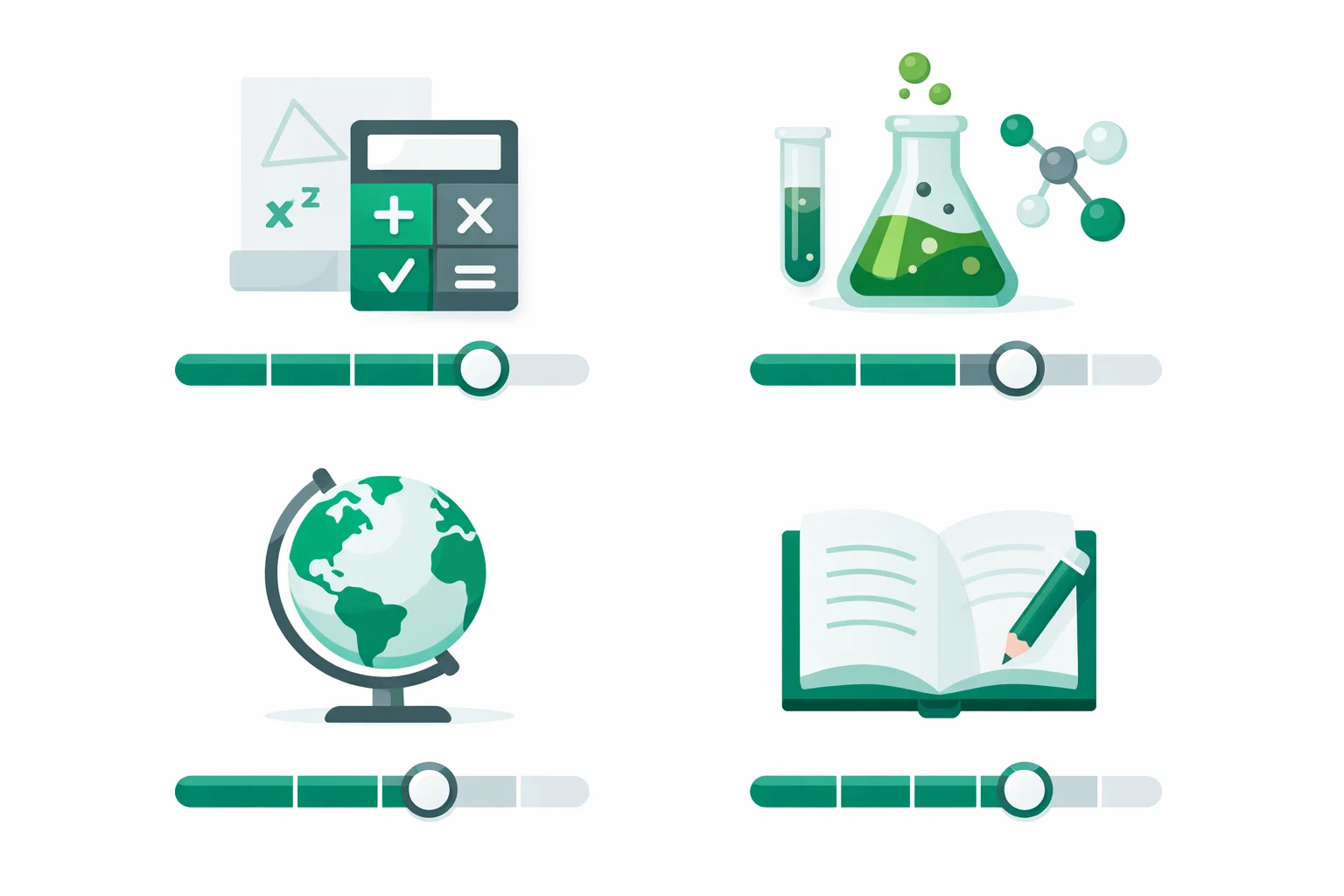
The modern GED exam covers four subjects: Mathematical Reasoning, Reasoning Through Language Arts (RLA), Science, and Social Studies. You do not need to take all four tests on the same day — you can schedule each subject independently, which allows you to focus your preparation on one area at a time. Once you pass a subject, you never need to retake it, even if it takes you multiple attempts to pass the other subjects.
How This GED Practice Quiz Works
This free practice quiz presents 20 multiple-choice questions — 5 per subject — that mirror the style and difficulty of the actual GED exam. Each question has one objectively correct answer. After completing all 20 questions, you receive a percentage score with a pass/fail classification, a subject-by-subject breakdown showing your strengths and weaknesses, and detailed answer explanations for every question.
The passing threshold on this quiz is set at 65%, which approximates the 145/200 minimum score required on the real GED. While 20 questions cannot replicate the full scope of a 160+ question official GED exam, they effectively test the core concepts and question types you will encounter. If you score 80% or above, you are likely well-prepared. If you score below 65%, the subject breakdown tells you exactly where to focus your study time. If you want to test your overall cognitive strengths first, try our free IQ Test to see how your reasoning abilities compare.
The 4 GED Subject Areas Explained
Understanding what each subject test covers helps you study smarter. Here is a breakdown of the four GED subjects and what the official exam tests in each:
| Subject | Questions | Time | Key Topics |
|---|---|---|---|
| 📐 Mathematical Reasoning | ~46 | 115 min | Algebra, geometry, data analysis, number operations, fractions/decimals |
| 📖 Language Arts (RLA) | ~46 + essay | 150 min | Reading comprehension, grammar, argument analysis, evidence-based writing |
| 🔬 Science | ~34 | 90 min | Life science, physical science, earth/space science, scientific method |
| 🌍 Social Studies | ~35 | 70 min | U.S. history, government/civics, economics, geography |
The math section is where most test takers struggle. About 30% of GED failures come from Mathematical Reasoning alone. The key is understanding that the GED math section provides a formula reference sheet and allows calculator use on all but the first 5 questions — so you do not need to memorize formulas, but you do need to know how to apply them.
GED Scoring System: Pass, College Ready, and College Ready + Credit
The GED scoring system uses a scale from 100 to 200 for each subject test. There are three performance levels:
- 145-164: GED Passing Score — This earns you a high school equivalency credential. About 60% of test takers score in this range on their first attempt. This credential is accepted by employers and colleges nationwide as equivalent to a high school diploma.
- 165-174: GED College Ready — Scoring at this level demonstrates that you are ready for college-level coursework without needing remedial classes. Many community colleges waive placement tests for students with College Ready scores, saving you a semester of non-credit classes.
- 175-200: GED College Ready + Credit — The top tier. Scoring here may earn you actual college credit at participating institutions, giving you a head start on your degree. This is the equivalent of scoring well on an AP exam in high school.
You must score at least 145 on every subject to earn your GED. If you pass three subjects with a 170 but fail one with a 140, you do not get your credential until you retake and pass that fourth subject. This is why identifying your weakest area through practice quizzes is so critical.
Proven GED Study Strategies That Work
Research on adult education and test preparation consistently shows that these strategies produce the best GED outcomes:
- Start with a diagnostic test. Before studying anything, take a full practice test to identify your starting level. This quiz serves as a quick diagnostic. Many people waste weeks studying subjects they already know while ignoring the ones that will actually fail them.
- Focus 70% of study time on your weakest subject. Your strongest subjects likely need only light review. Pour most of your energy into the area where your practice scores are lowest — that is where you get the biggest score improvement per hour studied.
- Study in short, consistent sessions. Research shows that 45-60 minutes of focused daily study beats 4-hour weekend cram sessions. Your brain consolidates information during sleep, so daily practice with good rest outperforms binge studying every time.
- Use the answer explanations. When you get a question wrong, do not just move on. Read the explanation, understand why the correct answer is right, and try to identify what thinking error led you astray. This metacognitive practice is what separates effective studying from just going through the motions.
- Practice under test-like conditions. Time yourself, minimize distractions, and avoid looking up answers. The more your practice resembles the real test environment, the less anxiety you will feel on test day. If you are considering different career paths after earning your GED, our Career Quiz can help you explore which fields match your interests.
Common Mistakes GED Test Takers Make
After analyzing thousands of GED results, these are the most common pitfalls that trip up test takers — and how to avoid them:
- Not reading questions fully. The GED tests critical reading as much as content knowledge. Many questions contain phrases like "which of the following is NOT" or "which BEST supports." Missing a single word can flip the correct answer. Train yourself to read every word of the question before looking at the options.
- Skipping the RLA extended response. The Language Arts section includes a 45-minute essay. Some test takers skip it or write only a few sentences, which guarantees a low score. Even a basic five-paragraph response that addresses the prompt directly can earn enough points to pass.
- Ignoring the math formula sheet. The GED provides a formula reference sheet for the math section. Learn what formulas are on it and how to use them. You do not need to memorize the area of a trapezoid — you just need to know which formula applies and how to plug in numbers.
- Taking all four tests on the same day. The GED allows you to schedule subjects independently. Taking all four in one marathon session leads to mental fatigue and lower scores on later tests. Space them out over days or weeks.
- Not managing time. Each section has a strict time limit. Practice with a timer so you learn to pace yourself. A good rule: spend no more than 90 seconds per question on your first pass, then return to difficult questions with remaining time.
GED vs. HiSET: Which Test Is Right for You?
The GED is the most recognized high school equivalency test, but it is not the only option. The HiSET (High School Equivalency Test) is an alternative accepted in many states. Here is how they compare:
| Feature | GED | HiSET |
|---|---|---|
| Format | Computer-based only | Computer or paper-based |
| Subjects | 4 tests | 5 tests (writing is separate) |
| Cost | ~$30-40 per subject | ~$15-25 per subject |
| Acceptance | All 50 states + DC | Most states (check locally) |
| College Credit option | Yes (175+ score) | No |
| Difficulty | Moderate to hard | Moderate |
If you are comfortable with computers and want the most universally recognized credential with potential for college credit, the GED is the stronger choice. If you prefer paper-based testing, want a lower cost, or find the GED content too challenging, the HiSET may be a better fit. Check your state's department of education website to see which exams are accepted. Planning your education path? Our College Major Quiz helps you figure out what to study after you earn your credential.
All 5 GED Practice Score Levels
Here is a description of every possible result level on this GED practice quiz, so you can understand what each classification means and how it maps to the real GED scoring system.
🏆 College Ready + Credit (90-100%) — Test takers who score in this range demonstrate exceptional mastery across all four GED subject areas. On the real exam, this corresponds to the 175-200 score band. You show strong analytical thinking in math, solid reading comprehension and writing ability, accurate scientific reasoning, and deep knowledge of social studies concepts. This level may qualify you for actual college credit at participating institutions.
⭐ College Ready (80-89%) — Scoring here means you are academically prepared for college-level work without needing remedial courses. On the real GED, this maps to the 165-174 range. Your knowledge base is strong across subjects, with perhaps one area that could use a bit more polish. Many community colleges waive placement tests for students with College Ready GED scores.
✅ Passing — High School Equivalency (65-79%) — You meet the minimum threshold to earn your GED credential. On the real exam, this corresponds to the 145-164 range. You demonstrate adequate knowledge across all four subjects, though you may have some gaps in specific topics. This credential is accepted by employers and colleges as equivalent to a high school diploma.
📘 Close to Passing (45-64%) — You are not far from the passing line, which is an encouraging position to be in. A few weeks of targeted study in your weakest subjects could push you over the threshold. Focus on understanding the concepts behind questions you missed rather than memorizing facts, and practice with full-length timed tests to build stamina and time management skills.
📖 Needs More Preparation (below 45%) — This score suggests you need a structured study plan before attempting the official GED. Many adults who start at this level pass within 3 to 6 months of dedicated preparation. Free GED prep programs are available through most local libraries, adult education centers, and community colleges. The key is consistent daily study rather than occasional marathon sessions.
What to Do After Taking This Practice Quiz
Your practice quiz results give you a clear action plan. Here is how to use them:
- Review every wrong answer. The most valuable part of a practice quiz is the answer explanations. For each question you missed, read the explanation and make sure you understand not just the correct answer but why your chosen answer was wrong. This prevents you from making the same mistake on the real test.
- Create a subject-specific study plan. Use your subject breakdown to prioritize. If you scored 2/5 in math but 5/5 in science, spend 70% of your study time on math. Do not waste hours reviewing subjects you already know well.
- Take a full-length official practice test. This 20-question quiz is a useful diagnostic, but the real GED has 160+ questions across four timed sections. The official GED Ready practice test (available at ged.com for about $6 per subject) is the most accurate predictor of your real score.
- Schedule your test strategically. Start with your strongest subject to build confidence and earn a passing score quickly. Then tackle weaker subjects one at a time, retaking this practice quiz periodically to measure your progress.
- Do not wait until you feel 100% ready. Many test takers delay indefinitely because they want to feel perfectly prepared. If your practice scores are consistently at or above the passing threshold, you are ready. The cost of a single subject test ($30-40) is worth it to build real test experience.