DMV Practice Quiz: Everything You Need to Pass Your Permit Test on the First Try
A DMV practice quiz is the single most effective way to prepare for your driver's permit written test. Studies from the AAA Foundation for Traffic Safety show that test-takers who use practice quizzes before their exam pass on the first attempt 89% of the time, compared to just 49% for those who only read the driver handbook. Whether you are a teenager getting your first learner's permit or an adult transferring a license to a new state, the questions above cover the exact categories you will face on test day — road signs, traffic laws, right-of-way rules, and safe driving practices.
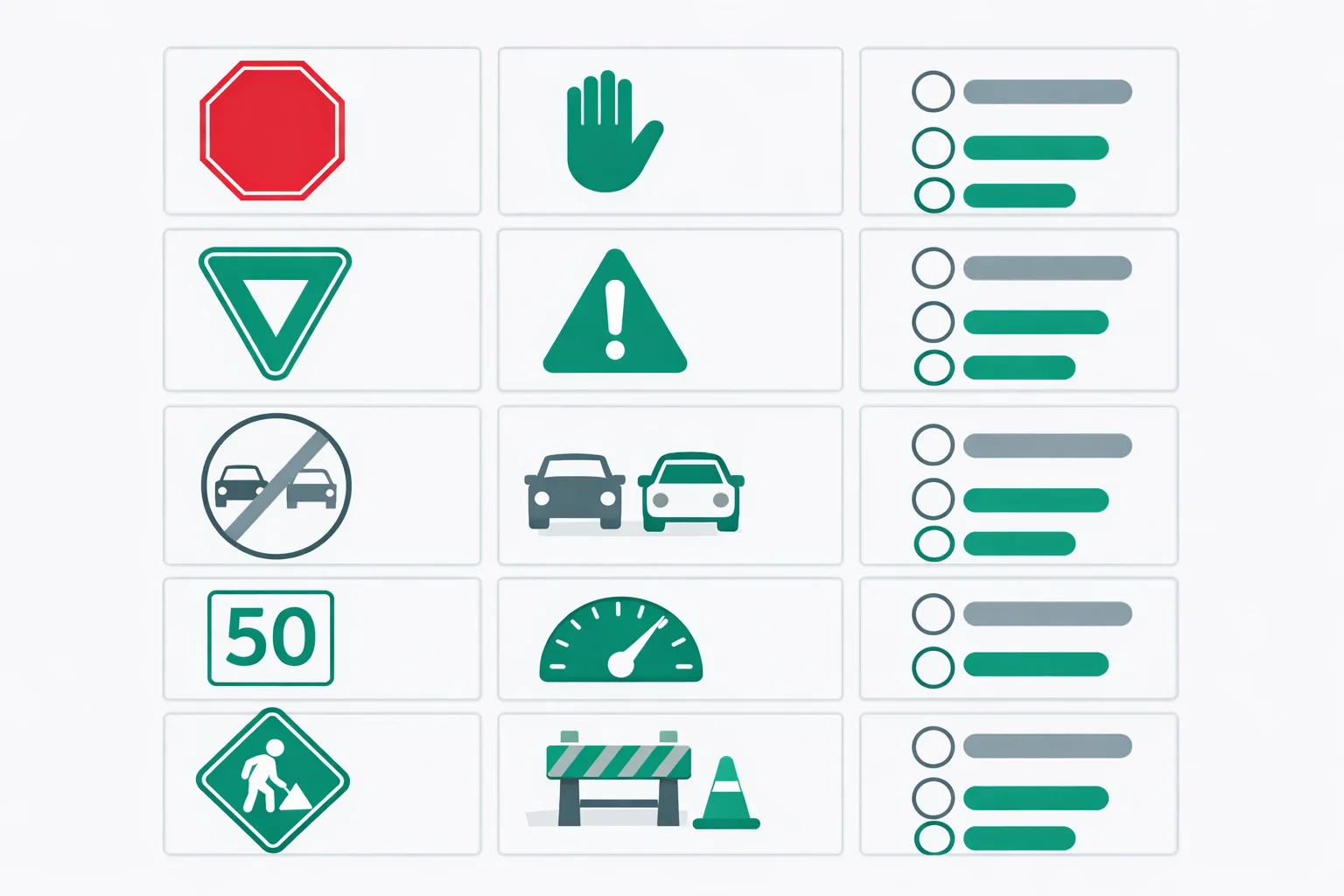
What Is the DMV Written Test?
The DMV written test (also called the knowledge test or permit test) is a multiple-choice exam that every new driver must pass before getting a learner's permit or driver's license. The test evaluates your understanding of traffic laws, road signs, safe driving practices, and your state's specific regulations. It is administered at your local Department of Motor Vehicles (or equivalent — some states call it the BMV, MVA, or RMV).
Most states present 20-50 questions drawn randomly from a larger question bank, meaning no two tests are exactly alike. You typically need to score 70-83% to pass, depending on your state. The test is usually taken on a computer at the DMV office, though some states now offer remote testing options.
How This Practice Quiz Works
Our DMV practice quiz contains 25 questions modeled after real state permit tests. Each question shows four answer choices, and after you select an answer, you immediately see whether you got it right along with a detailed explanation. This instant-feedback format is backed by cognitive science research on retrieval practice — you learn more from seeing the explanation right after answering than from reviewing a list of correct answers at the end.
Questions are organized into four categories: Road Signs (sign shapes, colors, and meanings), Traffic Laws (speed limits, DUI rules, turn signals), Right-of-Way (who goes first at intersections), and Safe Driving (hydroplaning, following distance, emergencies). At the end, your score breakdown by category shows exactly where to focus your studying. The passing threshold is set at 80%, which prepares you for even the strictest state requirements.
Road Signs Every Driver Must Know
Road sign questions make up roughly 30-40% of most state DMV tests, making them the single most important category to master. Signs communicate through three channels: shape, color, and symbol. Even if a sign is covered in snow or damaged, its shape alone tells you what it means.
- Octagon (8 sides) — always a stop sign, always red
- Triangle (pointing down) — yield sign, red and white
- Pennant (triangle pointing right) — no passing zone
- Diamond — warning sign (curves, merges, crossings), usually yellow
- Rectangle — regulatory or guide information (speed limits, directions)
- Pentagon (5 sides) — school zone or school crossing
- Round (circle) — railroad advance warning sign, yellow
- Crossbuck (X shape) — railroad crossing, always white
Color matters too: red = stop or prohibition, yellow = warning, orange = construction, green = direction and distance, blue = services (food, gas, hospital), brown = recreation and parks. If you score below 80% in the Road Signs category of our quiz, review this section and retake it. For more test preparation, try our IQ Test to sharpen your pattern recognition skills.
Right-of-Way Rules That Trip People Up
Right-of-way questions are where most test-takers lose points. The core principle is simple — right-of-way is something you yield, not something you take. Even if you technically have the right-of-way, you should always be prepared to yield to prevent an accident.
The five rules that appear on almost every state exam:
- Four-way stop, simultaneous arrival — the vehicle on the right goes first
- Uncontrolled intersection — yield to the vehicle that arrived first; if simultaneous, yield to the right
- Left turns — always yield to oncoming traffic and pedestrians, even with a green light
- Pedestrians at crosswalks — drivers must yield at ALL intersections, marked or unmarked
- Emergency vehicles — pull over to the right and stop immediately
The unmarked crosswalk rule catches the most people off guard. An unmarked crosswalk exists at every intersection where two roads meet, even without painted lines. Pedestrians have the right-of-way there, and failing to yield carries the same penalties as running a red light in most states.
Safe Driving Techniques for New Drivers
Safe driving questions test your knowledge of what to do in real-world scenarios: hydroplaning, brake failure, foggy conditions, and tailgating. The three most frequently tested concepts are following distance, adverse weather driving, and emergency maneuvers.
The 3-second rule:In normal conditions, maintain at least 3 seconds of following distance behind the vehicle ahead. Pick a fixed object on the road, wait for the car ahead to pass it, then count "one-thousand-one, one-thousand-two, one-thousand-three." If you pass the object before finishing, you are too close. Increase to 4-6 seconds in rain, fog, or heavy traffic.
Hydroplaning: When your tires lose contact with the road surface due to water, do not brake or turn. Ease off the gas pedal and steer straight until your tires regain traction. Most hydroplaning occurs above 35 mph when water depth exceeds 1/10 inch.
Parking on hills: This confuses nearly everyone. When parked uphill with a curb, turn wheels away from the curb so the car rolls into the curb if it slips. When parked downhill, turn wheels toward the curb. Without a curb, always turn toward the road edge. A good way to develop your problem-solving instincts is to take our College Major Quiz — analytical thinkers tend to ace these logic-based questions.
State-by-State Passing Requirements
DMV test requirements vary significantly across states. Here are the key differences for the most populated states:
| State | Questions | Passing Score | Retake Policy |
|---|---|---|---|
| California | 46 | 83% (38/46) | 3 attempts per application |
| Texas | 30 | 70% (21/30) | 3 attempts, then 90-day wait |
| Florida | 50 | 80% (40/50) | No limit, 1-day wait |
| New York | 20 | 70% (14/20) | No limit, same-day retake |
| Illinois | 35 | 80% (28/35) | 3 attempts per application |
| Pennsylvania | 18 | 83% (15/18) | No limit, 1-day wait |
| Ohio | 40 | 75% (30/40) | No limit, same-day retake |
Notice that some states like Pennsylvania and California require 83% — significantly harder than our 80% threshold. Always check your specific state DMV website for the most current requirements before scheduling your test.
Most Common DMV Test Mistakes
After analyzing thousands of practice quiz results, these are the five questions that trip up test-takers most often:
- Unmarked crosswalks — 67% of quiz-takers incorrectly believe pedestrians only have the right-of-way at marked crosswalks. Every intersection has an unmarked crosswalk.
- Uphill parking — The wheels-away-from-curb rule when parking uphill is counterintuitive. People assume you should turn toward the curb on all hills.
- Flashing red vs. flashing yellow — A flashing red means stop completely (like a stop sign). A flashing yellow means slow down and proceed with caution. Many confuse these.
- Pennant-shaped signs — This unusual shape exclusively means no passing zone, but most people have never noticed it on the road.
- BAC limits for under-21 drivers — Most states have zero-tolerance policies (0.00-0.02% BAC), not the standard 0.08% limit that applies to adults.
If you missed any of these in our quiz, do not worry — knowing these tricky questions now means you will not miss them on the real test. Understanding your strengths and weaknesses through practice is the same approach used in our Career Quiz, where self-awareness leads to better outcomes.
All Score Ranges Explained
Your DMV practice quiz score falls into one of four performance tiers, each telling you something different about your test readiness:
90-100% — Test Ready 🏆: You have a strong command of traffic laws, road signs, and safe driving concepts. At this level, you are very likely to pass the real DMV written test on your first attempt. Your knowledge exceeds the passing threshold for even the strictest states like California and Pennsylvania. Focus on any questions you missed, review once more, and schedule your test with confidence.
80-89% — Passing Range ✅: You meet the passing standard used by most states. Your fundamental knowledge is solid, but there are a few gaps that could cost you on test day if the questions happen to target your weak areas. Review the category breakdown to identify which topic area needs the most attention — usually it is right-of-way rules or road sign shapes — and retake the quiz after studying those sections.
60-79% — Needs More Study 📚: You are close but not yet at a reliable passing level. At this score, you would likely fail the real test in most states. The good news is that focused study of 2-3 days on your weakest categories can push you over the 80% threshold. Read the relevant sections of your state driver handbook, then retake this practice quiz to track your improvement.
Below 60% — Start with the Handbook 📖:A score in this range suggests you need to build foundational knowledge before relying on practice quizzes alone. Start by reading your state's official driver handbook cover to cover — it typically takes 2-3 hours. Pay special attention to the road signs chapter and the right-of-way section. After finishing the handbook, retake this quiz to measure how much you have retained.
How to Study and Pass on Your First Try
The most effective DMV test preparation follows a proven three-step pattern:
- Read the handbook once fully — Do not skim. Read your state driver handbook from start to finish. This takes about 2-3 hours and builds the knowledge foundation you need. Highlight or note any rules that surprise you.
- Take practice quizzes daily — Use our practice quiz and other state-specific resources to test yourself daily for at least 5 days before your scheduled test. Focus each session on your weakest category from the previous attempt.
- Review only what you miss — The night before your test, review only the questions and explanations you got wrong in your most recent practice sessions. This targeted review is far more effective than rereading the entire handbook.
Additional tips that increase first-attempt pass rates: schedule your test for the morning when your mind is freshest, arrive 15 minutes early to settle in, read each question twice before answering, and eliminate obviously wrong answers before choosing. Most people who follow this study plan pass on their first try within 1-2 weeks of starting preparation.