College Major Quiz: How to Choose the Right Major Based on Your Strengths and Goals
A college major quiz is the fastest way to cut through the overwhelm of choosing what to study — especially when you feel pulled in multiple directions. With over 1,800 degree programs available at U.S. colleges alone, picking a major can feel paralyzing. This quiz measures your natural thinking patterns across five academic dimensions and matches you to one of ten major paths, complete with salary data, career outlook, and degree requirements. Whether you are a high school junior building your college list or a freshman who has not declared yet, answering 18 honest questions will give you a concrete starting point that is based on how your brain actually works — not what your parents hope you will study.
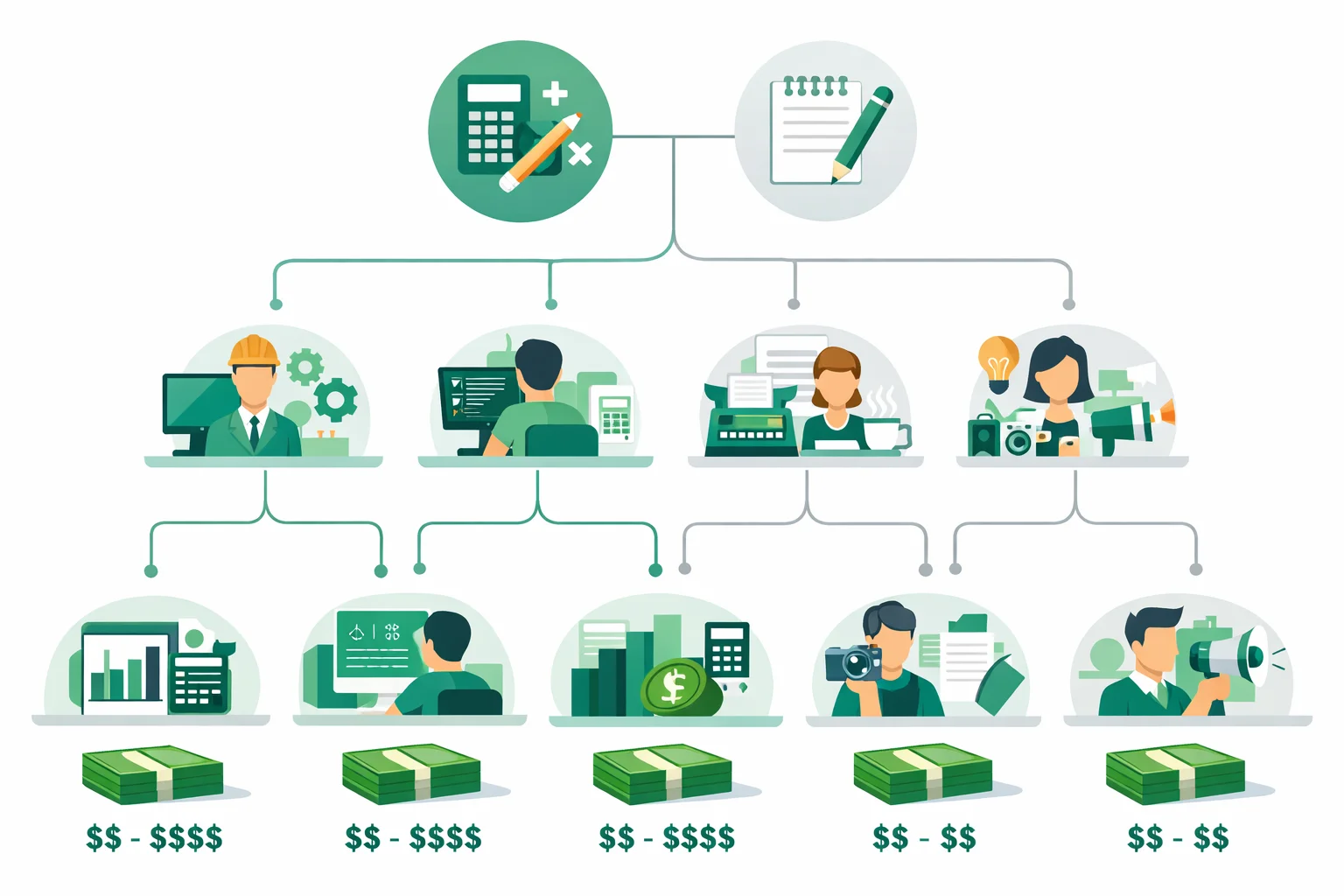
What Is a College Major Quiz?
A college major quiz is a structured assessment that connects your interests, thinking style, and values to academic programs most likely to keep you engaged for four years and employed after graduation. Unlike generic career aptitude tests that hand you a broad category like "you should work with people," a well-designed major quiz gets specific: it tells you which department, which degree, and which courses align with the way you naturally process information and solve problems.
The best college major quizzes are rooted in vocational psychology — specifically Holland's RIASEC model and the Strong Interest Inventory framework. Our quiz adapts these validated approaches by scoring your responses across five measurable dimensions: analytical reasoning, creative thinking, social impact orientation, business aptitude, and technical inclination. This multi-dimensional approach prevents the common trap of oversimplifying someone into a single label. You might be 60% analytical and 40% creative, which points toward data visualization or UX research rather than pure engineering or pure art.
How This Quiz Works
This free college major quiz presents 18 scenario-based questions designed to reveal how you think, not what you already know. Each question offers four options, and each option distributes weighted scores across the five academic dimensions. Your answers build a cumulative interest profile that is then matched against ten distinct major paths using cosine similarity — the same mathematical technique recommendation engines use to match Netflix viewers to shows.
The scenario-based format matters because it bypasses the "social desirability bias" that plagues traditional interest inventories. When a quiz asks "Do you like science?" students answer based on what they think they shouldsay. When it asks "You won $5,000 — what is your first instinct?" the answer reveals authentic priorities. Your result includes a primary major path, a secondary backup path, salary data, job growth projections, and a visual breakdown of your five-dimension profile.
If you have already taken our Career Quiz and know your Holland Code, your college major result will naturally complement it. RIASEC types map closely to academic dimensions: Investigative aligns with analytical, Artistic with creative, Social with social impact, Enterprising with business, and Realistic with technical.
The 5 Dimensions That Shape Your Major
Understanding your dimension profile is more useful than a single major label. Here is what each dimension measures and why it matters:
| Dimension | What It Measures | High-Score Majors | Low-Score Majors |
|---|---|---|---|
| 🧠 Analytical | Logic, quantitative reasoning, evidence-based thinking | Engineering, CS, Economics | Fine Arts, Education |
| 🎨 Creative | Original thinking, visual expression, aesthetic sensitivity | Design, Film, English | Accounting, Engineering |
| 🌍 Social Impact | Empathy, desire to help, community orientation | Nursing, Education, Public Health | Finance, Computer Science |
| 💼 Business | Strategy, competition, economic thinking | Finance, Marketing, Business Admin | Social Work, Fine Arts |
| ⚙️ Technical | Systems thinking, building, mechanical aptitude | CS, Engineering, Data Science | English, History |
Most students are not extreme on any single dimension. The interesting insight comes from your combination. High analytical plus high creative points toward architecture or UX design. High social plus high business suggests healthcare administration or nonprofit management. The quiz captures these blends rather than forcing you into a single box.
Choosing a Major by Interest vs. Salary
The "follow your passion vs. follow the money" debate is one of the most persistent myths in college advising — because both extremes are wrong. A 2019 longitudinal study published in the Journal of Career Assessment tracked 3,000 college graduates over 20 years and found that students who chose majors aligned with their genuine interests earned 12% more over their career than students who chased high starting salaries in fields they disliked. The mechanism is straightforward: interest drives engagement, engagement drives skill development, and skill development drives promotions and earnings.
That said, completely ignoring market demand is equally risky. The sweet spot is what career researchers call the "interest-opportunity intersection" — a major that genuinely engages your mind and connects to a labor market with growing demand. This quiz is designed to find that intersection: each result includes real salary data and job growth projections so you can evaluate both fit and opportunity simultaneously.
For a broader perspective on how your interests translate into specific job roles, take our Career Quiz for Teens — it maps school subjects and personality traits directly to career directions, which can help validate your major choice from a different angle.
Most Popular College Majors and What They Pay
Knowing where the crowds are headed helps you make a more informed choice — whether you want to join a popular field or strategically differentiate yourself. According to the National Center for Education Statistics, the five most awarded bachelor's degrees in the U.S. are Business (387,000 annually), Health Professions (256,000), Social Sciences (168,000), Engineering (140,000), and Biological Sciences (133,000).
But popularity does not equal earning power. Petroleum engineering graduates earn a median of $130,000, yet fewer than 2,000 degrees are awarded annually. Computer science graduates average $95,000 and face a 15% job growth rate — one of the highest of any field. Meanwhile, the most popular major (business administration) has a median salary of $65,000 but enormous variation depending on specialization. An accounting concentration within business earns significantly more than a general management concentration, because specialization signals competence to employers.
The takeaway: use salary data as one input, not the sole driver. A major you hate will cost you more in motivation, switching costs, and career stagnation than the salary premium it promised.
Common Mistakes Students Make When Picking a Major
After advising thousands of students, academic counselors see the same mistakes repeat every year:
- Choosing based on a single high school class. Loving AP Biology does not mean you will love organic chemistry, cadaver labs, and 8 years of medical school. A quiz that tests your thinking patterns across many scenarios catches this better than a single positive experience.
- Letting parents choose. Family influence is the #1 predictor of major dissatisfaction in first-generation college students. Parents often project their own unfulfilled ambitions or fear of financial instability. Respectfully gather their input, then make the call yourself.
- Ignoring the minor or double-major option. If your quiz result shows a strong secondary path, a double major or a major-minor combination captures both dimensions. Psychology major with a data science minor? That is a UX research career in the making.
- Waiting too long to decide. Students who declare by sophomore year graduate faster, accumulate less debt, and report higher satisfaction than those who wait until junior year. Indecision has real costs.
- Confusing "hard" with "wrong." The right major will still be challenging — but the challenge will feel energizing rather than draining. If you dread every assignment, that is a fit problem, not a work ethic problem.
When to Switch Your Major (and When to Stay)
About 33% of students switch their major at least once. Switching is smart when you are consistently disengaged — not struggling with a single hard course, but genuinely dreading the entire subject matter for two or more semesters. It is also smart when your career goals have shifted based on new experiences like internships, study abroad, or a powerful elective course.
Switching is not smart when it is a reaction to one bad professor, one tough exam, or comparison with a friend who seems more excited about their major. Every field has grind periods. The question is whether the peaks — the moments of genuine intellectual excitement — outweigh the valleys. If you are unsure, retake this quiz after a semester of new experiences and compare your results. A consistent pattern across multiple tries is a strong signal.
For adults considering going back to school for a new degree, our Career Quiz for Adults evaluates transferable skills and life priorities alongside academic interest — a more complete picture for career changers.
All 10 College Major Quiz Results
Whether you want to explore every possible outcome or compare your result with a friend, here is a complete guide to all ten major paths this quiz can recommend.
🔬 The Engineer. Engineers are precision-driven problem solvers who think in systems and thrive when math meets real-world application. Top majors include mechanical, civil, electrical, and chemical engineering. This path offers strong starting salaries ($78K-$95K) and steady job growth, but demands comfort with extended technical coursework and structured thinking.
💻 The Digital Architect. Digital Architects see code as a creative medium and data as a language worth mastering. Computer science, data science, and software engineering attract minds that love both logical puzzles and building products from scratch. Salary ceilings are among the highest of any major path ($85K-$120K), though the field evolves rapidly and demands lifelong learning.
📊 The Strategist. Strategists combine analytical rigor with competitive instincts. Finance, accounting, economics, and business administration suit people who think three moves ahead and find genuine energy in markets, negotiation, and strategy. The MBA track opens executive doors, but networking matters as much as grades in this field.
🩺 The Healer. Healers merge scientific knowledge with genuine compassion for others. Pre-med, nursing, public health, and biochemistry attract students who want their expertise to directly improve lives. The salary range is enormous ($70K-$200K+) depending on whether you pursue nursing or medical school, with healthcare job growth outpacing nearly every other sector.
🎨 The Creative. Creatives think visually and need freedom to experiment. Graphic design, fine arts, film, and music programs develop original thinkers who produce rather than consume. Portfolio quality often matters more than GPA, and early-career income can be volatile — but creative directors and UX leads command salaries rivaling engineering.
📝 The Communicator. Communicators are natural storytellers who understand that framing a message is one of the most versatile professional skills. Communications, journalism, marketing, and PR attract people who bridge ideas between audiences. The field is saturated at entry level, so specialization (digital marketing, data journalism, corporate communications) accelerates careers.
🧩 The Analyst of People. People Analysts are fascinated by behavior, culture, and the invisible forces shaping society. Psychology, sociology, political science, and anthropology develop critical thinkers who understand humans at scale. Graduate school is often required for top roles, but pairing these majors with data or management skills creates powerful career combinations.
📚 The Mentor. Mentors light up when they help someone else understand a concept. Education, special education, and educational psychology attract people who see teaching as a calling, not a fallback. Starting salaries are below average relative to education investment, but the work satisfaction scores are among the highest of any profession.
🌱 The Changemaker. Changemakers cannot separate career ambition from concern for the planet. Environmental science, sustainability, marine biology, and urban planning attract mission-driven students who see data as a call to action. Job growth is strong and accelerating as climate policy expands, though funding can be grant-dependent in early career.
📖 The Renaissance Mind. Renaissance Minds refuse to be boxed into one discipline. English, history, philosophy, and interdisciplinary studies develop versatile thinkers who see connections others miss. Career paths are less linear, but liberal arts graduates are overrepresented in law, policy, nonprofit leadership, and writing — fields where breadth of thinking is the product.
What to Do With Your Results
Your quiz result is a compass, not a contract. Here is how to use it practically:
- Explore the specific majors listed in your result. Visit university department websites for your top majors and read actual course descriptions. If the 300-level courses sound interesting — not just the intro ones — that is a strong fit signal.
- Check your secondary path. If your backup result is almost as strong as your primary, a double major or major-minor combination might capture both dimensions of your interest profile.
- Talk to a real student or professional in the field. LinkedIn makes this easy — search for people with the major you are considering and ask them what surprised them most. First-hand experience beats quiz results every time, but quizzes tell you where to look first.
- Test before committing. Take one or two elective courses in your result area before officially declaring. If the work feels energizing rather than draining, you have found your lane.
- Revisit in six months. Your interests evolve as you gain new experiences. Retaking this quiz after a semester of new courses, an internship, or a study-abroad trip can reveal how your academic identity is developing. A consistent pattern across multiple tries is a strong signal worth trusting.