Career Quiz for Adults: How to Navigate a Career Change After 10+ Years of Experience
A career quiz for adults is fundamentally different from the career assessments you took in high school or college. When you already have a decade or more of work experience, the question is not "What should I be?" but rather "Is what I am still who I want to be?" This quiz evaluates your readiness for a career transition across five research-backed dimensions — transferable skills, values alignment, risk tolerance, financial preparedness, and life stage flexibility — to reveal not just whether you should change careers, but how you are most likely to do it successfully.
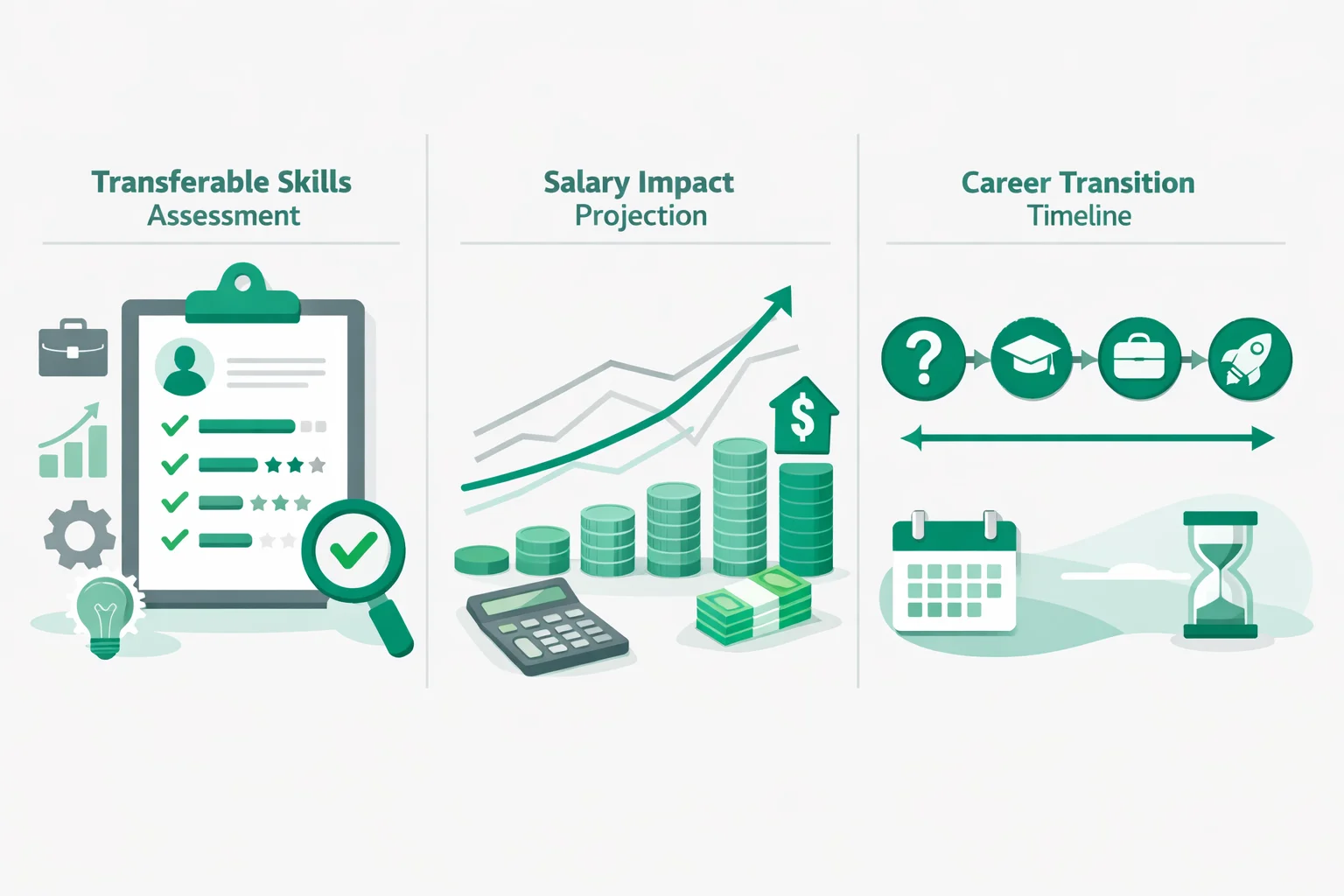
What Is a Career Quiz for Adults?
Unlike general career assessments that match personality types to job categories, a career quiz designed specifically for adults addresses the complex reality of changing direction when you have a mortgage, a family, retirement savings to protect, and an identity tied to your profession. The Bureau of Labor Statistics reports that the median tenure for workers aged 35-44 is just 4.7 years, meaning career changes among adults are not rare exceptions — they are the norm.
What makes adult career transitions uniquely challenging is not a lack of options but an abundance of constraints. You cannot simply follow your passion into a low-paying field when you have two kids in private school. You cannot go back for a four-year degree when you are 45. And you cannot ignore the psychological weight of walking away from years of accumulated expertise and seniority. This quiz accounts for all of those realities.
How This Career Change Quiz Works
The quiz presents 20 scenario-based questions designed to surface your honest instincts — not what you think you should feel about a career change, but what you actually feel. Each answer maps to one of five transition dimensions, and the pattern of your responses reveals your career transition archetype: the style in which you are most likely to successfully navigate a career change.
Your result is not a job recommendation. Instead, it tells you howto change careers given your unique combination of strengths, constraints, and motivations. A Bold Leaper and a Security-First Transitioner might both end up in the same new career — but the path they take to get there should look completely different.
The 5 Dimensions of Career Transition Readiness
Career change research identifies five factors that predict whether an adult's career transition will succeed. Understanding where you score highest — and lowest — is the first step toward a smart transition:
| Dimension | What It Measures | Why It Matters |
|---|---|---|
| 📈 Transferable Skills | How portable your expertise is across industries | Determines speed and cost of transition |
| 🧭 Values Alignment | How strongly purpose drives your career decisions | Predicts long-term satisfaction in new role |
| ⚡ Risk Tolerance | Your comfort with uncertainty and bold moves | Shapes transition speed and approach |
| 🛡️ Financial Readiness | Your financial buffer and income flexibility | Sets the timeline and risk level you can afford |
| ❤️ Life Stage Flexibility | How your personal obligations affect career moves | Determines pace and type of transition feasible |
If you have not taken our general Career Quiz based on the RIASEC model, consider taking it alongside this one. The RIASEC quiz tells you what type of work fits your personality, while this adult career change quiz tells you how to get there given your real-world constraints.
The Psychology of Career Change After 30
Career psychologist Herminia Ibarra's research at INSEAD reveals that career changes in adulthood rarely follow the "plan-then-act" model that career counselors recommend. Instead, successful career changers "test and learn" — they experiment with new identities through side projects, volunteer work, and exploratory conversations beforemaking the formal switch. Ibarra calls this "working identity," and it explains why adults who try to plan a career change on paper often stall while those who start doing the new thing — even part-time — build unstoppable momentum.
There is also the identity grief factor that nobody warns you about. When you have been "the marketing director" or "the engineer" for 15 years, walking away from that identity triggers a genuine grieving process. Psychologist William Bridges identifies three phases: ending (letting go of the old), neutral zone (the uncomfortable in-between), and new beginning (embracing the new identity). Adults who acknowledge this emotional arc transition more smoothly than those who try to power through it.
Why Transferable Skills Matter More Than You Think
The single biggest advantage adults have over younger career changers is their portfolio of transferable skills — and most adults dramatically undervalue theirs. A project manager switching to UX design carries skills in stakeholder management, timeline estimation, and cross-functional communication that a fresh UX bootcamp graduate simply does not have. A nurse moving into healthcare sales brings clinical credibility that no amount of sales training can replicate.
Research from LinkedIn's Economic Graph team shows that 40% of skills in any given job overlap with skills in completely unrelated jobs. The key is identifying which of your skills are platform skills — capabilities that serve as a foundation across multiple careers — versus domain skills that are specific to your current industry.
Curious about how your personality type influences which skills you lean on most? Our Personality Quizcan reveal whether your dominant traits lean toward leadership, analysis, creativity, or empathy — each of which translates to different career paths.
Career Change Strategies by Decade
Your optimal career change strategy shifts dramatically with each decade of life. Here is what the research suggests:
- 30s: The Pivot Window. You have enough experience to be taken seriously but enough runway to absorb a temporary setback. This is the ideal decade for bold moves into entirely new fields. Focus on speed — your energy and learning capacity are still near peak.
- 40s: The Leverage Decade. Your network, reputation, and expertise are your biggest assets. The smartest career changes at this age leverage existing relationships and skills into adjacent fields rather than starting from scratch. Consulting, advisory roles, and executive lateral moves are your highest-ROI paths.
- 50s: The Purpose Play. Financial obligations often begin decreasing (kids leaving home, mortgage nearly paid), opening space for purpose-driven career shifts. Many adults in their 50s successfully transition into teaching, mentoring, nonprofit leadership, or portfolio careers that combine multiple part-time roles.
- 60+: The Encore Career. Encore careers — paid work that combines personal meaning with social impact — are the fastest-growing career transition category. With decades of expertise and often fewer financial pressures, this decade is about legacy over ladder-climbing.
5 Career Change Mistakes Adults Make
After studying hundreds of adult career transitions, these are the mistakes that derail the most promising career changers:
- Over-investing in credentials. Many adults assume they need another degree before switching fields. In reality, employers increasingly value demonstrated skills and relevant experience over formal credentials. A portfolio of real projects often outweighs a diploma.
- Ignoring the income gap. Career changes that require a temporary pay cut succeed best when you have planned for exactly how long you can sustain the lower income and what milestones will bring you back to your previous earnings level.
- Changing jobs instead of careers. Moving from one company to another in the same role is not a career change — it is a job change. If the problem is your profession and not your employer, a lateral move will just restart the dissatisfaction clock.
- Going it alone. Adults who build a transition team — a mentor in the target field, a financial advisor, an accountability partner, and supportive family members — succeed at nearly twice the rate of those who try to figure it out solo.
- Waiting for certainty. The information you need to make a confident career change often only becomes available after you start moving. Pilots call this "ground effect" — the lift that only appears once you are already in motion. Waiting for perfect clarity before acting is the surest way to never act at all.
If you are curious whether your instincts lean more cautious or bold, our What Animal Am I quiz can reveal surprising patterns in your decision-making style that influence how you approach risk during career transitions.
All 5 Career Transition Types
Whether you want to compare your result with a partner's or simply explore every possible outcome, here is a guide to all five career transition archetypes from this quiz.
🎯 The Strategic Pivoter.Strategic Pivoters are methodical career changers who treat transitions like business plans. They research exhaustively, build bridges before burning them, and position themselves months before making a visible move. Their greatest strength is minimizing risk through preparation, but their greatest weakness is analysis paralysis — they can spend so long planning that the opportunity window closes. About 18% of adults match this type.
🔥 The Passion Reigniter. Passion Reigniters are driven by a deep need for purpose and meaning that their current career can no longer provide. They are willing to accept short-term financial sacrifices for long-term fulfillment and often gravitate toward mission-driven organizations, creative fields, or teaching. They bring extraordinary intrinsic motivation to their transition but need a financial reality check alongside their dream. This is the most common type at 22%.
🧱 The Skill Stacker. Skill Stackers approach career change as an evolution rather than a revolution. They instinctively look for roles that build on their existing expertise rather than discarding it, and they often transition through consulting, freelancing, or adjacent-industry moves. Their practical mindset makes them the most likely to maintain or increase their income during transition, though they sometimes limit their exploration to overly familiar territory. At 24%, this is the archetype most adults identify with.
🛡️ The Security-First Transitioner.Security-First Transitioners want change without chaos. They have real financial obligations and family responsibilities that make reckless leaps impossible, so they build dual-track transitions — working the new career alongside the old one until it can fully support their life. Their financial discipline is a genuine superpower, but they risk using security as a permanent excuse to delay. Around 20% of adults fall into this category.
🚀 The Bold Leaper. Bold Leapers are action-oriented career changers who believe momentum creates opportunities that planning alone never will. They have the risk tolerance to quit before they have the next thing fully lined up, and they thrive on the adrenaline of building something new from scratch. Their speed is their advantage, but they sometimes underestimate the emotional and financial adjustment period. At 16%, this is the rarest transition type.
What to Do With Your Results
Your transition archetype is a strategic guide, not a personality label. Here is how to use it:
- Match your strategy to your type. A Bold Leaper who tries to plan like a Strategic Pivoter will stall. A Security-First Transitioner who tries to leap like a Bold Leaper will panic. Honor your natural transition style instead of fighting it.
- Address your lowest dimension first. The dimension where you scored lowest is your biggest vulnerability during a career change. If your financial readiness is low, build a runway before you move. If your transferable skills score is low, invest in bridge skills.
- Start testing before committing. Regardless of your type, begin experimenting with the new career in low-risk ways: informational interviews, freelance projects, online courses, volunteer work, or a side hustle. Real experience is worth more than any quiz result.
- Build your transition team. Identify one mentor in your target field, one financial advisor or accountability partner, and one honest friend who will tell you the truth. Career changes made with support succeed at nearly double the rate of solo transitions.
- Set a decision deadline. The most dangerous place to be is permanent exploration mode. Give yourself a specific date by which you will make a concrete move — even if that move is deciding to stay. Clarity, not comfort, is the goal.
Whether you are a Passion Reigniter ready to chase meaning, a Skill Stacker building on a decade of expertise, or a Security-First Transitioner designing a risk-managed plan, your career change readiness is something you can actively build. The adults who create the most fulfilling second-act careers are not the ones with the fewest constraints — they are the ones who understand their constraints well enough to work around them. Your quiz result is the first step in that process.